
Categories List
Engineering Reliability in Moderately Corrosive Environments
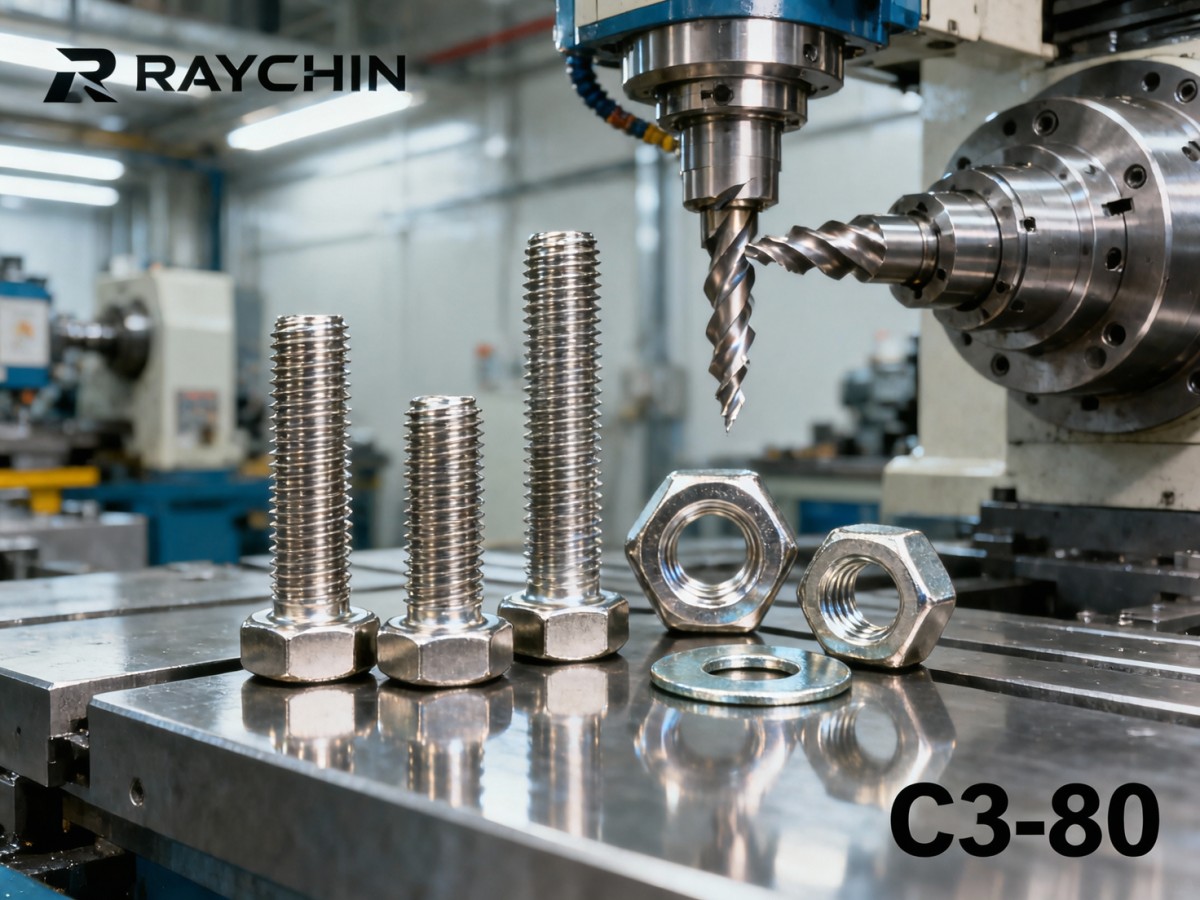
In applications requiring good corrosion resistance with higher mechanical strength than standard austenitic stainless steels, C3-80 fasteners—including bolts, nuts, screws, and washers—emerge as a practical engineering solution. As specialists in high-performance stainless steel fasteners, RAYCHIN manufactures precision C3-80 fastening components that deliver balanced performance in general corrosive environments. This comprehensive guide addresses critical technical questions while providing detailed engineering data for informed material selection across multiple industrial applications.
Part 1: Scientific Foundation of C3-80 Martensitic Stainless Steel
1.1 Chemical Composition: Balanced Engineering for Corrosion and Strength
C3-80 (commonly associated with AISI 420 stainless steel or similar martensitic grades) is a martensitic chromium stainless steel with a carefully balanced composition optimized for general corrosion resistance with enhanced mechanical properties:
Understanding the C3-80 Designation:
The "C3-80" designation typically follows the ISO 3506 standard where:
C3: Indicates martensitic stainless steel group
80: Specifies minimum tensile strength in MPa/10 (800 MPa minimum tensile strength)
Related Standards and Equivalents:
ISO 3506-4: Fasteners made of martensitic stainless steels
ASTM A493: Stainless steel wire for springs
AISI 420: Similar composition with variations in carbon content
EN 1.4021: European standard equivalent
RAYCHIN Quality Assurance: Our certified C3-80 fasteners are manufactured from controlled composition material with full traceability, ensuring optimal balance between corrosion resistance and mechanical properties.
1.2 Mechanical Properties: Strength Through Martensitic Transformation
C3-80 achieves its mechanical properties through controlled heat treatment to develop martensitic structure:
Mechanical Properties by Condition:
Elevated Temperature Performance (Quenched & Tempered):
Specialized Performance Characteristics:
Fatigue Strength: 50-60 ksi (345-414 MPa) at 10⁷ cycles (rotating beam, R=-1)
Impact Toughness: 15-25 ft-lb (20-34 J) at room temperature
Thermal Expansion: 6.0 × 10⁻⁶/°F (10.8 × 10⁻⁶/°C) from 70-600°F
Thermal Conductivity: 14.0 BTU·in/(hr·ft²·°F) at 70°F (24.2 W/m·K)
Electrical Resistivity: 28.0 microhm-cm at 70°F
Magnetic Permeability: Magnetic in all conditions due to martensitic structure
Heat Treatment Requirements:
Annealing: 1550-1650°F (843-899°C) followed by slow cooling
Hardening: 1850-1950°F (1010-1066°C) followed by oil or air quenching
Tempering: 400-1100°F (204-593°C) depending on required properties
Stress Relieving: 300-400°F (149-204°C) for 1-2 hours
Part 2: Critical Technical Questions & Expert Answers
2.1 What are the primary advantages of C3-80 over austenitic stainless steels?
C3-80 offers several distinct advantages that make it suitable for specific applications:
RAYCHIN Engineering Insight: "C3-80 fasteners provide an excellent balance between mechanical strength and corrosion resistance. They are particularly suitable for applications where higher strength is needed but the environment isn't aggressive enough to require premium austenitic or duplex stainless steels."
2.2 How does C3-80 compare to other martensitic stainless steel grades?
Understanding the C3-80 position within martensitic stainless steels is crucial for proper selection:
Critical Distinction: C3-80 occupies the mid-range of martensitic stainless steels, offering better corrosion resistance than 410 stainless with higher strength than many austenitic grades.
2.3 What are the temperature limitations and high-temperature behavior?
High-Temperature Performance Profile:
High-Temperature Comparison with Competing Materials:
Percentage values indicate yield strength retention relative to room temperature strength
RAYCHIN Recommendation: For continuous service above 600°F (316°C), consider austenitic stainless steels or precipitation-hardening grades. C3-80 is best suited for moderate temperature applications where its strength advantages can be fully utilized.
Part 3: Industry-Specific Applications & Solutions
3.1 General Engineering & Industrial Applications
Primary Applications:
Machinery Components: Fasteners for general machinery and equipment
Valve and Pump Parts: Bolts and screws for fluid handling equipment
Tooling Components: Fasteners for jigs, fixtures, and tooling
Agricultural Equipment: Bolts for farm machinery and implements
Performance Advantages:
Higher strength than standard austenitic stainless fasteners
Good resistance to general atmospheric corrosion
Cost-effective solution for strength-critical applications
Good wear resistance for moving components
3.2 Automotive & Transportation
Critical Applications:
Engine Components: Fasteners for non-critical engine applications
Suspension Parts: Bolts for suspension components requiring strength
Brake Systems: Screws and fasteners for brake system components
Exhaust Components: Fasteners for moderate temperature exhaust applications
Technical Benefits:
Good strength-to-weight ratio
Resistance to road salt and general atmospheric corrosion
Cost-effective performance enhancement over carbon steel
Proven reliability in automotive environments
3.3 Construction & Infrastructure
Essential Applications:
Structural Fasteners: Bolts for non-critical structural applications
Facade Systems: Screws for cladding and architectural elements
Bridge Components: Fasteners for moderate corrosion environments
Hardware Components: General construction hardware and fasteners
Operational Advantages:
Better strength than standard construction fasteners
Good corrosion resistance in urban and industrial atmospheres
Cost-effective corrosion protection compared to coated steels
Long-term reliability in exposed conditions
3.4 Food Processing & General Manufacturing
Specialized Applications:
Processing Equipment: Fasteners for food processing machinery
Conveyor Systems: Bolts and screws for material handling equipment
Packaging Machinery: Components for packaging and bottling equipment
General Manufacturing: Fasteners for various manufacturing equipment
Compliance & Safety:
Suitable for food contact applications with proper surface finish
Good cleanability and sanitation properties
Resistance to cleaning chemicals and mild corrosives
Compliance with general industrial safety standards
Part 4: Comprehensive Material Comparison
4.1 Direct Performance Comparison Table
4.2 Corrosion Performance Comparison
4.3 High-Temperature Performance Comparison
4.4 Selection Decision Matrix
Choose C3-80 Fasteners When:
Higher strength than standard austenitic stainless is required
Moderate corrosion resistance is sufficient for the environment
Cost-effective stainless solution is needed
Magnetic properties are acceptable or required
Operating temperatures remain below 600°F (316°C)
Good wear resistance is beneficial
Consider Alternatives When:
Maximum corrosion resistance is required (choose 316 or higher alloys)
Non-magnetic properties are essential (choose austenitic grades)
Operating temperatures exceed 600°F (316°C) continuously
Extreme chloride exposure is expected (choose super austenitic or duplex)
Highest possible strength is needed (choose 17-4PH or similar)
Budget constraints require lowest cost (choose coated carbon steel)
Part 5: The RAYCHIN Engineering Advantage for C3-80 Fasteners
5.1 Specialized Manufacturing Capabilities
Precision Heat Treatment: Controlled hardening and tempering for optimal properties
Advanced Thread Rolling: Produces superior fatigue-resistant threads
Surface Finishing: Various finishes including passivation for enhanced corrosion resistance
Quality Verification: Comprehensive testing including mechanical and corrosion testing
5.2 Technical Support Services
Material Selection Guidance: Helping determine if C3-80 is optimal for your application
Heat Treatment Optimization: Custom tempering treatments for specific requirements
Failure Analysis: Laboratory services to investigate performance issues
Application Engineering: Custom fastener designs for unique requirements
5.3 Certification & Compliance
Material Standards: Full compliance with ISO 3506-4, ASTM standards, and customer specifications
Testing Capabilities: Mechanical testing, corrosion testing, and metallurgical analysis
Traceability: Complete documentation from raw material to finished fastener
Industry Approvals: General engineering, automotive, and industrial quality systems
Engineering Excellence with C3-80 Fasteners
C3-80 fasteners represent a balanced engineering solution for applications requiring better mechanical strength than standard austenitic stainless steels without the cost premium of specialized alloys. With their good corrosion resistance and excellent mechanical properties, they provide engineers with a practical solution for a wide range of industrial applications.
The RAYCHIN Commitment: We deliver more than just precision C3-80 fasteners—we provide engineered solutions backed by metallurgical expertise and manufacturing excellence. Our comprehensive approach ensures that every C3-80 bolt, nut, screw, and washer performs reliably in your specific applications.
Next Steps for Your Project:
Application Analysis: Contact our engineering team for specific recommendations
Material Comparison: Evaluate C3-80 against alternative materials for your needs
Sample Testing: Request test samples for your qualification process
Production Partnership: Leverage our manufacturing expertise for reliable supply
Contact RAYCHIN today to discuss how certified C3-80 fasteners can enhance the performance, reliability, and cost-effectiveness of your general engineering, automotive, construction, or manufacturing applications. Request our C3-80 Fastener Technical Guide or schedule a consultation with our engineering specialists.
C3-80 fasteners, martensitic stainless steel fasteners, ISO 3506-4 fasteners, high-strength stainless bolts, C3-80 bolts, corrosion resistant fasteners, mechanical fasteners, industrial fasteners, AISI 420 fasteners, heat treated stainless fasteners, RAYCHIN C3-80 manufacturer, automotive fasteners, construction fasteners, machinery bolts, tempered stainless fasteners, C3-80 vs A2-70, C3-80 mechanical properties, C3-80 chemical composition, general engineering fasteners.
Request A Quote! We'll respond as soon as possible(within 12 hours)
Get a Quote