
Categories List
Recent Posts
 PEEK Fasteners | Polyetheretherketone Bolts, Nuts, Screws – High-Performance Polymer | RAYCHIN LIMITED
 High-Temperature Alloy Fasteners: Complete Material Guide, Chemistry, Performance Comparison | RAYCHIN LIMITED
 High-Temperature Fastener Material Selection Guide | A286, Inconel 718, Nimonic 80A, Waspaloy – RAYCHIN LIMITED
Engineering Excellence for Severe Thermal Cycling Environments
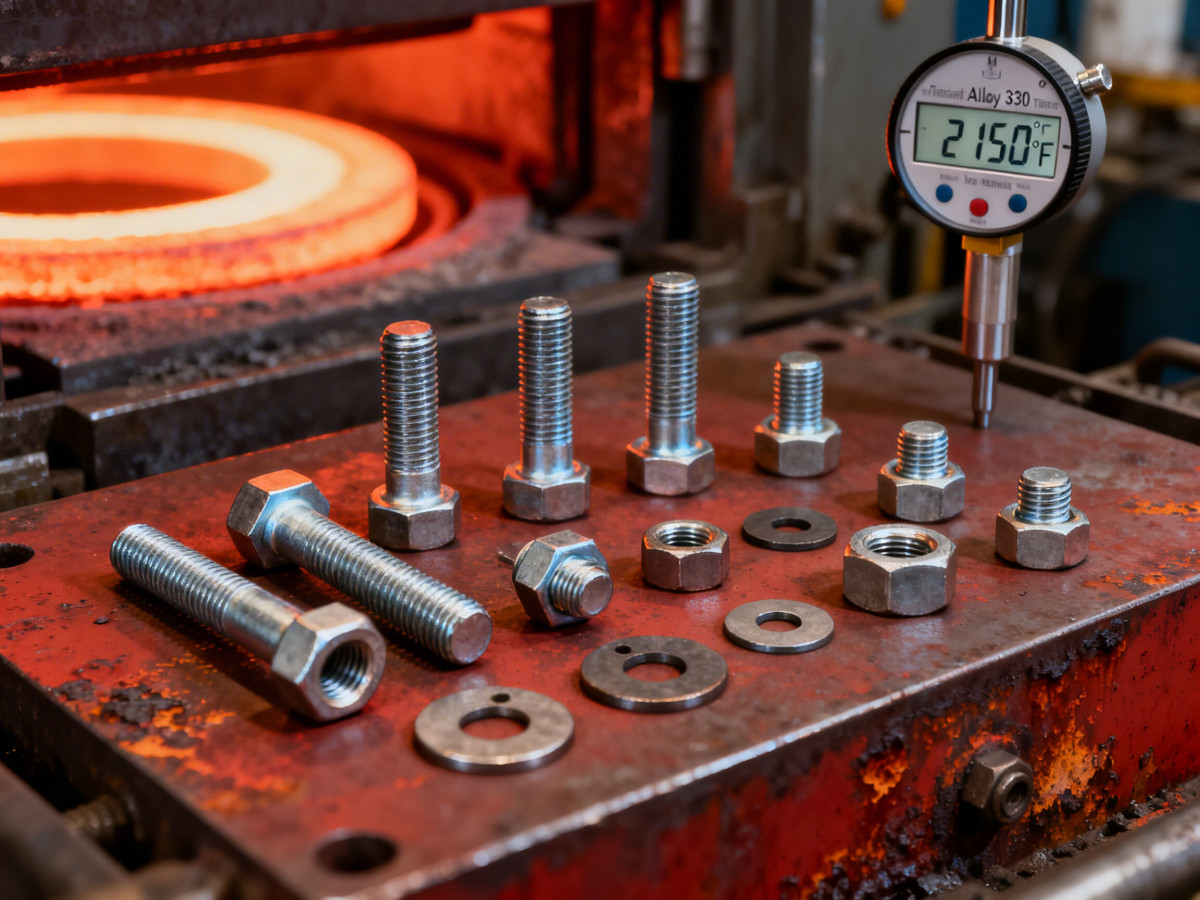
In applications demanding exceptional oxidation resistance, carburization resistance, and thermal stability in extreme temperature ranges, Alloy 330 fasteners—including bolts, nuts, screws, and washers—stand as the engineered solution of choice. As specialists in high-temperature superalloy fasteners, RAYCHIN manufactures precision Alloy 330 fastening components that deliver unparalleled performance in furnace, heat treatment, petrochemical, and aerospace applications. This comprehensive guide addresses critical technical questions while providing detailed engineering data for informed material selection in the most demanding thermal environments.
Part 1: Scientific Foundation of Alloy 330 (UNS N08330)
1.1 Chemical Composition: Optimized for Maximum High-Temperature Stability
Alloy 330 (UNS N08330, also known as RA 330) is a nickel-iron-chromium austenitic superalloy specifically engineered for exceptional performance in extreme thermal environments:
Special Variants:
RA 330-04: Enhanced version with improved oxidation resistance
RA 333: Higher nickel and molybdenum content for additional corrosion resistance
RA 330-HTX: High-temperature extruded version for specific applications
Critical High-Temperature Mechanisms:
Chromium Oxide Formation: Stable Cr₂O₃ scale protects up to 2100°F (1149°C)
Silicon Oxide Enhancement: SiO₂ forms beneath Cr₂O₃, providing additional protection
Carbide Stabilization: Controlled carbon for optimal M₂₃C₆ carbide distribution
Sigma Phase Resistance: Balanced composition minimizes harmful phase formation
RAYCHIN Quality Assurance: Our certified Alloy 330 fasteners are manufactured from vacuum-melted material with full traceability, ensuring optimal chemistry for maximum high-temperature performance and consistency.
1.2 Mechanical Properties: Strength Retention Across Extreme Temperature Ranges
Alloy 330 maintains excellent mechanical properties from cryogenic temperatures to extreme heat:
Room Temperature Mechanical Properties:
Elevated Temperature Performance:
Specialized Performance Characteristics:
Maximum Continuous Service: 2150°F (1177°C) in oxidizing atmospheres
Maximum Intermittent Service: 2200°F (1204°C)
Thermal Fatigue Resistance: Exceptional due to high ductility and thermal stability
Thermal Expansion: 8.2 × 10⁻⁶/°F (14.8 × 10⁻⁶/°C) from 70-1000°F
Thermal Conductivity: 8.8 BTU·in/(hr·ft²·°F) at 70°F (15.2 W/m·K)
Electrical Resistivity: 38.0 microhm-cm at 70°F
Magnetic Permeability: Essentially non-magnetic (<1.02 μ) at all temperatures
Heat Treatment Requirements:
Solution Annealing: 1950-2150°F (1066-1177°C) followed by rapid cooling
Stress Relieving: 1600-1800°F (871-982°C) for 1-2 hours, air cool
Stabilization Annealing: For maximum high-temperature stability
Part 2: Critical Technical Questions & Expert Answers
2.1 What makes Alloy 330 uniquely suitable for severe thermal cycling applications?
Alloy 330's exceptional thermal cycling performance results from several key characteristics:
High Silicon Content (0.75-1.50%): Provides unique oxidation protection through formation of a protective SiO₂ layer beneath the Cr₂O₃ scale, significantly enhancing resistance to cyclic oxidation.
Balanced Nickel-Iron Ratio (34-37% Ni, 40-44% Fe): Provides optimal thermal expansion characteristics and microstructural stability during repeated heating and cooling cycles.
Thermal Fatigue Resistance: Exceptional resistance to crack initiation and propagation due to high ductility and controlled thermal expansion.
Carburization and Nitriding Resistance: Excellent performance in reducing atmospheres containing carbon or nitrogen.
Thermal Cycling Performance Comparison:
RAYCHIN Engineering Insight: "For high-temperature furnace fasteners and thermal cycling applications, Alloy 330 fasteners provide superior thermal fatigue resistance and long-term stability compared to most other heat-resistant alloys."
2.2 How does Alloy 330 compare to other nickel-iron-chromium alloys?
Understanding Alloy 330's position within the nickel-iron-chromium alloy family is crucial for proper selection:
Key Distinction: Alloy 330's silicon content and balanced composition make it particularly suitable for severe thermal cycling applications, while offering better economic value than higher-nickel alloys.
2.3 What are the specific advantages in carburizing and nitriding environments?
Alloy 330 demonstrates exceptional performance in aggressive high-temperature atmospheres:
Performance in Various Atmospheres:
High-Temperature Strength Comparison:
Percentage values indicate yield strength retention relative to room temperature strength
RAYCHIN Recommendation: For applications involving severe thermal cycling or combined oxidizing-carburizing atmospheres, Alloy 330 offers the optimal balance of performance and cost-effectiveness.
Part 3: Industry-Specific Applications & Solutions
3.1 Heat Treatment & Furnace Industries
Primary Applications:
Furnace Rollers & Rails: Fasteners for continuous furnace conveyor systems
Radiant Tube Assemblies: Bolts for radiant tube hangers and supports
Heat Treatment Fixtures: Fasteners for baskets, grids, and fixtures
Annealing Systems: Components for bright annealing and continuous lines
Performance Advantages:
Exceptional thermal fatigue resistance for repeated cycling
Excellent oxidation resistance up to 2150°F (1177°C)
Good carburization resistance in furnace atmospheres
Long-term dimensional stability in continuous operation
3.2 Petrochemical & Chemical Processing
Critical Applications:
Ethylene Furnaces: Fasteners for pyrolysis furnace components
Reformer Systems: Bolts for steam methane reformer assemblies
Catalytic Cracking: Fasteners for FCC unit components
Process Heaters: Components for direct-fired heaters
Technical Benefits:
Resistance to oxidation and carburization in process streams
Good performance in reducing-carburizing atmospheres
Long service life in continuous high-temperature operation
Reduced maintenance compared to lower-grade materials
3.3 Aerospace & Heat Treating
Essential Applications:
Heat Treating Furnaces: Fasteners for aerospace component heat treatment
Vacuum Furnace Components: Bolts for vacuum and atmosphere furnaces
Brazing Fixtures: Fasteners for high-temperature brazing equipment
Sintering Furnaces: Components for powder metal sintering
Operational Advantages:
Excellent performance in vacuum and controlled atmospheres
Good thermal stability for precision heat treatment
Resistance to thermal distortion in fixture applications
Proven reliability in critical aerospace processing
3.4 Power Generation & Energy
Specialized Applications:
Waste Heat Boilers: Fasteners for high-temperature heat recovery
Thermal Oxidizers: Bolts for waste gas oxidation systems
Heat Recovery Systems: Components for cogeneration systems
Boiler Components: Fasteners for high-temperature boiler sections
Compliance & Safety:
Excellent oxidation resistance in combustion atmospheres
Good thermal fatigue resistance for cyclic operation
Long-term reliability in continuous service
Reduced risk of high-temperature failure
Part 4: Comprehensive Material Comparison
4.1 Direct Performance Comparison Table
4.2 High-Temperature Performance Comparison
4.3 Corrosion Performance at Elevated Temperatures
4.4 Selection Decision Matrix
Choose Alloy 330 Fasteners When:
Severe thermal cycling between room temperature and >1800°F (982°C) occurs
Combined oxidizing and carburizing atmospheres are present
Long-term dimensional stability at high temperatures is required
Good vacuum performance is needed
Cost-effective alternative to higher-nickel alloys is desired
Silicon-enhanced oxidation resistance is beneficial
Consider Alternatives When:
Maximum high-temperature strength is the primary requirement (consider nickel superalloys)
Sulfidizing atmospheres are present (choose nickel alloys with higher chromium)
Non-magnetic properties at all temperatures are essential (choose fully austenitic grades)
Extreme chloride corrosion is involved (choose nickel-molybdenum alloys)
Maximum creep resistance is needed (consider cobalt or nickel-based superalloys)
Part 5: The RAYCHIN Engineering Advantage for Alloy 330 Fasteners
5.1 Specialized Manufacturing Capabilities
High-Temperature Heat Treatment: Controlled solution annealing for optimal high-temperature properties
Precision Machining: Expertise with Alloy 330's work hardening characteristics
Surface Preparation: Specialized finishes for enhanced high-temperature performance
Quality Verification: Comprehensive testing including thermal cycling and oxidation testing
5.2 Technical Support Services
High-Temperature Analysis: Evaluation of specific thermal environments and material recommendations
Failure Analysis: Laboratory services to investigate high-temperature failures
Application Optimization: Custom fastener designs for specific thermal challenges
Lifecycle Cost Analysis: Demonstrating total cost advantages over alternative materials
5.3 Certification & Compliance
Material Standards: Full compliance with ASTM B511, ASTM B512, UNS N08330, and customer specifications
Testing Capabilities: Oxidation testing, thermal cycling, creep testing, and metallurgical analysis
Traceability: Complete documentation from melt to finished fastener
Industry Approvals: Heat treatment, furnace, aerospace, and petrochemical quality systems
Engineering High-Temperature Excellence with Alloy 330 Fasteners
Alloy 330 fasteners represent the optimal solution for applications demanding reliable performance in severe thermal cycling environments and combined oxidizing-carburizing atmospheres. With their unique silicon-enhanced oxidation resistance and exceptional thermal stability, they provide engineers with a cost-effective solution for the most challenging high-temperature applications.
The RAYCHIN Commitment: We deliver more than just precision Alloy 330 fasteners—we provide high-temperature engineering solutions backed by thermal processing expertise and manufacturing excellence. Our comprehensive approach ensures that every Alloy 330 bolt, nut, screw, and washer performs reliably in your most demanding high-temperature applications.
Next Steps for Your Project:
Thermal Analysis: Contact our engineering team for temperature and atmosphere-specific recommendations
Material Evaluation: Compare Alloy 330 with alternative high-temperature materials
Sample Testing: Request test samples for your qualification process
Production Partnership: Leverage our manufacturing expertise for reliable supply
Contact RAYCHIN today to discuss how certified Alloy 330 fasteners can enhance the performance, reliability, and cost-effectiveness of your high-temperature furnace, petrochemical, aerospace, or heat treatment applications. Request our Alloy 330 Fastener Technical Guide or schedule a consultation with our high-temperature engineering specialists.
Alloy 330 fasteners, RA 330 bolts, nickel-iron-chromium superalloy fasteners, high-temperature fasteners, thermal cycling resistant fasteners, furnace bolts, heat treatment fixture fasteners, UNS N08330 fasteners, carburization resistant fasteners, oxidation resistant fasteners, ASTM B511 fasteners, RAYCHIN Alloy 330 manufacturer, radiant tube fasteners, ethylene furnace bolts, vacuum furnace components, thermal fatigue resistant fasteners, Alloy 330 vs 310 stainless, Alloy 330 mechanical properties, Alloy 330 chemical composition, silicon-enhanced oxidation resistance, high-temperature stability fasteners.
Request A Quote! We'll respond as soon as possible(within 12 hours)
Get a Quote