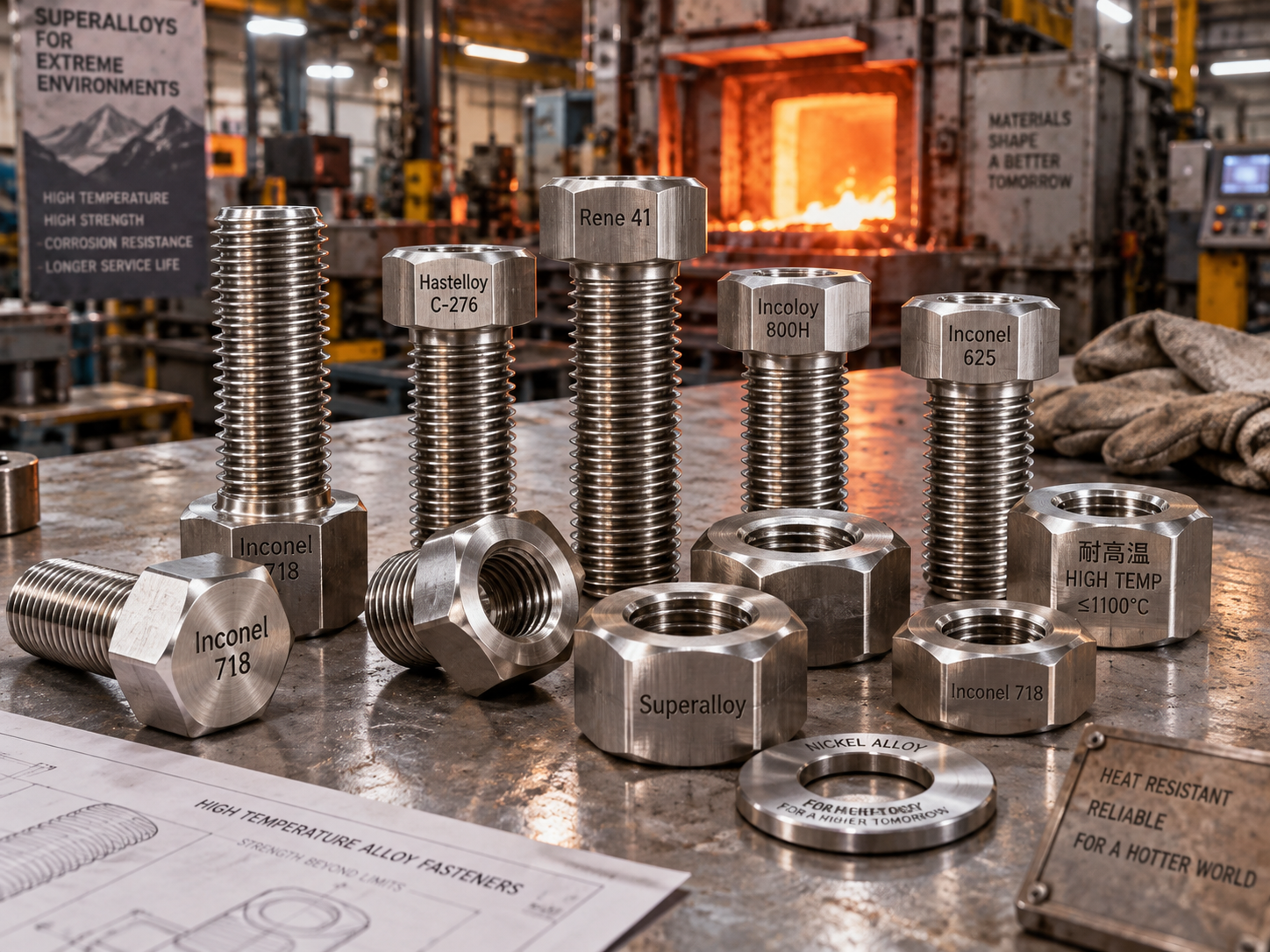
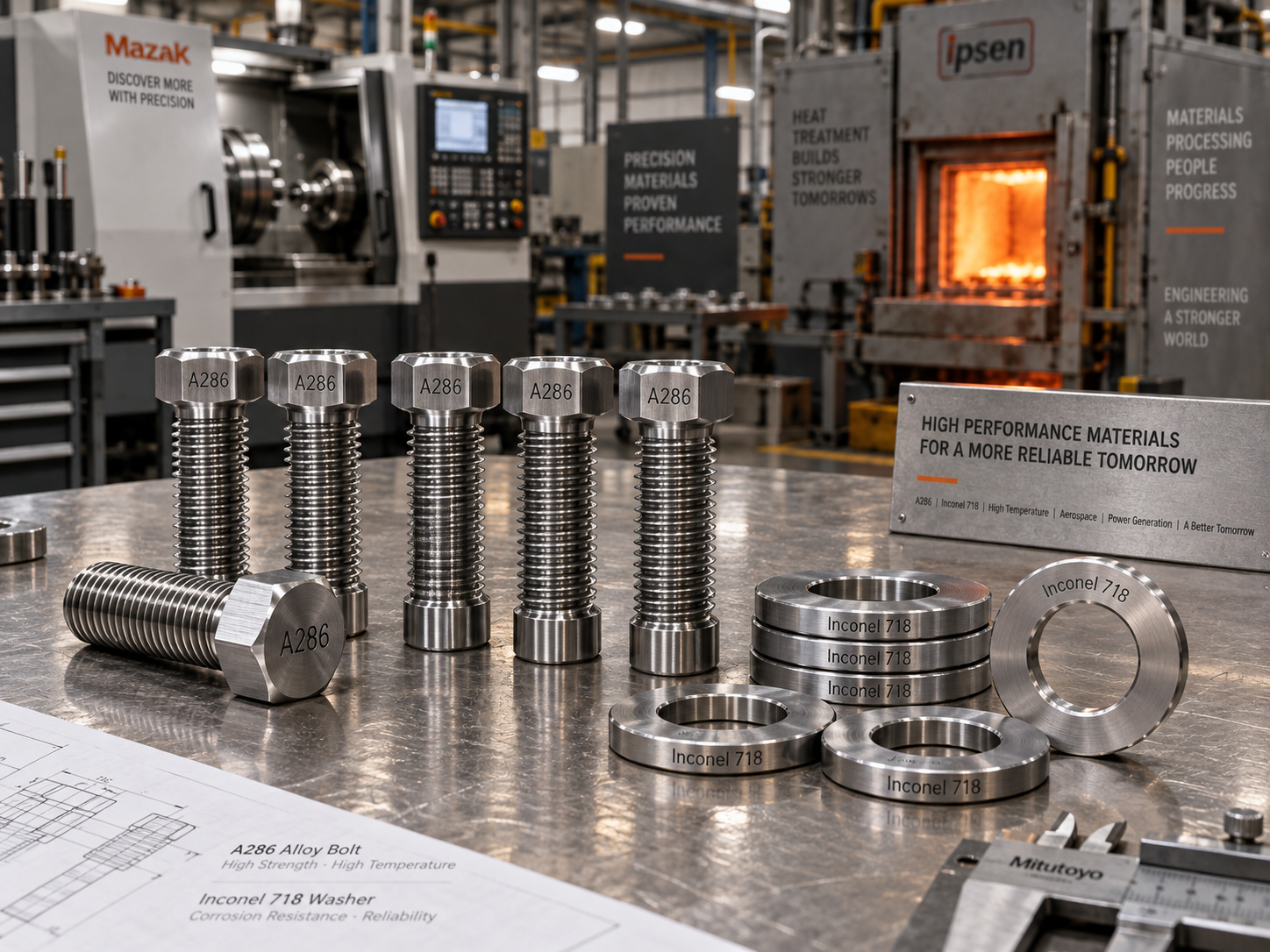
Incoloy is a trademarked family of nickel-iron-chromium-based superalloys, designed for exceptional performance in high-temperature, corrosive, and severe environments. Incoloy fasteners (such as bolts, nuts, studs, screws, and washers) are critical components in demanding applications where standard stainless steels or even other nickel alloys may fail. Key alloys in this family used for fasteners include Incoloy 800/800H/800HT(for high-temperature stability), Incoloy 825 (for superior aqueous corrosion resistance), and Incoloy 925 a precipitation-hardening grade for high strength with good corrosion resistance).
Their primary value lies in an optimal combination of:
High-Temperature Strength & Oxidation Resistance: Excellent creep rupture and scaling resistance up to ~1100°C (alloy dependent).
Superior Corrosion Resistance: Outstanding resistance to reducing acids (e.g., sulfuric, phosphoric), oxidizing environments (e.g., nitrates), chloride-induced stress corrosion cracking (SCC), and pitting/crevice corrosion in seawater and chemical process streams.
Stability: Good microstructural stability under prolonged heat exposure.
Typical Applications: Petrochemical furnace internals, heat exchangers, power generation (gas turbines, boiler components), offshore and marine systems, pollution control (FGD systems), nuclear reactors, chemical processing vessels, and sour gas/oil well components.
Comprehensive Comparison with Similar Material Fasteners
The selection of fastener material is a critical engineering decision. Here is a detailed comparison of Incoloy fasteners against other common high-performance fastener materials.
1. vs. Standard & Martensitic Stainless Steels (e.g., A2/AISI 304, A4/AISI 316, 17-4PH)
| Property | Incoloy Fasteners | Standard Austenitic SS (304, 316) | Martensitic/Precipitation-Hardening SS (410, 17-4PH) |
| Temp. Limit | Far Superior. Up to 1100°C for oxidation. | Moderate (~870°C max, prone to sensitization). | Good strength to ~600°C, but oxidation resistance lower. |
| Corrosion Resistance | Excellent & Broad. Superior to all standard SS, especially in acids, chlorides, and SCC. | Good in mild atmospheres/water. 316 resists pitting but highly susceptible to chloride SCC. | Moderate to good, but generally inferior to austenitic grades. Prone to various corrosion forms in harsh environments. |
| Strength | High, especially at elevated temps. Yield strength moderate at room temp. | Moderate at room temp, loses strength rapidly with heat. | Very High at room temperature (can be heat-treated). |
| Cost | High (Ni, Cr, Mo content). | Low (most economical). | Moderate. |
| Key Differentiator | Performance in combined high heat + corrosion. | Cost-effective for non-critical, mild environments. | High strength-to-weight at lower temperatures. |
2. vs. Duplex & Super Duplex Stainless Steels (e.g., 2205, 2507)
| Property | Incoloy Fasteners | Duplex/Super Duplex SS Fasteners |
| Temp. Limit | Superior for sustained high heat (>300°C). Duplex grades lose toughness above ~300°C. | Limited to ~250-300°C (risk of embrittlement). |
| Corrosion Resistance | More versatile in hot reducing acids and complex chemicals. Excellent SCC resistance. | Superior in chloride-rich, room-temp seawater (higher pitting resistance equivalent number - PREN). Excellent SCC resistance. |
| Mechanical Strength | Good, stable with heat. | Higher yield strength at room temperature (almost double some Incoloys). |
| Cost | High (nickel-based). | Moderate to High (lower Ni than Incoloy). |
| Key Differentiator | Temperature capability. Incoloy for hot processes; Duplex for strong, cool chlorides. |
|
3. vs. Inconel Fasteners (e.g., Inconel 600, 625, 718)
| Property | Incoloy Fasteners | Inconel Fasteners |
| Base Composition | Ni-Fe-Cr (Iron is a major element, typically >30%). | Ni-Cr (Iron content lower, higher nickel content). |
| Primary Use | Resistance to corrosion and oxidation. | High-temperature strength and oxidation resistance. |
| Temp. Strength | Good, but generally lower creep strength than Inconel at very high temps. | Superior mechanical strength retention at extreme temperatures (>1000°C). |
| Corrosion Focus | Excellent in aqueous corrosion, complex chemical media, sulfur environments. | Excellent oxidation resistance, but often selected more for strength in hot gases. |
| Typical Grades | 825 (chemical), 800H (heat treatment). | 600 (oxidation), 625 (pitting/strength), 718 (high strength). |
| Cost | High. | Very High (higher nickel/cobalt content). |
| Key Differentiator | "Corrosion-first" alloy for high temps. | "Strength-first" alloy for extreme temps/stress. |
4. vs. Hastelloy Fasteners (e.g., C276, B2/B3)
| Property | Incoloy Fasteners | Hastelloy Fasteners (Ni-Mo-Cr or Ni-Mo) |
| Corrosion Resistance | Excellent, but Hastelloys are the ultimate choice for severe corrosion. | Unparalleled in reducing acids (HCl, H₂SO₄), and localized corrosion. Hastelloy C-types also handle oxidizing media. |
| Temp. Performance | Better for combined thermal stability and corrosion. | Often limited by corrosion, not necessarily designed for highest temp strength. |
| Cost | High. | Extremely High (high Mo, specialized). |
| Key Differentiator | Balanced all-rounder for high-temp corrosion. | Specialist for the most aggressive chemical environments. |
5. vs. High-Temperature Titanium Alloys (e.g., Grade 5, Ti-6Al-4V)
| Property | Incoloy Fasteners | Titanium Alloy Fasteners |
| Strength-to-Weight | Moderate. | Exceptional (best in class). |
| Temp. Limit | Much Higher. Suitable for sustained high heat. | Limited to ~430°C for long-term use (oxidation & embrittlement). |
| Corrosion Resistance | Excellent in hot acids, sulfur, etc. | Excellent in oxidizing media (chlorides, seawater, nitric acid) but poor in reducing acids. |
| Galvanic Issues | More compatible with steel/petrochemical infrastructure. | Can cause severe galvanic corrosion with other metals; requires careful isolation. |
| Cost | High. | Very High (material & processing). |
| Key Differentiator | Heat and complex chemistry. | Lightweight strength and chloride resistance at lower temperatures. |
Comprehensive Comparative Analysis
The following analysis compares Incoloy fasteners against key competitor materials across fundamental engineering parameters.
1. Chemical Composition (Typical Wt.%)
| Alloy Family | Key Alloys (for Fasteners) | Ni | Fe | Cr | Mo | Cu | Other Key Elements | Primary Role of Additions |
| Incoloy | 825 | 38-46 | ~30 | 19.5-23.5 | 2.5-3.5 | 1.5-3.0 | Ti (~0.9) | Ni: Austenite matrix, corrosion base. Fe: Lowers cost, adds strength. Cr: Oxidation resistance. Mo+Cu: Acid/SCC resistance. |
| 800H | 30-35 | ≥39.5 | 19-23 | - | ≤0.75 | Al, Ti (Al+Ti: 0.85-1.2) | High Al/Ti: High-temp strength via carbide stability. |
| Austenitic SS | 316 (A4) | 10-14 | Bal. | 16-18 | 2-3 | - | - | Mo: Pitting/crevice corrosion resistance. |
| Duplex SS | 2205 (F51) | 4.5-6.5 | Bal. | 21-23 | 2.5-3.5 | - | N (~0.18) | N: Strengthener, pitting resistance (raises PREN). |
| Super Duplex SS | 2507 (F53) | 6-8 | Bal. | 24-26 | 3-4 | - | N (~0.3) | Higher Cr, Mo, N: Maximum PREN for chloride resistance. |
| Inconel | 625 | ≥58 | ≤5 | 20-23 | 8-10 | - | Nb (3.15-4.15) | High Ni+Mo: Intrinsic corrosion resistance. Nb: Strength via precipitation. |
| Hastelloy | C276 | Bal. | 4-7 | 14.5-16.5 | 15-17 | - | W (3-4.5) | Very High Mo: Premier reducing acid resistance. W: Solid solution strengthener. |
| Titanium | Grade 5 (Ti-6Al-4V) | - | ≤0.25 | - | - | - | Al (5.5-6.8), V (3.5-4.5) | Al: Stabilizes alpha phase, raises strength. V: Stabilizes beta phase, aids forgeability. |
2. Mechanical Properties (Room Temperature, Typical for Fasteners)
| Property | Incoloy 825 | Incoloy 800H | AISI 316 (Cold Worked) | Duplex 2205 | Inconel 625 | Hastelloy C276 | Titanium Gr. 5 |
| 0.2% Yield Strength (MPa) | 240 - 310 | 170 - 250 | 310 - 700+ | 450 - 550 | 415 - 550 | 350 - 415 | 825 - 900 |
| Tensile Strength (MPa) | 550 - 655 | 450 - 600 | 580 - 860 | 655 - 795 | 830 - 1035 | 690 - 790 | 895 - 1000 |
| Elongation (%) | 30 - 50 | 30 - 45 | 10 - 35 | 25 - 30 | 30 - 45 | 40 - 55 | 10 - 15 |
| Hardness (Brinell HB) | 150 - 210 | 130 - 190 | 150 - 220 | 220 - 290 | 180 - 240 | 180 - 210 | ~365 |
| Modulus of Elasticity (GPa) | 196 | 196 | 193 | 200 | 207 | 205 | 110 |
| Key Mechanical Trait | Good ductility & toughness | Good high-temp stability | Wide range via work hardening | High strength + good ductility | High strength, excellent fatigue | Excellent ductility & fracture toughness | Highest strength-to-weight ratio |
3. High-Temperature Performance
| Alloy Family | Continuous Service Temp. Limit (Oxidizing) | Key High-Temperature Strengthening Mechanism | Creep & Stress Rupture Performance | Critical Failure Mode at Limit |
| Incoloy (800H/HT) | Up to ~1100°C (2012°F) | Solid solution + Stable carbides (Ti, Al) | Excellent. Designed for creep resistance. | Overheating, loss of microstructural stability. |
| Austenitic SS (316) | ~870°C (1600°F) | Solid solution (Cr). | Poor. Rapid loss of strength. | Sensitization (Cr-carbide precipitation), scaling. |
| Duplex SS (2205) | ~300°C (570°F) | — | Not recommended for long-term >300°C. | 475°C embrittlement, loss of toughness. |
| Inconel (625/718) | Up to ~1150°C (2100°F) | γ' precipitates (718), Solid solution + NbC (625). | Superior. Industry benchmark for creep. | Overaging of precipitates, oxidation (long-term). |
| Hastelloy (C276) | ~1120°C (2050°F) in inert/red. | Solid solution (Mo, W). | Good, but often limited by corrosion. | Oxidation in air (Mo volatility above 1000°C). |
| Titanium (Gr.5) | ~430°C (800°F) | — | Poor. Rapid oxidation and embrittlement. | Severe oxidation, oxygen embrittlement. |
4. Corrosion Resistance Performance
| Environment / Mechanism | Incoloy 825 / 925 | AISI 316 | Duplex 2205 | Inconel 625 | Hastelloy C276 | Notes |
| General Oxidation | Excellent (High Cr) | Good to ~870°C | Fair (scales at high T) | Outstanding (High Cr) | Good (but Mo can oxidize) | Inconel best for thin, protective scale. |
| Pitting/Crevice (in Cl⁻) | Very Good (PRE ~33) | Fair (PRE ~26) | Excellent (PRE ~35) | Outstanding (PRE >45) | Outstanding (PRE ~69) | PRE = %Cr + 3.3x%Mo + 16x%N. |
| Chloride Stress Corrosion Cracking (SCC) | Excellent (Ni content >35%) | Poor (Highly susceptible) | Excellent (Duplex structure) | Excellent | Excellent | High nickel content is key to resistance. |
| Sulfuric & Phosphoric Acids | Excellent (Mo+Cu) | Poor to Fair | Fair | Very Good | Superior (High Mo) | Hastelloy is the premier choice. |
| Caustic (NaOH) | Good | Good (but risk of SCC) | Good | Excellent | Excellent | High Ni alloys resist caustic cracking. |
| Marine/Offshore | Excellent (resists SCC) | Fair (risk of pitting/SCC) | Excellent (high strength+resistance) | Excellent (overkill) | Excellent (overkill) | Duplex is a cost-effective marine choice. |
| Flue Gas Desulfurization (FGD) | Industry Standard for harsh zones | Not suitable | Good for less harsh zones | Used in severe areas | Used for hottest, most acidic zones | Incoloy 825 balances cost/performance in FGD. |
Synthesis and Selection Guidelines
Incoloy's Niche: Incoloy fasteners occupy a critical performance space where high temperature (typically 600°C to 1000°C) intersects with complex corrosion—particularly from reducing acids, chlorides, and sulfur compounds. Their higher iron content (vs. Inconel) makes them a more cost-effective nickel-based solution for many severe service applications.
Choose Incoloy 800H/HT for: High-temperature structural integrity in furnaces, heat treat fixtures, and thermal processing equipment where oxidation and creep are primary concerns.
Choose Incoloy 825/925 for: Chemical process industry applications—vessels, piping, pumps in sulfuric/phosphoric acid service, offshore splash zones, and environments where chloride SCC would destroy standard stainless steels.
Choose Over Inconel/Hastelloy: When the application does not require the ultimate creep strength (Inconel) or the most extreme reducing acid resistance (Hastelloy), offering significant cost savings without severe performance compromise.
Choose Over Duplex/Titanium: When the service temperature exceeds 300°C, where Duplex embrittles, or when the chemical environment involves hot reducing acids, where Titanium fails.
Avoid Incoloy for: Room-temperature, high-strength-only applications (use alloy steel or 17-4PH), mild environments (use 316 SS), or exclusively oxidizing acid media (may use titanium).
In summary, Incoloy fasteners are the premier balanced-performance engineering solution for the demanding intersection of heat, stress, and corrosion, justifying their selection through extended service life and reliability in critical infrastructure.