
Categories List
Superior Corrosion Resistance for Severe Chloride Environments
In applications where conventional stainless steels succumb to chloride-induced corrosion and higher nickel alloys prove economically prohibitive, Alloy 926 fasteners—including bolts, nuts, screws, and washers—emerge as the engineered solution of choice. As specialists in high-performance corrosion-resistant fasteners, RAYCHIN manufactures precision Alloy 926 fastening components that deliver exceptional resistance to pitting, crevice corrosion, and stress corrosion cracking in aggressive chloride environments. This comprehensive guide addresses critical technical questions while providing detailed engineering data for informed material selection in marine, chemical, and oil & gas applications.
Part 1: Scientific Foundation of Alloy 926 (UNS N08926)
1.1 Chemical Composition: Optimized for Maximum Chloride Resistance
Alloy 926 (also known as UNS N08926, 1.4529, or AL-6XN®) is a high-molybdenum, nitrogen-enhanced super-austenitic stainless steel with a carefully balanced composition:
Critical Performance Metrics:
PREN (Pitting Resistance Equivalent Number): 45-48
PREN = %Cr + 3.3 × %Mo + 16 × %N = 20 + (3.3 × 6.5) + (16 × 0.2) = 46.45CCT (Critical Crevice Temperature): >85°F (29°C) in ASTM G48 Method D
CPT (Critical Pitting Temperature): >104°F (40°C) in ASTM G48 Method A
RAYCHIN Quality Assurance: Our certified Alloy 926 fasteners are manufactured from vacuum-melted material batches that undergo rigorous chemical verification to ensure optimal composition for maximum corrosion resistance in chloride-rich environments.
1.2 Mechanical Properties: High Strength with Exceptional Toughness
Alloy 926 offers outstanding mechanical properties that combine high strength with excellent ductility:
Standard Mechanical Properties:
Elevated Temperature Properties:
Maximum Continuous Service: 800-1000°F (427-538°C)
Short-Term Exposure Limit: 1200°F (649°C)
Creep Strength: 25 ksi at 1000°F for 1000 hours
Thermal Fatigue Resistance: Excellent due to high ductility
Specialized Performance Characteristics:
Fatigue Strength: 45-50 ksi (310-345 MPa) at 10⁸ cycles (rotating beam, R=-1)
Impact Toughness: Excellent at cryogenic temperatures: >100 ft-lb at -320°F (-196°C)
Thermal Expansion: 8.6 × 10⁻⁶/°F (15.5 × 10⁻⁶/°C) from 70-600°F
Thermal Conductivity: 6.7 BTU·in/(hr·ft²·°F) at 70°F (11.6 W/m·K)
Specific Heat: 0.12 BTU/lb·°F at 70°F (500 J/kg·K)
Electrical Resistivity: 39.0 microhm-cm at 70°F
Heat Treatment Considerations:
Solution Annealing: 2050-2150°F (1121-1177°C) followed by rapid quenching
Stress Relieving: 1100-1200°F (593-649°C) for 1 hour per inch of thickness
No Precipitation Hardening: Alloy 926 is not age-hardenable
Part 2: Critical Technical Questions & Expert Answers
2.1 What makes Alloy 926 superior to 316/317L stainless in chloride environments?
Alloy 926's exceptional chloride corrosion resistance stems from three key compositional advantages:
High Molybdenum Content (6-7%): Molybdenum is the single most important element for resisting chloride-induced pitting and crevice corrosion. Compared to 316L (2-3% Mo) and 317L (3-4% Mo), Alloy 926's 6-7% Mo provides exponentially better protection.
Nitrogen Enhancement (0.15-0.25%): Nitrogen significantly increases pitting resistance while also providing solid solution strengthening. The synergistic effect of N with Mo and Cr creates a more stable passive film.
Optimized Nickel Content (24-26%): Higher nickel content improves resistance to chloride stress corrosion cracking (SCC), which is a common failure mode for 316/317L in warm chloride environments.
Quantitative Comparison in Seawater:
Time to First Pitting:
316L: 6-24 months in flowing seawater
Alloy 926: 15+ years in flowing seawater
Critical Crevice Temperature (CCT):
316L: <32°F (0°C)
Alloy 926: >85°F (29°C)
Maximum Chloride for SCC Immunity:
316L: <500 ppm at 140°F (60°C)
Alloy 926: >10,000 ppm at 140°F (60°C)
RAYCHIN Field Data: Our Alloy 926 marine fasteners have demonstrated 12+ years of service in seawater immersion without measurable corrosion, while 316L counterparts typically fail within 2-3 years.
2.2 When should I choose Alloy 926 over duplex/super duplex stainless steels?
This represents a critical decision in offshore, chemical, and desalination applications:
Critical Distinction: Alloy 926 is fully austenitic, eliminating concerns about ferrite-austenite phase balance during welding or heat treatment that can affect duplex alloys.
2.3 How does Alloy 926 compare to nickel alloys like Hastelloy C-276 for cost-performance?
This economic-performance analysis is crucial for project feasibility:
Engineering Rule: For applications primarily involving chloride corrosion at moderate temperatures (<300°F/149°C), Alloy 926 fasteners provide 90% of the performance of Hastelloy C-276 at 30-40% of the cost.
Part 3: Industry-Specific Applications & Solutions
3.1 Marine & Offshore: Conquering Seawater Corrosion
Primary Applications:
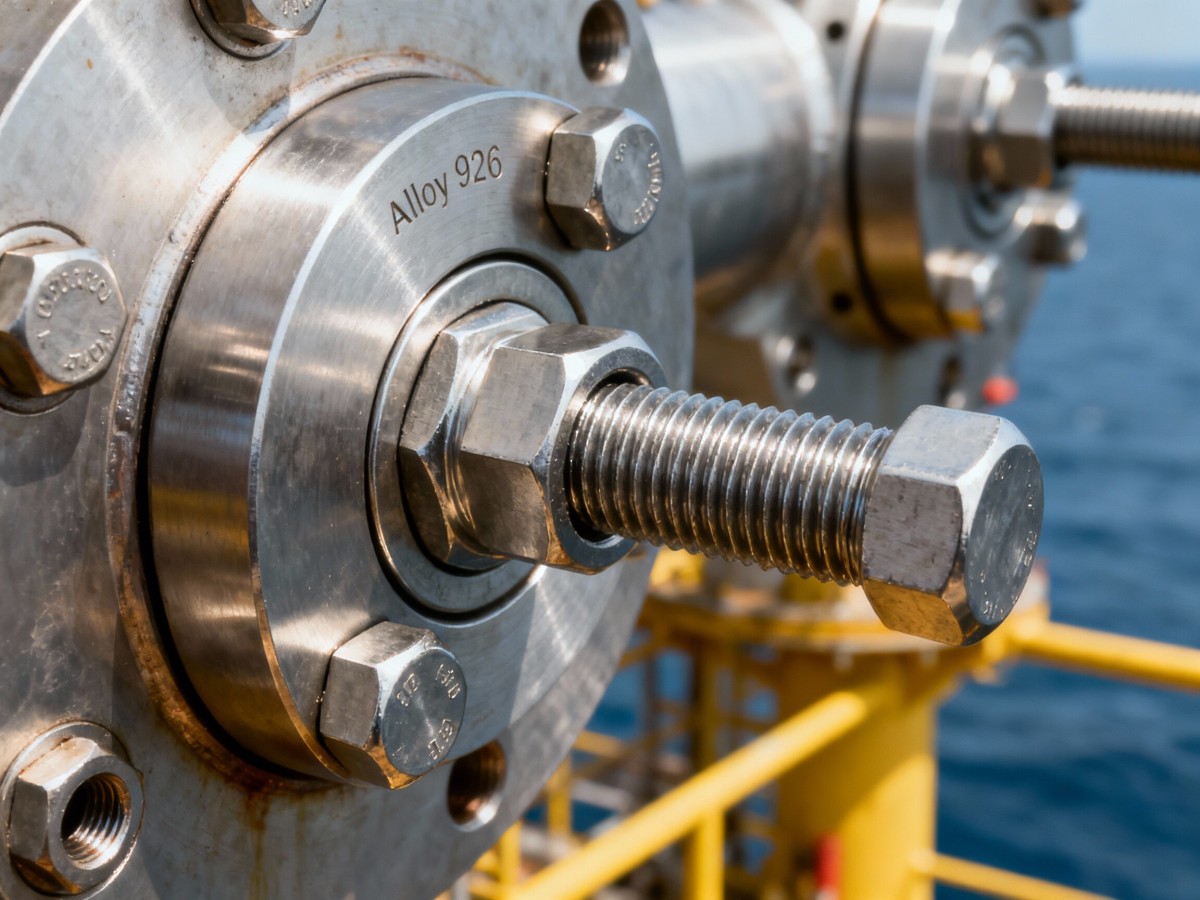
Offshore Platform Fasteners: Bolts for splash zone and submerged components
Desalination Plant Equipment: Fasteners for multi-stage flash (MSF) and reverse osmosis (RO) systems
Shipbuilding Components: Bolts for hulls, propellers, and seawater piping systems
Subsea Connectors: Fasteners for ROV systems and underwater instrumentation
Performance Advantages:
Immunity to chloride-induced pitting and crevice corrosion in seawater
Excellent resistance to marine biofouling and microbiologically influenced corrosion (MIC)
Long-term reliability reducing maintenance in inaccessible locations
Compatibility with cathodic protection systems
3.2 Chemical Processing: Reliability in Chloride-Containing Processes
Critical Applications:
Chlor-Alkali Production: Fasteners for chlorine, caustic, and hydrogen processing equipment
Organic Chemical Synthesis: Bolts for reactors handling chlorinated intermediates
Petrochemical Processing: Fasteners for units processing chloride-containing feedstocks
Pharmaceutical Manufacturing: Components for processes using chloride salts or solvents
Technical Benefits:
Resistance to chloride stress corrosion cracking at elevated temperatures
Good performance in acidic chloride environments
Minimal corrosion product contamination in high-purity processes
Excellent cleanability for batch operations
3.3 Pulp & Paper Industry: Withstanding Chlorinated Process Chemicals
Essential Applications:
Bleach Plant Equipment: Fasteners for chlorine dioxide (ClO₂) and peroxide bleaching stages
Paper Machine Components: Bolts for paper machines using brackish or seawater
Chemical Recovery Systems: Fasteners for systems handling chloride-containing liquors
Effluent Treatment: Bolts for chloride-containing wastewater systems
Operational Advantages:
Resistance to chlorinated bleaching chemicals and their byproducts
Good performance in acidic paper sizing environments containing chlorides
Long service life in continuous operation with minimal downtime
Reduced risk of chloride-induced stress corrosion cracking
3.4 Oil & Gas: Reliability in Sour, Salty Environments
Specialized Applications:
Sour Gas Production: Fasteners for wells with high chloride content in produced water
Subsea Production Systems: Bolts for Christmas trees, manifolds, and flowlines
Refinery Hydroprocessing: Fasteners for units processing high-chloride feedstocks
Produced Water Handling: Bolts for chloride-rich water treatment and injection systems
Compliance & Safety:
NACE MR0175/ISO 15156 compliance for sour service with chlorides
Resistance to sulfide stress cracking in chloride-containing environments
Good performance in CO₂ corrosion with chlorides present
Long-term reliability in critical safety applications
Part 4: Comprehensive Material Comparison
4.1 Direct Performance Comparison Table
4.2 Selection Decision Matrix
Choose Alloy 926 Fasteners When:
Primary corrosion concern is chloride-induced pitting or crevice corrosion
Seawater or brackish water exposure is continuous or intermittent
Chloride stress corrosion cracking risk exists at elevated temperatures
Good resistance to phosphoric and moderate sulfuric acids is required
Fabrication ease and weldability are important considerations
Consider Alternatives When:
Hydrochloric acid is the primary corrosive (choose nickel alloys)
Very high strength is the dominant requirement (super duplex offers higher strength)
Extreme temperatures (>800°F/427°C) are involved (consider nickel alloys)
Strongly oxidizing conditions prevail (higher chromium/nickel alloys may be better)
Budget constraints are severe and chloride levels are low (316L may suffice)
Part 5: The RAYCHIN Engineering Advantage for Alloy 926 Fasteners
5.1 Specialized Manufacturing Capabilities
Precision Machining: Optimized parameters for Alloy 926's work hardening characteristics
Advanced Surface Finishing: Electropolishing, passivation, and specialty coatings for maximum corrosion resistance
Controlled Heat Treatment: Solution annealing for optimal corrosion resistance properties
Quality Verification: Comprehensive testing including pitting and crevice corrosion testing per ASTM G48
5.2 Technical Support Services
Corrosion Engineering: Detailed analysis of chloride environments and material recommendations
Failure Analysis: Laboratory services to investigate corrosion failures and recommend prevention
Application Optimization: Custom fastener designs for specific chloride exposure conditions
Lifecycle Cost Analysis: Demonstrating total cost advantages over alternative materials
5.3 Certification & Compliance
Material Standards: Full compliance with ASTM B691, UNS N08926, and customer specifications
Testing Capabilities: Pitting/crevice corrosion testing, mechanical testing, and metallurgical analysis
Traceability: Complete documentation from melt to finished fastener
Industry Approvals: Marine (DNV, ABS), offshore, chemical processing, and nuclear quality systems
Engineering Chloride Immunity with Alloy 926 Fasteners
Alloy 926 fasteners represent the optimal solution for applications where chloride-induced corrosion defeats conventional stainless steels but full nickel alloys are economically unjustified. With their unique combination of 6% molybdenum, nitrogen enhancement, and balanced nickel-chromium content, they provide exceptional, cost-effective corrosion resistance in the most aggressive chloride environments encountered in industry.
The RAYCHIN Commitment: We deliver more than just precision Alloy 926 fasteners—we provide chloride corrosion engineering solutions backed by marine and chemical process expertise. Our comprehensive approach ensures that every Alloy 926 bolt, nut, screw, and washer performs reliably in your most demanding chloride exposure applications.
Next Steps for Your Project:
Corrosion Analysis: Contact our engineering team for chloride environment-specific recommendations
Material Validation: Request test samples for your specific exposure conditions
Design Consultation: Discuss optimized fastener designs for your equipment
Production Partnership: Leverage our manufacturing expertise for reliable supply
Contact RAYCHIN today to discuss how certified Alloy 926 fasteners can enhance the reliability, safety, and cost-effectiveness of your marine, chemical processing, or offshore applications. Request our Alloy 926 Fastener Selection Guide or schedule a consultation with our corrosion engineering specialists.
Alloy 926 fasteners, UNS N08926 bolts, 6% molybdenum stainless fasteners, super-austenitic stainless steel fasteners, chloride corrosion resistant fasteners, seawater resistant bolts, AL-6XN fasteners, marine grade fasteners, offshore platform bolts, desalination plant fasteners, chemical processing fasteners, pitting resistant fasteners, crevice corrosion resistant fasteners, PREN 45 fasteners, ASTM B691 fasteners, RAYCHIN Alloy 926 manufacturer, NACE MR0175 compliant fasteners, subsea connector bolts, high-performance marine fasteners, Alloy 926 vs 316 stainless, Alloy 926 mechanical properties, Alloy 926 chemical composition.
Request A Quote! We'll respond as soon as possible(within 12 hours)
Get a Quote