
Categories List
Recent Posts
When Maximum Strength Meets Severe Environments
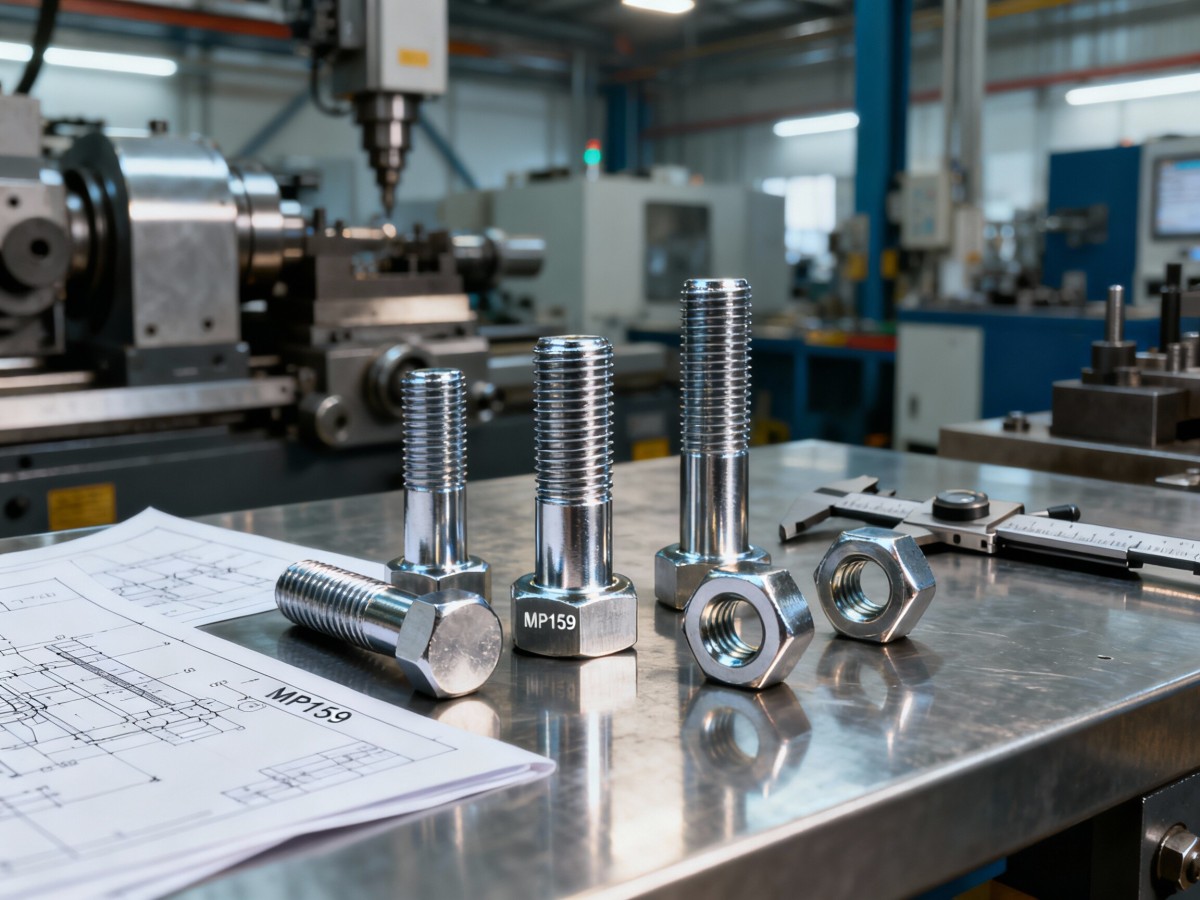
In the most demanding aerospace, defense, and downhole applications, where failure carries catastrophic consequences, material selection becomes the ultimate engineering challenge. MP159 fasteners (bolts, nuts, screws, washers) represent the pinnacle of advanced alloy technology—combining unprecedented strength with exceptional corrosion resistance. As specialists in ultra-high-performance fasteners, RAYCHIN leverages decades of expertise to manufacture MP159 components that reliably perform where other materials reach their limits. This guide addresses the most critical technical questions surrounding MP159 and clarifies its unique position in the material hierarchy.
Part 1: Top 5 Technical Questions About MP159 Fasteners
1. What is MP159 Alloy, and What Makes it Unique for Critical Fasteners?
MP159 is a cobalt-nickel-chromium-based, multi-phase, age-hardenable superalloy developed specifically for applications requiring the highest possible strength combined with excellent corrosion resistance. Unlike conventional alloys that sacrifice one property for another, MP159 achieves a remarkable balance through its sophisticated metallurgy.
Key Characteristics for Fasteners:
Ultra-High Strength: Capable of achieving ultimate tensile strengths exceeding 260 ksi (1790 MPa) and yield strengths over 240 ksi (1655 MPa) after proper heat treatment—among the highest of any commercially available fastener alloy.
Exceptional Corrosion Resistance: Maintains excellent resistance to stress corrosion cracking, pitting, and general corrosion in chloride and sour (H₂S) environments.
Non-Magnetic: Essential for applications requiring magnetic transparency, such as certain aerospace and marine systems.
High Fatigue Strength: Excellent resistance to crack initiation and propagation under cyclic loading.
Good Ductility at High Strength: Unlike some materials that become brittle at high strength levels, MP159 retains useful elongation.
RAYCHIN Insight: "MP159 is not an 'everyday' alloy. It is specified for applications where both extreme mechanical loads and aggressive environments coexist—think critical aerospace structural joints in corrosive atmospheres or deep-well downhole tools under immense pressure."
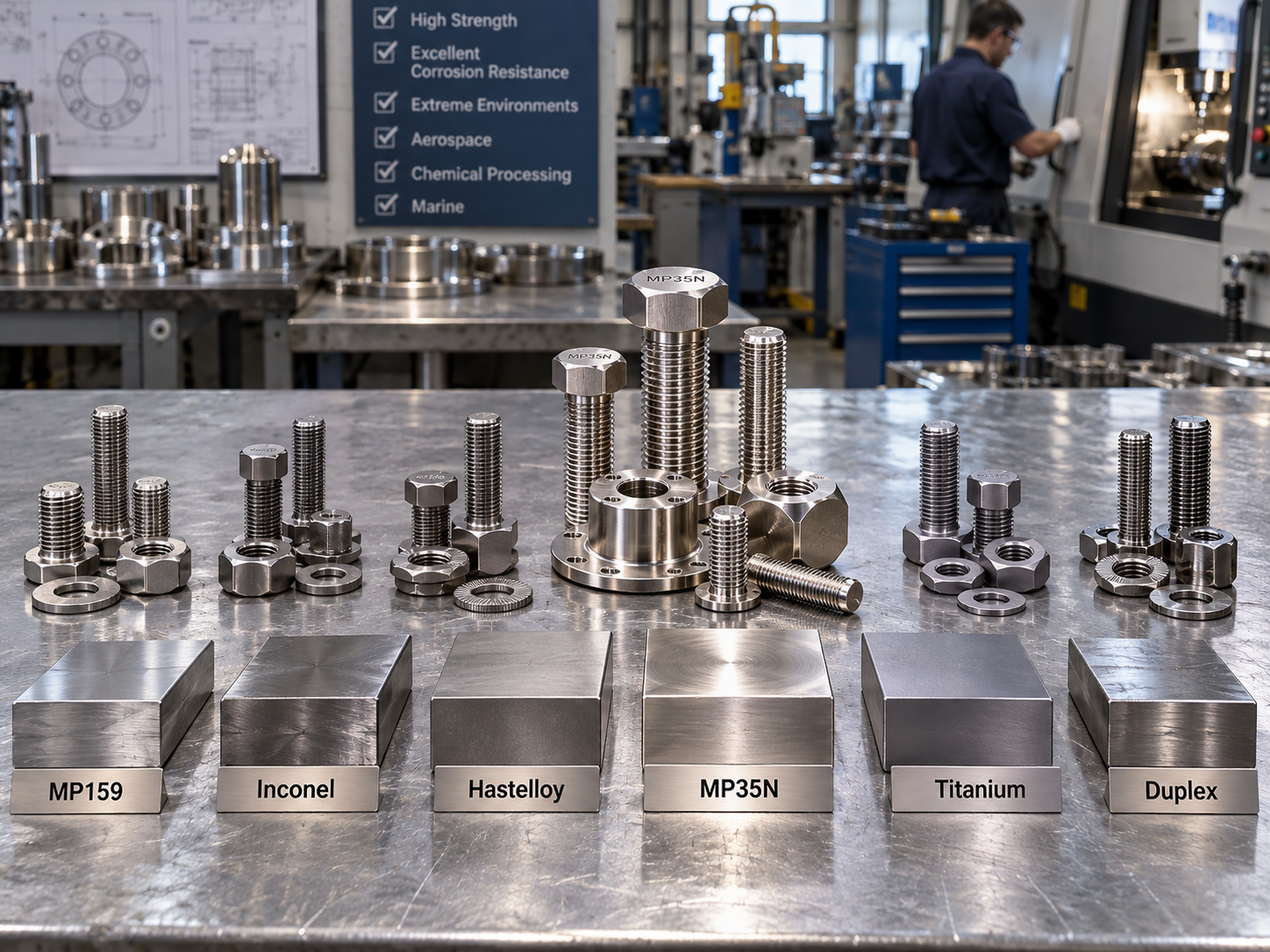
2. How Does MP159 Compare to MP35N® for Fastener Applications?
This is one of the most searched comparisons, as both are cobalt-nickel superalloys. Understanding their distinct profiles is crucial for correct selection.
The Verdict: For finished machined fasteners like bolts and nuts where you cannot apply extreme cold work after machining, MP159's heat-treatable nature provides a more reliable and optimized pathway to the highest strength with excellent corrosion properties.
3. In Which Applications Are MP159 Fasteners Absolutely Essential?
MP159 is specified for missions where performance margins are zero:
Aerospace & Defense: Critical structural airframe bolts, landing gear components, engine mounts, and helicopter rotor systems where high strength-to-weight and corrosion resistance are mandatory.
Downhole Oil & Gas: Fasteners for Measurement-While-Drilling (MWD) and Logging-While-Drilling (LWD) tools, deep-well packers, and completion equipment exposed to H₂S, CO₂, and high pressures (NACE MR0175 compliant).
High-Performance Automotive: Critical fasteners in motorsports and aerospace-derived automotive systems.
Marine & Subsea: Connectors and fasteners for deep-sea systems requiring high strength and immunity to seawater stress corrosion cracking.
4. What are the Key Manufacturing and Heat Treatment Challenges with MP159?
The exceptional properties of MP159 are only achieved through exacting manufacturing control:
Precision Heat Treatment: MP159 requires a specific, multi-step thermal cycle:
Solution Treatment: Typically around 1400°F (760°C) to dissolve secondary phases.
Rapid Quench: To maintain a supersaturated solid solution.
Aging: A multi-stage aging process (e.g., 1100°F + 1300°F) to precipitate the strengthening phases uniformly.
Deviation from specified times/temperatures can drastically reduce properties.
Machining: Must be performed in the annealed or solution-treated condition. It is a tough, gummy material that requires sharp carbide tooling, rigid setups, and adequate cooling.
Thread Rolling: Preferred over cutting for superior fatigue performance in the final, aged condition.
RAYCHIN's Expertise: We operate dedicated, calibrated furnaces with precise atmosphere control to execute the exacting MP159 heat treatment cycle, with full documentation for each batch.
5. What Certifications and Testing are Required for MP159 Fasteners?
Given their critical applications, MP159 components demand rigorous verification:
Material Standards: Compliant with AMS 5842 and ASTM F562 (modified for MP159 composition).
Heat Treatment Certification: Documentation of full time-temperature profiles for solution and aging treatments is mandatory.
Mechanical Testing: Tensile testing at room temperature is standard. Testing at elevated temperature or for stress rupture may be specified.
Corrosion Testing: Often required to confirm resistance to specific media (e.g., ASTM G36 for stress corrosion cracking in MgCl₂).
Full Traceability: Material Test Reports (MTRs) from the mill through all processing steps are non-negotiable.
Part 2: Material Comparison: MP159 vs. The Competition
When does MP159 warrant its premium over other high-strength alloys? This detailed comparison provides the answer.
Performance Comparison Table: MP159 vs. Key Alternatives
Strategic Selection Guidelines:
Choose MP159 over AISI 4340 Steel: When the application involves any corrosive environment (including atmospheric). The cost of plating, hydrogen embrittlement risk, and maintenance of steel is eliminated with MP159.
Choose MP159 over Ti-6Al-4V: When you need significantly higher absolute strength (not strength-to-weight) and superior resistance to crevice corrosion and galvanic issues.
Choose Inconel 718 over MP159: When continuous operating temperatures exceed 800°F (427°C). MP159's strength advantage diminishes at higher temperatures where 718 excels.
Choose MP159 over Custom 465 Stainless: When immunity to chloride stress corrosion cracking is required or the application is in a marine/offshore environment. MP159 offers a much broader corrosion resistance envelope.
The RAYCHIN Recommendation: MP159 is the premier choice for room-to-moderate temperature applications demanding the highest possible strength alongside aerospace-grade corrosion resistance. It is the alloy that eliminates the trade-off.
Part 3: The RAYCHIN Advantage for MP159 Fastener Solutions
Producing reliable MP159 fasteners requires more than standard machining—it demands metallurgical precision and rigorous process control.
Metallurgical Mastery: Our in-house metallurgists oversee the entire production process, from verifying mill chemistry to designing and validating the heat treatment cycle for each fastener geometry.
Vertical Process Control: We manage material procurement, precision machining, controlled heat treatment, and final testing under one roof, ensuring consistency and traceability.
Application Engineering Partnership: We work with your design team to optimize fastener geometry (fillet radii, thread design) for MP159's specific properties, maximizing fatigue life and performance.
Comprehensive Certification Package: We deliver not just parts, but a complete quality dossier: Mill Certs, Heat Treat Charts, Mechanical Test Reports, and Final Inspection records.
Your Next Step with the Ultra-High-Performance Specialists
If your design is pushing the boundaries of strength and environmental resistance, compromising on the fastener material is the greatest risk you can take.
Contact RAYCHIN today to:
Consult with our materials engineers on your specific performance requirements.
Request a quotation for certified MP159 fasteners to AMS 5842.
Discuss prototyping and testing programs for new applications.
Download our technical datasheet on MP159 properties and processing.
For the connection that cannot fail, specify RAYCHIN MP159 Fasteners.
MP159 fasteners, MP159 bolts, cobalt nickel alloy fasteners, ultra high strength fasteners, AMS 5842 fasteners, non-magnetic high strength bolts, corrosion resistant high strength fasteners, downhole tool fasteners, aerospace structural bolts, MP159 vs MP35N, RAYCHIN MP159 supplier, NACE compliant MP159 fasteners.
Request A Quote! We'll respond as soon as possible(within 12 hours)
Get a Quote