
Categories List
Recent Posts
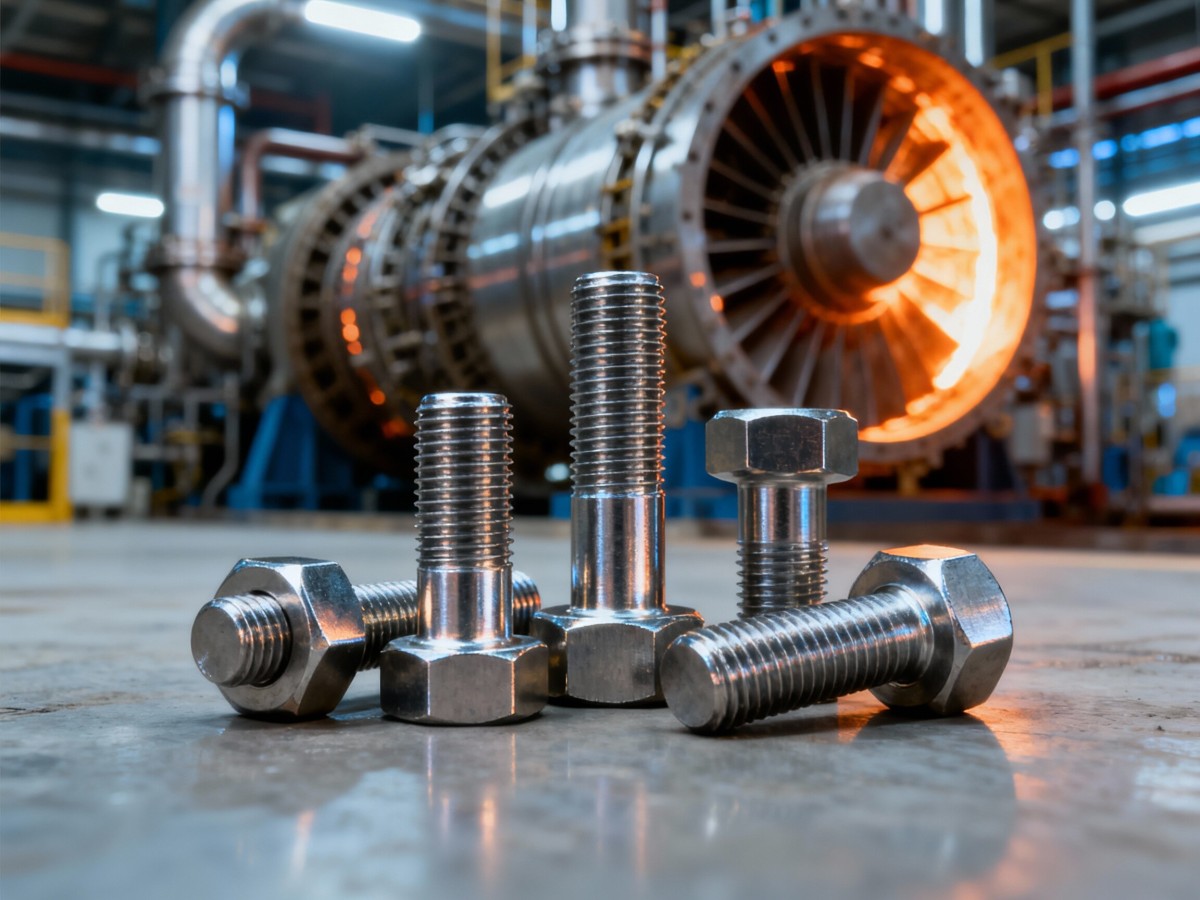
In high-temperature environments—such as gas turbines, jet engines, power generation boilers, petrochemical crackers, and nuclear reactors—fasteners face severe challenges. These include creep (slow, time-dependent deformation under stress), stress relaxation (loss of clamping force), oxidation/corrosion, and reduced mechanical strength. Special alloy fasteners are engineered to maintain their load-bearing capability, structural integrity, and sealing function under prolonged exposure to temperatures typically ranging from 540°C (1000°F) to well above 1000°C (1832°F).
Primary Application Areas:
Aerospace & Jet Engines: Turbine case bolts, compressor disc bolts, combustion chamber fasteners, and afterburner components.
Power Generation: Gas turbine bolts, steam turbine casing studs, boiler hanger rods, superheater/ reheater supports, and advanced nuclear reactor internals.
Oil & Gas (Downhole & Refining): Fasteners for deep-well tools (high temperature/high pressure or HTHP), hydrocracker, and catalytic reformer reactors.
Industrial Processing: Fasteners for high-temperature furnaces, heat treatment fixtures, and chemical/petrochemical cracking furnaces.
Specific High-Temperature Alloy Fastener Materials
Materials are selected based on the maximum operating temperature, stress level, environmental atmosphere (oxidizing, sulfidizing, carburizing), and required service life. Here are the key alloy families, progressing from moderate to extreme temperature capabilities.
1. Heat-Resistant Stainless Steels
These are often the first choice for applications up to ~650-750°C (1200-1380°F), offering a good balance of oxidation resistance, strength, and cost.
Common Grades:
A-286 (UNS S66286 / ASTM A453 Grade 660): A precipitation-hardening iron-nickel superalloy. It is arguably the most widely used high-temperature fastener alloy in the 550-700°C range.
17-4 PH (UNS S17400): A precipitation-hardening stainless steel used up to ~300°C (570°F) for high-strength needs, but its use at higher temperatures is limited compared to A-286.
Key Properties & Use-Case:
A-286 retains high tensile and creep strength up to ~700°C. It has excellent oxidation resistance and can be age-hardened to strengths over 130 ksi (900 MPa). It is the standard for jet engine turbine case bolts, high-temperature pump bolts, and supercharger hardware. Its workhorse status stems from its reliable performance and well-established manufacturing.
2. Nickel-Based Superalloys
This is the dominant material family for the most demanding high-temperature fastener applications, especially where creep strength is paramount. Their performance derives from a solid-solution strengthened nickel-chromium matrix, often with precipitation hardening via gamma prime (γ') phases.
Common Grades (in order of increasing temperature capability):
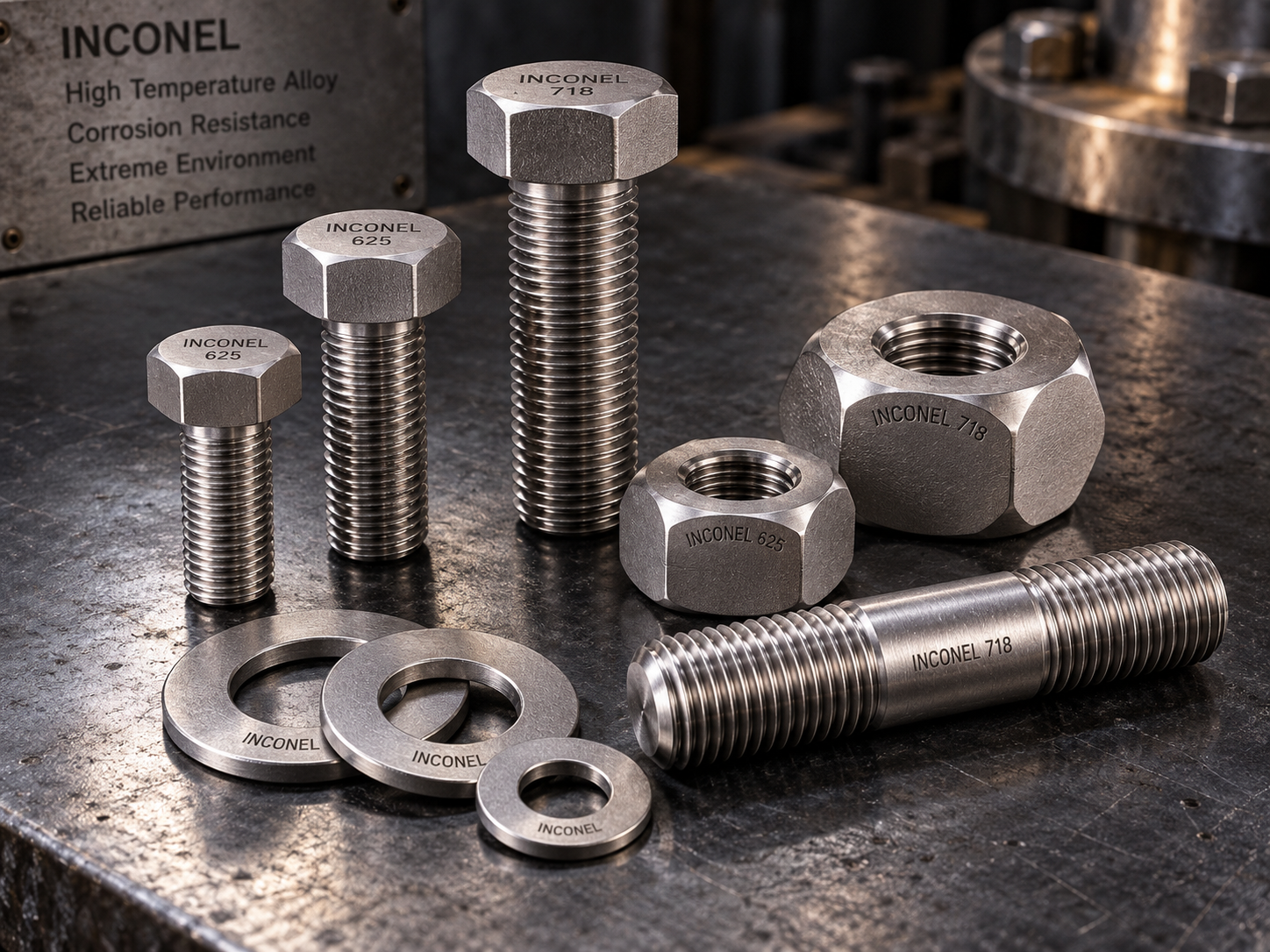
Inconel 718 (UNS N07718): The most prevalent nickel superalloy for fasteners. It offers an exceptional combination of very high strength (up to 180 ksi / 1240 MPa yield), good creep resistance up to ~650°C, and excellent oxidation resistance. It is widely used in gas turbine engines, rocket motors, and high-strength bolting for pressure vessels. Its drawback is a limit of ~650°C due to the instability of its primary strengthening phase (γ'') above this temperature.
Waspaloy (UNS N07001): A classic γ'-hardened superalloy used for high-stress fasteners in the 650-815°C (1200-1500°F) range. It has better thermal stability than Inconel 718 at higher temperatures but is more difficult to machine and form. Common in turbine disc bolts and high-performance engine components.
R-41 (UNS N07041): Similar to Waspaloy but with higher aluminum and molybdenum content, offering improved strength at temperatures up to ~980°C (1800°F). Used in strenuous aerospace applications.
Inconel 738LC / IN-738: A high-strength, castable superalloy often used for turbine blades, but its derivatives are used for very high-temperature bolting in hot sections of industrial turbines.
Haynes 282 (UNS N07208): A newer, advanced γ'-strengthened superalloy designed to outperform 718 and Waspaloy. It offers an outstanding balance of creep strength, thermal stability, fabricability, and weldability for long-term service in the 700-900°C (1300-1650°F) range. It is increasingly specified for next-generation gas turbine bolts and high-temperature reactor components.
Nimonic 80A / 90 (UNS N07080 / N07090): Long-standing European/Nickel Institute alloys similar to Waspaloy, extensively used in aerospace and turbocharger fasteners.
3. Cobalt-Based Superalloys
These alloys are chosen for their superior hot corrosion (sulfidation) resistance, excellent thermal fatigue resistance, and retention of hardness at very high temperatures. They are often used in the most aggressive environments where nickel alloys may degrade.
Common Grades:
Haynes 25 (L-605, UNS R30605)
Haynes 188 (UNS R30188)
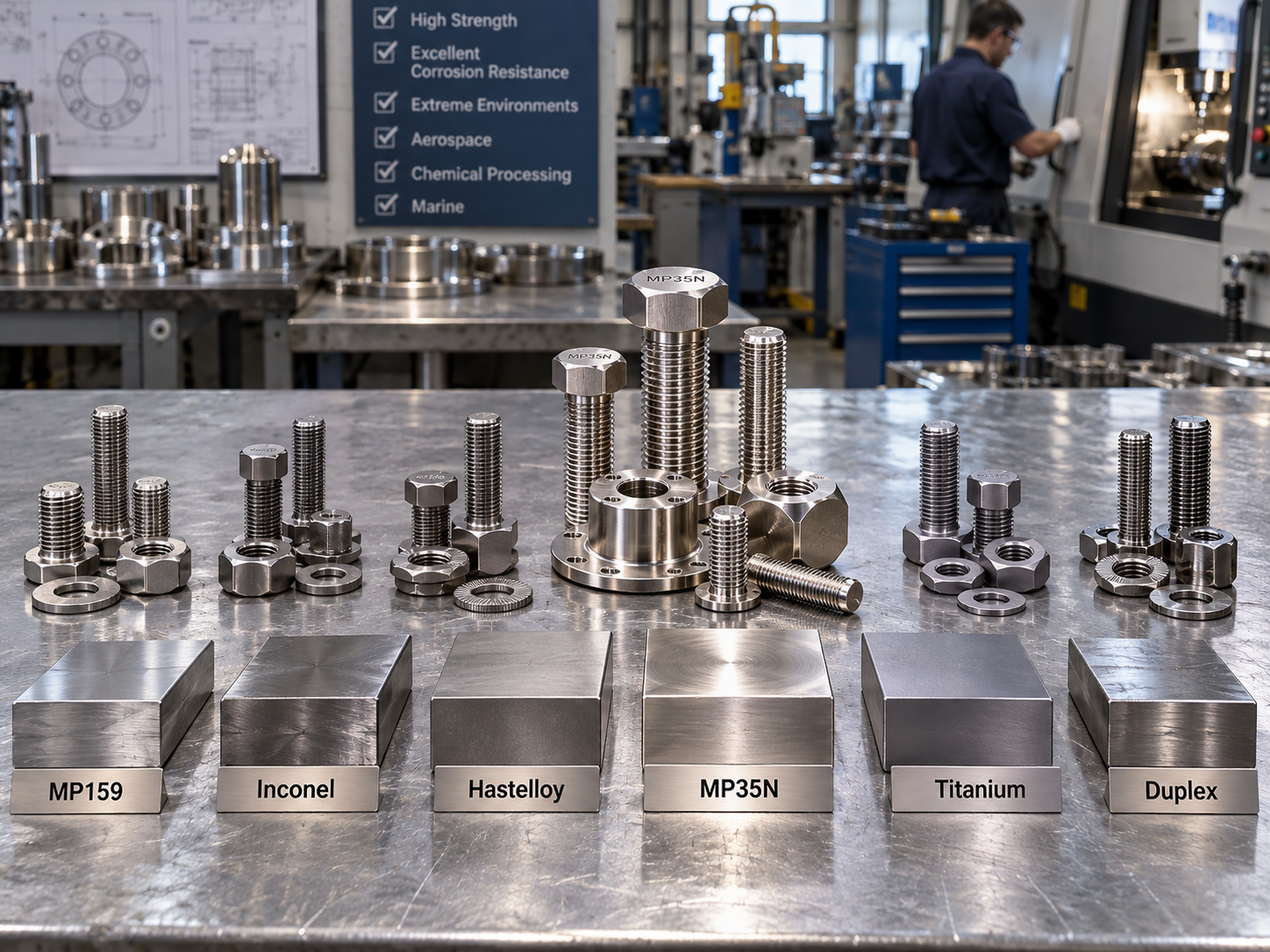
MP35N (UNS R30035) - Actually a cobalt-nickel-chromium-molybdenum alloy known for ultra-high strength and corrosion resistance, used in demanding downhole applications.
Key Properties & Use-Case:
They are solid-solution strengthened (not precipitation hardened) and generally not as strong as peak-aged nickel alloys but maintain their strength better at very high temperatures (>980°C). They are used for fasteners in severe hot-corrosion environments (e.g., near combustion gases with sulfur impurities), stationary gas turbine vanes, and critical bolting in chemical processing where sulfidation is a concern.
4. Refractory Metal Alloys
For extreme temperatures (>1200°C / 2192°F) in vacuum or inert atmospheres (as they oxidize readily in air).
Common Grades:
Molybdenum Alloys (e.g., TZM): High strength and creep resistance at very high temperatures, but requires protective coating or atmosphere.
Tantalum Alloys:
Niobium (Columbium) Alloys:
Key Properties & Use-Case: Used almost exclusively in specialized aerospace, vacuum furnace, and research applications. Not typical for general industrial bolting due to cost, oxidation susceptibility, and fabrication difficulty.
5. Specialty Iron-Based & Other Alloys
Alloy 660 (A-286): Already listed, but worth reiterating as an iron-based superalloy.
Nitronic 60 (UNS S21800): A nitrogen-strengthened austenitic stainless steel. While its high-temperature strength is not on par with superalloys, it is valued for excellent galling and wear resistance at moderately elevated temperatures, making it ideal for threaded studs, nuts, and valve stems in high-temperature service where seizure prevention is critical.
Selection & Design Critical Factors
Creep Strength: The single most important property for long-term service. Data for 0.2% creep in 10,000 or 100,000 hours is used for design.
Stress Relaxation: Determines how well a fastener maintains clamp load over time at temperature.
Environmental Resistance: Oxidation (scaling), hot corrosion (sulfidation/chloridation), and carburization resistance must match the atmosphere.
Thermal Expansion: Mismatch with joined materials can induce excessive thermal stresses.
Thermal Fatigue/Fracture Toughness: Resistance to cracking from repeated thermal cycles.
Compatibility with Coatings: Aluminide or thermal barrier coatings are often applied to nickel/cobalt superalloy fasteners to further extend their life in oxidizing environments.
In summary, A-286 (to ~700°C) and Inconel 718 (to ~650°C) are the pervasive workhorse alloys. For higher temperatures and stresses, Waspaloy, R-41, and Haynes 282 are the go-to nickel-based solutions, while cobalt alloys like Haynes 188 are selected for superior hot-corrosion resistance. The selection is always a precise engineering compromise between temperature, stress, environment, life, and cost.
Request A Quote! We'll respond as soon as possible(within 12 hours)
Get a Quote