
Categories List
Recent Posts
 Hastelloy C276 Fasteners: Bolts, Nuts, Screws, Studs & Washers for the World's Most Aggressive Corrosive Environments
 Inconel Fasteners: Bolts, Nuts, Washers, Studs – Complete Technical Guide | RAYCHIN LIMITED
 MP35N vs Inconel, Titanium, C276, Complete Material Comparison Guide for Fasteners | RAYCHIN LIMITED
Why Heat Treatment Matters in A286 Stainless Steel Fasteners
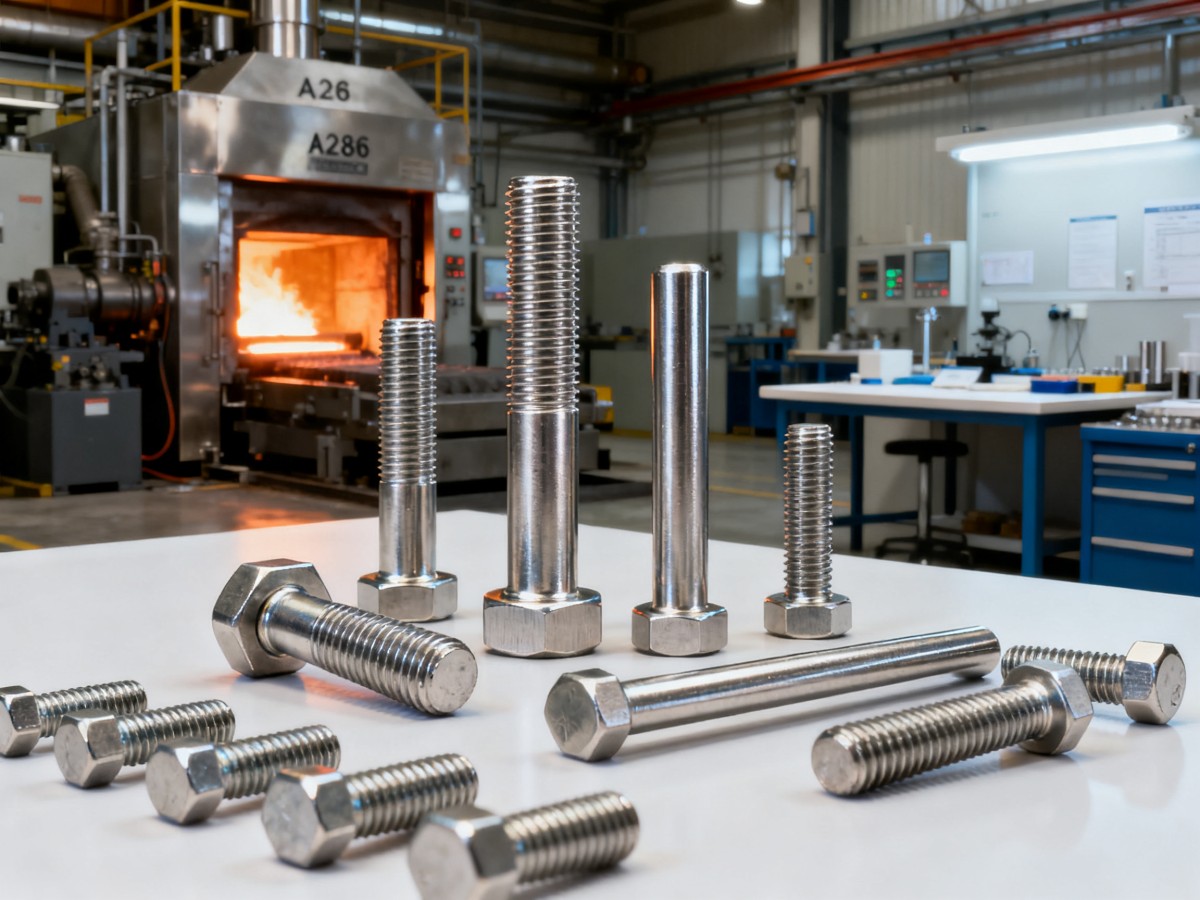
For engineers, buyers, and project teams evaluating a286 fasteners, heat treatment is a key factor behind strength, durability, and service reliability. From a286 bolts and a286 screws to a286 socket head cap screw and a286 threaded rod, the right thermal process directly affects a286 bolt strength, hardness, and performance in demanding applications. This article explains how heat treatment influences a286 stainless steel fasteners and what to consider when selecting a286 stainless steel bolts for critical use.
In metal processing equipment, fasteners often work under vibration, elevated temperature, thermal cycling, and repeated assembly loads. In these conditions, material grade alone does not decide service life. The final mechanical behavior of A286 is strongly linked to how the alloy is solution treated, aged, and controlled during cooling. A part with the right chemistry but the wrong heat treatment can fail torque targets, lose preload, or show unstable hardness from batch to batch.
For technical evaluators and quality teams, this means heat treatment should be reviewed as one of the 3 core checks during approval: material composition, process route, and final inspection. For procurement and commercial teams, it affects not only price but also risk cost, replacement frequency, and the chance of field failure. For operators and maintenance personnel, it influences whether a fastener remains reliable after 6 months, 12 months, or longer service intervals.
A286 is widely selected because it combines high-temperature strength, corrosion resistance, and good fabrication potential. However, these benefits do not appear automatically. They are developed through controlled precipitation hardening. In practical terms, the heat treatment route determines whether the alloy delivers balanced tensile strength, yield strength, ductility, and stress relaxation resistance in real equipment environments.
This is especially important in assemblies such as furnace structures, high-temperature fixtures, exhaust-related systems, turbine-adjacent equipment, and demanding bolted joints in metal processing machinery. In these applications, a286 stainless steel bolts may be expected to maintain preload across temperature swings, resist galling during installation, and survive long cycles without sudden loss of clamping force. Heat treatment is the process variable that connects those expectations to actual product performance.
- Solution treatment prepares the microstructure for later strengthening and improves consistency across the section.
- Aging treatment develops precipitation hardening and directly influences strength and hardness.
- Time and temperature control, often within narrow production windows, affect batch repeatability and inspection stability.
- Post-treatment verification, such as hardness and dimensional checks, helps confirm whether the parts match the intended application load.
How the Heat Treatment Process Changes Strength, Hardness, and Reliability
A286 is an iron-nickel-chromium alloy designed for precipitation hardening. In simple terms, the alloy gains much of its useful strength after a planned thermal sequence rather than from cold working alone. The most common route includes solution treatment followed by aging. While exact plant settings may vary by specification, section size, and product form, the process generally includes 2 major stages and several control points that determine final fastener behavior.
Stage 1: Solution treatment builds the starting structure
During solution treatment, the alloy is heated into a range suitable for dissolving strengthening phases and homogenizing the matrix. This stage is important for a286 bolts, screws, and threaded rod because it establishes a more uniform base structure before aging. If the solution condition is not properly controlled, later precipitation may be uneven, which can lead to hardness spread, lower yield performance, or distortion concerns in long or slender parts.
For manufacturers serving critical applications, furnace uniformity, soak time, load spacing, and cooling method all matter. A large threaded rod and a small socket head cap screw do not always react the same way. Section thickness, head geometry, and thread form can influence heat distribution. This is why buyers should not assess A286 only by nominal grade. They should also ask whether the heat treatment route is matched to the actual product geometry.
What solution treatment mainly affects
- Microstructural uniformity across head, shank, and thread.
- Readiness for effective aging and stable precipitation hardening.
- Dimensional stability after later thermal steps, especially in longer products.
- The baseline for balancing strength with ductility instead of pushing only one property.
Stage 2: Aging treatment develops usable fastener strength
Aging is the stage most directly associated with final a286 bolt strength. By holding the material at a controlled temperature for a defined period, fine precipitates form and strengthen the alloy. If the aging cycle is insufficient, the fastener may remain under-strength. If it is excessive, the alloy may overage, reducing the intended balance between tensile properties and toughness. In metal processing equipment, this balance matters because joints often face both static clamp load and dynamic stress.
The effect is not limited to tensile values. Proper aging also influences hardness consistency, resistance to relaxation at elevated temperature, and in some cases the stability of assembly torque behavior. Quality managers often review 4 linked outputs after aging: hardness range, proof load behavior, dimensional change, and surface condition. These checks are useful because a fastener that looks acceptable visually may still show hidden variation if aging control is poor.
When users compare batches from different suppliers, differences in strength often come from process discipline rather than from alloy name alone. One supplier may keep tighter controls on furnace mapping, holding time, lot traceability, and cooling sequence. Another may have greater variation between production runs. For procurement teams, this is a strong reason to assess process capability and inspection records, not just unit price.
The table below summarizes how major heat treatment stages influence practical fastener properties in equipment manufacturing and maintenance environments.
For engineering and sourcing teams, the practical takeaway is clear: heat treatment is not a background factory step. It is a performance-setting process. When equipment uptime, replacement intervals, and safety margins matter, reviewing the treatment route can prevent costly mismatch between specification sheets and field performance.
Which Properties Are Most Sensitive to Heat Treatment in Metal Processing Equipment?
Not every property changes to the same degree. In A286 stainless steel fasteners, the most heat-treatment-sensitive characteristics are usually tensile strength, yield behavior, hardness level, ductility balance, and resistance to stress relaxation at elevated temperature. For metal processing equipment, at least 5 practical performance outcomes should be reviewed before approving a fastener for production use or aftermarket replacement.
1. Tensile and yield strength
When people ask about a286 bolt strength, they usually focus on load-bearing capacity. That is reasonable, but tensile values alone do not tell the whole story. Heat treatment changes how the alloy distributes stress under load, which influences both ultimate strength and the point where permanent deformation begins. In equipment frames, heating chambers, and vibration-prone assemblies, stable yield behavior can be as important as peak tensile performance.
2. Hardness and installation behavior
Hardness is often checked because it is fast to measure and useful for process verification. However, a higher hardness number is not automatically better. Excessive hardness may raise concerns about reduced ductility or more challenging installation in some threaded assemblies. Insufficient hardness can point to under-aging or inconsistent thermal processing. For operators, the result may appear as unstable torque response, thread damage risk, or uneven tightening across a flange pattern.
3. Elevated temperature stability
A286 is often chosen for service above room temperature, so heat treatment must support retention of useful properties after long exposure. In real systems, maintenance cycles may occur every 3 months, 6 months, or annually. If the fastener loses preload too quickly under heat, the problem may not be visible until leakage, looseness, or alignment issues appear. Proper aging helps the alloy maintain a stronger and more stable response in such environments.
4. Dimensional stability and straightness
Threaded rod, long studs, and precision-headed parts can be sensitive to distortion during thermal processing. This is especially relevant when tolerances are tight or when post-treatment machining is limited. For project managers working on shutdown schedules, distortion translates into rework time, delayed installation, or unexpected scrap. Evaluating straightness control and lot inspection can therefore reduce schedule risk as much as it reduces technical risk.
The following table helps different stakeholders connect heat-treatment-sensitive properties with actual field concerns in metal processing equipment.
A disciplined supplier will connect these property checks with product form, lot history, and intended service conditions. That matters because the same alloy may behave differently as a small screw, a large bolt, or a long threaded rod. For critical projects, that difference should be evaluated before purchase order release rather than after field complaints begin.
How to Evaluate A286 Fasteners for Selection, Sourcing, and Risk Control
Selecting A286 for high-performance bolted joints is rarely just a material decision. It is a combination of alloy choice, heat treatment route, drawing requirements, product geometry, and verification level. Buyers in metal processing equipment often compare at least 4 factors during sourcing: mechanical reliability, delivery timing, documentation quality, and total risk cost. Heat treatment interacts with every one of these factors.
A practical procurement checklist
Before ordering a286 stainless steel bolts for production or maintenance use, teams should confirm the intended service temperature range, required preload stability, and whether the application involves vibration, cyclic loading, or frequent disassembly. These conditions affect whether a standard heat-treated product is adequate or whether a more tightly controlled route is necessary. In many industrial projects, missing this early clarification causes the biggest avoidable cost.
- Define the application environment, including heat exposure, joint type, and maintenance interval.
- Confirm whether strength, hardness, or preload retention is the main design driver.
- Check if the supplier can provide process traceability from raw material to heat treatment lot.
- Review inspection items such as hardness, dimensions, thread quality, and material certification.
- Ask about standard lead times, sample support, and the effect of custom geometry on production scheduling.
Why lower price can become higher cost
In B2B purchasing, a low initial quotation may hide later expense. If heat treatment control is weak, users may face re-inspection, fit-up delay, replacement during startup, or more frequent maintenance shutdowns. For a line operating on weekly or monthly production targets, these indirect costs can quickly exceed the price difference between two suppliers. This is why technical and commercial teams should evaluate total ownership cost rather than ex-works price only.
RAYCHIN LIMITED supports this decision process by focusing on specialty metals fasteners, including standard and customized configurations for demanding service. With a professional technical team and ongoing material and product development capability, the company helps customers review not only grade selection but also process suitability, application matching, and supply planning for challenging environments.
For projects needing a combination of technical guidance and sourcing efficiency, it is useful to review available product forms such as bolts, screws, studs, and rods through A286 Fasteners. This can shorten the path from early evaluation to sample confirmation and formal procurement.
Common Mistakes, FAQ, and What Teams Often Overlook
Many issues with a286 fasteners do not come from the alloy itself. They come from assumptions made during specification, purchasing, or installation. In real projects, 3 recurring mistakes appear most often: choosing by material name only, ignoring heat-treatment consistency across product forms, and treating hardness as the only acceptance criterion. These shortcuts can create hidden reliability gaps even when documentation appears complete.
Is harder always better for A286 bolts?
No. Hardness is useful, but it is not the only target. A fastener must also maintain adequate ductility, thread integrity, and service stability. If heat treatment pushes hardness without preserving balance, the part may become less suitable for cyclic or thermally variable loading. Engineers should assess hardness together with load requirements, dimensional condition, and installation method.
Do all A286 product forms respond the same way to heat treatment?
No. A286 bolts, screws, socket head cap screws, and threaded rods can respond differently because of geometry, section thickness, head mass, and thread profile. This is why the same alloy grade may require different process attention depending on whether the application uses short cap screws or long studs. Buyers should ask whether the supplier treats these products with geometry-specific control rather than assuming one cycle works equally well for all.
What should quality control check first during incoming inspection?
A practical first set includes 4 items: traceable material documentation, hardness verification, dimensional accuracy, and thread condition. If the parts are intended for high-temperature duty, QC should also review whether the declared heat treatment condition matches the application requirement. Where the project is critical, sample-based verification before full installation is usually more efficient than discovering issues during assembly.
What is a reasonable delivery discussion for custom A286 fasteners?
Lead time depends on size, quantity, and whether tooling or non-standard processing is required. In industrial sourcing, standard configurations may move faster than custom parts, while special dimensions or documentation packages can extend the schedule. Instead of asking only for the shortest delivery date, project teams should discuss 3 timeline points clearly: sample timing, production timing, and inspection or export preparation timing.
Another overlooked point is application communication. If a supplier does not understand whether the fastener will face elevated temperature, vibration, or repeated maintenance cycles, the recommendation may remain too generic. Good sourcing outcomes depend on sharing enough use-case detail for proper process and product matching.
Why Many Buyers Work with a Technical Fastener Partner Instead of Buying by Grade Alone
In specialty fastener sourcing, the question is not only “Do you supply A286?” but also “Can you support the right A286 condition for my load, temperature, and project schedule?” This distinction matters in metal processing equipment, where fasteners may be small components but have large consequences for line reliability, maintenance planning, and safety management. Technical support before ordering often saves more time than troubleshooting after installation.
RAYCHIN LIMITED focuses on the development, manufacturing, and global distribution of standard and customized fasteners made from high-performance specialty metals. For users evaluating heat treatment effects on strength and service life, this matters because supplier value is not limited to product availability. It also includes application guidance, support on material selection, and alignment between process capability and demanding operating conditions.
What you can discuss with us before placing an order
- Whether A286 is suitable for your target temperature range and clamping requirement.
- Which product form fits best, such as bolts, screws, studs, or threaded rod.
- How heat treatment condition may influence strength, hardness, and service stability in your assembly.
- What documentation, sample support, or inspection checkpoints are practical for your project stage.
- How standard and customized options may affect delivery planning and cost control.
A more effective next step
If you are comparing a286 stainless steel fasteners for a new build, replacement cycle, or technical approval process, it is helpful to start with the application details rather than the drawing alone. Share the fastener type, service temperature, joint function, expected load condition, quantity level, and target lead time. This allows a more accurate discussion of product selection, heat treatment suitability, sample options, and quotation structure.
You can also review available options through A286 Fasteners and contact RAYCHIN LIMITED for support on parameter confirmation, product selection, delivery cycle planning, custom solutions, inspection requirements, sample coordination, and quotation communication. For engineering, purchasing, and project teams, that creates a clearer path from evaluation to dependable supply.
Request A Quote! We'll respond as soon as possible(within 12 hours)
Get a Quote