
Categories List
Recent Posts
 PEEK Fasteners | Polyetheretherketone Bolts, Nuts, Screws – High-Performance Polymer | RAYCHIN LIMITED
 High-Temperature Alloy Fasteners: Complete Material Guide, Chemistry, Performance Comparison | RAYCHIN LIMITED
 High-Temperature Fastener Material Selection Guide | A286, Inconel 718, Nimonic 80A, Waspaloy – RAYCHIN LIMITED
Executive Summary: Are They Different?
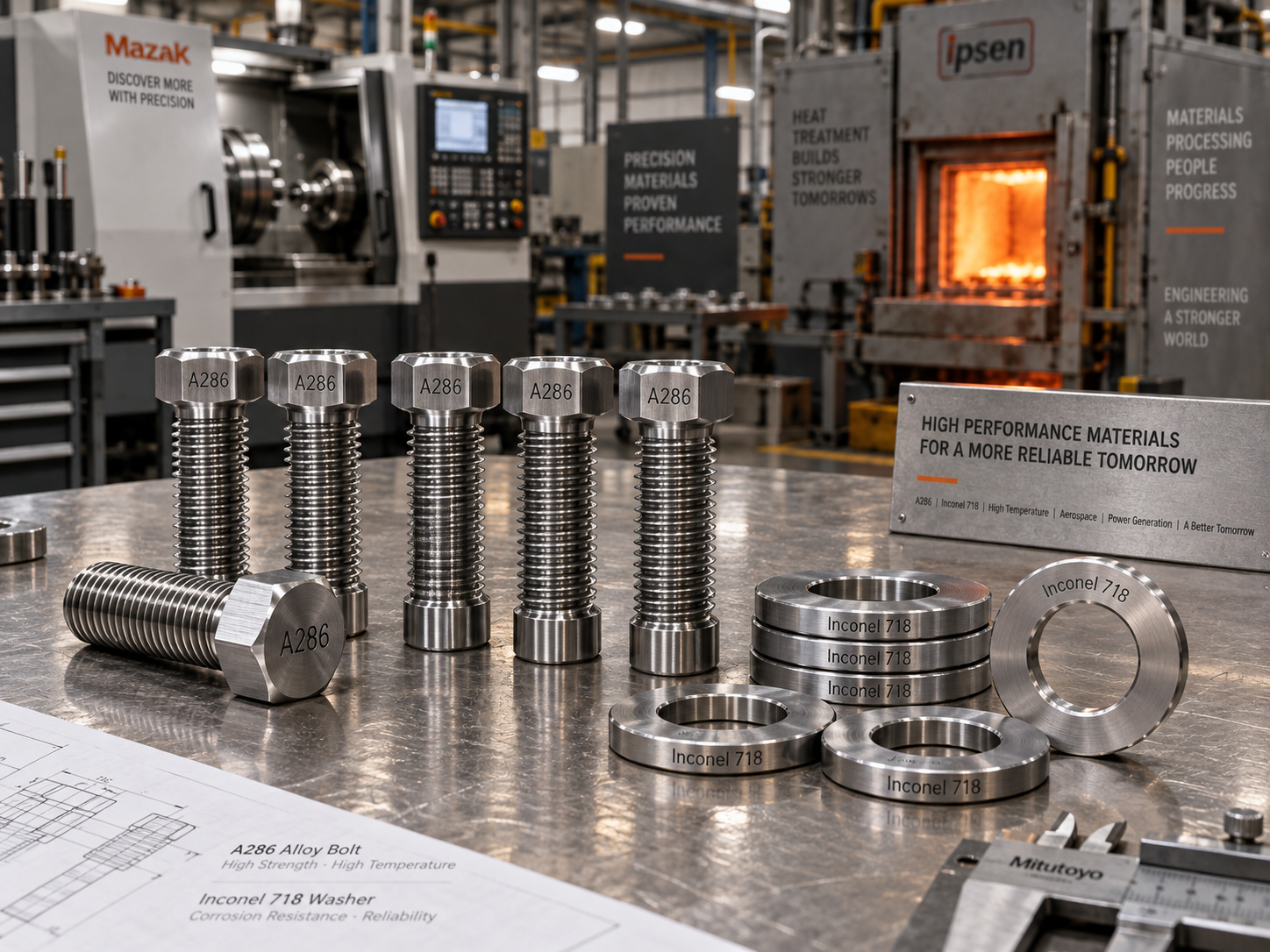
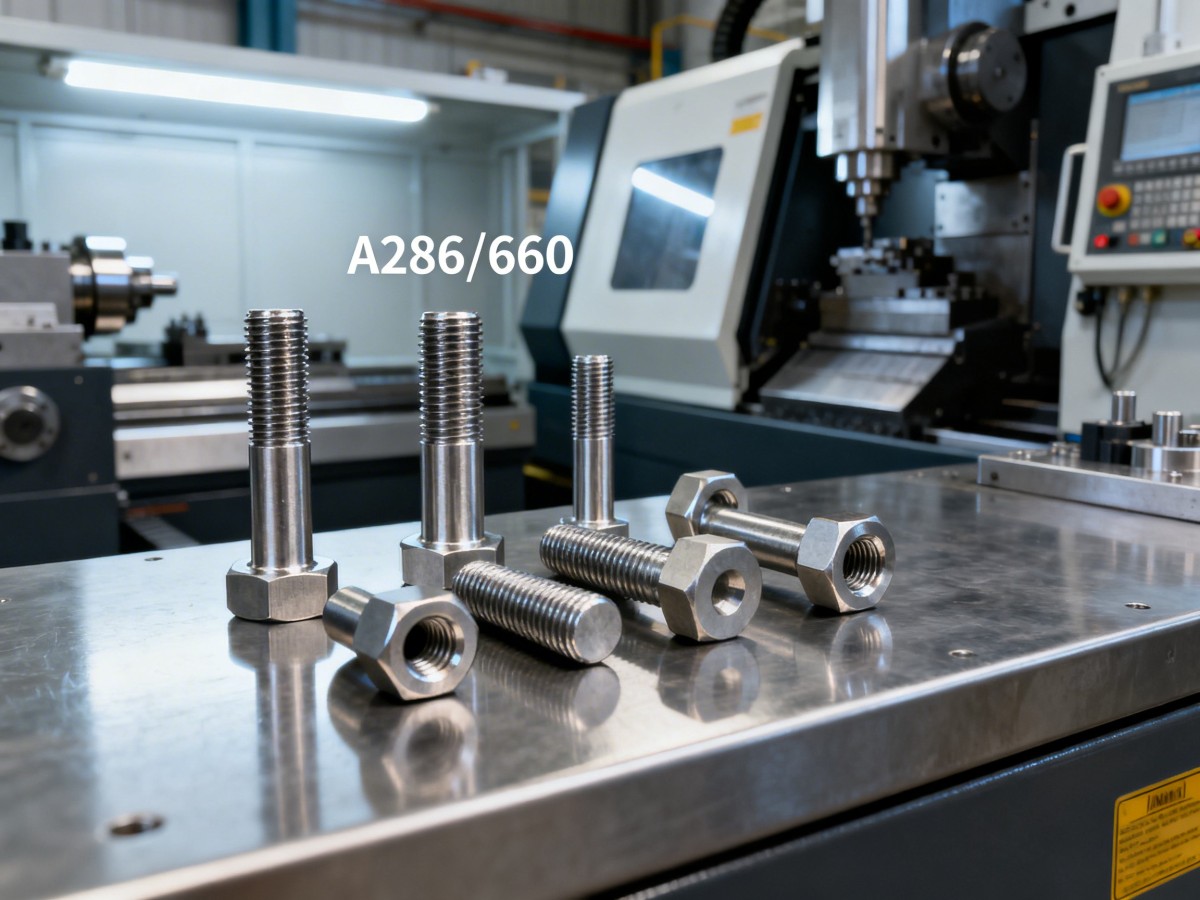
No, there is no technical difference. "A286" and "660" refer to the same material.
A286 is the commercial/trade name for this iron-based superalloy (originally developed by Allegheny Technologies).
660 is the standard designation (e.g., ASTM A453 Grade 660 or AISI 660) used in engineering specifications and procurement standards.
The material is also identified by the Unified Numbering System (UNS) as UNS S66286.
Detailed Comparison Table
While the chemistry is identical, the terminology differs based on whether you are looking at the Material Specification (A286) vs. the Product/Procurement Standard (660). The following table provides a technical breakdown based on authoritative data.
Comparative Analysis for Technical, Procurement, and Decision-Maker Roles
1. Technical Perspective (Engineering & Quality Assurance)
From a technical standpoint, there is no distinction regarding performance. Both names yield the same material properties.
Material Performance: Whether specified as A286 or Grade 660, the fastener provides exceptional high-temperature strength (up to ~700°C) and creep resistance. It relies on the same precipitation-hardening mechanism (gamma-prime phase, Ni3(Al, Ti)).
Traceability: The critical distinction lies in the standard. If a drawing calls for "Grade 660," the supplier must comply with ASTM A453 or specific aerospace standards (like NA0026, which requires 1100 MPa UTS). If it calls for "A286," it often implies compliance with the chemical and mechanical ranges of UNS S66286 but may lack the specific "Class" requirements.
Data Accuracy: For a Technical Buyer at RAYCHIN, verify the Class (A, B, C, D) when procuring "660" fasteners. Class C/D offers higher strength (130 ksi vs 120 ksi) but lower ductility than Class A/B.
2. Procurement & Supply Chain Perspective
For the procurement team, the naming convention affects sourcing, cost, and availability.
Nomenclature: "A286" is the industry standard commercial term. Searching for "A286 bolts" yields a broader range of suppliers (including those serving automotive and industrial markets) than searching for "Grade 660 bolts," which is more common in strictly oil & gas or pressure vessel sectors.
Cost Drivers:
Material Cost: Medium range (high due to Nickel content ~26%).
Manufacturing Cost: High. This material is difficult to machine (machinability rating ~28% of B1112) and requires a precise two-step heat treatment (Solution + Age). Fasteners must often be thread rolled after heat treatment to meet stringent tensile requirements (such as 1100 MPa in NA0026).
Certification: There is no significant price difference between a fastener labeled "A286" vs "Grade 660" if the chemical and mechanical properties align. However, Grade 660 fasteners sold with ASTM A453 certification typically command a premium due to the rigorous testing (stress rupture, hardness) and third-party verification required.
3. Decision-Maker & Strategic Perspective (Management/Engineering Leadership)
For decision-makers, the choice between specifying "A286" or "660" is a matter of risk management and compliance.
Designation Strategy: If the application is regulated (e.g., ASME Boiler and Pressure Vessel Code, military, or civil aerospace), always specify "Grade 660" per ASTM A453. Using the commercial name "A286" without the ASTM standard introduces liability because it does not guarantee compliance with the specific yield strength (e.g., 100 ksi min for Class D) required for safety factors in critical bolting.
Standardization: For manufacturers like RAYCHIN, aligning production to Grade 660 (ASTM A453) standards allows for entry into high-value markets (aerospace, defense, energy). Standards like SAE AS4892 or NA0026 specifically reference UNS S66286 (A286) and define the stringent quality assurance (QA) requirements for lot control, traceability, and mechanical testing that justify the higher price point of specialized fasteners.
Application Lifecycle: For components operating above 500°F (260°C), A286/660 is a cost-effective alternative to nickel-based superalloys like Inconel 718. Using Grade 660 ensures the fastener meets the stress-rupture life required for long-term turbine or engine operation.-
Summary Conclusion
There is no technical difference between A286 and 660 fasteners; they are metallurgically identical.
For Technical: Focus on the Class (A, B, C, D) under ASTM A453, not the name.
For Procurement: Sourcing "A286" is common for industrial use; sourcing "Grade 660" is mandatory for certified pressure vessel or aerospace applications.
For Decision-Makers: To ensure safety and regulatory compliance in high-temperature environments, specify using the standard (ASTM A453 Grade 660) rather than the commercial trade name (A286).
Request A Quote! We'll respond as soon as possible(within 12 hours)
Get a Quote