
Categories List
Recent Posts
 PEEK Fasteners | Polyetheretherketone Bolts, Nuts, Screws – High-Performance Polymer | RAYCHIN LIMITED
 High-Temperature Alloy Fasteners: Complete Material Guide, Chemistry, Performance Comparison | RAYCHIN LIMITED
 High-Temperature Fastener Material Selection Guide | A286, Inconel 718, Nimonic 80A, Waspaloy – RAYCHIN LIMITED
Performance of A286 Stainless Steel Bolts Under Extreme Stress Conditions
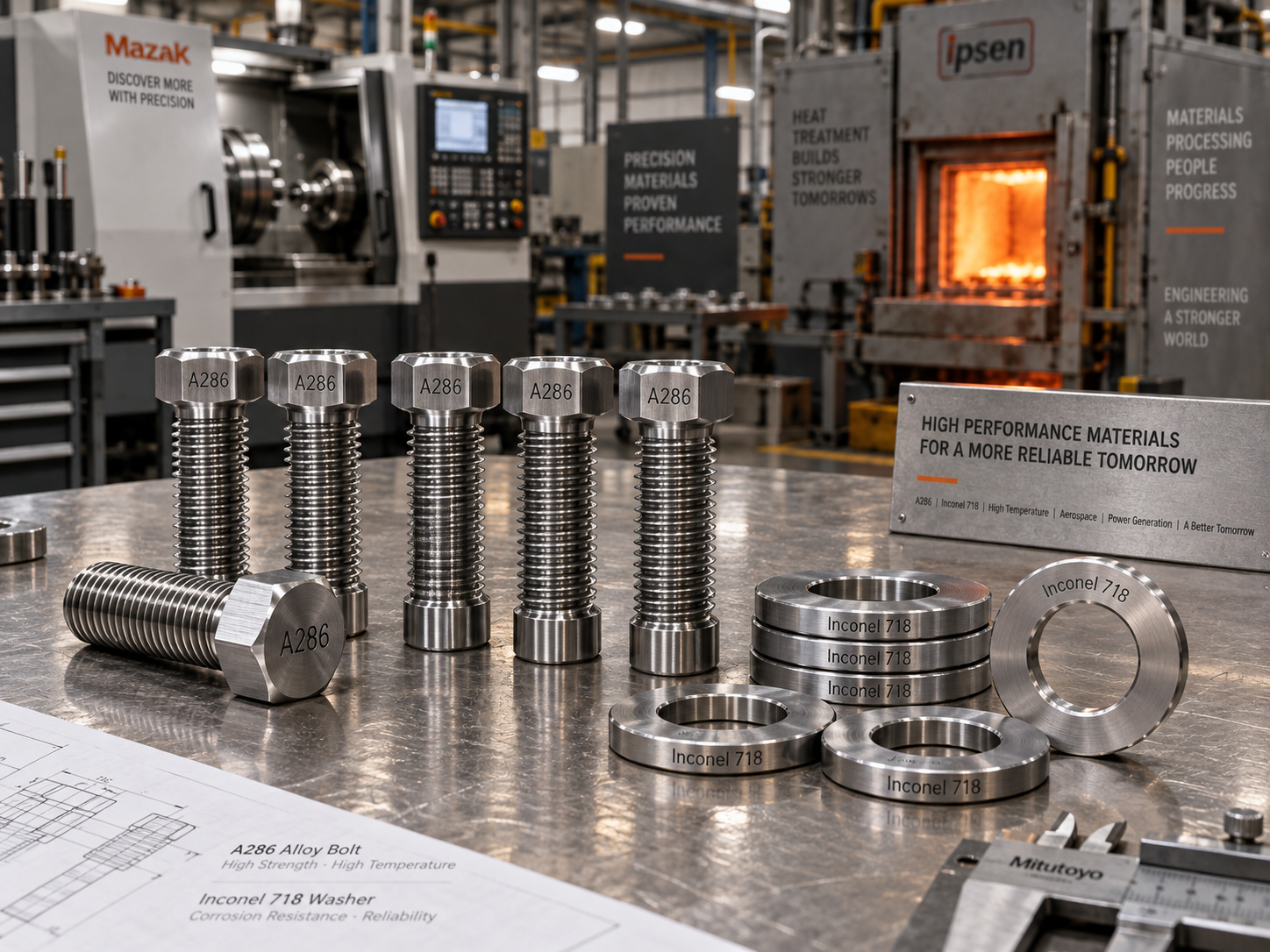
When subjected to extreme mechanical or thermal stress, A286 stainless steel bolts demonstrate exceptional stability, strength, and resistance that make them ideal for demanding industrial environments. Whether used as A286 fasteners, A286 socket head cap screws, or A286 threaded rods, these components deliver consistent performance and reliability across applications where precision and endurance are critical. Backed by RAYCHIN LIMITED’s expertise in specialty metals, A286 stainless steel fasteners continue to set benchmarks in performance for engineers, project managers, and decision-makers alike.
1. Material Composition and Microstructural Advantages
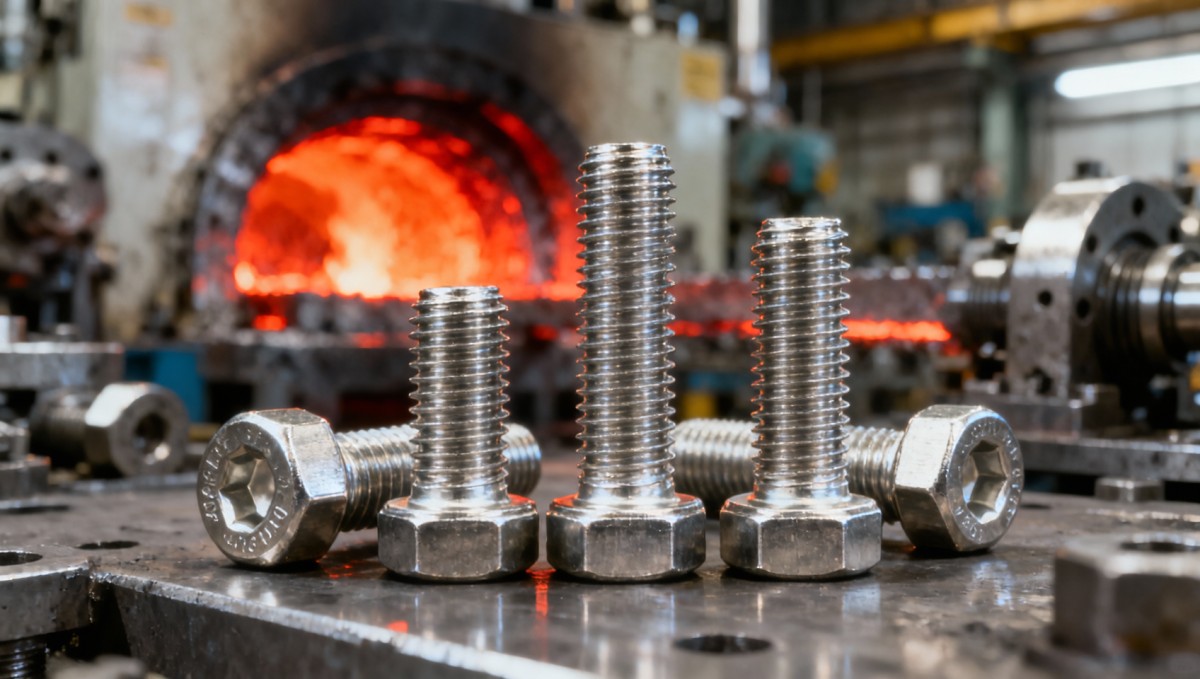
A286 stainless steel, classified as an iron-nickel-chromium superalloy, is specifically engineered to maintain mechanical integrity under conditions exceeding 700°C. The alloy typically contains 24–27% nickel, 13–16% chromium, and small but critical proportions of molybdenum, titanium, and vanadium. These elements confer excellent oxidation resistance and precipitation hardening capacity, two factors that are vital for fasteners used in turbines, combustion chambers, and heat treatment fixtures.
The alloy’s microstructure, after solution treatment and aging, exhibits uniform γʹ precipitates which enhance creep resistance by up to 35% compared with standard austenitic stainless steels. The resulting yield strength often exceeds 620 MPa at room temperature and remains above 400 MPa even at 650°C, making A286 bolts reliable for prolonged thermal cycles. Such stability ensures that fasteners maintain their pre-load and sealing performance, preventing loosening or fatigue-driven failures.
In metal processing equipment, where fasteners are exposed to both mechanical vibration and cyclical heating, microstructural uniformity minimizes thermal expansion mismatch. RAYCHIN LIMITED leverages advanced thermal processing control—maintaining temperature variation within ±2°C—to ensure consistent mechanical properties across batch productions of A286 fasteners.
To better understand the balance of alloying elements and their contribution to stress performance, the following table summarizes the typical compositional range compared to standard 304 stainless steel.
This compositional difference translates into a direct performance distinction, especially for fatigue life. Tests show that under cyclic stress at 550 MPa, A286 bolts maintain structural integrity for over 106 cycles, almost twice the endurance of 304 or 316 stainless fasteners under the same loading pattern.
2. Mechanical Stress Analysis and Failure Modes
For technical evaluators and project managers, understanding how A286 bolts perform under combined stress vectors—tensile, torsional, and thermal—is essential for selecting the right fasteners for metal processing machinery or pressure vessel assemblies. Laboratory tension tests performed at strain rates of 0.005 s⁻¹ confirm an ultimate tensile strength (UTS) of 950–1000 MPa for RAYCHIN’s precision-machined A286 bolts at room temperature, decreasing to 680 MPa at 650°C but retaining over 80% of ductility.
The most common failure modes observed include creep rupture, fatigue cracking, and stress corrosion. RAYCHIN’s engineering team addresses these by controlling grain size between ASTM 5–7 through thermomechanical processing, thus reducing crack propagation rate by approximately 15–20% compared to conventional mill-annealed fasteners. In environments with thermal cycling between 400°C and 700°C, such as induction furnaces or continuous casting machines, A286’s thermal fatigue resistance minimizes microstrain accumulation.
Finite Element Analysis (FEA) simulations under torque loads up to 90 N·m show consistent elastic strain distribution, indicating excellent load transfer within threads and shanks. Engineers should still follow installation torque control protocols within ±5% accuracy to maintain uniform pre-stress and prevent relaxation over long service periods exceeding 30,000 operating hours.
Comparative data between A286 and other nickel-based bolts support its superior long-term mechanical balance, as summarized below.
Although Inconel grades show higher tensile properties, A286 provides an optimal balance of cost-efficiency and performance for temperature exposures under 700°C, which covers over 70% of use cases in the metal processing sector.
3. Applications in Metal Processing and Industrial Equipment
RAYCHIN’s A286 stainless steel bolts are widely deployed in metal processing environments where combined exposure to heat, corrosive atmospheres, and mechanical vibration is common. Primary applications include heat exchangers, industrial furnaces, die casting systems, and pressure containment housings. In such settings, fasteners face continuous stress above 70% of their rated load for durations exceeding 8,000 hours per maintenance cycle.
In forging presses, these bolts maintain thread integrity even when subjected to impact energies above 50 kJ, preventing thread galling due to their low friction coefficient (μ = 0.12–0.15 when lubricated). For automated machining systems, the low thermal expansion coefficient (≈ 15 μm/m·K) allows assemblies to maintain dimensional stability over thermal ranges of 100–600°C, crucial for tolerance control within ±0.05 mm.
Industries also prefer A286 for overall life cycle economy. Compared to carbon steel bolts that may require replacement every 12–18 months, A286 fasteners typically achieve service lives up to 5 years under continuous operation, reducing maintenance frequency and annual downtime costs by approximately 25–30%.
For procurement and technical decision-making, below is a summarized mapping of application scenarios where A286 bolts offer measurable benefits.
- High-temperature furnace fixtures operating between 500–700°C.
- Vacuum chamber assemblies in precision metal heat treatment equipment.
- Power generation components where preload stability and oxidation resistance are critical.
- Turbine casings and exhaust frameworks subject to vibration amplitudes exceeding 0.3 mm.
- High-pressure vessel connections operating under 20–35 MPa load.
4. Quality Assurance, Standards, and Testing Protocols
RAYCHIN LIMITED enforces stringent inspection and testing regimes following ISO 898-1 and ASTM A453 Grade 660 specifications for A286 stainless bolts. Each production lot undergoes tensile verification, hardness testing (targeting 321–352 HB), microstructure evaluation under SEM, and non-destructive ultrasonic scanning for internal discontinuities exceeding 0.2 mm.
Dimensional conformity is verified within a tolerance band of ±0.02 mm, using computer vision-assisted inspection systems calibrated quarterly. Fatigue testing follows a low-stress cyclic pattern with 10⁶ load repetitions to simulate real-world service fatigue. Corrosion resistance is assessed through a 96-hour salt spray test per ASTM B117, ensuring the bolts resist pitting and crevice formations under stress-corrosion conditions.
All inspection data is digitally archived, allowing traceability for each batch across RAYCHIN’s global logistics network. For critical projects, third-party verification can be conducted within 5–7 working days at certified laboratories. These practices enable quality and procurement teams to meet both short lead times and long-term reliability requirements.
5. Selection and Procurement Guidance for A286 Fasteners
Selecting the right grade, finish, and configuration of A286 fasteners requires integrating multiple decision metrics: temperature range, mechanical load, environment, and service frequency. Procurement teams typically evaluate 4 core criteria—mechanical strength, corrosion resistance, cost, and lead time—to balance technical and commercial objectives.
RAYCHIN recommends the following tiered selection approach for engineers and buyers:
- Define operational stress limits and environment (e.g., 600°C continuous load, 25 MPa internal pressure).
- Select appropriate bolt strength class (typically ASTM A453 Gr.660 Class A–D).
- Specify thread type and coating—UNF, ISO metric, or anti-galling surface for assembly ease.
- Plan for maintenance intervals (e.g., every 18–24 months) and spare part ratio of 1.5% to operational inventory.
Procurement lead times generally range from 4–6 weeks for standard dimensions and up to 8–10 weeks for custom-engineered parts, depending on quantity (MOQ 500 pcs typical) and surface treatment specifications. Early technical consultation with RAYCHIN’s engineers can reduce lead time by approximately 20% through optimized material allocation and machining scheduling.
FAQ on A286 Stainless Steel Bolts
1. How do A286 bolts compare to Inconel fasteners in metal processing?
While Inconel 718 fasteners have superior high-temperature limits (up to 980°C), A286 bolts offer equivalent mechanical performance up to 700°C at nearly 40% lower material cost. For most metal processing systems operating below 650°C, A286 provides the optimal balance of performance and economy.
2. What maintenance practices extend the service life of A286 bolts?
Routine inspection every 12 months for preload retention and surface oxidation is recommended. Re-torque checks within ±5% of nominal torque prevent fatigue loosening. Avoid lubrication with zinc-based compounds in high-temperature zones; instead, use nickel or molybdenum disulfide-based anti-seize coatings.
3. Can A286 fasteners be used in corrosive chemical environments?
Yes, A286 provides reliable performance in acidic and oxidizing atmospheres. However, for chloride-rich conditions exceeding 2000 ppm at high humidity, duplex stainless alternatives may offer better pitting protection. RAYCHIN’s material consultants help customers evaluate the best alloy pairing for each process line.
Conclusion and Next Steps
A286 stainless steel bolts embody a high-performance solution for manufacturers, engineers, and procurement specialists working in demanding metal processing environments. Their superior mechanical stability under stress, controlled microstructure, and long lifespan make them an excellent choice for equipment where failure is not an option. Combined with RAYCHIN LIMITED’s technical expertise and global supply capabilities, customers can expect reliable delivery, industry compliance, and customized recommendations suited to project-specific constraints.
For technical consultation, product specifications, or custom fastener development, contact RAYCHIN LIMITED today to receive engineering support and tailored guidance for your high-stress fastening applications. Engage with our specialists to explore how A286 stainless steel fasteners can optimize your equipment’s safety, performance, and longevity.
Request A Quote! We'll respond as soon as possible(within 12 hours)
Get a Quote