
Categories List
Recent Posts
 Hastelloy C276 Fasteners: Bolts, Nuts, Screws, Studs & Washers for the World's Most Aggressive Corrosive Environments
 Inconel Fasteners: Bolts, Nuts, Washers, Studs – Complete Technical Guide | RAYCHIN LIMITED
 MP35N vs Inconel, Titanium, C276, Complete Material Comparison Guide for Fasteners | RAYCHIN LIMITED
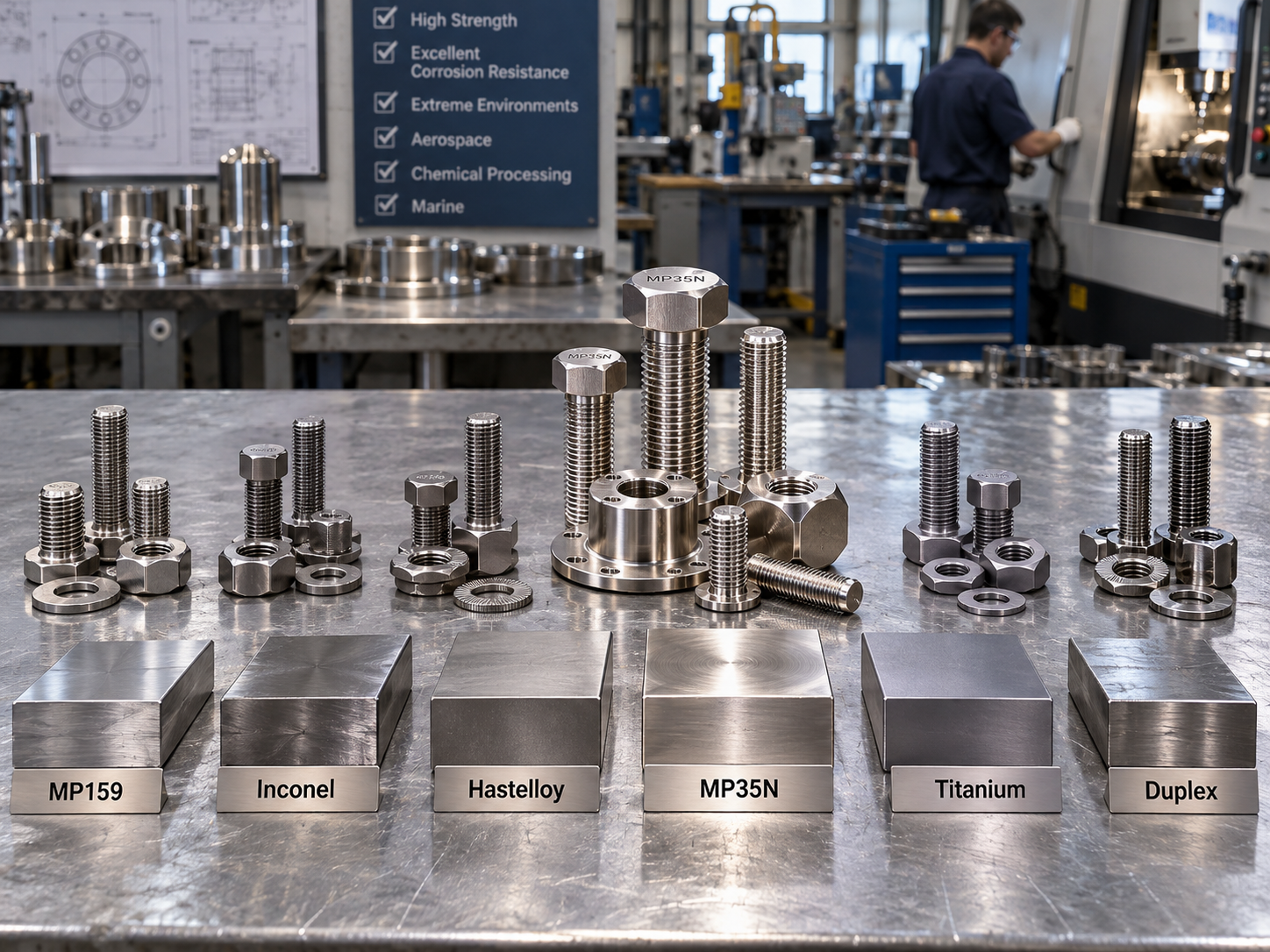
Inconel vs Hastelloy, Monel, Duplex, Titanium & Stainless Steel: The Ultimate Fastener Material Showdown
Selecting the optimal fastener alloy means navigating a dense field of high‑performance materials. Inconel 718 or Inconel 625? Inconel or Hastelloy? When does Monel K500 make more sense than Inconel? Should you upgrade from 316L stainless to Inconel 625? As a dedicated manufacturer of nickel‑alloy, duplex, titanium, and special stainless fasteners, RAYCHIN LIMITED brings clarity to these comparisons. This guide maps the key distinctions, giving engineers the data‑driven confidence to specify the right alloy for temperature, corrosion, strength, and budget.
1. Inconel 718 vs Inconel 625 Fasteners
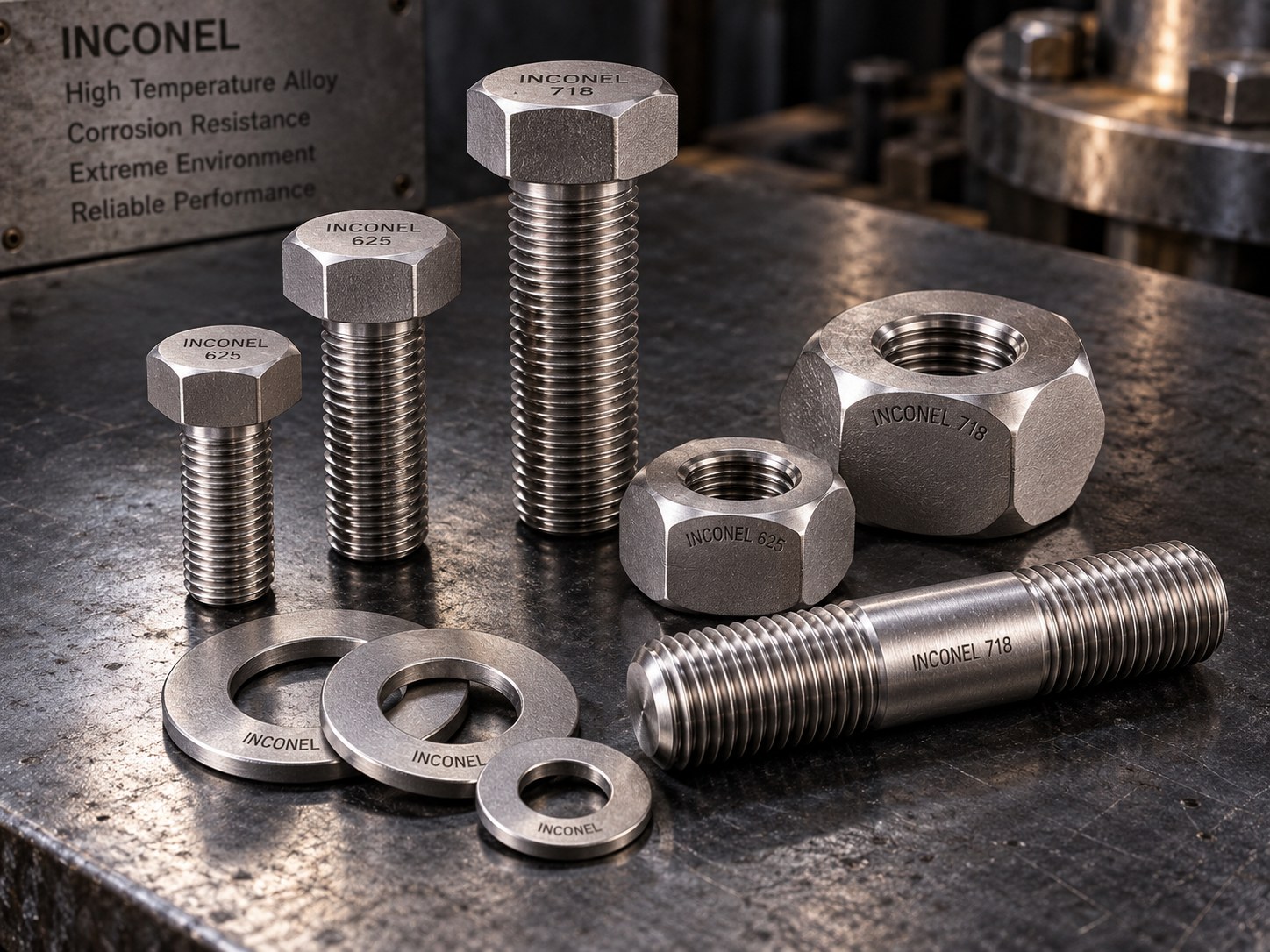
This is the most frequent internal comparison within the Inconel family. The table below crystallizes the differences that matter for fastener specification.
Choose 718 when high tensile strength and creep resistance up to 700°C are paramount. Choose 625 when the environment is seawater, wet chlorine, or mixed acids and strength requirements are moderate.
2. Inconel vs Hastelloy Bolts
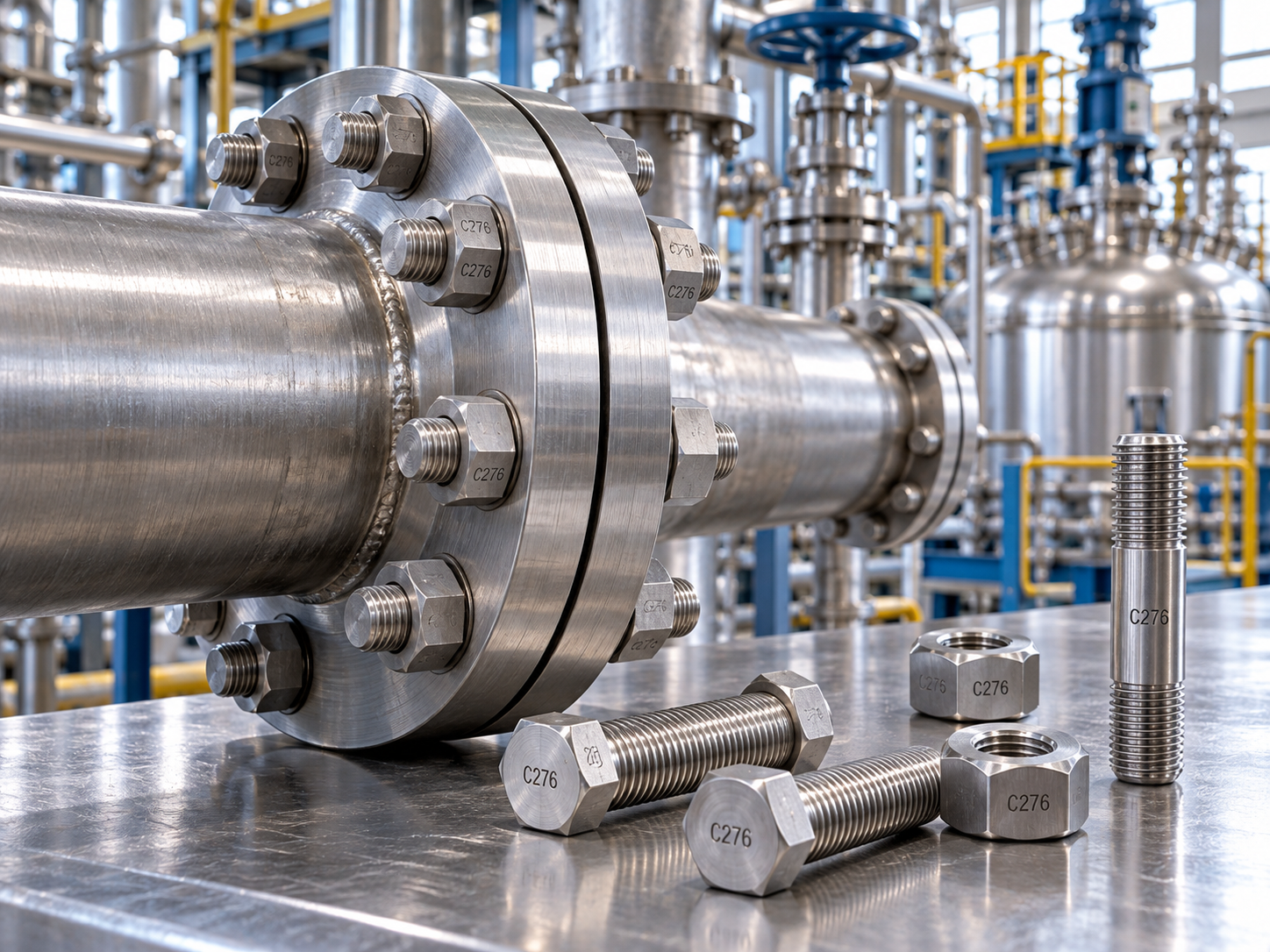
Both are nickel‑based, but Hastelloy C276 is engineered primarily for wet corrosion—reducing and oxidizing acids including hot sulfuric and wet chlorine. Inconel 625 also offers excellent corrosion resistance but with higher strength and temperature limits. Inconel 718 is the choice where mechanical load and high‑temperature strength dominate. In a chemical plant handling mixed acids with oxidizers, C276 often beats both Inconels in corrosion rate. In a gas turbine, Inconel 718 is unmatched.
3. Inconel 718 vs Monel K500
Monel K500 is a precipitation‑hardened Ni‑Cu alloy (UNS N05500) with yield strength up to 690 MPa and is non‑magnetic, ideal for submarine and marine applications. Inconel 718 offers nearly double the yield strength and far higher temperature capability (704°C vs 300°C for K500). However, Monel K500 resists seawater and hydrofluoric acid at a lower cost. For subsea fastener applications below 300°C where non‑magnetic properties matter, Monel K500 is excellent; for high‑temperature or high‑stress subsea bolting, Inconel 718 is required.
4. Inconel vs Duplex Stainless Steel Fasteners
Super Duplex 2507 (UNS S32750) offers yield strength ~550 MPa and good chloride pitting resistance (PREN ≥40). It is significantly less expensive than Inconel. However, its practical temperature limit is about 300°C, and it is susceptible to pitting and crevice corrosion in warm seawater above 80°C. Inconel 625 is immune to seawater pitting at all practical temperatures and withstands far more aggressive acids. The upgrade from Duplex to Inconel is justified when process temperature or chemical aggressiveness exceeds Duplex limits.
5. Inconel 625 vs Super Duplex 2507 Bolts
For subsea Christmas trees and high‑temperature seawater cooling, 625 is the safe choice. For topside seawater piping below 40°C, 2507 may offer acceptable performance at lower cost.
6. Inconel 718 vs Titanium Fasteners
Titanium Grade 5 (Ti‑6Al‑4V) delivers yield strength ~828 MPa at roughly half the weight of Inconel 718. It is immune to seawater corrosion. However, titanium is limited to about 400°C and is attacked by reducing acids, fluorides, and hot HCl. Inconel 718 handles much higher temperatures and a wider chemical spectrum. Aerospace and motorsport often favor titanium where weight saving is critical; oil & gas and chemical processing favor 718 for strength and thermal stability.
7. Inconel 718 vs A-286 Bolts
A-286 (ASTM A453 Grade 660) is an iron‑based, precipitation‑hardenable stainless steel with yield strength ~585 MPa and temperature limit ~700°C. It is less expensive than Inconel 718 and works well in steam turbines and exhaust systems. However, Inconel 718 offers nearly double the yield strength and superior corrosion resistance. Where 718 is over‑engineered and budget is a factor, A-286 provides a viable intermediate solution. RAYCHIN manufactures both and advises based on your stress and corrosion requirements.
8. Inconel 625 vs 316L Stainless Steel: Cost and Performance
The initial cost of Inconel 625 fasteners is typically 5–10 times that of 316L stainless. However, Inconel 625 vs 316L stainless steel cost must be evaluated over the lifecycle. 316L fails quickly in wet chlorine, hot acids, and high‑chloride, low‑pH environments. The total cost of replacement, downtime, and potential leakage overwhelmingly favors 625 in these conditions. Use 316L only in mild chemical service below 60°C; upgrade to 625 whenever the environment is corrosive or safety‑critical.
9. When to Use Inconel Instead of Stainless Steel
Upgrade from stainless steel to Inconel when any of these conditions apply:
- Temperature exceeds 400°C under load—stainless loses strength rapidly.
- Chlorides above 1000 ppm at pH < 4—stainless pits and stress‑corrosion cracks.
- Presence of H₂S (sour service)—austenitic stainless may sulfide stress crack.
- Wet chlorine, hypochlorite, or hot acids—stainless corrodes rapidly.
- Zero‑failure tolerance—aerospace, nuclear, subsea safety‑critical joints.
10. Best Nickel Alloy for High Temperature Bolts
The best nickel alloy for high temperature bolts depends on the specific temperature window and environment:
- Up to 704°C under high stress: Inconel 718—unmatched strength and creep resistance.
- Up to 982°C oxidizing atmosphere: Inconel 625 or Inconel 601—excellent oxidation resistance.
- Up to 1200°C low‑stress: Hastelloy X or Inconel 601.
- 650–760°C moderate stress + corrosion: Inconel 725 or X-750.
RAYCHIN's engineering team provides precise material selection based on your temperature, stress, and environmental data.
11. The RAYCHIN Advantage in Special Alloy Fastener Supply
As a manufacturer with in‑house testing and full traceability, RAYCHIN LIMITED provides:
- Complete alloy range—Inconel, Hastelloy, Monel, Duplex, Titanium, A‑286, stainless steels.
- Custom manufacturing—M6 to M100, 1/4″ to 4″, all thread forms and head styles.
- Technical support—free alloy selection, torque tables, anti‑galling strategies.
- Global supply—inventory for fast‑track MRO and project deliveries.
Send your process parameters, specifications, or drawings to our technical team. We provide impartial alloy recommendations and a competitive quotation within 24 hours.
✉️ sales@ray-chin.com? www.ray-chin.com | Special Alloy Fastener Expert · Factory‑Direct · Global Delivery
Request A Quote! We'll respond as soon as possible(within 12 hours)
Get a Quote