
Categories List
Recent Posts
 Hastelloy C276 Fasteners: Bolts, Nuts, Screws, Studs & Washers for the World's Most Aggressive Corrosive Environments
 Inconel Fasteners: Bolts, Nuts, Washers, Studs – Complete Technical Guide | RAYCHIN LIMITED
 MP35N vs Inconel, Titanium, C276, Complete Material Comparison Guide for Fasteners | RAYCHIN LIMITED
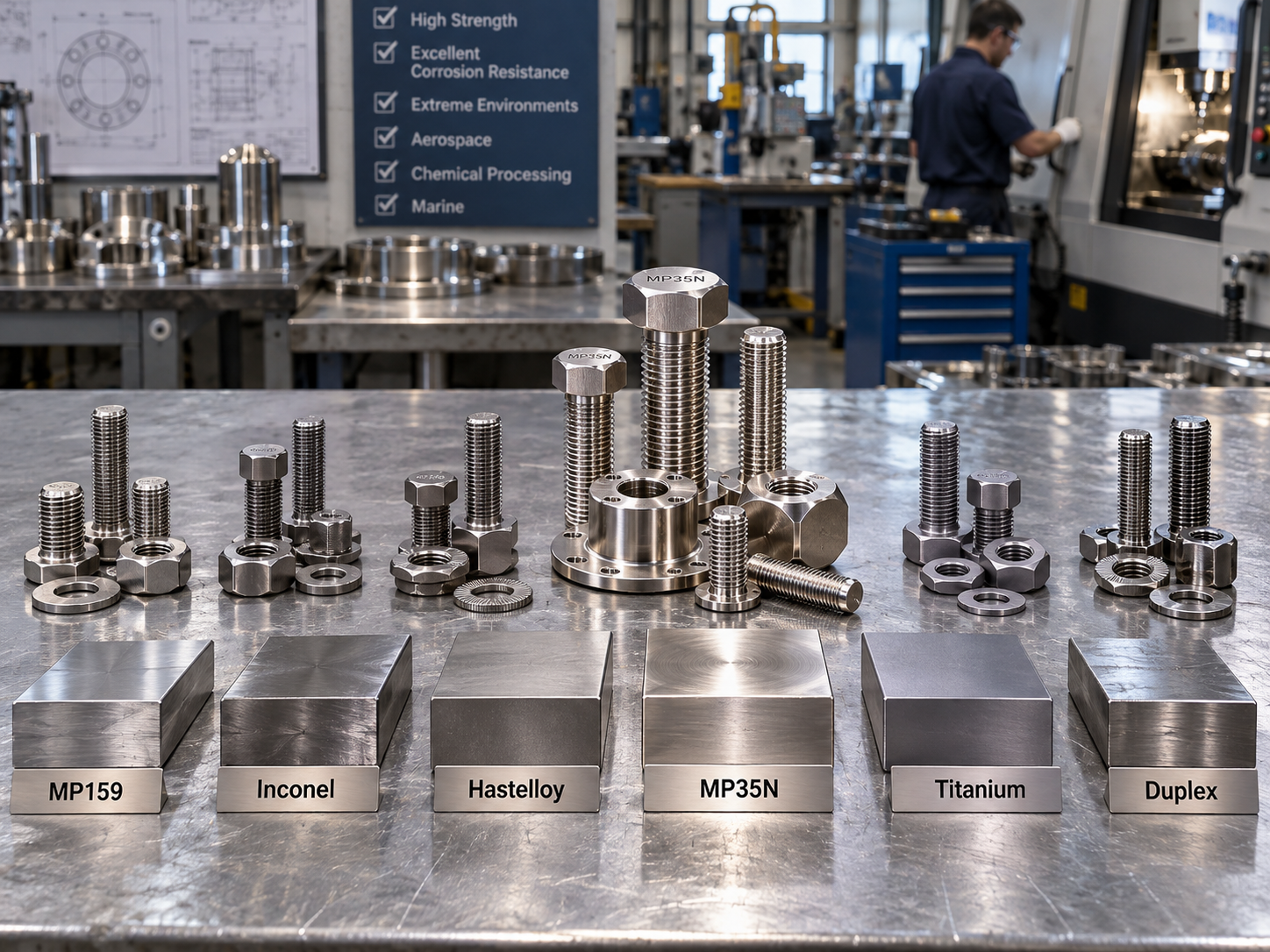
MP35N vs Inconel 718 vs Monel K500 Fasteners: Selecting the Ultimate Alloy for Extreme Strength and Corrosion
In the most critical bolting applications—deepwater HPHT wellheads, sour gas downhole tools, military submarine components—three alloys repeatedly emerge as the final contenders: MP35N, Inconel 718, and Monel K500. Each represents the pinnacle of high‑strength corrosion‑resistant fastener technology, yet they are metallurgically distinct and cannot be interchanged without risk. RAYCHIN LIMITED, a specialist manufacturer of all three alloy families, presents this definitive technical comparison to guide engineers toward the optimal choice for extreme environments.
1. Chemical Composition and Strengthening Mechanisms: Fundamentally Different Philosophies
The three alloys achieve their properties through entirely different metallurgical paths. Understanding these differences is essential to predicting in‑service behavior.
MP35N relies on extreme cold drawing (often 50–60% reduction) to create a heavily dislocated, multiphase microstructure, followed by aging to precipitate fine phases that pin dislocations. This yields the highest tensile strength of any corrosion‑resistant fastener alloy. Inconel 718 achieves its strength through a controlled solution‑anneal‑and‑age cycle, forming gamma‑double‑prime precipitates. Monel K500 is strengthened by gamma‑prime (Ni₃Al,Ti) in a Ni‑Cu matrix, giving it the lowest strength of the three but excellent seawater corrosion resistance.
2. Mechanical Properties: The Strength Hierarchy
For fasteners, the hierarchy is clear: MP35N > Inconel 718 > Monel K500 in terms of ultimate tensile and yield strength. The table below uses typical values for high‑strength fastener conditions.
*MP35N retains excellent toughness up to ~500°C; above this, cobalt‑based diffusion can embrittle grain boundaries. Inconel 718 is the clear choice for sustained elevated temperature strength.
3. Corrosion Resistance Spectrum: Each Alloy Has a Niche
This is where material selection becomes highly application‑specific.
- MP35N – Offers near‑immunity to chloride stress corrosion cracking, outstanding resistance to H₂S, and excellent crevice corrosion resistance in seawater. It is the gold standard for NACE MR0175 Level VII sour service where both extreme strength and corrosion resistance are required. In hot, sour, high‑pressure gas wells, MP35N is frequently the only alloy that meets all requirements simultaneously.
- Inconel 718 – Resists chloride SCC well and can operate in sour service up to NACE Level VII, but only if hardness is strictly controlled (≤40 HRC) and the microstructure is free from continuous δ‑phase. Its high‑temperature oxidation resistance is superior to MP35N.
- Monel K500 – Excels in seawater, hydrofluoric acid, and caustic environments. It is non‑magnetic and has excellent resistance to flowing seawater impingement. However, it can be susceptible to stress corrosion cracking in sour H₂S environments and is not recommended for NACE sour service.
4. Application Matrix: Where Each Alloy Wins
5. Consequences of Incorrect Material Selection
We at RAYCHIN have witnessed and investigated costly failures resulting from alloy misapplication:
- Substituting Inconel 718 for MP35N in a NACE VII sour wellhead: If 718 hardness exceeds 40 HRC or the heat treatment is not optimized, sulfide stress cracking can occur within hours, leading to catastrophic blowout risk.
- Using Monel K500 in a sour gas environment: K500 is not NACE qualified; SCC can initiate rapidly in H₂S‑containing brines.
- Specifying MP35N for a 650°C gas turbine: While MP35N has high room‑temperature strength, prolonged exposure above 500°C can embrittle the material, leading to unexpected brittle fracture.
Each alloy has a defined operating envelope; venturing outside it without validation invites failure.
6. Cost and Availability Considerations
The price hierarchy is MP35N > Inconel 718 > Monel K500. MP35N can be 2–3 times the cost of Inconel 718 and 5–8 times Monel K500. However, lifecycle costing in critical applications often reverses the apparent economics. A single failed fastener in a subsea tree can incur millions in intervention costs. RAYCHIN maintains inventory of all three alloy bar stocks and provides fast turnaround on custom fasteners, helping clients optimize both performance and project budgets.
7. Why RAYCHIN is the Trusted Partner for Extreme‑Alloy Fasteners
RAYCHIN LIMITED is one of the few global manufacturers who produce MP35N, Inconel 718, and Monel K500 fasteners concurrently under the same quality management system. This gives us a unique, holistic perspective:
- Unbiased selection advice – we don't push one alloy over another; we engineer the right solution for your specific environment.
- Complete in‑house testing – PMI, tensile (ambient and elevated), Charpy, hardness, and NACE TM0177 when required.
- Full certifications – EN 10204 3.1/3.2, NORSOK M‑650, API 6A, and PED 4.3.
- Custom manufacturing – precision‑rolled threads, anti‑galling coatings (WS₂, silver), and custom geometries per your engineering drawing.
Send your completion fluid chemistry, downhole temperature, pressure, and NACE requirements to our metallurgy team. We'll return a detailed material recommendation and competitive quotation within 24 hours.
✉️ sales@ray-chin.com? www.ray-chin.com | MP35N · Inconel 718 · Monel K500 Expert · Global Supply
Request A Quote! We'll respond as soon as possible(within 12 hours)
Get a Quote