
Categories List
Recent Posts
Nimonic vs Inconel, Waspaloy, A286 & Stainless Steel: The Ultimate High‑Temperature Fastener Showdown
At the upper limits of temperature—where stainless steel and even some nickel alloys have long since lost their strength—a select group of materials remains viable. Nimonic 80A and Nimonic 90 are among the premier choices for bolting at extreme temperatures, but how do they compare to Inconel 718, Waspaloy, A286, Inconel X‑750, and Inconel 625? The answer depends on the specific temperature, load, and corrosion requirements of your application. RAYCHIN LIMITED, as a specialist global manufacturer of all these high‑temperature alloys with decades of in‑house experience, presents this comprehensive comparison to guide you to the right material choice.
1. Nimonic 80A vs Inconel 718 Fasteners
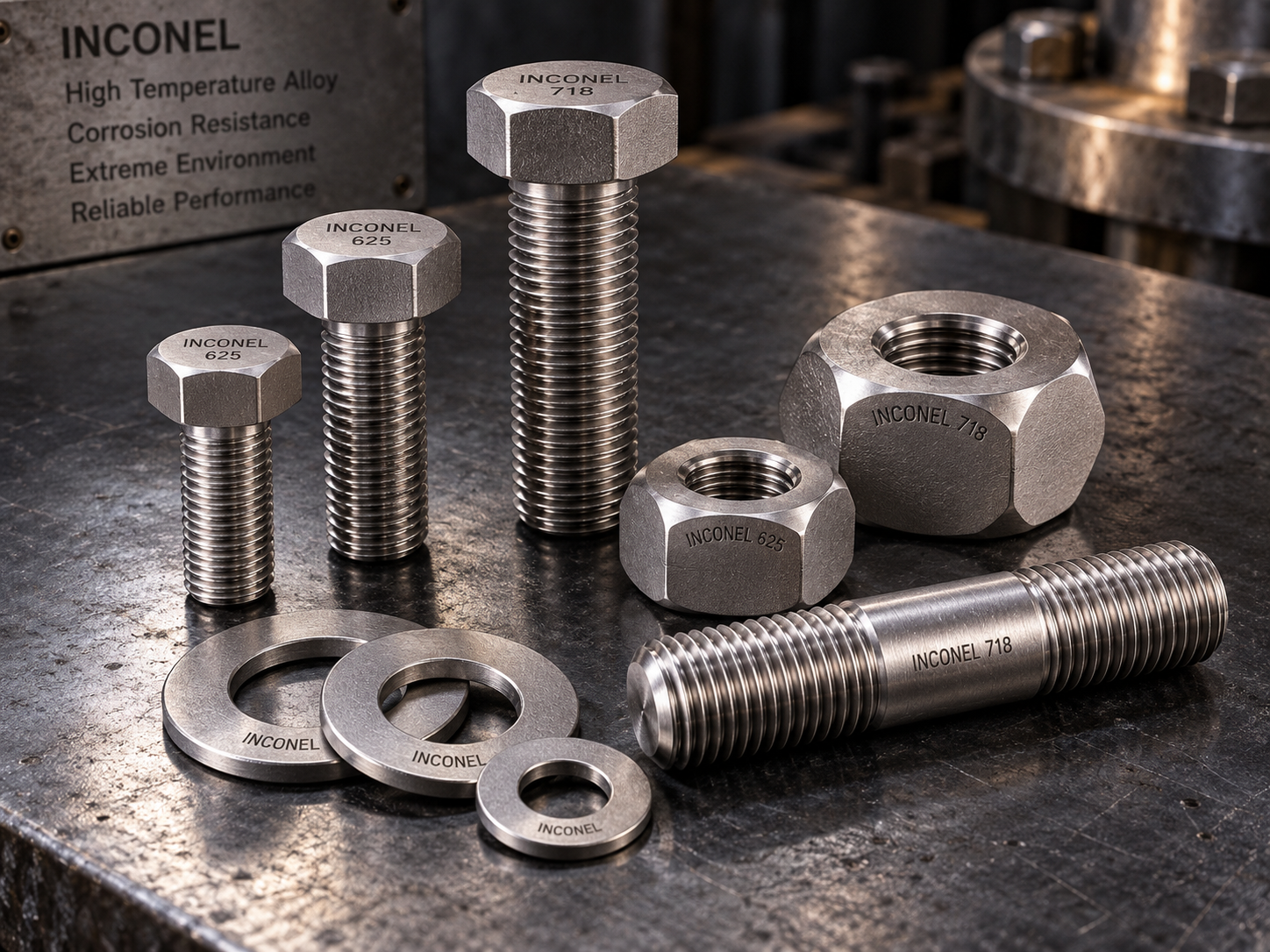
Nimonic 80A vs Inconel 718 fasteners is the most common crossroads for high‑temperature bolting. Both are precipitation‑hardened nickel alloys, but their strengthening mechanisms and temperature capabilities differ significantly.
- Inconel 718 offers a higher room‑temperature yield strength (150 ksi / 1034 MPa min) and is the industry workhorse for bolting up to 704°C (1300°F). Its gamma‑double‑prime strengthening phase, however, over‑ages and dissolves above about 650°C, causing a steep strength decline.
- Nimonic 80A has a lower room‑temperature yield strength (90 ksi / 620 MPa) but maintains its strength to much higher temperatures—up to 815°C (1500°F)—owing to its stable gamma‑prime precipitates. Its creep‑rupture life at 700–800°C is significantly better.
When to use Nimonic instead of Inconel: Upgrade to Nimonic 80A or 90 when the service temperature consistently exceeds 700°C, or when creep and stress‑rupture resistance are the primary design drivers—exhaust valves, turbocharger turbine sections, and high‑temperature furnace bolting. For applications below 650°C with high tensile demands, Inconel 718 remains the more cost‑effective choice.
2. Nimonic 90 vs Inconel 718 Bolts
Nimonic 90 vs Inconel 718 bolts extends the comparison further. Nimonic 90's additional cobalt content (15–21%) raises its gamma‑prime solvus temperature, allowing it to operate to 870°C (1600°F). Its tensile strength is approximately 180 ksi (1240 MPa) at room temperature—comparable to 718—but its strength advantage widens dramatically as temperature climbs. Nimonic 90 is the material of choice for gas turbine disc bolts, afterburner fasteners, and the hottest aerospace engine connections, where 718 would quickly lose temper and fail.
3. Nimonic vs Waspaloy Fasteners
Waspaloy and Nimonic 90 are close competitors. Both are gamma‑prime‑strengthened nickel‑base superalloys with similar temperature limits (~870°C). Waspaloy is more commonly specified in US‑origin turbine designs, while Nimonic 90 appears more frequently in European programs. In practice, the two are often interchangeable. RAYCHIN manufactures both alloys and can supply whichever your OEM specification requires.
4. Nimonic 80A vs A286 Bolts
A286 is an iron‑based superalloy with a practical temperature limit of about 650°C. While it is an excellent cost‑effective choice for automotive exhaust and turbocharger fasteners, it cannot match Nimonic 80A's high‑temperature capability. Nimonic 80A vs A286 bolts: A286 is selected for the 500–650°C range; above 650°C, Nimonic 80A or 90 is required. RAYCHIN frequently supplies both alloys to the automotive and aerospace sectors, respectively.
5. Nimonic vs Inconel X‑750
Inconel X‑750 (UNS N07750) is another gamma‑prime‑strengthened nickel alloy, frequently used for high‑temperature springs and bolting up to about 870°C. Its strength is comparable to Nimonic 80A, but Nimonic 90 generally offers superior creep‑rupture life at the highest temperatures. For nuclear reactor internals, both alloys are specified; RAYCHIN can advise on the optimal choice based on your service conditions and required specifications.
6. Nimonic 90 vs Inconel 625
Inconel 625 is solid‑solution strengthened—it cannot be hardened by heat treatment and therefore has a significantly lower yield strength (60–100 ksi) than Nimonic 90 (115 ksi). While 625 offers outstanding oxidation resistance to 982°C and excellent seawater corrosion resistance, it is not a substitute for Nimonic 90 where high mechanical loads are present at temperature. Use Inconel 625 for corrosion‑dominated applications with moderate loads; use Nimonic 90 for load‑bearing hot‑section fasteners.
7. Nimonic vs Stainless Steel High Temperature Bolts
Standard austenitic stainless steels (304, 316) and even precipitation‑hardened 17‑4 PH cannot approach the high‑temperature performance of Nimonic alloys. Stainless steels lose strength rapidly above 400–500°C and are susceptible to creep and oxidation. Nimonic alloys are designed specifically to resist these degradation mechanisms at 700–1000°C. For any exhaust, turbine, or furnace bolting above 600°C, Nimonic or another nickel‑base superalloy is mandatory.
8. Nimonic 80A vs Nimonic 90 Fasteners
The difference between Nimonic 80A and 90 lies in cobalt content and high‑temperature capability. Nimonic 90 contains substantially more cobalt (15–21% vs. ≤2%), which stabilizes the gamma‑prime precipitate to higher temperatures. As a result, Nimonic 90 provides about 55°C (100°F) higher service capability and superior creep‑rupture strength. In practice:
- Choose Nimonic 80A for exhaust valves, steam turbine bolting, and furnace hardware up to 815°C.
- Choose Nimonic 90 for gas turbine disc bolts, afterburner fasteners, and applications requiring maximum creep resistance at 815–870°C.
9. Best Alloy for High Temperature Exhaust Bolts — Decision Matrix
10. RAYCHIN's Multi‑Alloy Manufacturing and Application Support
RAYCHIN LIMITED is uniquely positioned to provide unbiased material selection guidance and certified fasteners across the entire high‑temperature alloy spectrum. Our in‑house manufacturing, vacuum heat treatment, and complete mechanical testing—including elevated‑temperature tensile and stress‑rupture—ensure that every fastener we deliver meets the exact properties required for your most demanding applications.
Send your operating temperature, stress, and environmental requirements to our technical team. We'll provide an unbiased alloy recommendation and competitive quotation within 24 hours.
✉️ sales@ray-chin.com? www.ray-chin.com | Nimonic · Inconel · Waspaloy · A286 · Global Supply
Request A Quote! We'll respond as soon as possible(within 12 hours)
Get a Quote