
Molybdenum Lock Nuts
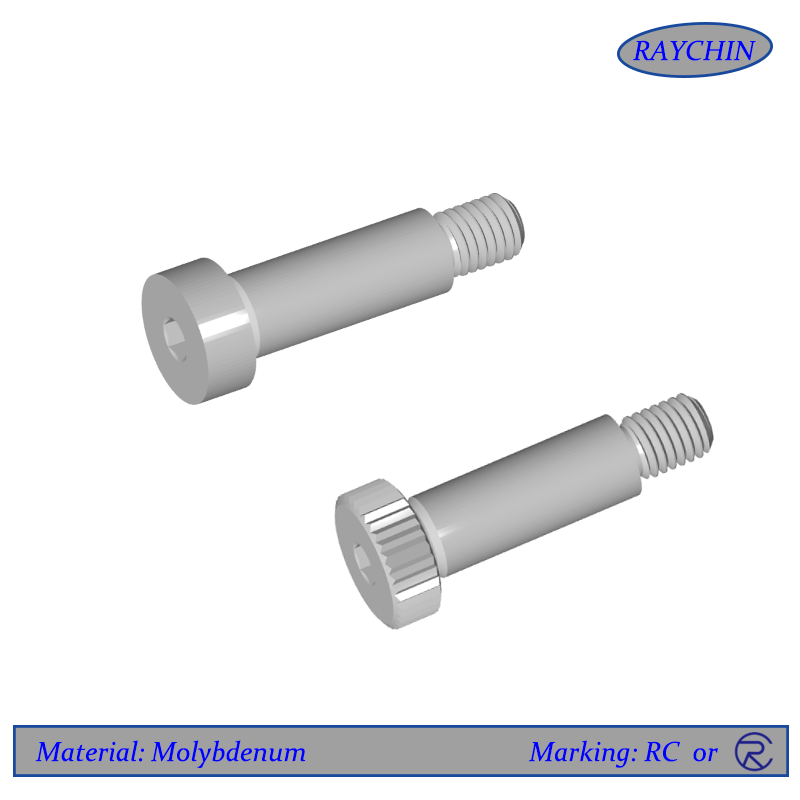
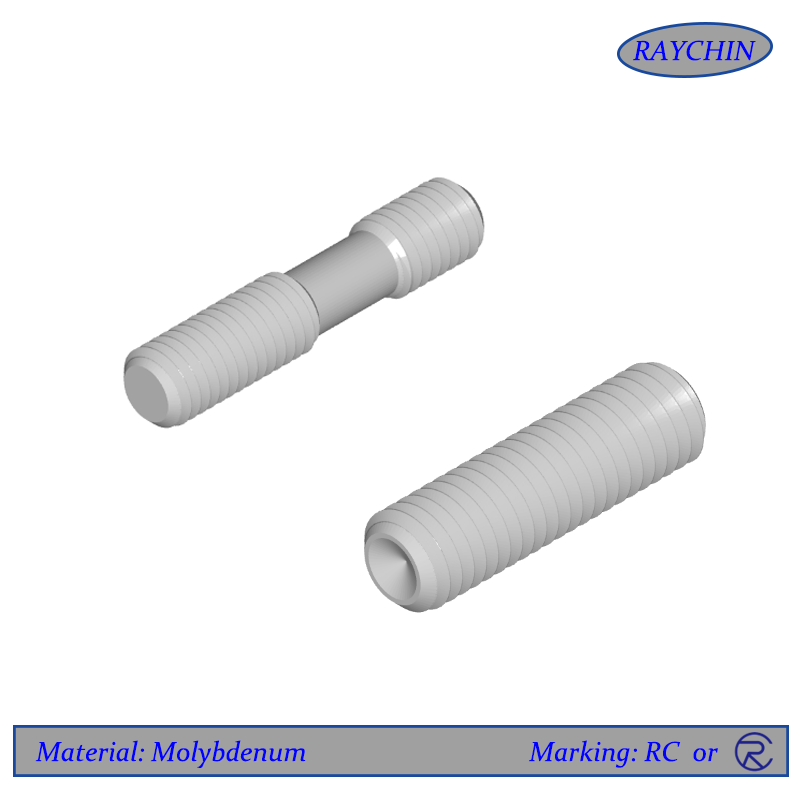
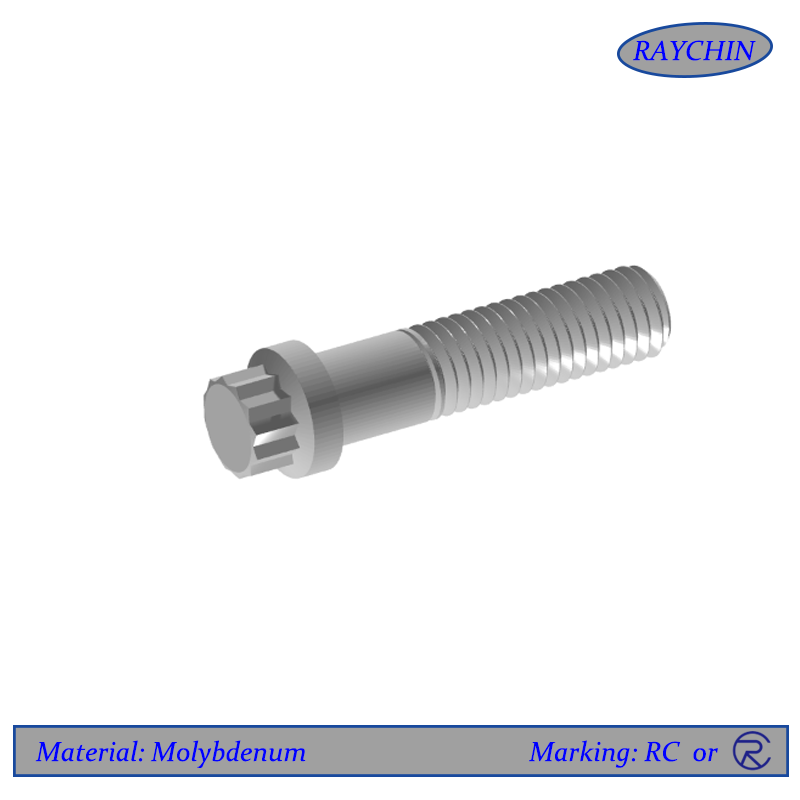
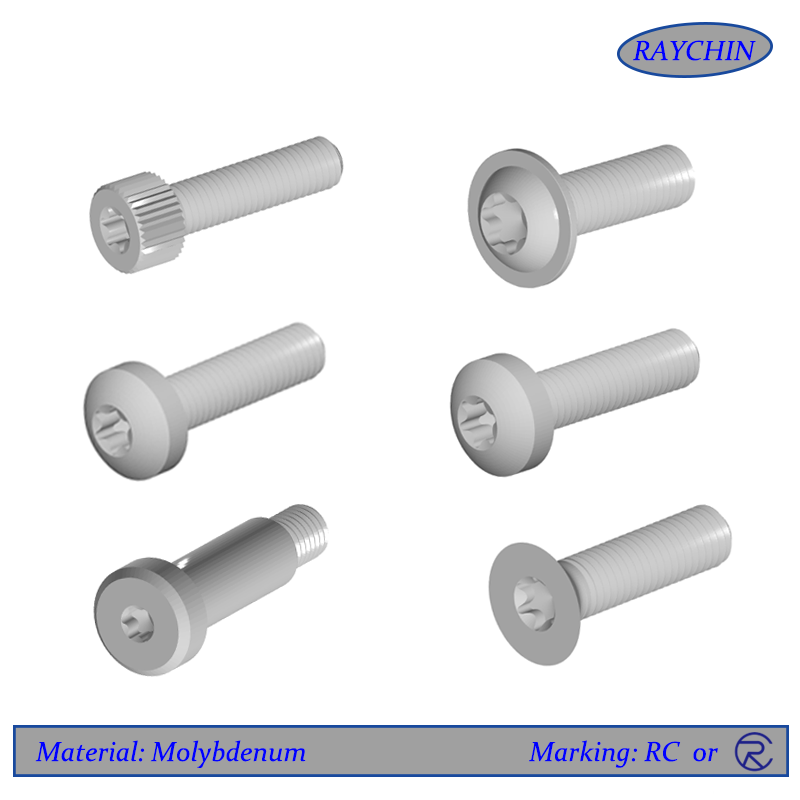
RAYCHIN SPECIALTY METALS FASTENERS: BOLTS, NUTS, SCREWS, WASHERS, STUDS, THREADED RODS, U-BOLT, J-BOLTS
STANDARD AND CUSTOMIZED, SMALL BATCH AND LARGE BATCH, IMPERIAL AND METRIC
Molybdenum lock nuts find their way into high temperature vacuum furnaces, glass production, military and space applications where oxygen is not present.
Extreme high temperature stability & strength
Maintains strength at elevated temperatures
Low distortion at high temperature
Molybdenum must be used in vacuum or inert gas at high temperatures
Request a Quote from RAYCHIN
We're here to help!
RAYCHIN LIMITED
Molybdenum Lock Nuts · Flexloc / Nylon Insert / Prevailing Torque · Inch & Metric · Pure Mo / TZM / MoLaMolybdenum Lock Nuts: Ultra-High Purity Refractory Metal Locknuts for Extreme Temperature Environments
RAYCHIN LIMITED is a leading manufacturer of Molybdenum Lock Nuts – precision threaded fasteners produced from refractory molybdenum and its alloys, delivering exceptional high-temperature strength, thermal stability, and corrosion resistance in extreme environments. Molybdenum lock nuts possess a very high melting point of 2620°C, a low coefficient of thermal expansion and a high level of thermal conductivity . Because molybdenum nuts have the ability to withstand extremely high temperatures without changing shape, expanding or softening significantly, they are ideal for high strength / high temperature applications that are shielded from oxygen . Our comprehensive product line includes molybdenum flexloc lock nuts (all-metal), molybdenum polymer insert lock nuts, and prevailing torque lock nuts – all manufactured to the highest precision standards. Available grades include Pure Molybdenum (≥99.95%), TZM alloy (Mo-0.5Ti-0.08Zr-0.02C), and Molybdenum Lanthanum (MoLa) with enhanced recrystallization temperature . Our portfolio includes all standard and custom configurations manufactured to NAS, AN, MS, ANSI, ASTM, ASME, SAE, API, NACE, ISO, DIN and KS standards, including ASTM B386/B387, ASTM B384/B385, and UNS R03630 . Whether you require molybdenum lock nuts for high-temperature vacuum furnaces, semiconductor sputtering equipment, sapphire crystal growth systems, or aerospace propulsion components, RAYCHIN delivers precision, quality, and full traceability. All mechanical properties are presented in MPa and ksi (kilopound per square inch).
Molybdenum Lock Nuts – Design & Configurations
All-Metal Flexloc Lock Nuts
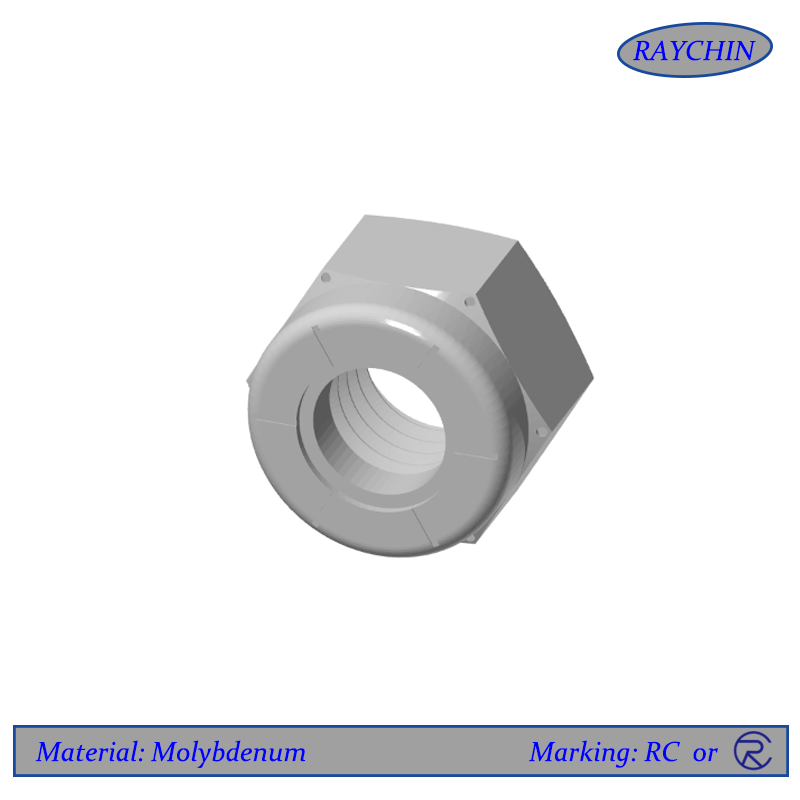
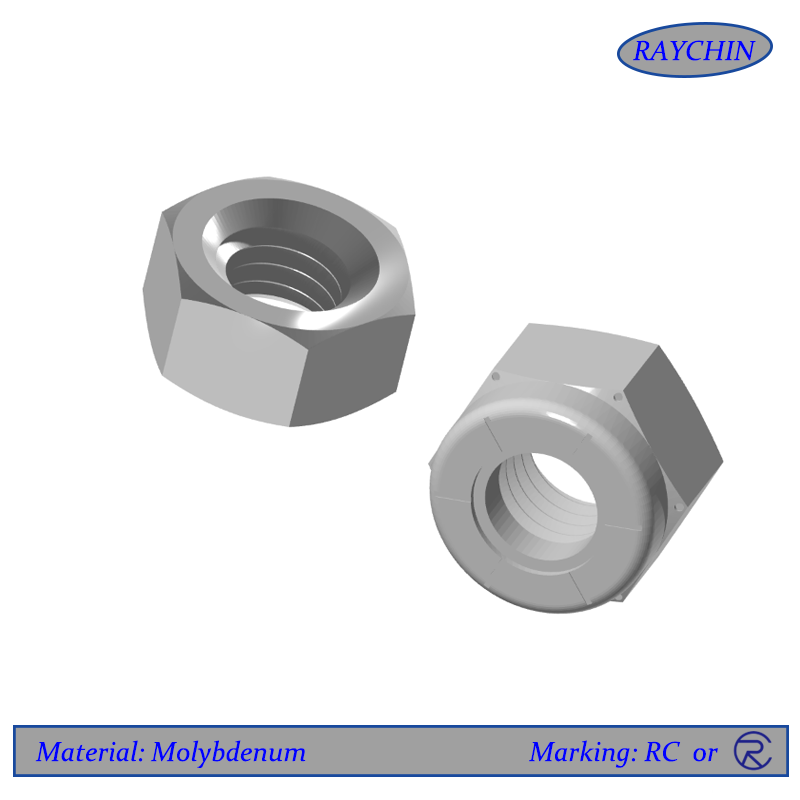
Molybdenum flexloc lock nuts are all-metal in composition with a segmented collar that creates six "locking fingers" that act as a spring . This design provides prevailing torque to prevent loosening under extreme thermal cycling and vibration. Can be used at high temperatures up to the limits of molybdenum. Distributes load evenly due to one-piece construction. One of the only all-metal lock nuts certified to 15 cycles of prevailing torque – which is military standard . Best for high temperature or corrosive applications in vacuum or inert atmospheres. Available in hexagonal and 12-point configurations .
Polymer Insert Lock Nuts
Molybdenum polymer insert lock nuts (often referred to as nylon insert locknuts) feature a polymer ring that deforms elastically when the nut is tightened, providing prevailing torque . Various high-performance polymers available including Nylon (standard), Vespel, and PVDF for higher temperature or corrosive applications . Overall the most reliable locknut style, with the only limitation being application temperature. Best for low temp applications, typically less than 350°F for standard nylon, but high-performance polymers extend range. Excellent reusability – can reliably be re-used 15 times . Eliminates galling and cold-welding common with refractory alloys .
Prevailing Torque Design
Molybdenum prevailing torque lock nuts feature a prevailing torque feature which deforms elastically, preventing them from freely spinning like a standard nut . This creates frictional resistance against the bolt threads, ensuring the nut remains securely fastened under vibration and dynamic loads. Available in both all-metal and polymer insert styles. The two most common and reliable forms of prevailing torque locknuts are the flexloc style and the polymer insert lock nut . Other all-metal styles include stover and elliptical lock nuts, though flexloc offers superior reliability .
Hexagonal & 12-Point Configurations
Molybdenum lock nuts are available in both hexagonal and 12-point configurations . Hexagonal lock nuts are standard for general high-temperature applications, providing easy installation with standard wrenches. 12-point lock nuts offer higher torque capability and are commonly used in aerospace and defense applications where compact design and increased wrench engagement are required. Both configurations available in all-metal flexloc and polymer insert styles.
Alloy Grades: TZM & MoLa
TZM alloy lock nuts (Mo-0.5Ti-0.08Zr-0.02C, UNS R03630) offer higher recrystallization temperature (~1400°C), improved strength, and creep resistance compared to pure Mo . TZM is excellent for support structures in vacuum furnaces or other high temperature and oxygen free environments . MoLa alloy lock nuts (Mo doped with La₂O₃) exhibit enhanced ductility and high-temperature stability. Both alloys available for applications exceeding 1400°C in vacuum or reducing atmospheres .
Custom & Non-Standard Lock Nuts
Need special thread sizes, non‑standard heights, proprietary locking features, or unique drive configurations? RAYCHIN engineers design and produce custom molybdenum lock nuts to your exact specifications – any grade (pure Mo, TZM, MoLa), any condition (stress relieved, recrystallized), with full material traceability. Prototype to production volumes supported. In-house metallurgical laboratory and failure analysis capabilities ensure optimal performance for your application . Cleanroom wash and packaging available for sensitive applications .
Critical Applications of Molybdenum Lock Nuts
High-Temperature Vacuum Furnaces
Molybdenum lock nuts are essential in vacuum furnace construction, including hot zones, heating element supports, heat shields, and hearth assemblies. They maintain structural integrity at temperatures exceeding 1700°C (3090°F) in vacuum or inert gas environments where superalloys fail . Used in sintering furnaces, brazing furnaces, and annealing furnaces. All-metal flexloc style provides reliable prevailing torque under extreme thermal cycling without outgassing .
Semiconductor & Sputtering Equipment
Molybdenum lock nuts in semiconductor manufacturing equipment, including sputtering targets, PVD chambers, ion implanters, and wafer processing systems. The interior of semiconductor equipment may reach high temperatures of 500° to 1000°C in ion generators, light sources, and processing chambers. Molybdenum's low coefficient of thermal expansion, high thermal conductivity, and non-contaminating properties (no outgassing) make it ideal for ultra-high-vacuum (UHV) environments . Essential for securing electrodes, shields, and process kits. Polymer insert lock nuts with high-performance polymers (Vespel, PVDF) available for moderate temperature applications .
Aerospace & Defense
Molybdenum lock nuts in rocket engine components, nozzle assemblies, re-entry vehicle heat shields, and supersonic aircraft skin elements. Molybdenum alloys maintain strength at extreme temperatures where other metals would soften or melt . Used in thrust vector control systems and high-temperature structural joints. Prevailing torque design prevents loosening under extreme vibration during launch and re-entry. Flexloc lock nuts certified to 15 cycles of prevailing torque per military standards .
Nuclear Engineering
Molybdenum lock nuts in nuclear reactors, particle accelerators, and experimental fusion devices. Molybdenum exhibits excellent resistance to radiation damage and retains mechanical properties under neutron irradiation . Used for fuel cladding supports, control rod mechanisms, and plasma-facing component fasteners. Resists corrosion by liquid metal coolants (lithium, sodium, potassium). All-metal design ensures no polymer degradation under radiation .
Sapphire Crystal Growth & Glass Melting
Molybdenum lock nuts used in sapphire crystal growth furnaces (Kyropoulos, Czochralski) and glass melting electrodes. Molybdenum withstands molten glass corrosion and extreme temperatures required for LED sapphire substrate production . Lock nuts secure crucible assemblies, heat shields, and electrode holders in aggressive molten environments. Flexloc design maintains preload under thermal cycling without loosening .
Military & Space Applications
Molybdenum lock nuts find their way into high temperature vacuum furnaces, glass production, military and space applications where oxygen is not present . Their ability to withstand extreme temperatures without significant softening or expansion makes them ideal for satellite components, missile guidance systems, and other defense applications requiring absolute reliability in oxygen-free environments .
International Standards & Global Designations – Molybdenum Lock Nuts
RAYCHIN LIMITED manufactures molybdenum lock nuts from vacuum arc melted (VAR) or powder metallurgy (PM) material conforming to the most widely used national and international specifications. All material is traceable to the mill .
Chemical Composition (Weight %) – Molybdenum Alloys for Lock Nuts
Our molybdenum lock nuts are produced from vacuum arc melted (VAR) or powder metallurgy (PM) material conforming to ASTM B386/B387 and industry standards .
Pure Molybdenum (Grade 360 / 361) – Mo ≥99.95%
TZM Alloy (Grade 363 / 364) – Mo-0.5Ti-0.08Zr-0.02C
MoLa Alloy (Mo with Lanthanum Oxide)
Metallurgical note: Molybdenum is a refractory metal with a body-centered cubic (BCC) crystal structure . Pure molybdenum lock nuts are typically supplied in stress-relieved condition (recrystallization temperature ~1100°C). TZM alloy offers significantly higher recrystallization temperature (~1400°C) and improved creep strength through carbide dispersion strengthening . MoLa (lanthanated molybdenum) maintains ductility after high-temperature exposure due to oxide dispersion pinning grain boundaries . All molybdenum lock nuts must be used in vacuum, inert gas, or reducing atmospheres above 600°C to prevent catastrophic oxidation .
Complete Mechanical & Physical Properties – Molybdenum Lock Nuts (MPa / ksi)
Molybdenum lock nuts are supplied in various conditions (hard/stress relieved, soft/annealed) per ASTM B387. Data represent typical values based on industry standards and are compared with SUS304 stainless steel for reference .
Mechanical Properties – Pure Molybdenum vs. SUS304
Mechanical Properties – TZM Alloy Lock Nuts
Physical Properties – Molybdenum
High‑Temperature Performance of Molybdenum Lock Nuts
Molybdenum and its alloys are renowned for exceptional high-temperature strength and stability. Pure molybdenum maintains useful mechanical properties up to 1700°C (3090°F) in vacuum or reducing atmospheres, with TZM extending capability further through carbide strengthening . Molybdenum has a melting point of 2620°C (4760°F), a low coefficient of thermal expansion and a high level of thermal conductivity . Because molybdenum lock nuts have the ability to withstand extremely high temperatures without changing shape, expanding or softening significantly, they are ideal for high strength / high temperature applications that are shielded from oxygen . However, exposing molybdenum lock nuts to oxygen above 600°C will cause them to readily oxidize, limiting use to vacuum, inert gas, or reducing atmospheres unless protected by coatings .
Elevated Temperature Capabilities
Molybdenum lock nuts support use with vacuum equipment in high-temperature environments. In oxidizing atmospheres above 600°C, rapid oxidation will occur; use is therefore recommended only in vacuum, inert gas, or reducing atmospheres . For air applications, protective coatings (MoSi₂, Al₂O₃, Y₂O₃) may be applied.
Corrosion Resistance of Molybdenum Lock Nuts
Molybdenum exhibits excellent resistance to many corrosive media, particularly in reducing environments and in the absence of oxidizing agents. It has considerably higher corrosion resistance than tungsten in high-temperature water environments .
- High-Temperature Water Corrosion: Mo shows a considerably higher corrosion resistance than W . At 180°C, corrosion rates are 0.022-0.029 mm/year for Mo . At 260°C, corrosion rates are 0.141-0.214 mm/year . At 320°C, significant attack occurs depending on the material . Mo–Re alloys may corrode more severely, with Mo–17.7%Re reaching 0.405 mm/year at 320°C .
- Oxidation Resistance: Molybdenum must be protected by a suitable coating to withstand temperatures above 500°C under an oxidizing environment . Exposing molybdenum to oxygen above 600°C will cause them to readily oxidize .
- Acid Resistance: Molybdenum is not resistant to acids . It has high solubility in concentrated sulphuric acid and nitric acid.
- Liquid Metals: Excellent resistance to liquid lithium, sodium, potassium, and bismuth, making it valuable in nuclear coolant systems.
- Hydrogen: Excellent resistance to hydrogen attack even at high temperatures.
- Glass Corrosion: Outstanding resistance to molten glass, widely used in glass melting electrodes and stirrers .
- Low Vapor Pressure: Excellent low vapor pressure at high temperatures, making it ideal for vacuum applications .
Manufacturing Standards – Molybdenum Lock Nuts
All molybdenum lock nuts are manufactured and tested to meet the following standards:
We offer surface finishes: black (as-machined), chemical cleaned, ground, polished, and passivated. Special coatings (MoSi₂, Al₂O₃, Y₂O₃) available for oxidation protection. Cleanroom wash and cleanroom packaging available for semiconductor, medical, and aerospace applications – batch cleanroom packing provided for orders containing multiple items of the same size . Full traceability and destructive/non‑destructive testing available (UT, PMI, MPI). ISO 9001, AS9100D, ISO 13485 certified.
Why RAYCHIN LIMITED – The Molybdenum Lock Nut Authority
Contact the molybdenum lock nut experts
Request a quotation for molybdenum lock nuts, flexloc lock nuts, nylon insert lock nuts – any standard (ASME, ISO, NAS, MS) – any grade (Pure Mo, TZM, MoLa) – any condition (stress relieved, recrystallized), any quantity. Global delivery. Mechanical data in MPa/ksi available for all products.
sales@ray-chin.com | +86 534 2166 566Our team provides technical support in English, German, Mandarin, Japanese.
Request A Quote! We'll respond as soon as possible(within 12 hours)
 Molybdenum Fasteners
 Molybdenum Bolts
 Molybdenum Nuts
 Molybdenum Screws
 Molybdenum Washers
 Molybdenum Threaded Rods
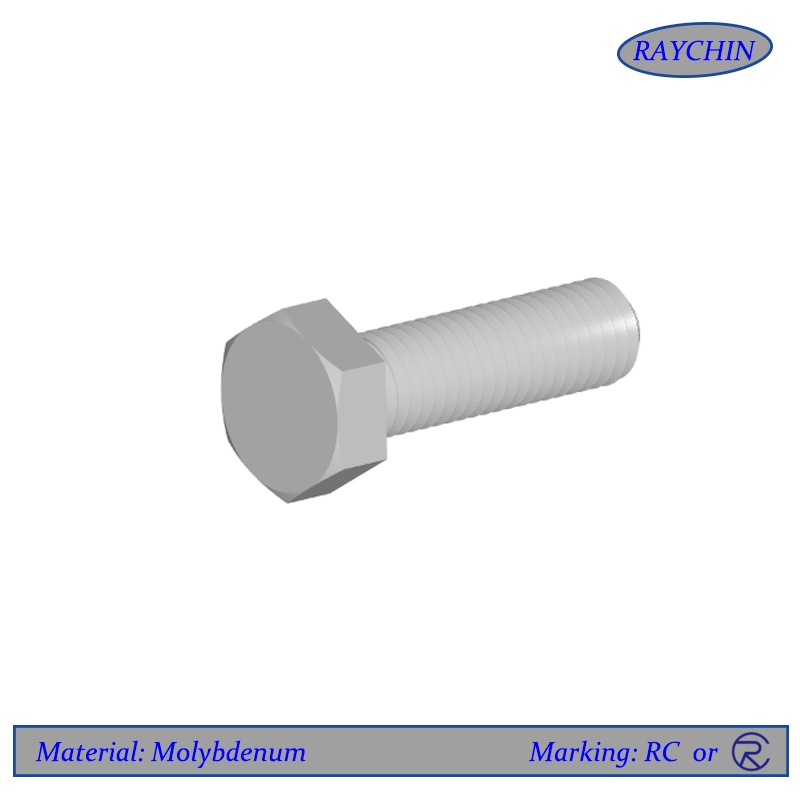
 Molybdenum Hex Bolts
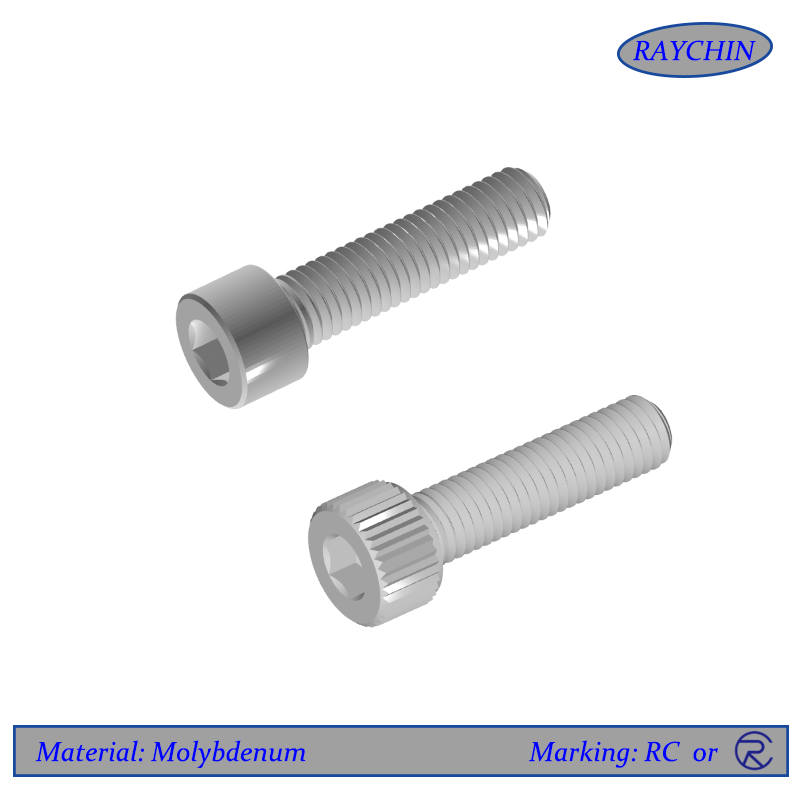
 Molybdenum Socket Head Cap Screws
 Molybdenum Hex Cap Screws
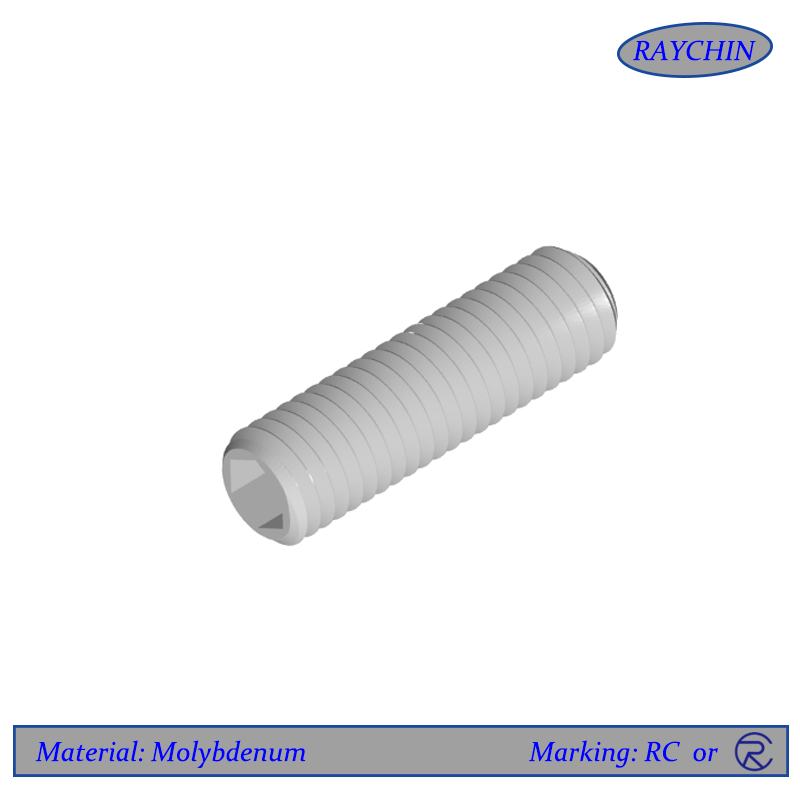
 Molybdenum Set Screws
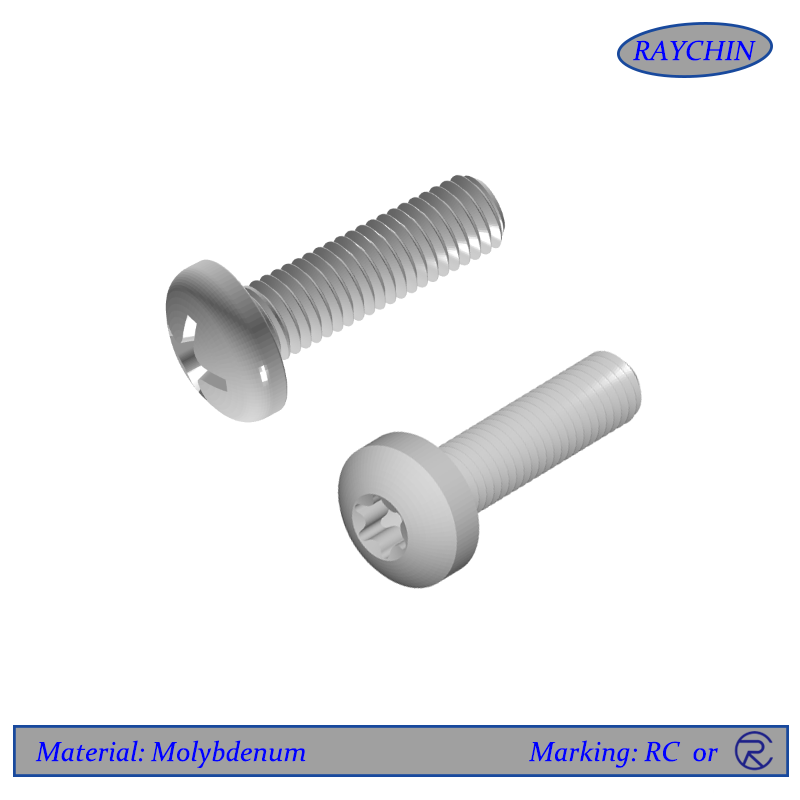
 Molybdenum Pan Head Screws
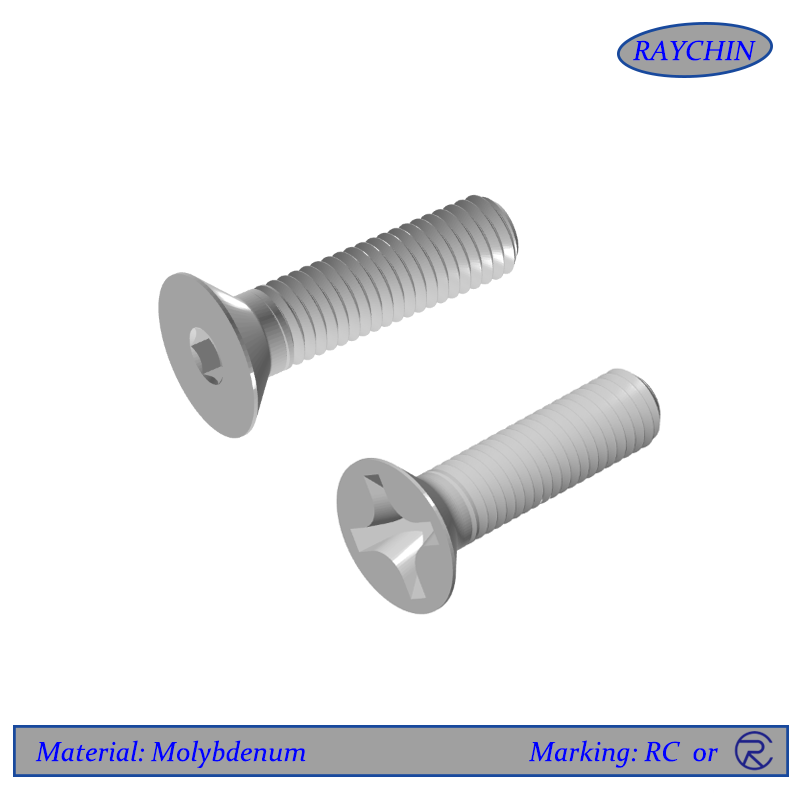
 Molybdenum Flat Head Screws
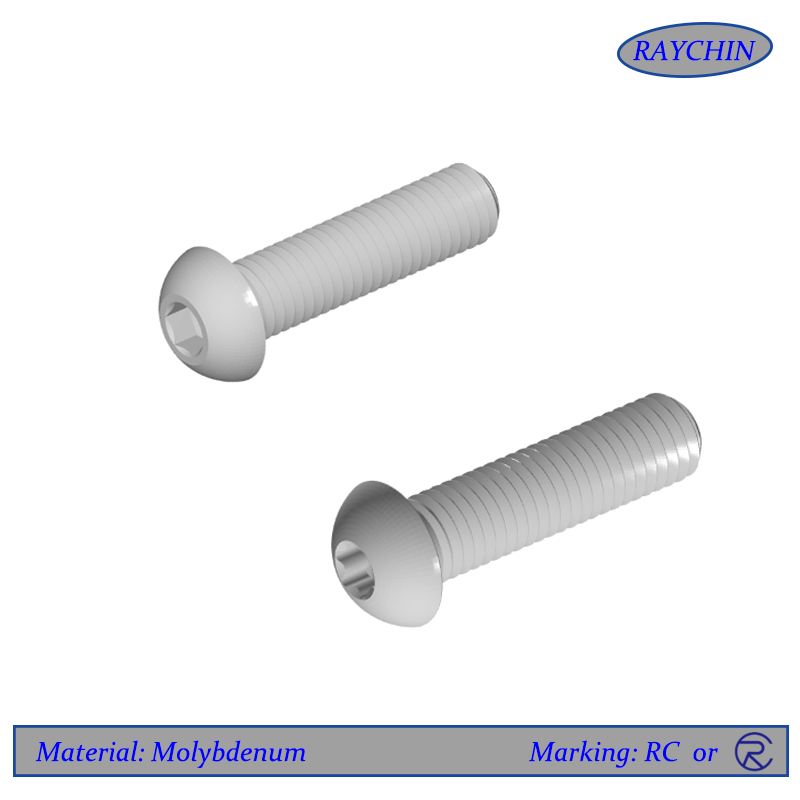
 Molybdenum Button Head Cap Screws
 Molybdenum Lock Nuts
 Molybdenum Shoulder Bolts
Get a Quote