
Categories List
Recent Posts
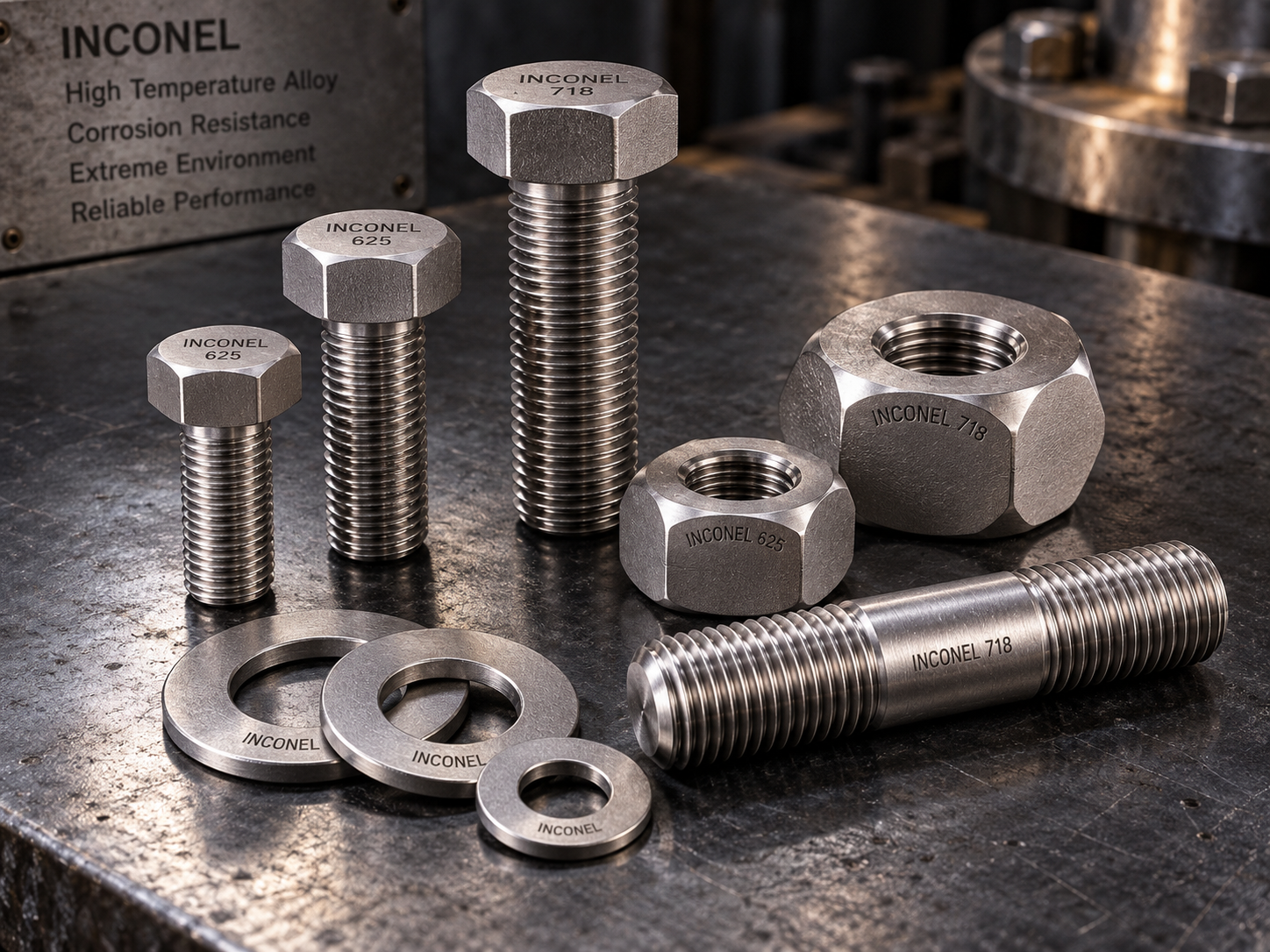
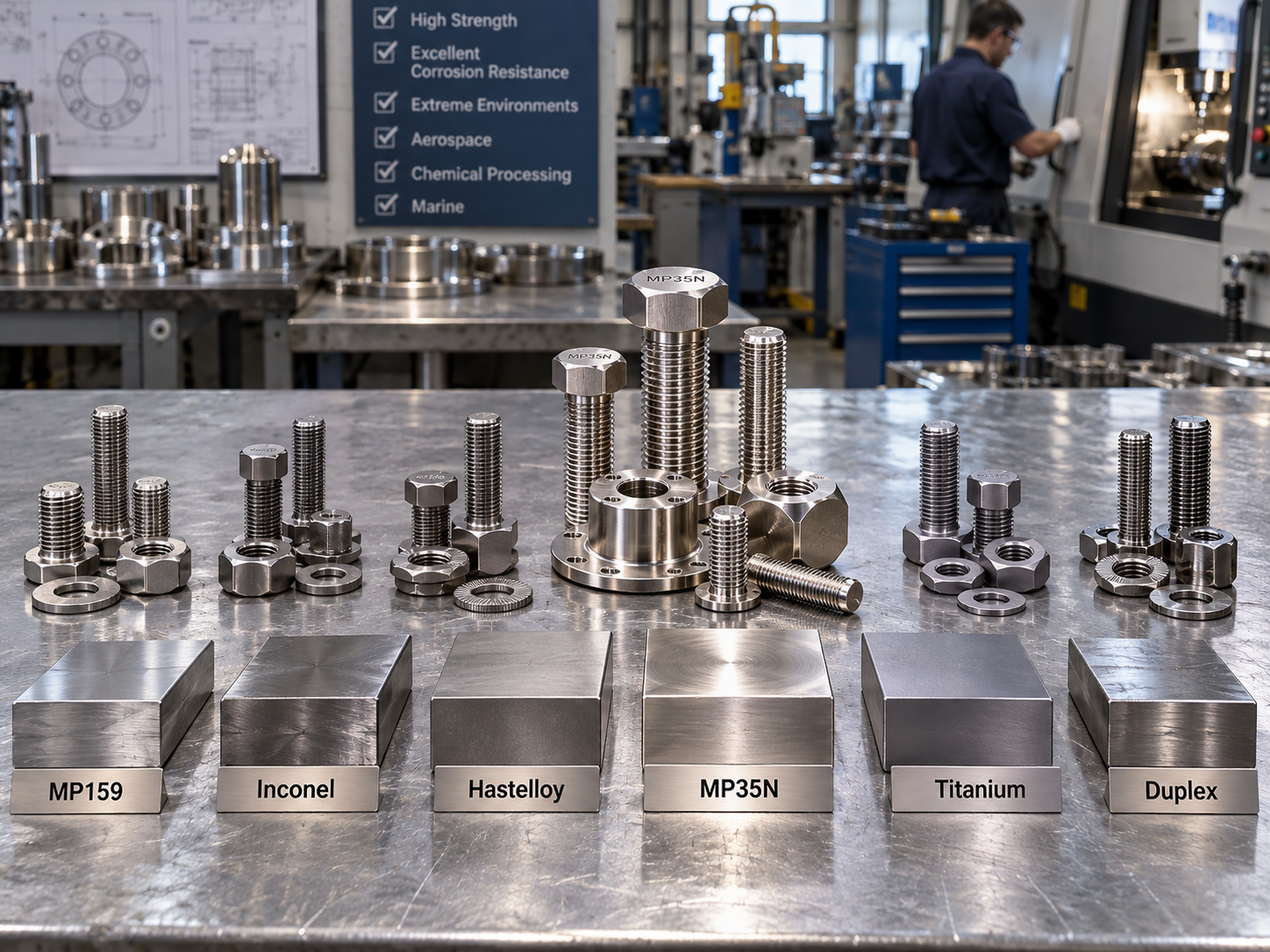
Expert technical resource from RAYCHIN LIMITED on Waspaloy bolts for gas turbines, aerospace assembly locations, service life comparison against Inconel fasteners, and strength retention at 700°C.
1. Waspaloy Bolts for Gas Turbines: Pushing the Limits of Heat Resistance
Waspaloy bolts are a key component in modern gas turbines, designed to maintain structural integrity at extreme temperatures. This nickel-based, age-hardenable superalloy retains useful strength at temperatures up to approximately 650°C (1200°F) for critical rotating components and up to roughly 870°C (1600°F) for less stressed parts. In gas turbine atmospheres, Waspaloy has demonstrated good performance due to its excellent resistance to high-temperature oxidation and corrosion, even under frequent thermal cycling.
The alloy’s ability to withstand aggressive environments — including sulfuric acid, nitric acid, hydrochloric acid, saltwater, and both oxidizing and reducing conditions — makes it particularly suitable for gas turbine applications. Typical engine components manufactured from Waspaloy include compressor and rotor discs, shafts, spacers, seals, rings and casings, as well as fasteners.
Creep and rupture resistance are key advantages: Waspaloy demonstrates superior creep resistance and longer stress rupture life under sustained high-temperature loading compared to Inconel 718. For fasteners operating in industrial power generation turbines and high-temperature reactors, this translates into reduced maintenance intervals and enhanced operational safety.
Thermal fatigue resistance ensures reliability under the frequent start-stop cycles common in gas turbine power plants. The alloy performs exceptionally well in applications with cyclic thermal loading where many conventional materials would fail prematurely.
RAYCHIN LIMITED leverages proprietary heat treatment protocols to optimize Waspaloy‘s gamma prime (γ’) precipitation strengthening, maximizing its high-temperature performance in every fastener batch.
2. Waspaloy Fasteners vs. Inconel: Which Delivers Longer Service Life?
When comparing Waspaloy and Inconel fasteners for high-temperature applications, the choice has a significant impact on service life and maintenance costs. Both are nickel-based superalloys, but their performance characteristics differ substantially in key areas that directly affect fastener longevity.
The fundamental distinction lies in their strengthening mechanisms and operational temperature limits:
Inconel 718 achieves high strength through γ″ (gamma double-prime) phase precipitation. This phase is stable and effective up to approximately 650°C (1200°F). Beyond this threshold, the γ″ phase transforms into the stable δ phase, which significantly reduces creep rupture life and overall mechanical performance. In contrast, Waspaloy relies on the more thermally stable γ′ (gamma prime) phase, which remains effective up to about 760°C (1400°F) and beyond.
Waspaloy Advantages for Longer Service Life:
Waspaloy’s fatigue life reaches 10⁶ cycles in high-temperature fatigue testing, significantly exceeding Inconel 718’s performance.
Waspaloy’s thermal expansion coefficient is approximately 12.5 ppm/°C in the 600°C–1000°C range, about 15% lower than Inconel 718. This reduces thermal stress accumulation during temperature cycling and extends bolt service life.
Under repeated high-temperature cycling, Waspaloy’s high-temperature strength stability is notably better than Inconel 718, which drops significantly under equivalent conditions.
When extended stress rupture life is critical — particularly in applications exceeding 1300°F (704°C) — Waspaloy bolts demonstrate a clear advantage. However, this comes with trade-offs: Inconel 718 generally offers better weldability and lower manufacturing complexity, making it a more cost-effective solution for applications operating below 650°C.
The table below summarizes the key comparison factors for service life evaluation:
Waspaloy strengths: High-temperature oxidation and hot corrosion resistance is optimized for sustained operation in combustion environments, whereas Inconel 718 focuses more on general corrosion resistance in aggressive chemical environments.
Inconel 718 strengths: Better weldability (Waspaloy requires post-weld heat treatment to restore properties) and lower production cost make Inconel 718 suitable for applications where temperatures remain within its operational limits.
3. Waspaloy Bolts in Aerospace Assembly: Where They Belong
Waspaloy fasteners are not general-purpose components — they are specifically designated for locations where failure would have catastrophic consequences. In the aerospace industry, these critical assembly positions include:
Jet Engine Hot Sections:
Turbine case fasteners, combustor bolts, and afterburner components represent the primary applications for Waspaloy bolts. These positions demand materials that maintain clamping force at temperatures where Inconel 718 capabilities are exceeded. Exhaust system fasteners also rely on Waspaloy for this reason.
Rocket Engine Structural Connections:
High-heat structural joints in rocket propulsion systems require the exceptional creep resistance and thermal stability that Waspaloy provides. The alloy maintains dimensional stability and mechanical properties even under the intense thermal cycling typical of rocket engine operation.
Aerospace Standards and Classifications:
Waspaloy fasteners are formally recognized in international aerospace standards, classified under the designation NI-P101HT (Waspaloy) with a rating of 1,210 MPa / 730°C. Specific aerospace bolt standards include:
EN 2929: Bolts, double hexagon head, relieved shank, long thread
EN 3010: Bolts, hexagon head, relieved shank, long thread
EN 3294: Bolts, T-head, close tolerance, for increased height nuts
The standardized classification of 1,210 MPa at ambient temperature / 730°C service capability provides design engineers with a reliable basis for specifying Waspaloy bolts in critical aerospace assemblies.
Additional Aerospace Applications:
Beyond engines, Waspaloy fasteners find use in airframe assemblies and missile systems where high-temperature strength and corrosion resistance are required. Military aircraft particularly benefit from Waspaloy fasteners in high-performance engine and airframe applications, where the combination of thermal stress, vibration, and mechanical loading demands maximum material reliability.
4. Waspaloy Bolt Data: Strength Retention at 700°C
The strength retention characteristics of Waspaloy at 700°C are critical for engineers designing high-temperature bolted joints. Data from multiple sources provides a clear picture:
In the 650–870°C (1200–1600°F) range, Waspaloy maintains exceptional mechanical properties where most alloys fail, maintaining yield strength above 100 ksi (approximately 690 MPa) at 1200°F (650°C).
Strength Retention at 700°C:
Based on published mechanical properties and aging studies, Waspaloy demonstrates remarkably stable strength at 700°C. Studies on long-term aging at 700°C show that Waspaloy‘s γ′ phase growth follows Ostwald ripening kinetics, and notably, the yield strength at room temperature gradually increases after long-term aging at this temperature, stabilizing after 1,000 hours.
For a standard solution-treated and aged Waspaloy fastener with a room-temperature tensile strength of approximately 1,200–1,276 MPa, the estimated strength retention at 700°C is approximately 60–70% of room-temperature ultimate tensile strength.
At 700°C specifically, Waspaloy’s potential strength reaches 260 MPa in long-term fatigue assessments (700°C/100,000 hours exceeding 100 MPa), significantly outperforming Inconel 617 (160 MPa) and Inconel 706 (110 MPa). This three-way comparison confirms Waspaloy as the premier choice for sustained high-temperature bolting applications where long-term creep and fatigue performance are paramount.
Key Takeaway for Engineers: Waspaloy bolts are estimated to retain approximately 60–70% of their room-temperature tensile strength at 700°C — a level of stability that surpasses Inconel 718 and makes Waspaloy the definitive choice for critical high-temperature fastening. Additional significant data points include:
Waspaloy exhibits excellent stress rupture life at 760°C (1033K), with outstanding tensile strength and extended rupture life.
The alloy’s oxidation resistance is effective for continuous exposure up to 1038°C (1900°F), though mechanical strength limits practical service temperatures to approximately 760°C for long-term applications.
Post-weld heat treatment can improve creep resistance at 700°C to 750°C, though performance may degrade at higher temperatures (800°C to 850°C)
Request A Quote! We'll respond as soon as possible(within 12 hours)
Get a Quote