
Categories List
Recent Posts
 PEEK Fasteners | Polyetheretherketone Bolts, Nuts, Screws – High-Performance Polymer | RAYCHIN LIMITED
 High-Temperature Alloy Fasteners: Complete Material Guide, Chemistry, Performance Comparison | RAYCHIN LIMITED
 High-Temperature Fastener Material Selection Guide | A286, Inconel 718, Nimonic 80A, Waspaloy – RAYCHIN LIMITED
When it comes to sourcing Monel fasteners—whether Monel rivets, bolts, or specialized Monel K500 fasteners—many assume that buying locally ensures quality and safety. However, the reality in the metalworking and engineering sectors can be more complex. Factors such as material grade consistency, production standards, and supplier expertise often play a more decisive role than proximity. As a global leader in specialty metal fasteners, RAYCHIN LIMITED helps businesses recognize why global sourcing from trusted Monel fastener suppliers can deliver superior performance, reliability, and long-term value.
Understanding the Real Value of Monel Fasteners in Metalworking
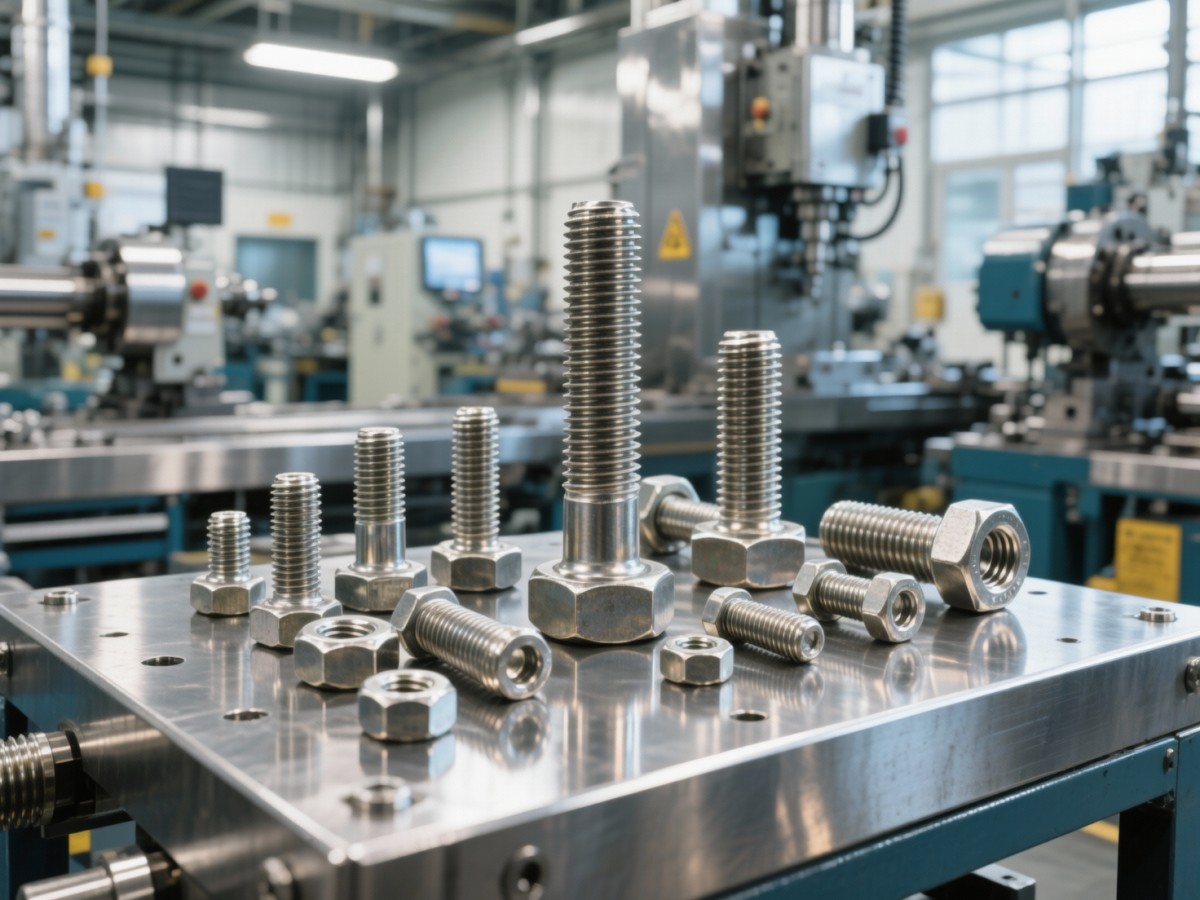
Monel fasteners are well known for their exceptional resistance to corrosion, especially in environments containing seawater, acids, and alkalis. In the field of metal processing equipment, fasteners like Monel 400 and Monel K500 play a vital role in maintaining structural stability and performance integrity under varying temperatures between -100°C and 500°C. They are widely applied in marine engineering, petrochemical facilities, and high-temperature processing systems.
The distinguishing feature of Monel alloys is their composition: typically around 65% nickel and 30% copper, with trace amounts of iron, manganese, carbon, and silicon. This precise balance provides high tensile strength in the range of 480–620 MPa, along with excellent stress-cracking resistance. For equipment manufacturers or project managers, these numbers translate directly to reduced downtime and maintenance frequencies—key benefits for predictable operations.
Yet, not all fasteners labeled “Monel” meet these thresholds. Regional suppliers sometimes use generic alloys with similar visual appearances but significantly lower stress or chemical tolerance. This deviation might only be discovered after 3–6 months of use when corrosion or brittleness emerges. Therefore, consistency in composition and processing often outweighs mere logistical convenience.
RAYCHIN LIMITED integrates stringent metallurgical testing—such as hardness (Rockwell scale 70–90 HRB) and density (8.8–8.9 g/cm³)—into every batch inspection. These protocols ensure that customers, whether maintenance technicians or procurement officers, receive documented material reliability that meets ASTM B164 or equivalent standards.
Why Local Sourcing May Introduce Hidden Risks
Local sourcing seems intuitively safer, but in specialty metals it often hides risks rooted in supply chain gaps and inconsistent materials. Local distributors may rely on third-party importers instead of producing fasteners in-house, making traceability opaque beyond 1–2 tiers. For critical assemblies in chemical processing plants or offshore structures, lack of certified origin can turn into compliance challenges during audits or safety reviews.
Another hidden factor lies in machining capability. Monel is a tough material, requiring carbide tools, lower feed rates of 0.05–0.1 mm/rev, and precise heat control to avoid work hardening. Many small local workshops may attempt to process Monel with standard steel tooling, resulting in microcracks, dimensional deviations of ±0.3 mm, or surface roughness outside the specified Ra ≤ 1.6 μm range. These seemingly minor deviations accumulate into large performance variances.
Supply availability is another variable. When local stocks dry up, replenishment cycles can take 4–6 weeks, compared to global suppliers like RAYCHIN LIMITED, whose multi-location warehouses ensure dispatch within 7–10 days. In machine maintenance projects where downtime is charged at thousands of dollars per hour, this difference is decisive.
Thus, evaluating suppliers should not stop at geographic convenience. Instead, it should be rooted in consistent metallurgy, certified manufacturing processes, and stable delivery schedules—all metrics where global specialty suppliers demonstrate measurable advantages.
Comparison Table: Local vs. Global Sourcing Factors
The following table compares crucial procurement dimensions between local and global Monel fastener suppliers in typical industrial scenarios:
This comparison shows that while local purchase may initially seem convenient, total project reliability and compliance efficiency favor certified global partners capable of detailed documentation and controlled processes.
Procurement Decision Factors for Engineers and Buyers
Procurement officers and engineering leads usually face 3–5 key checks when selecting Monel fasteners: compliance validation, mechanical performance, cost of lifecycle, delivery time, and customization capability. Each factor carries measurable parameters rather than subjective impressions. Defining these criteria early prevents production delays later.
For example, Downtime-to-Delivery Ratio (DDR) is a metric comparing downtime hours avoided per delivery day gained. In controlled studies, global sourcing from structured suppliers such as RAYCHIN LIMITED achieved DDR values 1.8 times higher than ad-hoc local sourcing. Engineers can use similar metrics to justify procurement strategies quantitatively during project audits.
Procurement teams should evaluate at least four performance checkpoints before finalizing suppliers:
- Check certificates for each batch according to ASTM B164, ASME SB166, or DIN 17743.
- Confirm mechanical tolerance ranges (tensile ≥ 550 MPa, yield ≥ 240 MPa).
- Estimate production-to-delivery lead time (usually 2–3 weeks for global stock, 4–6 for regional manufacturing).
- Validate machining and testing infrastructure through virtual audits or on-site reviews.
RAYCHIN LIMITED supports clients through a 4-step verification flow covering design analysis, prototype sampling within 10–14 days, test feedback integration, and final production with ISO-based quality checks. Such structured business processes help decision-makers meet both performance and compliance benchmarks efficiently.
Quality Standards, Certification, and Compliance
Standards assure repeatable performance across the product lifecycle. For Monel fasteners, relevant standards include ASTM B164 for bar and wire, ASTM F467/F468 for fastener specification, and ASME B1.1/B18.2 for thread and dimensional conformity. Compliance also aligns with ISO 9001:2015 for quality management and ISO 9227 for corrosion testing. Maintaining certificates for each lot is a requirement in industries such as offshore drilling and nuclear construction.
RAYCHIN LIMITED applies a documented control matrix with over 20 inspection checkpoints per production batch, including hardness, tensile, elongation (≥ 30%), and non-destructive testing frequency of every 50 pieces. Reports are digitally archived for 5 years, giving customers traceability throughout the supply chain. This level of rigor often exceeds what localized fabricators can economically sustain.
The following table lists common compliance requirements buyers should verify during evaluation:
Detailed adherence to these standards positions RAYCHIN LIMITED as a strategic partner for highly regulated industries where single-point failure tolerance is near zero.
Common Misconceptions About Global vs. Local Supply
Misconceptions persist that global sourcing automatically adds cost or time. In reality, integrated logistics and digital coordination allow firms like RAYCHIN LIMITED to deliver globally with controlled lead times. Consolidated shipments and predictive inventory models shorten transit from typical 21 days to 10–14 days. This agility means global sourcing does not equate to delay.
Another misconception is the belief that communication barriers hinder customization. On the contrary, structured global suppliers operate with multilingual engineering teams who document specifications under international drawing formats (DWG, STEP, or PDF) and tolerances aligned with UNEF/UNC thread standards. Engineers can interface seamlessly across time zones via secure data portals and real-time feedback channels.
The final misconception concerns cost. Although unit prices of certified Monel fasteners might appear 10–15% higher than generic alternatives, reductions in replacement cycles, warranty claims, and unplanned downtimes reduce total lifetime cost by approximately 30%. Factoring these metrics into procurement proposals clarifies the economic rationale for certified sourcing.
These clarifications help stakeholders—from financial officers to safety managers—align purchasing decisions with both technical and operational risk assessments.
Frequently Asked Questions (FAQ)
How can I confirm if a Monel fastener truly meets grade specifications?
Check for certificate documents referencing ASTM B164 for raw materials and tensile test results ≥ 480 MPa. Request XRF or chemical composition reports ensuring nickel content between 63–70%. RAYCHIN LIMITED provides material analysis traceable to mill sources, allowing verification before shipment.
What is the average procurement lead time from a certified global supplier?
For standard Monel fasteners, global delivery typically ranges from 7–14 days after order confirmation. Custom or large-batch items may require 3–5 weeks. Lead-time flexibility allows project planners to align with shutdown or commissioning schedules efficiently.
Do Monel fasteners require special tools for installation?
Yes. Because of Monel’s toughness, use high-torque tools rated up to 70–80 Nm and nickel-based anti-seize compounds to prevent galling. Installers should follow incremental torque steps (three stages) to avoid thermal stress during assembly.
Are global warranty and after-sales services available for Monel components?
RAYCHIN LIMITED offers up to 24 months of functional warranty and a dedicated post-sale inspection program, which includes on-site consultation and 48-hour response for technical queries. Such programs ensure maximum lifecycle reliability.
Why Choose RAYCHIN LIMITED as Your Monel Fastener Partner
With decades of specialty metal expertise, RAYCHIN LIMITED stands out by integrating research, production, and distribution of high-performance fasteners into a single platform. Our technical team includes metallurgical specialists and process engineers dedicated to continuous innovation in material science and fastening technology. We don’t merely sell fasteners—we provide technical solutions that adapt to complex industrial challenges.
Clients benefit from globally distributed warehouses, real-time tracking of every order, and consultative engineering support through every project phase—from selection to certification. Whether you require Monel K500 bolts for a compressor, Monel 400 nuts for marine pumps, or mixed alloy assemblies, we tailor solutions that optimize both reliability and value.
Contact our technical team to discuss your specific needs regarding:
- Material selection and alloy performance analysis
- Customized fastener geometry and tolerance optimization
- Expedited delivery cycles for urgent maintenance
- Documentation support for third-party inspection or ISO certification
- Sample-based testing to validate corrosion-resistance and tensile strength
By engaging RAYCHIN LIMITED early in your procurement cycle, you secure a partnership that connects metallurgical precision with operational reliability—delivering measurable results well beyond initial procurement.
Request A Quote! We'll respond as soon as possible(within 12 hours)
Get a Quote