
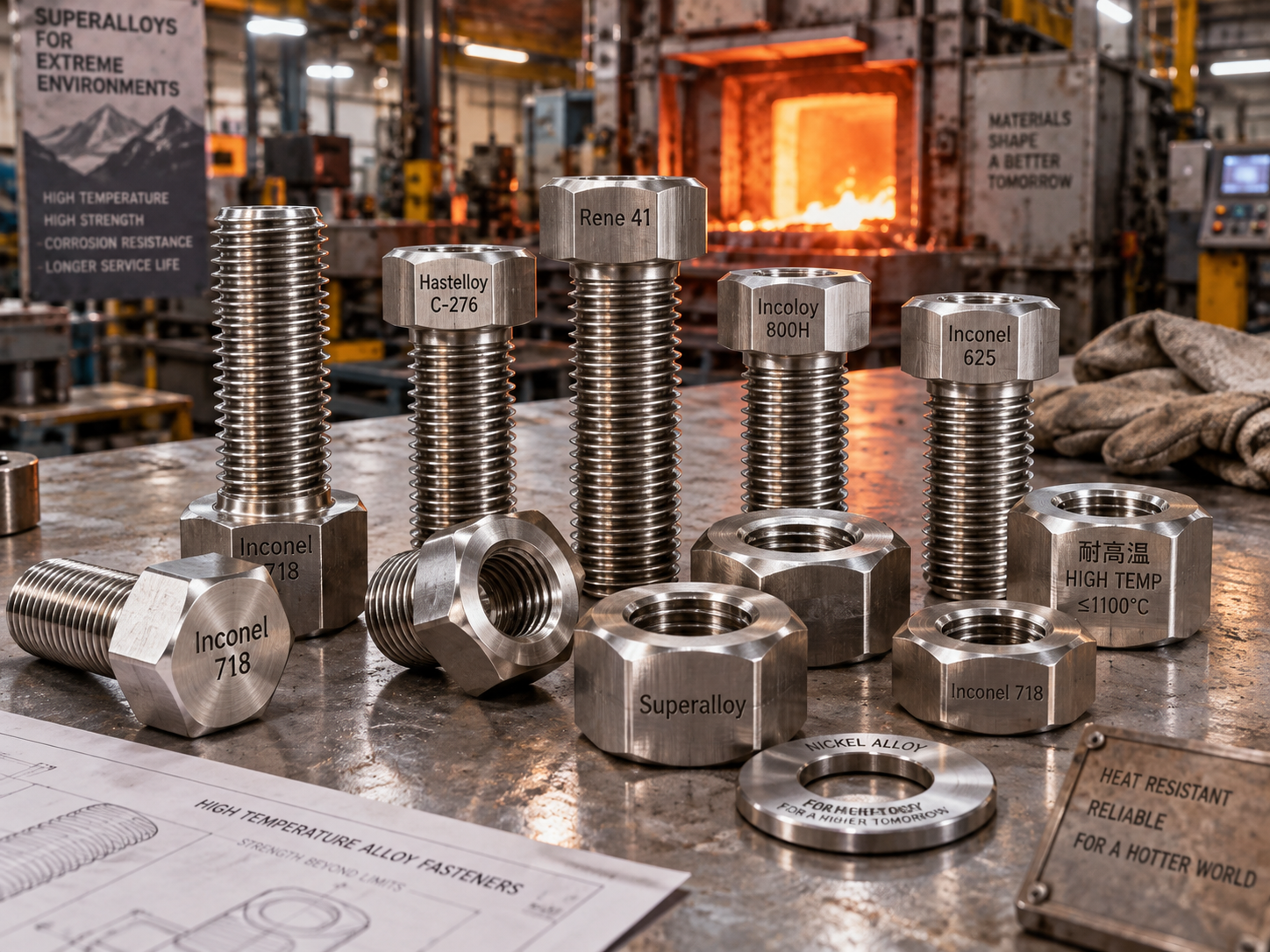
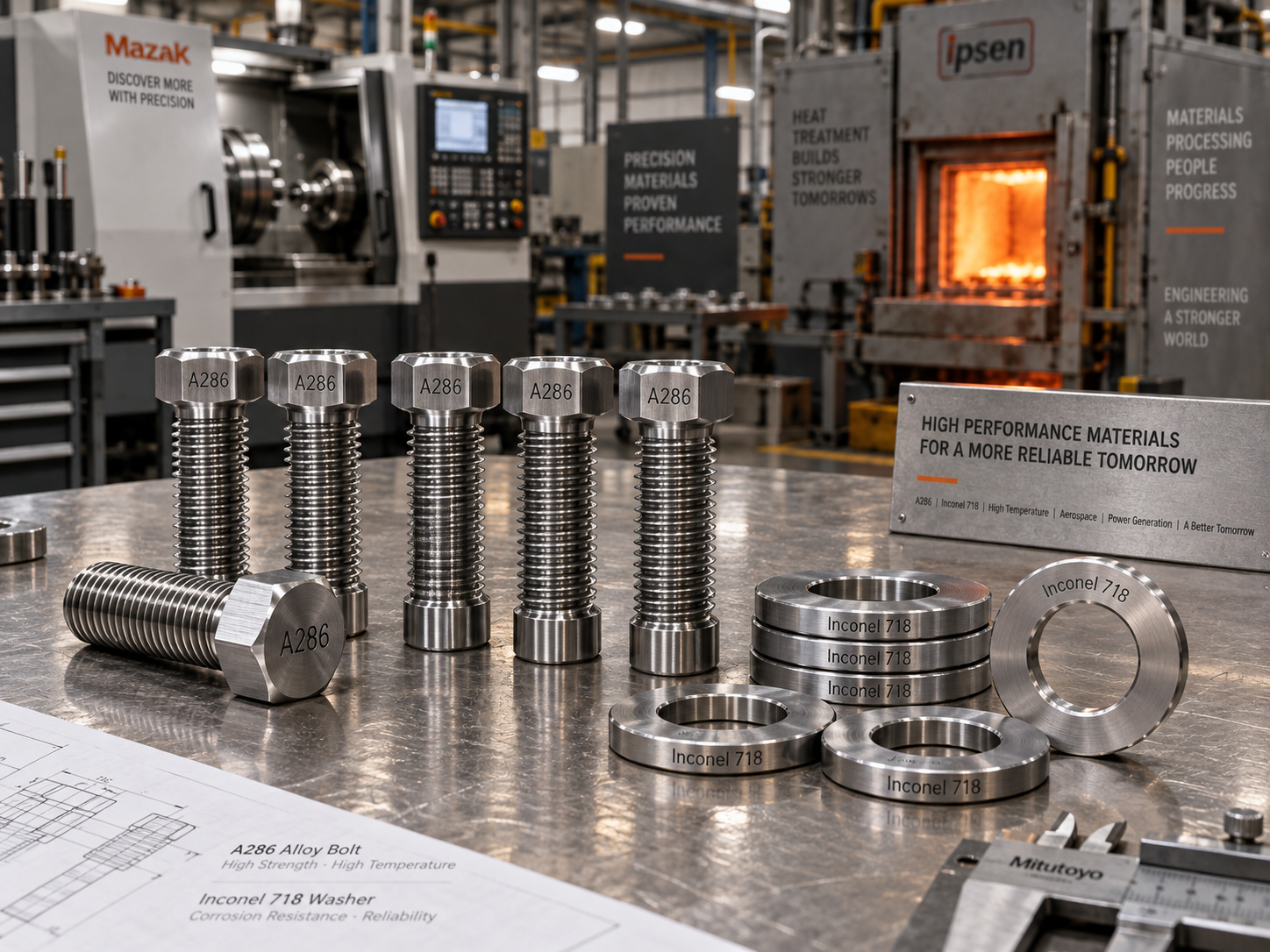
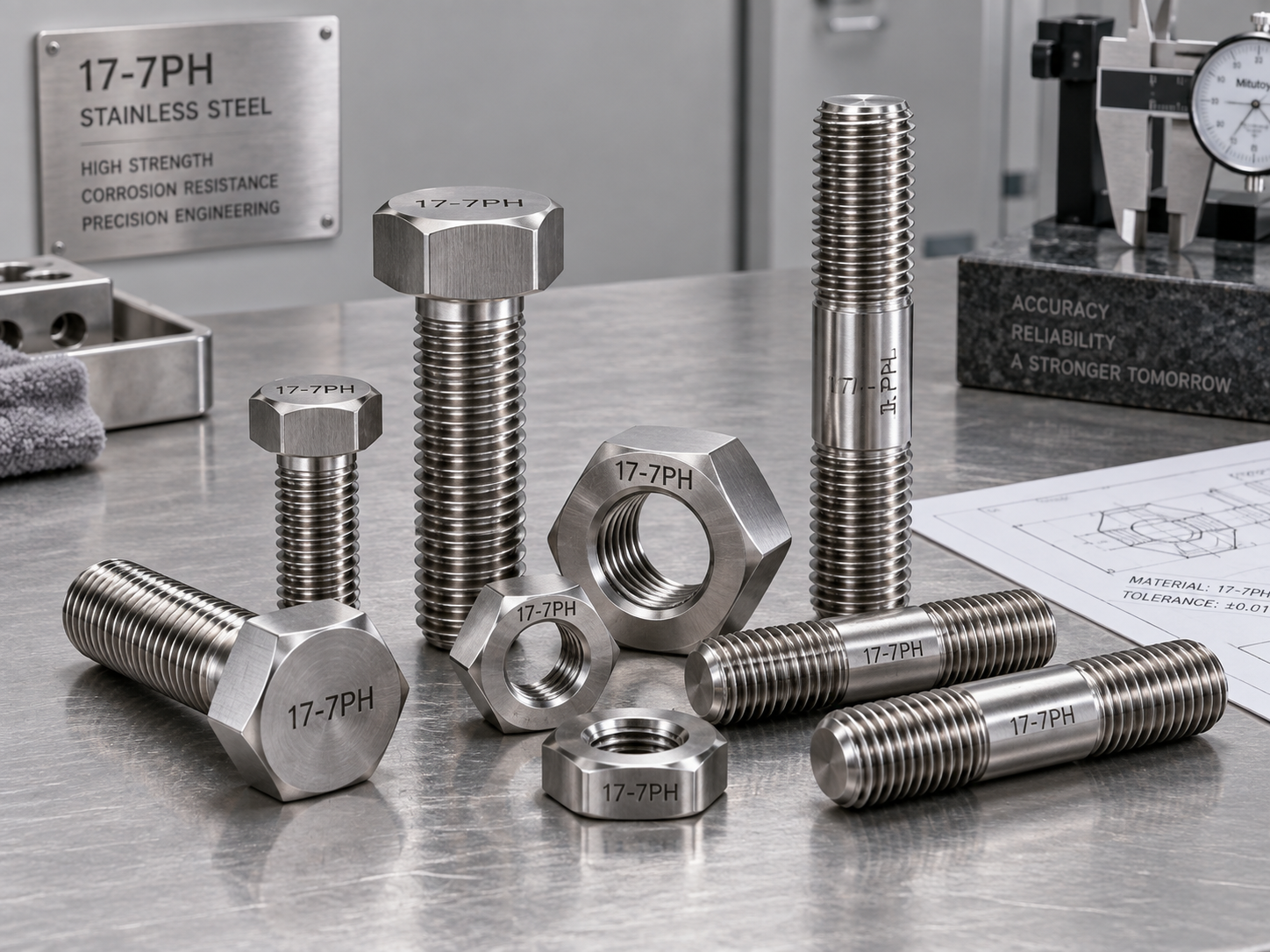
High-Temperature Alloy Fasteners:
The Complete Material Guide, Chemistry & Performance Comparison
When a bolted joint operates above 400°C, the metallurgy of the fastener becomes the defining constraint on joint integrity. Standard carbon alloy and stainless steel fasteners lose yield strength, creep relaxation bleeds off clamp load, and oxidation degrades the thread interface. The solution is a fundamentally different class of materials — high-temperature alloy fasteners manufactured from superalloys engineered for the most demanding thermal and mechanical environments. This guide provides a comprehensive technical reference covering alloy classification, detailed chemical composition, mechanical properties, comparative performance data, and systematic selection logic. It draws on RAYCHIN LIMITED's decades of experience manufacturing special alloy fasteners for aerospace, oil & gas, power generation, and chemical processing worldwide.
1. What Are High-Temperature Alloy Fasteners?
High-temperature alloy fasteners are bolting components manufactured from superalloys — a class of materials designed to maintain mechanical integrity, resist creep relaxation, and resist oxidation at service temperatures typically ranging from 400°C to 1,200°C. They are distinguished from conventional fasteners not by a single property but by the combination of three critical capabilities:
- High-temperature strength retention: The ability to maintain yield and tensile strength at temperature, unlike carbon steels whose quench-and-temper microstructure reverses above ~370°C.
- Creep and stress-rupture resistance: The ability to resist time-dependent permanent deformation under sustained load at temperature — the dominant failure mode for bolted joints above 250°C.
- Oxidation and corrosion resistance: The ability to form a stable, adherent oxide layer at temperature, preventing scaling, metal loss, and thread galling.
These fasteners are essential in gas turbine engines, aerospace airframes and propulsion systems, oil and gas wellheads and subsea equipment, chemical reactors, industrial furnaces, and nuclear power generation. The material families used are nickel-based superalloys, cobalt-based alloys, and iron-nickel-based superalloys, with titanium alloys serving lower-temperature weight-critical applications.
2. Metallurgical Classification of Superalloys
Superalloys are classified by their base element and strengthening mechanism. Understanding this classification is the foundation of correct alloy selection.
2.1 Nickel-Based Superalloys
Nickel-based superalloys are the workhorses of high-temperature fastening. They derive their strength from two mechanisms:
- Gamma-prime (γ′) precipitation: Ordered intermetallic Ni₃(Al, Ti) precipitates that impede dislocation motion. Used in Waspaloy, Nimonic 80A/90, Rene 41, Udimet 500, and Inconel X-750.
- Gamma-double-prime (γ″) precipitation: Body-centered tetragonal Ni₃Nb precipitates that provide exceptional strength with better weldability than γ′ alloys. Used in Inconel 718 — the most widely used superalloy for fasteners worldwide.
Nickel-based alloys are the preferred choice for temperatures from 650°C to 980°C, offering the best balance of strength, creep resistance, fatigue resistance, and oxidation resistance.
2.2 Cobalt-Based Alloys
Cobalt-based alloys (Haynes 25 / L-605, Haynes 188) are solid-solution strengthened with chromium and tungsten. They offer:
- Superior hot hardness and wear resistance compared to nickel alloys.
- Excellent sulfidation resistance — critical in environments containing sulfur compounds.
- Superior thermal fatigue resistance under rapid thermal cycling.
Cobalt alloys are generally used up to ~1,100°C in applications where wear, galling, and thermal fatigue are dominant concerns rather than pure creep strength.
2.3 Iron-Nickel-Based Superalloys
A286 (UNS S66286) is the primary iron-nickel-chromium superalloy used for fasteners. It offers a cost-effective middle ground between austenitic stainless steels and full nickel-based superalloys, with good strength up to ~650°C and corrosion resistance comparable to austenitic stainless steels[reference:0].
3. Detailed Chemical Composition of High-Temperature Fastener Alloys
The table below provides detailed chemical composition data for the principal alloys used in high-temperature fastener manufacturing. All values are in weight percent (wt%).
Composition ranges per applicable ASTM/AMS specifications. "Bal." indicates balance. A286 also contains V 0.10–0.50 and B 0.001–0.010[reference:1]. Inconel 718 also contains B 0.006 max[reference:2]. Rene 41 also contains B 0.003–0.010. Waspaloy also contains B 0.003–0.010, Zr 0.02–0.12[reference:3].
4. Mechanical Properties Comparison of High-Temperature Fastener Alloys
The table below compares the mechanical properties of the major high-temperature fastener alloys at room temperature in their standard heat-treated conditions. These values represent minimum specification requirements or typical properties as noted.
UTS = Ultimate Tensile Strength. Yield = 0.2% offset yield strength. Service temperatures are approximate continuous-service limits; short-term excursions may be higher. A286 data per ASTM A453 Gr 660[reference:4]. Inconel 718 data per AMS 5662/5663 aged condition[reference:5]. Waspaloy data per ASM[reference:6]. Nimonic 80A annealed + aged data per Alloy Wire International[reference:7]. Hastelloy X data per Haynes International[reference:8]. MP35N data per Carpenter Technology[reference:9].
5. Performance Comparison: Key Selection Criteria
The following table compares the principal high-temperature fastener alloys across the criteria that drive selection decisions.
6. Alloy Profile Summary Cards
A286 (UNS S66286)
Iron-Nickel SuperalloyChemistry: Ni 24–27%, Cr 13.5–16%, Mo 1.0–1.5%, Ti 1.9–2.35%
Mechanical: ≥895 MPa UTS / ≥585 MPa Yield / 248–341 HB
Max Service: ~650°C (1,200°F)
Best For: Exhaust manifolds, EGR joints, turbocharger-adjacent hardware, oil & gas manifolds. ASTM A453 Gr 660, NACE MR0175 compliant.
Inconel 718 (UNS N07718)
Nickel-Based SuperalloyChemistry: Ni 50–55%, Cr 17–21%, Nb 4.75–5.5%, Mo 2.8–3.3%
Mechanical: ≥1,240 MPa UTS / ≥1,034 MPa Yield / 331–401 HB
Max Service: ~650–700°C (1,200–1,300°F)
Best For: The most widely used superalloy for fasteners. Excellent fatigue and oxidation resistance. AMS 5662/5663, NACE MR0175.
Waspaloy (UNS N07001)
Nickel-Based, γ′ StrengthenedChemistry: Ni ~57%, Cr 18–21%, Co 12–15%, Mo 3.5–5%
Mechanical: ≥1,276 MPa UTS / ≥897 MPa Yield / 38 HRC
Max Service: ~815°C (1,500°F)
Best For: Higher strength than 718 above 650°C. Turbine engine bolting where stress relaxation resistance is critical. BS EN 3389: 1,210 MPa / 730°C.
Nimonic 80A (UNS N07080)
Nickel-Chromium, γ′ StrengthenedChemistry: Ni ~69%, Cr 18–21%, Ti 1.8–2.7%, Al 1.0–1.8%
Mechanical: 1,200–1,400 MPa UTS (aged) / ~780 MPa Yield
Max Service: ~815°C (1,500°F)
Best For: Turbocharger shaft hardware, racing engine exhaust valves, nuclear applications (low cobalt content). ASTM B637.
Nimonic 90 (UNS N07090)
Nickel-Chromium-CobaltChemistry: Ni Bal., Cr 18–21%, Co 15–21%, Ti 2.0–3.0%
Mechanical: ~1,250 MPa UTS / ~850 MPa Yield
Max Service: ~920°C (1,688°F)
Best For: Higher temperature capability than Nimonic 80A. Stress-rupture strength and creep resistance to 920°C. AMS 5829.
Inconel X-750 (UNS N07750)
Nickel-Chromium, γ′ StrengthenedChemistry: Ni ≥70%, Cr 14–17%, Ti 2.25–2.75%, Nb 0.7–1.2%
Mechanical: ~1,250 MPa UTS / ~793 MPa Yield
Max Service: ~815°C (1,500°F)
Best For: Springs, high-temperature studs, relaxation-resistant joints. AMS 5542, AMS 5598.
Rene 41 (UNS N07041)
Nickel-Chromium-Cobalt, γ′ StrengthenedChemistry: Ni ~52%, Cr 18–20%, Co 10–12%, Mo 9–10.5%
Mechanical: ≥1,241 MPa UTS / ≥793 MPa Yield
Max Service: ~980°C (1,800°F)
Best For: Highest strength at 649–982°C. Most demanding aerospace applications. Challenging to weld and heat treat.
Hastelloy X (UNS N06002)
Nickel-Chromium-Iron-MolybdenumChemistry: Ni Bal., Cr 20.5–23%, Mo 8–10%, Fe 17–20%
Mechanical: ≥690 MPa UTS / ≥310 MPa Yield / ≤241 HB
Max Service: 1,090°C continuous / 1,150°C short-term
Best For: Combustion chamber liners, industrial furnace hardware, turbojet afterburners. Excellent oxidation and carburization resistance. AMS 5754.
Haynes 25 / L-605 (UNS R30605)
Cobalt-Chromium-TungstenChemistry: Co Bal., Cr 19–21%, W 14–16%, Ni 9–11%
Mechanical: 896–1,240 MPa UTS / ~450 MPa Yield
Max Service: ~980°C (1,795°F)
Best For: Excellent hot hardness and wear resistance. Sulfidation resistance. Turbine case bolts, oxidizing/sulfidizing atmospheres. AMS 5759.
Haynes 188 (UNS R30188)
Cobalt-Nickel-Chromium-TungstenChemistry: Co Bal., Cr 20–24%, Ni 20–24%, W 13–16%
Mechanical: ~860 MPa UTS / ~430 MPa Yield
Max Service: 1,095°C (2,000°F)
Best For: Oxidation and sulfidation resistance up to 1,095°C. Superior thermal fatigue resistance. AMS 5608.
MP35N (UNS R30035)
Nickel-Cobalt-Chromium-MolybdenumChemistry: Ni 33–37%, Co Bal., Cr 19–21%, Mo 9–10.5%
Mechanical: ≥1,900 MPa UTS / ≥1,500 MPa Yield / 45–50 HRC
Max Service: ~450°C (842°F) continuous
Best For: Highest strength alloy approved in NACE MR0175. Medical implants, aerospace downhole tools, high-stress marine hardware. AMS 5844/5845.
Udimet 500 (UNS N07500)
Nickel-Based, γ′ StrengthenedChemistry: Ni ~53%, Cr 16–20%, Co 13–20%, Mo 3–5%, Ti 2.5–3.25%
Mechanical: ≥1,100 MPa UTS / ≥760 MPa Yield
Max Service: ~870°C (1,600°F)
Best For: Sealing strips, combustion chamber components, fasteners operating at 760–870°C. Good resistance to deformation at temperature.
7. Failure Mechanisms in High-Temperature Bolted Joints
Understanding why high-temperature joints fail is essential to selecting the correct alloy. Three mechanisms account for the majority of failures in practice.
7.1 Creep Relaxation — The Dominant Mechanism
Above 250°C, sustained load causes the fastener to slowly and permanently elongate through creep — time-dependent plastic deformation under constant stress. The initial elastic strain imposed by tightening converts progressively into permanent creep strain. The result is rotation-free preload loss: the nut has not moved, the fastener has not stripped, but the joint has lost clamping force[reference:10]. Creep relaxation is the most important factor in high-temperature joint design and the primary driver of alloy selection above 400°C[reference:11].
7.2 Thermal Expansion Mismatch
When the fastener and flange materials have different coefficients of thermal expansion (CTE), clamp load changes as the joint heats up. If the flange expands more than the fastener, preload decreases and the joint may leak. If the fastener expands more, preload increases — potentially beyond yield. In turbine and aerospace applications, CTE mismatch is a primary driver of preload loss and joint stiffness reduction[reference:12].
7.3 Oxidation, Scaling, and Galling
At high temperature, the alloy forms an oxide layer. Under thermal cycling, this oxide scale builds on mating thread surfaces, becomes abrasive, and accelerates wear. Galling — adhesive wear where thread surfaces cold-weld under high contact stress — is significantly more likely with nickel-based alloys, which are inherently prone to this failure mode. Silver plating, MoS₂ coatings, and specialized anti-seize compounds are commonly specified to control galling and maintain removability.
8. Selection Logic: Choosing the Right Alloy
- Determine fastener metal temperature. This is the temperature at the fastener shank, not the flange surface or exhaust gas temperature. It is the single input that drives correct alloy selection.
- Identify the corrosive environment. H₂S (sour service) requires NACE MR0175 compliance — A286, Inconel 718, or MP35N. Sulfidation environments favor cobalt-based alloys (Haynes 25/188). Oxidation-dominated environments favor Hastelloy X or Haynes 188.
- Select by temperature zone:
- ≤650°C: A286 — best cost-performance balance.
- 650–700°C: Inconel 718 — the default choice for most high-temperature fastener applications.
- 700–815°C: Nimonic 80A, Inconel X-750, or Waspaloy (when higher strength is required).
- 815–980°C: Waspaloy, Rene 41, or Udimet 500 (when high strength is required); Hastelloy X or Haynes 188 (when oxidation resistance dominates).
- 980–1,200°C: Hastelloy X, Haynes 188, or Haynes 25.
- Verify creep relaxation behavior at the design temperature and stress. The alloy's creep resistance determines whether the joint will maintain clamp load over the service life.
- Check CTE compatibility between fastener and flange. Account for mismatch in the preload calculation.
- Specify coating and locking method appropriate for the temperature and environment. Anaerobic threadlockers are limited to ~232°C; nylon-insert nuts to ~120°C. All-metal mechanical locking is required above these limits.
- Confirm standards and certification: ASTM A453 Gr 660, AMS 5662/5663/5707/5708, NACE MR0175, EN 10204 3.1 / 3.2, with full traceability.
9. RAYCHIN LIMITED: Your Partner in High-Temperature Fastening
RAYCHIN LIMITED manufactures and supplies high-temperature fasteners in the full range of alloys covered in this guide. Our capabilities include:
- Alloy coverage: A286, Inconel 718, Waspaloy, Nimonic 80A/90, Inconel X-750, Hastelloy X, Rene 41, Haynes 25/188, MP35N, Udimet 500, and custom alloys
- Product forms: Bolts, stud bolts, socket head cap screws, 12-point aerospace bolts, threaded rod, nuts, washers, and custom-machined components
- Standards compliance: ASTM A453 Gr 660, AMS 5662/5663/5707/5708/5754/5759/5608, ASTM B637, NACE MR0175/ISO 15156, and customer-specific specifications
- Quality documentation: EN 10204 3.1 / 3.2 material certificates, PMI reports, mechanical testing (tensile, yield, stress rupture), hardness verification, and third-party inspection
- Global supply: Serving aerospace, oil & gas, power generation, chemical processing, and industrial customers in 40+ countries
Our engineering team can assist with alloy selection, preload calculation, coating specification, and failure analysis. Contact us with your application parameters and we will recommend the optimal solution.
Frequently Asked Questions
What are high-temperature alloy fasteners?
High-temperature alloy fasteners are bolting components manufactured from superalloys — nickel-based, cobalt-based, or iron-nickel-based alloys — designed to maintain mechanical integrity, resist creep relaxation, and resist oxidation at service temperatures from 400°C up to 1,200°C.
What is the difference between nickel-based and cobalt-based superalloys for fasteners?
Nickel-based superalloys (Inconel 718, Waspaloy, Nimonic 80A, Rene 41) derive strength from γ′ or γ″ precipitation and offer the best combination of strength, creep resistance, and oxidation resistance up to ~980°C. Cobalt-based alloys (Haynes 25, Haynes 188) offer superior hot hardness, wear resistance, and sulfidation resistance, typically used up to ~1,100°C.
What is the difference between A286 and Inconel 718 for high-temperature fasteners?
A286 is an iron-nickel-chromium alloy with minimum UTS of 895 MPa and yield of 585 MPa, suitable up to ~650°C. Inconel 718 is a nickel-chromium alloy with minimum UTS of 1,240 MPa and yield of 1,034 MPa in the aged condition, suitable up to ~700°C with superior fatigue and oxidation resistance. A286 is more cost-effective; Inconel 718 is preferred for higher stress and fatigue-critical applications.
Why do high-temperature bolted joints lose clamp load?
Clamp load loss at high temperature is caused by three primary mechanisms: creep relaxation — the time-dependent permanent elongation of the fastener under sustained load; thermal expansion mismatch between fastener and flange; and oxidation or galling at the thread interface. Creep relaxation is the most significant factor above 250°C.
Which high-temperature fastener alloy complies with NACE MR0175?
A286 (Grade 660), Inconel 718, MP35N, and alloy 925 comply with NACE MR0175 / ISO 15156 for sour service. MP35N is approved as the highest strength alloy in NACE MR0175.
What is the best alloy for fasteners at 700°C?
Inconel 718 is the default choice for 700°C service, offering excellent strength retention, fatigue resistance, and oxidation resistance. Waspaloy is an alternative when higher strength is needed at the upper end of this range, with a maximum test temperature of 730°C per BS EN 3389.
Need High-Temperature Alloy Fasteners?
Send us your application parameters — temperature, environment, load, and required standard — and our engineering team will recommend the optimal alloy.
Email sales@ray-chin.comVisit www.ray-chin.com