
MP35N vs Inconel, Titanium & C276: The Complete Material Comparison Guide for Fasteners
An engineering-grade comparison of MP35N against Inconel 625, Titanium Grade 5, Hastelloy C276, 316 Stainless Steel, and MP159 — covering mechanical properties, corrosion resistance, hydrogen embrittlement, temperature limits, and real-world selection criteria.
Table of Contents
- Why Material Selection Matters in Critical Fastening
- MP35N vs Inconel 625: Strength vs Temperature
- MP35N vs Titanium Grade 5: Strength vs Weight
- MP35N vs Hastelloy C276: Corrosion Face-Off
- MP35N vs 316 Stainless Steel: When Standard Isn't Enough
- MP35N vs MP159: The 240 MPa Difference
- Hydrogen Embrittlement: MP35N's Unique Advantage
- Galvanic Compatibility & Common Problems
- Temperature Limits: Complete Comparison
- Material Selection Decision Matrix
- Frequently Asked Questions
1. Why Material Selection Matters in Critical Fastening
In extreme bolting environments — aerospace engines, HPHT sour wells, deepwater subsea hardware, and medical implants — the material decision is not merely technical. It determines whether a joint survives for decades or fails catastrophically. MP35N has emerged as a benchmark solution, offering an unmatched combination of ultra-high strength, exceptional corrosion resistance, and NACE compliance. But how does it compare against Inconel 625, Titanium Grade 5, Hastelloy C276, 316 stainless steel, and MP159? This guide provides the definitive comparison.
2. MP35N vs Inconel 625: Strength vs Temperature
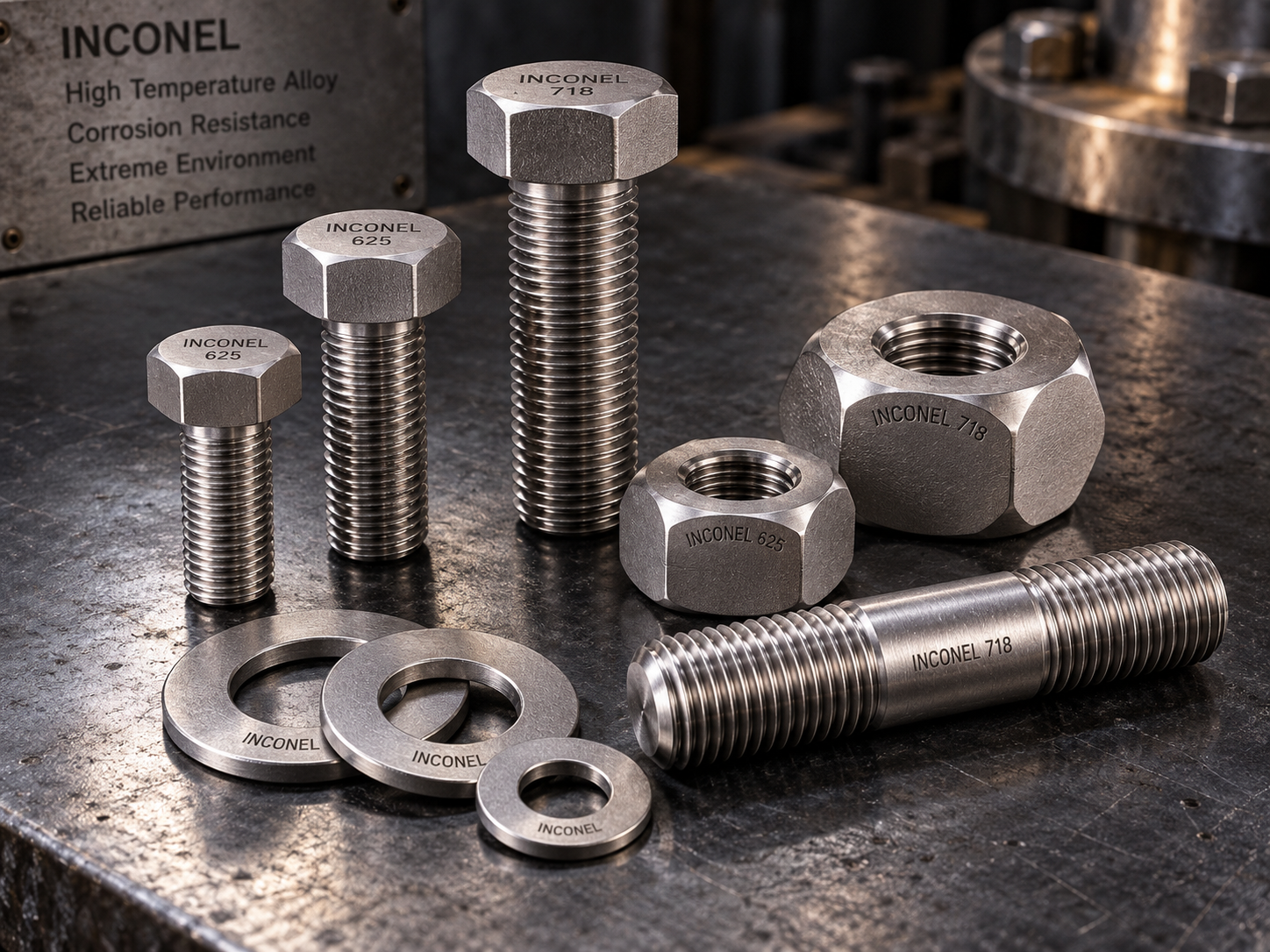
Inconel 625 is a nickel-chromium-molybdenum alloy strengthened by niobium, while MP35N is a nickel-cobalt-chromium-molybdenum alloy strengthened through cold working and aging[reference:0]. The fundamental trade-off is clear: MP35N delivers higher room-temperature strength, while Inconel 625 maintains strength at elevated temperatures.
At 538°C, MP35N exhibits a stress rupture strength of 210 ksi (1448 MPa) with a life of 28 hours in a crevice corrosion test environment, demonstrating its capability in moderate-temperature, high-stress applications. However, above 400°C, Inconel 625 is the superior choice for sustained high-temperature service.
RAYCHIN Verdict: MP35N vs Inconel 625
- Choose MP35N for room-temperature to moderate-temperature applications (below 300°C) requiring maximum strength and corrosion resistance — especially in sour service and seawater.
- Choose Inconel 625 for high-temperature service up to 982°C, oxidation resistance, and applications where thermal stability is paramount.
3. MP35N vs Titanium Grade 5 (Ti-6Al-4V): Strength vs Weight
Titanium Grade 5 is the workhorse of aerospace and medical implants, prized for its excellent strength-to-weight ratio and biocompatibility. MP35N, however, offers roughly double the tensile strength and significantly higher fatigue resistance.
MP35N’s fatigue strength is approximately 50% higher than Titanium Grade 5, making it ideal for dynamically loaded fasteners in aerospace engines and medical implants subject to cyclic loading. Titanium’s lower density (4.43 g/cm³ vs 8.42 g/cm³) gives it a decisive weight advantage where mass reduction is critical.
RAYCHIN Verdict: MP35N vs Titanium Grade 5
- Choose MP35N for high-stress, high-fatigue, and high-strength fastening applications where weight is not the primary constraint.
- Choose Titanium Grade 5 where maximum strength-to-weight ratio and osseointegration (medical implants) are the driving factors.
4. MP35N vs Hastelloy C276: Corrosion Face-Off
Hastelloy C276 is renowned for its resistance to oxidizing and reducing acids, chlorides, and mixed chemical environments. MP35N matches or exceeds this in most chloride-rich and seawater environments, while offering significantly higher strength.
Research confirms that both MP35N and Hastelloy C276 are highly resistant to localized corrosion in quiescent and low-velocity seawater conditions, while nickel-base alloys such as Alloy K-500 and Alloy 718 are susceptible to crevice corrosion in the same environments. MP35N’s unique advantage lies in its ability to combine this corrosion resistance with ultra-high strength — a combination Hastelloy cannot match.
RAYCHIN Verdict: MP35N vs Hastelloy C276
- Choose MP35N when you need corrosion resistance combined with ultra-high strength — especially in sour service, subsea bolting, and medical implants.
- Choose Hastelloy C276 for chemical processing environments dominated by oxidizing/reducing acids at moderate temperatures, where strength requirements are lower.
5. MP35N vs 316 Stainless Steel: When Standard Isn't Enough
316 stainless steel is the baseline for corrosion-resistant fasteners, but it falls far short of MP35N in strength, fatigue resistance, and aggressive environment performance.
*Note: In specific electrochemical conditions such as charge injection electrodes, MP35N exhibits a lower breakdown potential (0.45 V SCE) compared to 316LVM (1.05 V SCE), indicating susceptibility to pitting under those specific conditions. In general chloride/seawater environments, MP35N significantly outperforms 316 stainless steel.
6. MP35N vs MP159: The 240 MPa Difference
MP159 is an evolution of MP35N, with deliberate additions of titanium and aluminum that form gamma-prime precipitates during aging. This results in dramatically improved high-temperature strength retention.
At 600°C, MP159 retains approximately 80% of its room-temperature yield strength, while MP35N retains only about 57% — a difference of roughly 240 MPa (35 ksi). In fastener design, this translates to higher preload capacity, the ability to downsize fasteners, and a greater safety margin in HPHT wells.
RAYCHIN Verdict: MP35N vs MP159
- Choose MP159 when service temperature exceeds 400°C, or when maximum preload and safety margin are required in HPHT sour wells.
- Choose MP35N for moderate-temperature sour service (below 300°C) where the strength difference is less critical and cost is a primary driver.
7. Hydrogen Embrittlement: MP35N's Unique Advantage
Hydrogen embrittlement is a critical concern for high-strength alloys in hydrogen-rich environments. A landmark study published in High Pressure Research (2024) tested MP35N under 200 MPa (~30,000 psi) hydrogen gas pressure and found that MP35N with a tensile strength exceeding 1800 MPa does not suffer any strength loss, retains a significant amount of ductility, and appears to be highly resistant to hydrogen embrittlement even under elevated stress when exposed over a time-scale of hours.
The study concluded that this exceptional resistance to H-embrittlement seems to be unique among all high-performance steels and alloys of comparable strength, bearing on the use of this material for high-pressure H₂ research devices and storage applications.
However, heat treatment conditions significantly affect hydrogen embrittlement resistance. High-temperature (1,350–1,500°F) heat treatments improve the hydrogen-embrittlement resistance of MP35N, while aging at 204°C (400°F) can increase susceptibility following long-term, low-temperature aging. RAYCHIN LIMITED ensures proper heat treatment protocols to maximize hydrogen embrittlement resistance in all MP35N fasteners.
8. Galvanic Compatibility & Common Problems
One of the most overlooked issues in fastener material selection is galvanic compatibility. MP35N has poor galvanic compatibility with several common alloys, and coupling it with these materials can accelerate their corrosion rates.
In seawater applications, MP35N and Titanium fasteners are virtually immune to corrosive attack, while Alloy K-500, Alloy 725, Alloy 925, Alloy 718, and A286 fasteners require cathodic protection or sealants to prevent localized corrosion. RAYCHIN LIMITED recommends proper isolation techniques and can supply MP35N fasteners with insulating coatings or washers for dissimilar metal joints.
Other Common MP35N Fastener Issues
- High Yield Strength and Assembly: MP35N’s very high yield strength can prevent ferrules from “biting” into parent tube material if insufficient torque is applied — a critical consideration in compression fitting applications.
- Galling: Like many high-strength alloys, MP35N can experience galling under high contact pressure. Proper lubrication (e.g., molybdenum disulfide or PTFE-based) is essential.
- Machinability: MP35N’s machinability is similar to Waspaloy. Recommended drilling speeds: 7.6 m/min (25 sfm) with 0.10 mm/rev feed; turning: 9.1 m/min (30 sfm) with 0.254 mm/rev feed. High-speed steels and carbide tools are suitable.
9. Temperature Limits: Complete Comparison
The usable temperature limit is often the single most important selection criterion. The table below provides a definitive comparison across all relevant materials.
MP35N’s 426°C limit positions it firmly in the moderate-temperature category, well below Inconel and Hastelloy but above Titanium and standard stainless steels. For applications approaching or exceeding 400°C, MP159 or Inconel 718 should be considered.
10. Material Selection Decision Matrix
Use this quick-reference matrix to guide your material selection based on primary application requirements:
11. Frequently Asked Questions
What is the main difference between MP35N and Inconel 625 fasteners?
MP35N offers higher ultimate tensile strength (up to 2068 MPa) at room temperature, while Inconel 625 maintains strength at higher temperatures (up to 982°C). MP35N is preferred for room-temperature or moderate-temperature applications requiring maximum strength and corrosion resistance, while Inconel 625 is better for high-temperature service.
Is MP35N susceptible to hydrogen embrittlement?
Research shows that MP35N with tensile strength exceeding 1800 MPa does not suffer strength loss and retains significant ductility under 200 MPa hydrogen gas pressure, making it highly resistant to hydrogen embrittlement — a performance level unique among high-strength alloys. Proper heat treatment is essential to maximize this resistance.
How does MP35N compare to Titanium Grade 5 for fasteners?
MP35N has significantly higher tensile strength (1790–2070 MPa vs 895–1170 MPa) and superior fatigue resistance (~800–1000 MPa vs 400–700 MPa). Titanium Grade 5 offers better strength-to-weight ratio (density 4.43 vs 8.42 g/cm³). MP35N is preferred for high-stress, high-fatigue applications, while Titanium is better where weight savings are critical.
What is the maximum service temperature for MP35N fasteners?
MP35N fasteners have a usable temperature limit of approximately 426°C (800°F). At 600°C, MP35N retains only about 57% of its room-temperature yield strength, while MP159 retains approximately 80%. For service temperatures above 400°C, MP159 or Inconel alloys are recommended.
Is MP35N compatible with other metals in seawater applications?
MP35N has poor galvanic compatibility with Alloy K-500, 316 stainless steel, carbon steel and 7075-T6 aluminum. Coupling MP35N with these alloys can accelerate their corrosion rates. In seawater, MP35N is virtually immune to crevice and stress corrosion cracking, but careful isolation is required when coupled with less noble metals. Titanium is fully compatible with MP35N.
MP35N vs MP159: which is better for high-temperature fasteners?
MP159 is superior for high-temperature applications above 400°C. At 600°C, MP159 retains approximately 80% of its room-temperature yield strength while MP35N retains only 57%, creating a yield strength difference of roughly 240 MPa (35 ksi). MP35N is more cost-effective for moderate-temperature applications below 300°C.
Does MP35N have any pitting corrosion limitations compared to 316 stainless steel?
In specific electrochemical conditions such as charge injection electrodes, MP35N has shown a lower breakdown potential (0.45 V SCE) compared to 316LVM stainless steel (1.05 V SCE), indicating susceptibility to pitting under certain conditions. However, in general chloride and seawater environments, MP35N significantly outperforms standard stainless steels.
Need Help Selecting the Right Alloy?
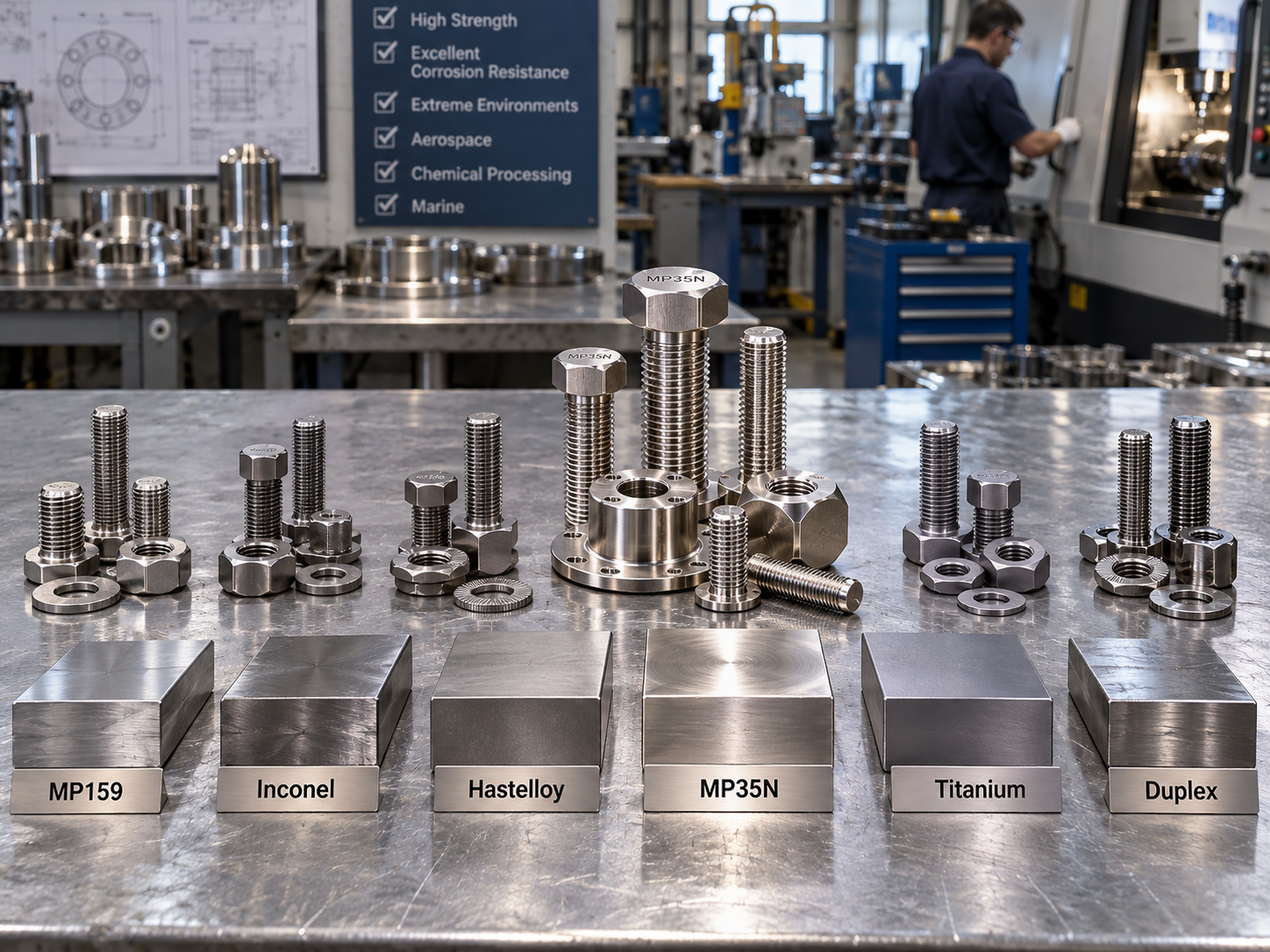
RAYCHIN LIMITED manufactures MP35N, MP159, Inconel, Hastelloy, Titanium and Duplex fasteners under one quality system — giving you genuinely unbiased, data-driven material recommendations.
Email sales@ray-chin.comVisit www.ray-chin.com