
Categories List
Recent Posts
 PEEK Fasteners | Polyetheretherketone Bolts, Nuts, Screws – High-Performance Polymer | RAYCHIN LIMITED
 High-Temperature Alloy Fasteners: Complete Material Guide, Chemistry, Performance Comparison | RAYCHIN LIMITED
 High-Temperature Fastener Material Selection Guide | A286, Inconel 718, Nimonic 80A, Waspaloy – RAYCHIN LIMITED
A286 Fasteners: Complete Technical Properties – Tensile, Yield, Hardness, Torque, Fatigue, Heat Treatment & More
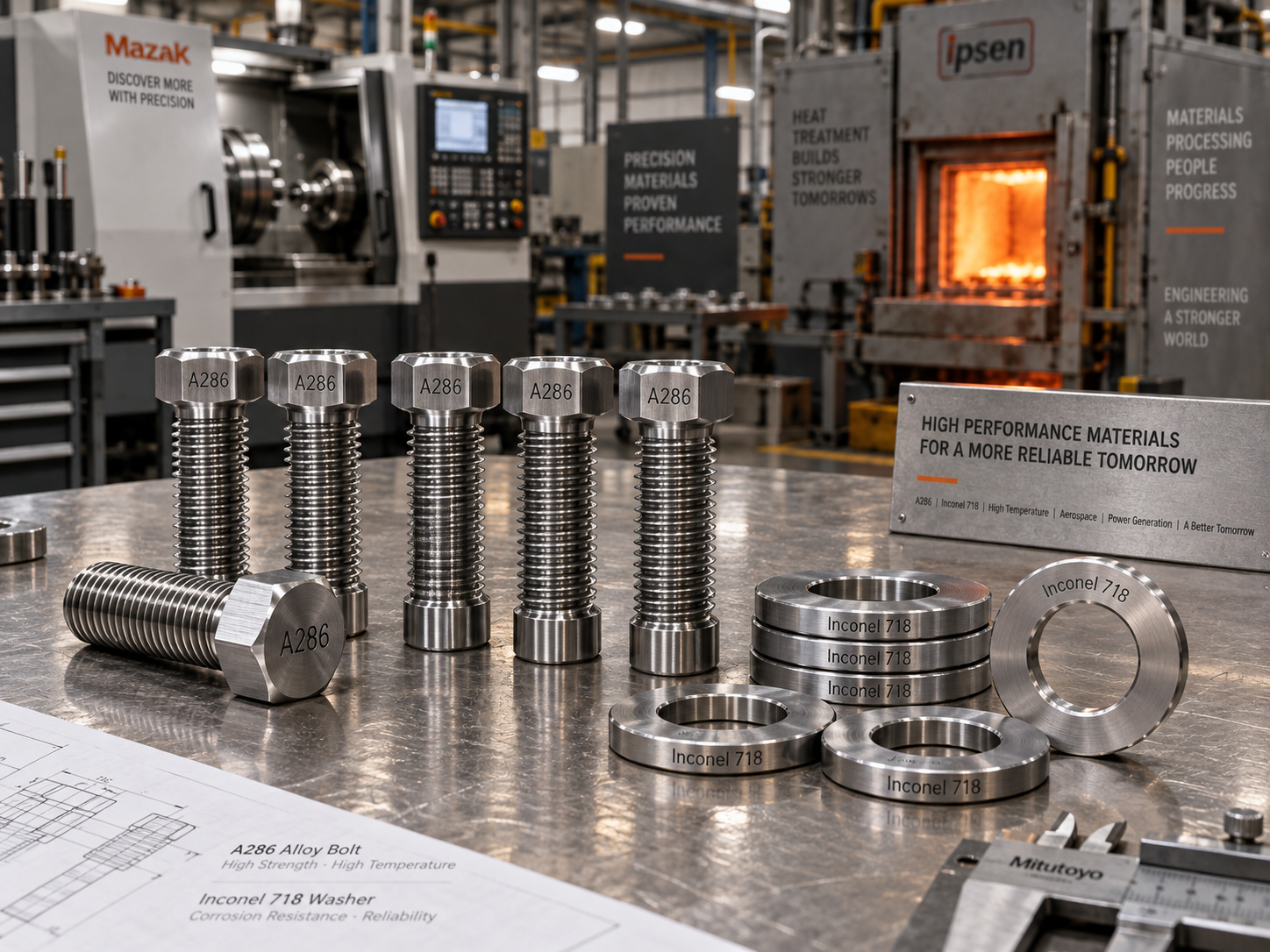
For engineers specifying A286 fasteners, accessing accurate mechanical property data is non‑negotiable. As a specialist global manufacturer of A286 bolting for demanding industries, RAYCHIN LIMITED presents this comprehensive technical reference. It covers tensile and yield strength, Rockwell hardness, torque values, fatigue and stress rupture performance, heat treatment protocols, temperature limits, relaxation resistance, galling prevention, and machining guidance. All data is drawn from our own production experience and international standards, ensuring you have the reliable information needed to design safe, durable bolted joints.
1. Mechanical Properties: Tensile Strength, Yield Strength & Hardness
A286 tensile strength and A286 yield strength vary with heat treatment condition. The most commonly specified condition for high‑stress fasteners is ASTM A453 Class D, achieved through solution annealing followed by a two‑step precipitation aging. Typical room‑temperature properties are:
For lower‑stress applications, Class B or C can be supplied with proportionally lower strength levels. A286 hardness Rockwell is a critical quality control checkpoint; RAYCHIN performs 100% hardness verification on every fastener, ensuring consistent precipitation response and avoiding the soft or over‑aged conditions that compromise service life.
2. A286 Torque Values & Tightening Torque Chart
Achieving the correct preload without damaging threads requires accurate A286 torque values. Nickel‑bearing alloys like A286 have a higher coefficient of friction than plain carbon steel, and lubrication reduces the required torque. RAYCHIN provides a conservative torque guideline based on 50% of yield strength and a lubricated nut factor K = 0.15.
These values assume clean, lubricated threads with a nickel‑compatible anti‑seize compound (MoS₂ or boron nitride). RAYCHIN can supply a detailed A286 bolt tightening torque chart specific to your fastener geometry and coating upon request. Always use calibrated torque wrenches and a slow, steady application to avoid galling.
3. Fatigue and Stress Rupture Properties
A286 fatigue strength depends on surface finish, thread condition, and mean stress. In rotating‑beam fatigue tests at room temperature, the endurance limit (10⁷ cycles) is approximately 450 MPa (65 ksi). Rolled threads, which introduce beneficial compressive residual stresses at the thread root, significantly enhance fatigue life—typically by a factor of 2–3 compared to cut threads. RAYCHIN rolls threads after aging as standard for this reason.
A286 stress rupture properties are critical for prolonged high‑temperature service. At 650°C, the 100‑hour stress‑rupture strength is approximately 345 MPa (50 ksi), while at 540°C it exceeds 550 MPa (80 ksi). These values demonstrate A286's superior creep resistance compared to 17‑4PH and other martensitic stainless steels, making it suitable for turbocharger and exhaust system fasteners that experience sustained thermal exposure.
4. Heat Treatment: Solution Anneal and Age
The full A286 heat treatment solution anneal and age cycle is fundamental to achieving the required mechanical properties. The standard procedure, followed by RAYCHIN in vacuum furnaces, is:
- Solution annealing: Heat to 980°C ± 15°C (1800°F ± 25°F), hold for 30–60 minutes depending on cross‑section, followed by rapid oil or water quenching.
- Precipitation aging: Reheat to 720°C ± 10°C (1325°F ± 20°F), hold for 16 hours, and air cool. This single‑step aging differs from Inconel 718's two‑step process and is designed to precipitate fine gamma‑prime (Ni₃Al,Ti) for maximum strength.
Solution annealing dissolves any prior cold work and carbides, restoring a uniform austenitic matrix. The subsequent aging uniformly precipitates the strengthening phase throughout the cross‑section. RAYCHIN's digitally controlled vacuum furnaces guarantee temperature uniformity within ±5°C, preventing surface oxidation and ensuring consistent hardness from fastener to fastener.
5. Maximum Temperature Use and Relaxation Resistance
A286 maximum temperature use depends on loading conditions. For continuously loaded fasteners, the practical upper limit is 650°C (1200°F). At this temperature, A286 retains over 50% of its room‑temperature yield strength, making it far more capable than 17‑4PH (which over‑ages above 315°C) and most stainless steels. In oxidizing atmospheres, the chromium‑rich scale provides adequate protection to about 700°C, but under high stress, 650°C is the recommended maximum.
A286 relaxation resistance is one of its defining advantages. In sustained‑load tests at 540°C and an initial stress of 500 MPa, the retained stress after 1000 hours is approximately 75%, compared to less than 40% for 10.9‑grade alloy steel. This exceptional relaxation resistance is why A286 exhaust manifold and turbocharger studs maintain gasket sealing over hundreds of thermal cycles, eliminating warranty claims from exhaust leaks.
6. Galling Resistance and Prevention
A286 galling resistance is moderate: better than austenitic stainless steels like 304/316, but still requiring attention for reliable assembly. The alloy's high ductility and relatively low thermal conductivity create conditions for adhesive wear under high‑speed or dry assembly. RAYCHIN prevents galling through multiple measures:
- Rolled threads after aging: The smooth, work‑hardened surface reduces the tendency for cold welding compared to cut threads.
- Pre‑applied high‑temperature anti‑seize: Molybdenum disulfide (MoS₂), boron nitride, or silver‑based solid film lubricants are applied in‑house, maintaining a stable friction coefficient through repeated heat cycles.
- Dissimilar nut material: Pairing an A286 bolt with a nut of slightly different hardness or alloy (e.g., Inconel 625) disrupts the adhesive interaction.
- Controlled assembly: We provide lubricated K‑factors and recommend slow, torque‑controlled tightening without impact tools.
7. Machining A286 Fasteners: Challenges and RAYCHIN's Solutions
Machining A286 fasteners demands experience with precipitation‑hardened alloys. The primary challenges are work hardening during cutting, high cutting forces, and built‑up edge on tooling. RAYCHIN's production floor employs these proven strategies:
- Rigid CNC turning centers with positive‑rake carbide inserts (PVD‑coated) to shear the material cleanly.
- Low cutting speeds (10–25 m/min for threading) combined with aggressive feed rates to cut below the work‑hardened surface layer.
- High‑pressure coolant delivery (chlorinated or sulfurized cutting oil) to evacuate chips and control the thermal buildup that accelerates tool wear.
- Stress relief between operations when significant material removal is required, restoring machinability and dimensional stability.
Our dedicated nickel‑alloy machining cell, combined with thread rolling rather than cutting for final thread production, guarantees the dimensional accuracy and surface finish required for aerospace and turbocharger applications.
8. RAYCHIN's Technical Support Commitment
Every A286 fastener shipment from RAYCHIN LIMITED is accompanied by a full quality dossier: chemical analysis, tensile test results, hardness readings, PMI report, and EN 10204 3.1 certificate (3.2 with third‑party witness on request). Our metallurgists are available to provide application‑specific data—elevated‑temperature tensile curves, S‑N fatigue curves, stress‑relaxation data, and customized torque tables—to support your design process.
Contact our engineering team with your specifications. We'll provide detailed application support and a competitive quote within 24 hours.
✉️ sales@ray-chin.com? www.ray-chin.com | A286 Technical Authority · Certified · Global Supply
Request A Quote! We'll respond as soon as possible(within 12 hours)
Get a Quote