
Categories List
Recent Posts
 Hastelloy C276 Fasteners: Bolts, Nuts, Screws, Studs & Washers for the World's Most Aggressive Corrosive Environments
 Inconel Fasteners: Bolts, Nuts, Washers, Studs – Complete Technical Guide | RAYCHIN LIMITED
 MP35N vs Inconel, Titanium, C276, Complete Material Comparison Guide for Fasteners | RAYCHIN LIMITED
Inconel 718 vs Inconel 625 Fasteners: A Complete Technical Comparison for Critical Applications
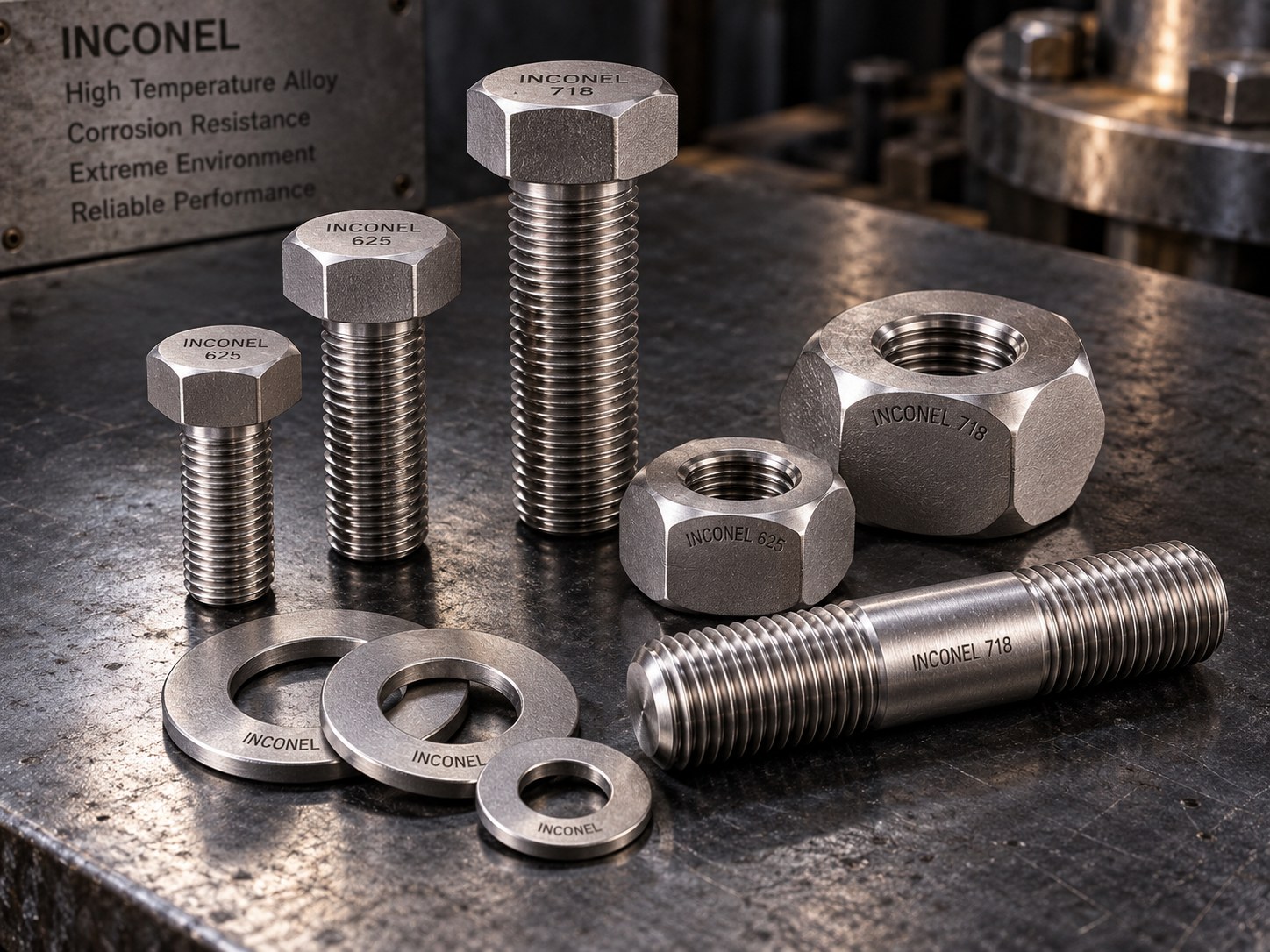
Inconel 718 and Inconel 625 are the two most widely specified nickel‑based superalloys for high‑performance fasteners. Yet they are fundamentally different in how they derive their strength, withstand temperature, and resist corrosion. Selecting the wrong grade can lead to premature failure, costly downtime, or unnecessary overspending. As a specialized manufacturer of both alloys, RAYCHIN LIMITED provides this definitive technical comparison to help engineers make the right choice with confidence.
1. Chemical Composition and Strengthening Mechanisms: The Fundamental Difference
Although both are nickel‑chromium alloys, the strengthening philosophy and chemistry set them apart:
- Inconel 718 (UNS N07718) is precipitation‑hardenable. It contains ~5.3% niobium (Nb) and smaller amounts of aluminum and titanium. During aging, gamma‑double‑prime (γ″) and gamma‑prime (γ′) phases precipitate, providing exceptional strength up to 704°C. This heat treatment is what gives 718 its remarkable tensile properties.
- Inconel 625 (UNS N06625) is primarily solid‑solution strengthened with ~9% molybdenum (Mo) and ~3.7% niobium. While it can gain some strength from cold work, 625 does not respond to aging heat treatment. Its strength in the annealed condition is moderate, but its corrosion resistance is outstanding.
2. Mechanical Properties: Strength and Hardness Face‑Off
For fasteners, tensile and yield strength dictate load‑carrying capacity and preload capability.
Key takeaway: Inconel 718 provides roughly double the yield strength of annealed 625 and significantly higher hardness. If your joint demands high preload or minimal flange thickness, 718 is the clear winner. However, 625's lower hardness can be beneficial in galling‑sensitive applications when properly managed.
3. Corrosion Resistance: Each Excels in Different Environments
Inconel 625's high molybdenum content (8‑10%) gives it superior resistance to pitting and crevice corrosion in seawater and chloride‑rich environments. It is virtually immune to stress corrosion cracking in marine atmospheres. Inconel 718, while highly resistant to chloride SCC due to its nickel content, has lower molybdenum and may pit under severe stagnant seawater conditions.
Conversely, Inconel 718 offers outstanding resistance to high‑temperature oxidation and sulfidation, and it performs well in sour service (NACE MR0175) when appropriately heat‑treated. For applications involving hot sulfuric acid or wet flue gas, 625 is often preferred; for extreme high‑temperature strength combined with moderate oxidation, 718 leads.
4. Application Domain Matrix
5. Expert Guidance from RAYCHIN
In summary, if your application demands extreme high‑temperature strength, fatigue resistance, and high preloads, Inconel 718 is the premier choice. If seawater corrosion, broad chemical resistance, and moderate strength are the primary requirements, Inconel 625 offers a more cost‑effective solution. Both alloys are stocked and manufactured by RAYCHIN LIMITED, and we ensure every batch meets the relevant AMS, ASTM, and NACE specifications.
Our engineers are ready to analyze your operating temperature, pressure, and media to recommend the optimal alloy—saving you from overspending on unnecessary alloy upgrades or, worse, suffering a fastener failure.
Send your design requirements to our technical team. We'll return a detailed alloy recommendation, competitive quote, and delivery schedule within 24 hours.
✉️ sales@ray-chin.com? www.ray-chin.com | Expert Alloy Selection · Certified Inconel Fasteners
Request A Quote! We'll respond as soon as possible(within 12 hours)
Get a Quote