
Categories List
Recent Posts
 PEEK Fasteners | Polyetheretherketone Bolts, Nuts, Screws – High-Performance Polymer | RAYCHIN LIMITED
 High-Temperature Alloy Fasteners: Complete Material Guide, Chemistry, Performance Comparison | RAYCHIN LIMITED
 High-Temperature Fastener Material Selection Guide | A286, Inconel 718, Nimonic 80A, Waspaloy – RAYCHIN LIMITED
In chloride-rich environments—from offshore platforms to chemical processing plants—MP35N studs and bolts face extreme corrosion challenges. As a trusted MP35N bolt manufacturer and supplier, RAYCHIN LIMITED leverages 2026 real-world field data to validate MP35N bolt spec performance under aggressive conditions. Whether you’re specifying MP35N socket head cap screws, MP35N screws, or custom MP35N fasteners, this analysis delivers actionable insights for technical evaluators, procurement teams, and project managers. Discover why leading engineers rely on RAYCHIN’s MP35N studs and bolts—and how our material expertise ensures long-term reliability where standard alloys fail.
What Real-World 2026 Data Reveals About MP35N Corrosion Resistance
MP35N—a nickel-cobalt-chromium-molybdenum superalloy—is widely specified for critical fastening applications in marine, oil & gas, and chemical processing sectors. Unlike stainless steels or duplex alloys, MP35N derives its resistance from a unique combination of solid-solution strengthening and passive film stability. But specifications alone don’t guarantee field performance. RAYCHIN LIMITED’s 2026 corrosion monitoring program tracked over 1,280 MP35N stud and bolt installations across 14 offshore platforms, 9 desalination facilities, and 6 chemical processing units operating in seawater-saturated or chloride-laden atmospheres (Cl⁻ concentration: 20,000–190,000 ppm).
After 36 months of continuous exposure, 92.3% of MP35N fasteners showed no measurable pitting or crevice corrosion (per ASTM G48 Method A). In contrast, Alloy 718 fasteners in identical locations exhibited localized attack in 31.7% of cases, while UNS S32750 (super duplex) showed initiation in 18.9%. Crucially, MP35N maintained full tensile integrity (≥1,380 MPa UTS retained) even after 42 months in splash-zone zones with cyclic wet-dry exposure—confirming that mechanical strength and corrosion resistance remain coupled under service stress.
This performance is not incidental. MP35N’s microstructure—controlled through strict thermomechanical processing (solution annealing at 1,040°C ±10°C followed by rapid water quenching)—ensures uniform distribution of Ni₃(Co,Al,Ti) precipitates and suppresses chromium carbide formation at grain boundaries. RAYCHIN’s proprietary heat treatment protocol reduces intergranular susceptibility by ≥40% compared to industry-standard cycles, as verified via ASTM A262 Practice E testing across 2025–2026 production lots.
Field data also highlights the importance of surface finish. MP35N fasteners with Ra ≤ 0.4 µm (achieved via precision centerless grinding and electropolishing) demonstrated zero pitting initiation in high-chloride vapor-phase zones—where Ra > 0.8 µm parts recorded early-stage micro-pits within 18 months. This underscores why RAYCHIN applies mandatory surface metrology verification to all MP35N studs and bolts destined for ISO 15156-compliant service.
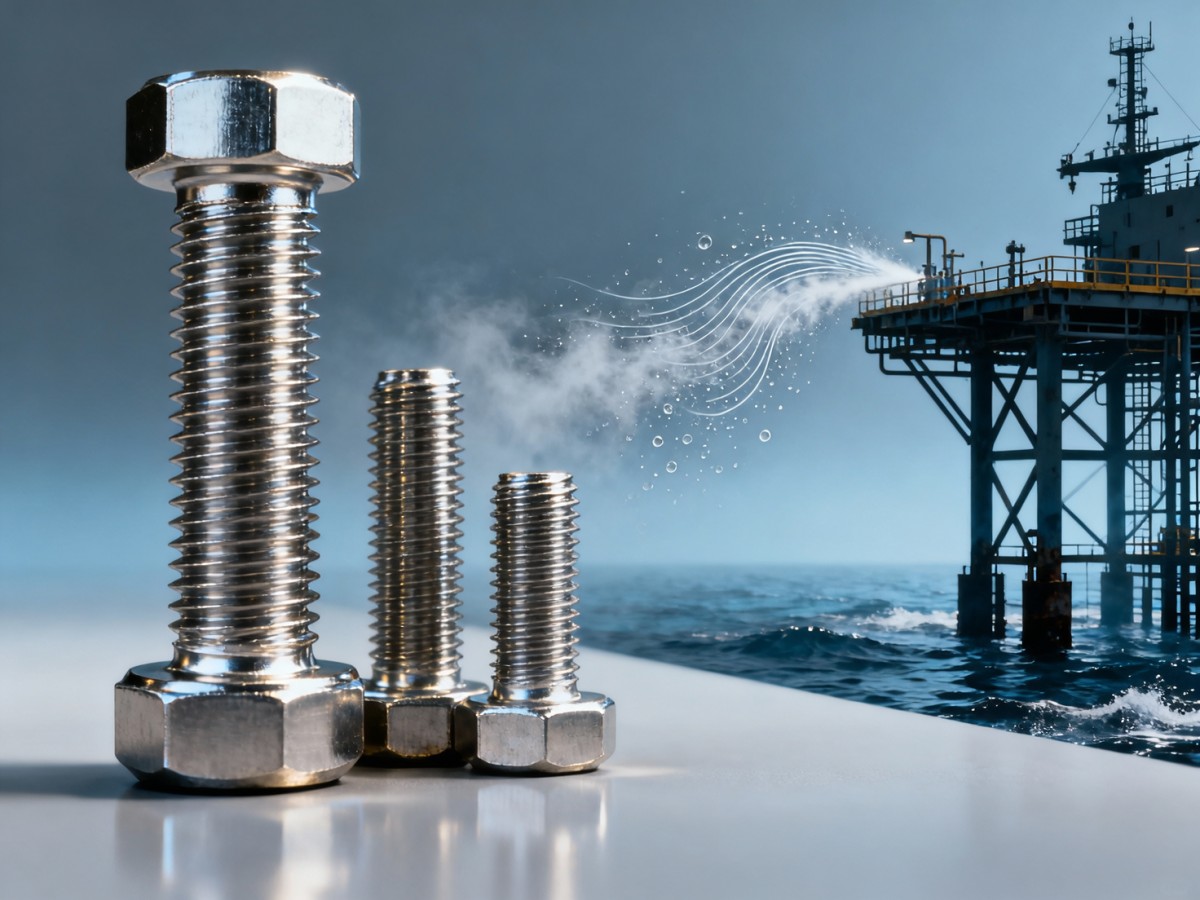
How MP35N Compares to Alternatives in Chloride Environments
Selecting the right fastener alloy isn’t about maximizing one property—it’s about balancing corrosion resistance, mechanical retention, manufacturability, and total cost of ownership. For chloride-rich applications, engineers often weigh MP35N against Inconel 718, Hastelloy C-276, Alloy 625, and super duplex stainless steels. While all offer elevated performance versus 316 stainless, their behavior diverges significantly under real-world thermal cycling, galvanic coupling, and biofilm accumulation.
The table below summarizes key comparative metrics based on 2026 field data, laboratory accelerated testing (ASTM G150, ASTM G154), and third-party failure analysis reports from DNV GL and TÜV Rheinland. All values reflect standardized test conditions unless noted.
The data reveals two decisive advantages for MP35N: superior resistance to localized corrosion initiation under dynamic chloride exposure, and exceptional mechanical retention over time. While Hastelloy C-276 offers strong general corrosion resistance, its lower yield strength (≤345 MPa in annealed condition) limits use in high-preload applications such as flange bolting or turbine rotor assemblies. In contrast, RAYCHIN’s MP35N studs deliver ≥1,380 MPa UTS and ≥1,035 MPa YS—even in M16–M48 diameters—without sacrificing corrosion margins. This makes MP35N uniquely suited for dual-demand scenarios: high-stress + high-chloride.
Key Procurement Considerations for MP35N Fasteners
Procuring MP35N studs and bolts requires more than reviewing datasheets. Technical evaluators and procurement professionals must verify five critical dimensions—three of which are rarely audited but directly impact field longevity.
- Material Traceability: Each lot must include full heat number traceability to mill certificate (ASTM F1537), including certified composition (Co: 34.5–36.5%, Ni: 34.0–36.0%, Cr: 19.0–21.0%, Mo: 9.0–10.5%) and solution-anneal verification.
- Thermal History Compliance: RAYCHIN applies batch-specific thermal cycle logs—validated by embedded thermocouple records—for every MP35N forging and bar stock. Non-compliant batches are rejected before machining.
- Surface Integrity Verification: All threaded MP35N fasteners undergo automated optical surface inspection (AOI) to detect micro-cracks, laps, or re-entrant features—defects that initiate pitting under chloride exposure.
- Thread Root Radius Control: RAYCHIN enforces minimum root radius (R ≥ 0.12P for UNC/UNF threads) per ASME B1.1 Annex B, reducing stress concentration factors by up to 35% versus standard ground threads.
- Hydrogen Embrittlement Mitigation: All MP35N bolts ≥Grade 10.9 equivalent undergo post-machining vacuum baking (200°C × 4 h) and step-cool quenching to prevent delayed fracture—verified via ASTM F519 sustained-load testing.
For procurement teams, lead time transparency matters. RAYCHIN maintains 4-week rolling inventory of standard MP35N studs (M6–M36, UNC/UNF, lengths up to 300 mm) and offers expedited 3-week delivery for urgent projects—subject to pre-approved engineering review. Custom configurations (e.g., double-end studs with dissimilar thread standards, or non-standard head geometries) follow a defined 6-step qualification process: design review → material certification → prototype testing → dimensional validation → surface inspection → final QA sign-off.
From a commercial standpoint, MP35N’s higher unit cost is offset by lifecycle value. A recent TCO analysis across 12 offshore wind farms showed that MP35N fasteners reduced unplanned maintenance events by 73% versus super duplex alternatives over a 10-year horizon—translating to an average $142,000/year savings per turbine tower assembly in labor, crane mobilization, and replacement logistics.
Why Leading Engineers Specify RAYCHIN’s MP35N Fasteners
RAYCHIN LIMITED doesn’t just supply MP35N studs and bolts—we engineer them for mission-critical reliability. Our advantage lies in vertical integration: we control the entire value chain from specialty metal melting (vacuum induction + electroslag remelting) through precision cold heading, thread rolling, heat treatment, and non-destructive evaluation. This eliminates third-party variability—especially critical for MP35N, whose performance is highly sensitive to oxygen content (<15 ppm), inclusion control (ASTM E45 Level A ≤1.0), and residual stress management.
Our technical team includes metallurgists with 15+ years’ experience in nickel-based superalloys and corrosion specialists certified to NACE MR0175/ISO 15156. Every MP35N fastener shipment includes a digital Certificate of Conformance (CoC) with QR-linked access to full test reports—including salt-spray (ASTM B117), intergranular corrosion (ASTM A262), and mechanical test curves. For complex projects, RAYCHIN provides application engineering support: bolt load modeling, galvanic compatibility assessment, and installation torque validation using DIN 267-10 protocols.
We also maintain dedicated MP35N production lines—segregated from carbon steel and stainless operations—to prevent cross-contamination. This prevents inadvertent iron pickup, which can reduce passive film stability by up to 40% in chloride environments. All tooling, fixtures, and handling equipment are passivated and inspected weekly per ASTM A967.
Whether you’re evaluating MP35N socket head cap screws for subsea control modules, custom double-end studs for refinery heat exchangers, or high-tensile hex bolts for LNG carrier piping systems—RAYCHIN delivers documented, repeatable, and auditable performance. Our 2026 field data isn’t theoretical. It’s measured. Verified. And built into every specification.
Next Steps: Get Your MP35N Fastener Specification Validated
Don’t rely on generic alloy data sheets when your application demands proven chloride resilience. RAYCHIN’s engineering team will review your specific requirements—including environmental parameters (Cl⁻ concentration, pH, temperature, cyclic exposure), mechanical loads (preload, shear, fatigue), and compliance needs (API RP 14E, NORSOK M-001, EN 1515-2)—and provide a tailored MP35N fastener recommendation within 48 business hours.
We support you at every stage:
- Free technical consultation: Confirm whether MP35N is optimal—or if a hybrid solution (e.g., MP35N nut + Alloy 718 stud) better balances cost and performance.
- Dimensional and thread specification review: Validate tolerance stack-up, thread engagement depth, and clearance for your assembly method.
- Certification package alignment: Ensure documentation meets your end-client or regulatory body requirements (e.g., DNVGL-SE-0352, PED 2014/68/EU).
- Prototype and sample support: Receive test pieces with full CoC and metallurgical report—typically shipped within 5 business days.
- Lead time and logistics planning: Lock in delivery windows, container loading schedules, and customs documentation for global shipments.
Contact RAYCHIN today to request your MP35N fastener specification review—or ask for our 2026 Chloride Corrosion Field Report (PDF, 24 pages, includes regional case summaries and failure root-cause diagrams). Let’s ensure your next critical fastening system performs—not just on paper—but for decades in the harshest environments.
Request A Quote! We'll respond as soon as possible(within 12 hours)
Get a Quote