
Where Waspaloy Bolts Fit in Aerospace Assemblies
In aerospace assemblies where heat, stress, and reliability define project success, selecting the right fastening material is a critical engineering decision.
Waspaloy bolts are widely considered for high-temperature, high-strength applications such as turbine sections, engine hardware, and structural connections exposed to extreme operating conditions.
For project managers and engineering leads, understanding where these fasteners fit can help reduce risk, improve lifecycle performance, and support compliance-driven procurement.
This article explores the practical role of Waspaloy fasteners in demanding aerospace environments, with emphasis on application fit, risk control, and procurement decisions.
Why Project Teams Consider Waspaloy Bolts in Aerospace Programs
Project managers usually evaluate Waspaloy bolts when conventional stainless steels, alloy steels, or lower-grade nickel alloys cannot meet temperature and stress requirements.
The core search intent behind this topic is practical: where do Waspaloy bolts genuinely belong, and when are they unnecessary or excessive?
Aerospace teams rarely select a fastener material for one property alone. They weigh strength, heat resistance, fatigue behavior, corrosion exposure, and compliance risk.
Waspaloy is a nickel-based superalloy known for retaining mechanical strength at elevated temperatures, particularly in environments involving thermal cycling and sustained loading.
For aerospace assemblies, that combination matters because fasteners may sit near engines, exhaust paths, combustion hardware, or systems affected by severe temperature gradients.
The value of Waspaloy bolts is not simply that they are strong. Their value is that they remain reliable where strength loss is unacceptable.
For a project leader, the decision is tied to lifecycle economics. A more expensive fastener can reduce failures, maintenance events, and qualification disruptions.
However, using Waspaloy everywhere is rarely efficient. The right decision depends on location, load path, operating temperature, inspection access, and certification expectations.
This is why application mapping is essential. Waspaloy bolts fit best where high heat, mechanical stress, and consequence of failure are all significant.
The Main Aerospace Assemblies Where Waspaloy Bolts Fit
Waspaloy bolts are most relevant in aerospace zones where fasteners must survive high temperature while maintaining clamp load and fatigue performance over time.
Typical use areas include engine-adjacent assemblies, turbine-related hardware, exhaust components, compressor sections, hot structural interfaces, and specialized mounting points.
In turbine sections, bolts may face sustained elevated temperatures, vibration, and cyclic stress. Ordinary materials can relax, creep, or lose strength prematurely.
Waspaloy provides stronger resistance to temperature-driven degradation, making it suitable for hardware that must retain preload during demanding thermal exposure.
Engine casings, brackets, and support assemblies can also justify Waspaloy when they experience heat transfer, dynamic loads, and critical alignment requirements.
Exhaust assemblies and hot ducting systems may use Waspaloy bolts where oxidation resistance and mechanical stability are required during repeated operating cycles.
In some airframe locations, Waspaloy may be specified near heat-affected zones or systems where fire resistance and high strength are design priorities.
It is less likely to be the first choice for cool, lightly loaded, easily accessible assemblies where titanium or stainless options satisfy requirements.
The practical rule is simple: use Waspaloy bolts where environmental severity and failure consequence justify a premium fastener material.
What Makes Waspaloy Suitable for High-Temperature Fastening
Waspaloy belongs to the family of precipitation-hardened nickel-based superalloys. Its chemistry is designed to support strength at temperatures beyond ordinary alloys.
The alloy typically contains nickel, cobalt, chromium, molybdenum, titanium, and aluminum, with strengthening phases formed through controlled heat treatment.
For fastener applications, this metallurgical structure helps resist tensile failure, creep deformation, and stress relaxation under elevated-temperature service conditions.
Creep resistance is especially important. A bolt that slowly elongates under heat and load can lose clamp force and compromise assembly integrity.
Stress relaxation is another project concern. Even if the bolt does not fracture, reduced preload can trigger vibration, leakage, or misalignment.
Waspaloy bolts are selected because they help maintain fastening performance where temperature would otherwise weaken the joint over time.
The alloy also offers oxidation resistance, which supports service life in hot gas or engine-adjacent environments where surface degradation can accelerate failure.
For engineering leads, these properties translate into fewer unexpected maintenance findings and stronger confidence during qualification and operational review.
The material advantage is therefore operational, not theoretical. It protects joint function in assemblies where heat and stress interact continuously.
How Waspaloy Bolts Support Reliability and Risk Reduction
In aerospace projects, fastener failure is rarely isolated. One failed joint can create delays, inspections, redesigns, documentation updates, and supplier investigations.
Project managers care about schedule risk as much as material performance. Waspaloy bolts can reduce uncertainty in high-severity fastening locations.
The primary reliability benefit is stable mechanical behavior under harsh operating conditions. This supports predictable joint performance across service intervals.
When fasteners retain preload, connected components experience less movement, lower vibration damage, and reduced risk of fretting at critical interfaces.
In engine-related assemblies, small changes in alignment or clamp force can affect sealing, vibration response, thermal distortion, and inspection outcomes.
Using Waspaloy bolts in the correct locations helps protect those interfaces from gradual degradation that may not appear during initial installation.
Risk reduction also involves procurement traceability. High-performance aerospace fasteners require proper material certification, heat treatment records, and dimensional control.
A strong supplier should provide documentation that supports audits, customer review, incoming inspection, and long-term program quality requirements.
For project teams, the right Waspaloy fastener is not just a part number. It is a controlled technical and supply-chain decision.
When Waspaloy Bolts Are Preferable to Stainless Steel or Alloy Steel
Stainless steel fasteners offer corrosion resistance and availability, but many grades lose meaningful strength at temperatures common in aerospace hot sections.
Alloy steel bolts can provide high room-temperature strength, yet they may require coatings and may not tolerate oxidation or high heat well.
Waspaloy bolts become preferable when the joint must retain strength under sustained high temperature, not merely survive short thermal exposure.
They are also relevant when creep resistance is more important than basic tensile strength measured at ambient laboratory conditions.
A stainless or alloy steel bolt may appear acceptable on a procurement sheet but fail the broader service-environment comparison.
Project leaders should ask whether the fastener will experience heat soak, rapid thermal cycling, vibration, corrosive gases, or inaccessible service locations.
If the answer includes several of these conditions, Waspaloy deserves serious evaluation, especially where maintenance access is limited.
However, if operating temperatures remain moderate and the joint is not mission critical, Waspaloy may add cost without proportional benefit.
The best choice is not the strongest alloy on paper. It is the alloy that matches the real service environment.
Comparing Waspaloy Bolts with Inconel and Other Nickel Alloy Fasteners
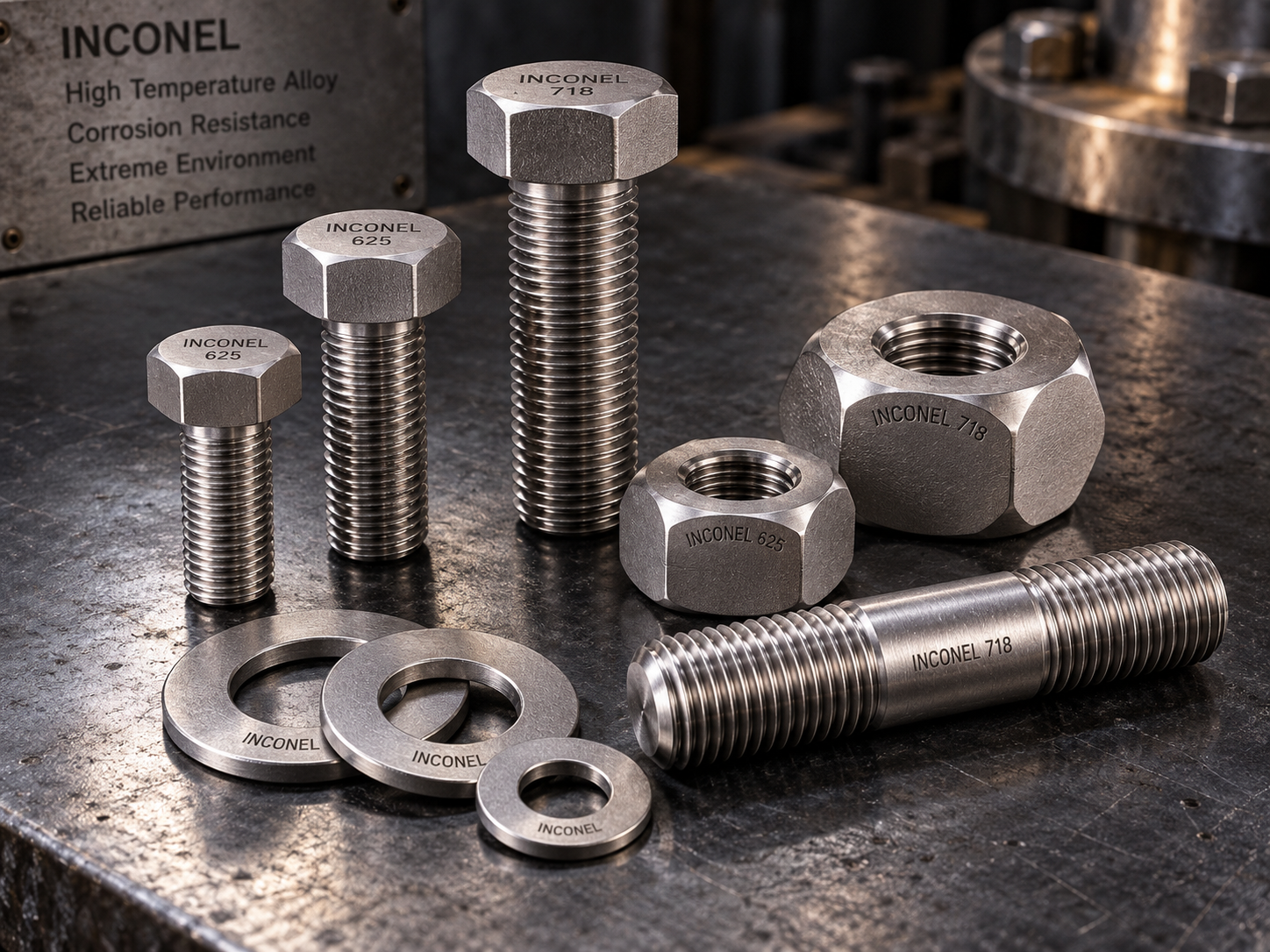
Aerospace teams often compare Waspaloy bolts with Inconel fasteners, especially Inconel 718, because both serve demanding high-temperature applications.
Inconel 718 is widely used, well understood, and often selected for strength, corrosion resistance, and availability across aerospace specifications.
Waspaloy is commonly considered when higher temperature capability and resistance to stress relaxation are particularly important in the assembly.
The decision is not always about which alloy is superior. It is about matching performance priorities to operating conditions.
If a joint operates at elevated temperatures where long-term preload retention is critical, Waspaloy may offer a stronger technical case.
If the assembly requires a balance of strength, availability, manufacturability, and broad specification familiarity, Inconel 718 may remain competitive.
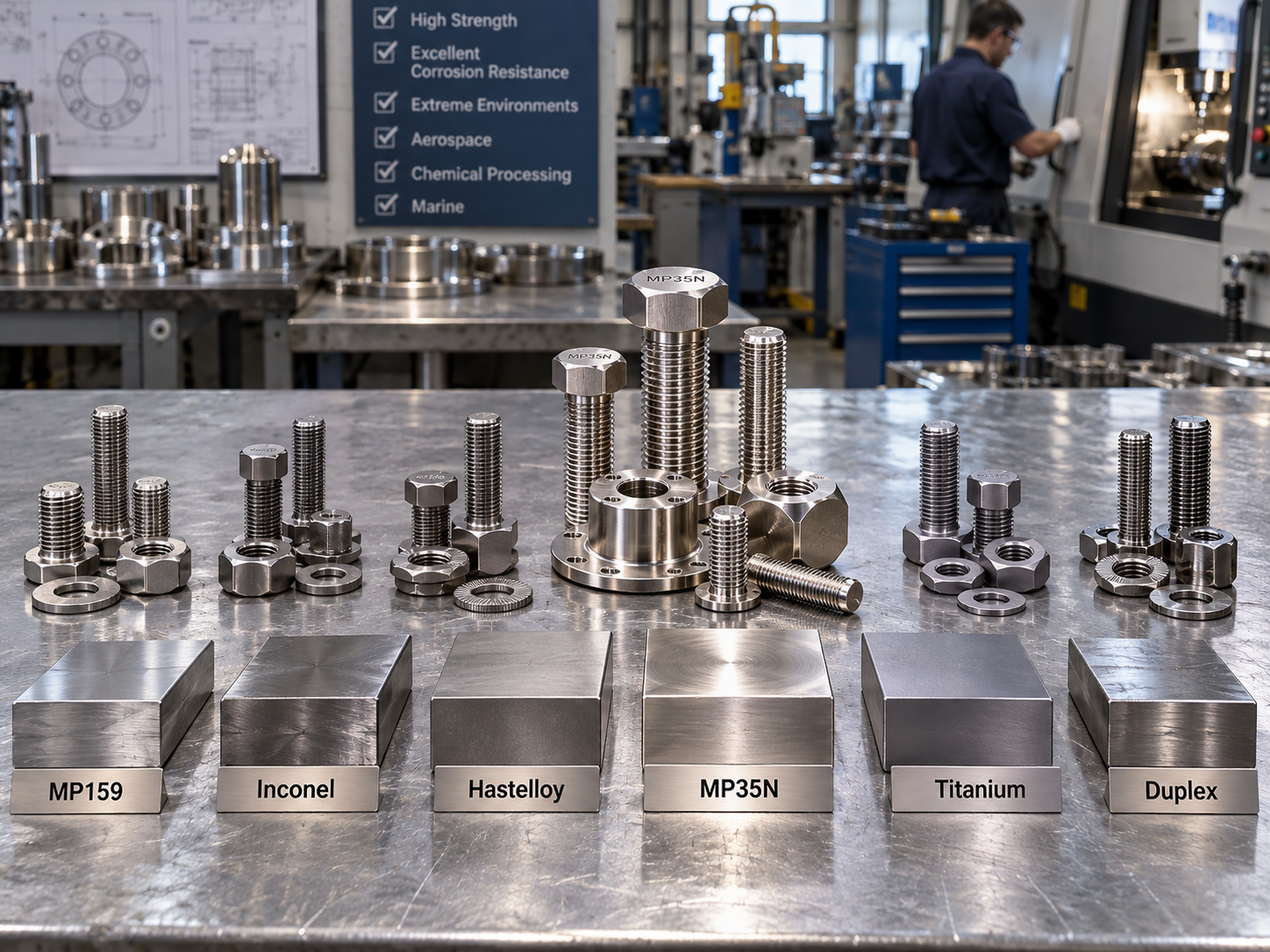
Other nickel alloys may serve corrosion-dominant environments, while Waspaloy is usually associated with heat, strength, and creep-related challenges.
Engineering teams should avoid substitution without review. Similar alloy families can have different heat treatments, strengths, and service limitations.
For procurement managers, approved material equivalency must come from engineering authority, not from price comparison or supplier convenience.
Key Selection Criteria Before Specifying Waspaloy Bolts
Before specifying Waspaloy bolts, project teams should define the assembly environment more clearly than a general phrase like “high temperature.”
The actual temperature range, peak exposure, duration, thermal cycling frequency, and surrounding atmosphere all affect material suitability.
Load conditions also matter. Engineers should identify tensile loads, shear loads, vibration exposure, fatigue cycles, and required clamp force.
Joint design must be reviewed because even excellent fastener material cannot compensate for poor preload strategy or unsuitable thread engagement.
Fastener size, thread form, head style, shank length, tolerance class, and surface finish should align with assembly drawings and standards.
Heat treatment condition is critical for Waspaloy. Improper processing can undermine the properties that justified the material selection.
Project managers should ensure that purchasing requirements include applicable specifications, certification documents, inspection criteria, and packaging expectations.
If the program is safety-critical, the supplier should understand aerospace documentation discipline and the importance of batch traceability.
A good selection process begins with performance conditions and ends with controlled procurement, rather than starting with generic material availability.
Procurement Considerations for Aerospace Project Managers
For project managers, Waspaloy bolts introduce procurement questions that go beyond unit price and delivery time.
Availability can vary because specialty metal fasteners often require controlled production, certified raw material, heat treatment, and inspection processes.
Lead time should be discussed early, especially for customized dimensions, nonstandard heads, specific thread requirements, or program-specific documentation packages.
A reliable supplier should clarify whether parts are standard stock, make-to-order, or subject to minimum production quantities.
Documentation requirements should be defined before purchase order release. Missing certificates can delay acceptance even when the parts are physically correct.
Typical documentation may include material test reports, chemical composition, mechanical test data, heat treatment records, dimensional inspection, and traceability information.
Project teams should also clarify whether additional testing is required, such as hardness checks, tensile testing, or non-destructive examination.
Packaging and identification matter because aerospace fasteners can be small, similar in appearance, and highly sensitive to traceability errors.
The procurement goal is not simply to buy Waspaloy bolts. It is to receive compliant fasteners without introducing schedule risk.
Manufacturing and Quality Factors That Affect Performance
Waspaloy is not the easiest material to manufacture. Its strength and heat resistance can make forming, machining, and threading more demanding.
Fastener quality depends on controlled material sourcing, accurate forging or machining, proper heat treatment, and careful thread production.
Thread quality is especially important because aerospace bolts concentrate stress around threaded regions. Poor thread geometry can reduce fatigue performance.
Surface integrity also matters. Cracks, laps, tool marks, or improper finishing can become initiation points under cyclic loading.
Heat treatment must be aligned with required mechanical properties. Deviations can produce fasteners that appear dimensionally acceptable but underperform in service.
Inspection should confirm both dimensional compliance and material condition, particularly when bolts are used in critical hot-section assemblies.
For customized Waspaloy bolts, early engineering communication helps prevent manufacturability problems, tolerance conflicts, and unnecessary production delays.
Experienced suppliers can advise on practical design adjustments while maintaining required performance and compliance boundaries.
RAYCHIN LIMITED supports this type of technical selection by combining specialty metals knowledge with fastener manufacturing and global distribution capability.
Cost, Lifecycle Value, and Return on Material Investment
Waspaloy bolts are typically more expensive than conventional fasteners, so project teams need a lifecycle-based justification.
The correct question is not whether Waspaloy costs more. It is whether the application risk costs more than the material premium.
In critical aerospace assemblies, premature fastener degradation can cause rework, downtime, inspection burden, warranty exposure, or certification complications.
If Waspaloy reduces those risks, its return on investment may appear through fewer maintenance actions and more predictable program performance.
Lifecycle value is strongest when replacement is difficult, operating conditions are severe, or failure consequences are expensive.
For accessible, low-temperature joints, the same premium may not be justified because simpler materials can perform adequately.
Project managers should classify fasteners by criticality instead of applying the same purchasing logic across all assemblies.
A tiered approach helps allocate premium materials where they produce measurable reliability and risk-management benefits.
This approach supports both engineering quality and budget discipline, which is essential in complex aerospace programs.
Common Misjudgments When Applying Waspaloy Bolts
One common mistake is assuming that any high-strength bolt can replace another if dimensions appear similar.
In aerospace assemblies, material behavior under temperature, fatigue, and oxidation can be more important than static strength ratings.
Another mistake is selecting Waspaloy bolts without reviewing mating materials, galvanic compatibility, coatings, lubricants, and installation procedures.
Fastener performance depends on the complete joint system. The bolt, nut, washer, surface condition, and preload method all interact.
Some teams also underestimate lead time. Specialty fasteners may require material procurement and production steps that cannot be compressed easily.
Others overlook documentation, discovering too late that received parts lack certificates needed for customer acceptance or regulatory review.
There is also a risk of over-specification. Using Waspaloy where it is unnecessary can increase cost and complicate sourcing.
The best practice is to connect every Waspaloy requirement to a specific operating condition, engineering rationale, or compliance need.
This prevents both under-selection and over-selection, helping project teams balance performance, cost, and schedule.
How to Decide Whether Waspaloy Bolts Fit Your Assembly
A practical decision framework begins by identifying whether the fastener sits in a hot, loaded, vibrating, or difficult-to-service location.
If the assembly involves sustained elevated temperature and critical clamp retention, Waspaloy bolts should move higher on the candidate list.
If the environment is mainly corrosive but not extremely hot, another nickel alloy may be more cost-effective or specification-friendly.
If the joint is cool, lightly loaded, and easily accessible, Waspaloy may be technically capable but economically unnecessary.
Next, confirm whether existing aerospace specifications, customer standards, or internal engineering rules already define acceptable fastener materials.
Then evaluate procurement feasibility, including lead time, quantity, certification requirements, and supplier experience with specialty metal fasteners.
Finally, consider lifecycle consequences. High criticality, difficult replacement, and severe operating conditions strengthen the business case for Waspaloy.
Project managers should document the decision logic so procurement, quality, engineering, and customer stakeholders share the same rationale.
This structured approach reduces debate, supports audits, and helps avoid rushed substitutions late in the project schedule.
Why Supplier Capability Matters for Waspaloy Fasteners
Supplier selection is especially important when dealing with Waspaloy bolts because material value depends on correct processing and documentation.
A supplier should understand specialty metals, not merely offer a catalog listing. Technical support can prevent costly specification mistakes.
RAYCHIN LIMITED focuses on standard and customized fasteners made from high-performance specialty metals for demanding global applications.
For aerospace-related projects, that capability supports teams needing guidance on material selection, production feasibility, and compliance-oriented procurement.
Customized fasteners may be required when standard dimensions, head configurations, or thread forms do not match assembly constraints.
In these cases, early supplier involvement can identify whether a design is practical, certifiable, and manufacturable within program timing.
Technical communication should include drawings, operating conditions, required standards, quantities, target delivery, and inspection expectations.
The right supplier helps convert an engineering requirement into a reliable, traceable, and deliverable fastener solution.
For project managers, this reduces uncertainty and improves coordination between engineering intent and purchasing execution.
Application Checklist for Engineering and Project Review
Before approving Waspaloy bolts, project teams should run a focused review covering temperature, load, fatigue, corrosion, access, and criticality.
The temperature profile should include maximum exposure, continuous operating range, startup and shutdown cycles, and possible abnormal conditions.
The mechanical review should confirm tensile and shear requirements, preload targets, vibration environment, fatigue expectations, and joint stiffness assumptions.
The material review should examine compatibility with mating components, washers, nuts, lubricants, coatings, and any environmental exposure.
The compliance review should confirm specifications, drawing notes, certification requirements, testing expectations, and customer approval requirements.
The procurement review should confirm supplier capability, lead time, minimum order quantity, traceability, inspection process, and packaging control.
The maintenance review should consider access difficulty, inspection interval, replacement cost, and consequences of preload loss or fastener degradation.
If most of these factors indicate severe service, Waspaloy bolts may offer strong technical and commercial justification.
If only one factor appears demanding, the team should compare alternative alloys before committing to a premium solution.
Conclusion: Where Waspaloy Bolts Fit Best
Waspaloy bolts fit best in aerospace assemblies where high temperature, sustained stress, vibration, and critical reliability requirements overlap.
They are especially relevant for turbine-related hardware, engine-adjacent structures, exhaust systems, hot-section brackets, and specialized high-load connections.
Their value comes from retaining strength, resisting creep, reducing stress relaxation, and supporting stable clamp performance under severe service conditions.
For project managers, the decision should be based on lifecycle risk, compliance needs, maintenance consequences, and total project value.
Waspaloy is not the default answer for every aerospace fastener. It is a targeted solution for assemblies where ordinary materials create unacceptable risk.
A successful selection process connects engineering conditions with procurement discipline, supplier capability, documentation control, and realistic lead-time planning.
When used in the right locations, Waspaloy bolts can help aerospace teams improve reliability, reduce uncertainty, and protect demanding program outcomes.