
Categories List
Recent Posts
 Hastelloy C276 Fasteners: Bolts, Nuts, Screws, Studs & Washers for the World's Most Aggressive Corrosive Environments
 Inconel Fasteners: Bolts, Nuts, Washers, Studs – Complete Technical Guide | RAYCHIN LIMITED
 MP35N vs Inconel, Titanium, C276, Complete Material Comparison Guide for Fasteners | RAYCHIN LIMITED
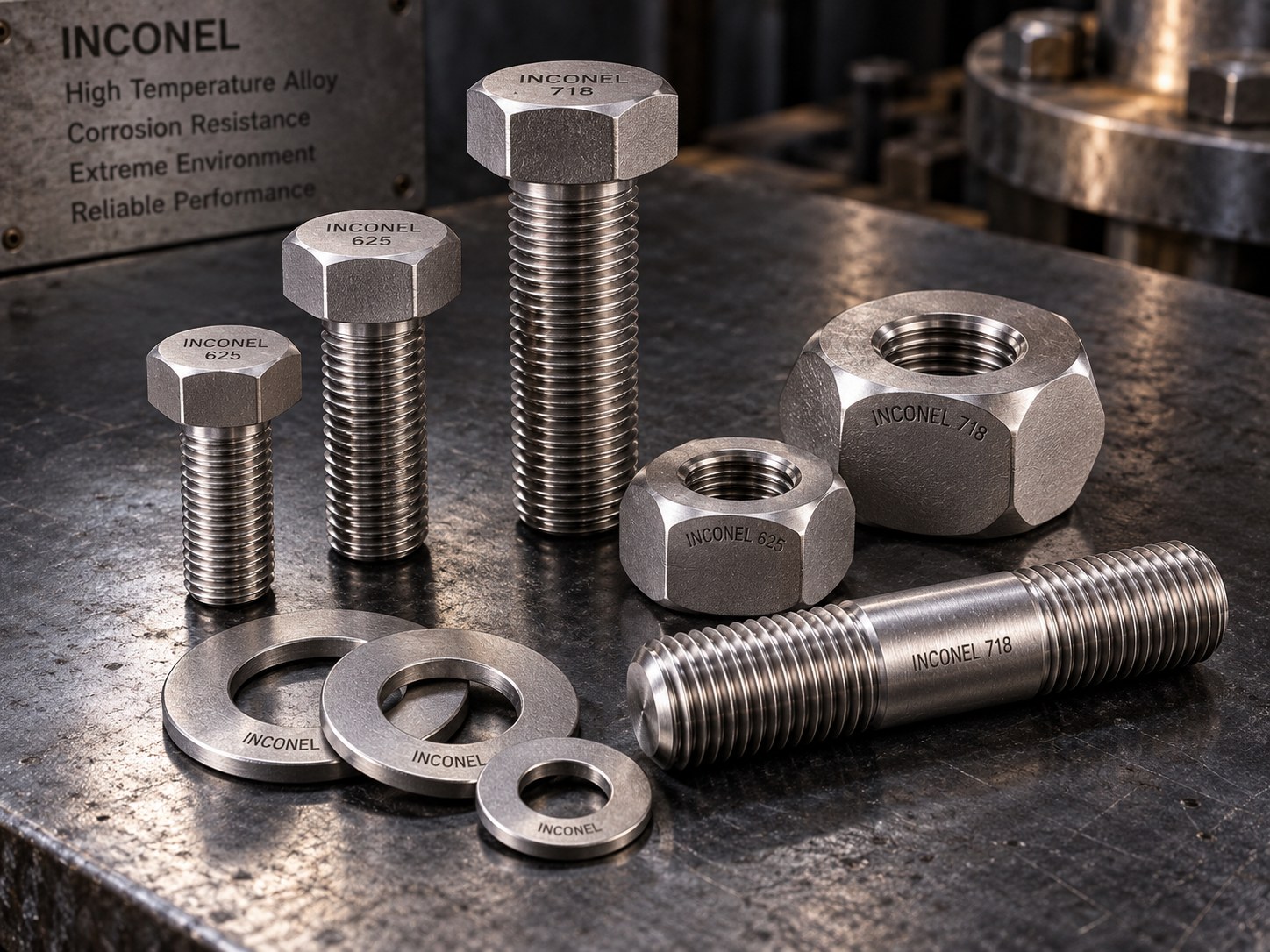
Choosing the right Inconel 718 bolts for high-heat service requires more than matching size and strength. In real operating conditions, the best choice depends on temperature range, load profile, corrosion exposure, required standards, and how well the fastener can hold preload over time. For engineers, buyers, and project teams, the practical question is not simply whether Inconel 718 is a “high-temperature alloy,” but whether it is the right bolt material for a specific service window compared with options such as Inconel 625 bolts or other specialty metal fasteners. This guide focuses on the factors that matter most in specification, procurement, and long-term reliability.
What matters most when choosing Inconel 718 bolts for high-heat service?
The core search intent behind this topic is practical selection: readers want to know how to determine whether Inconel 718 bolts are suitable for demanding high-temperature applications, how they compare with alternatives, and what technical and commercial checkpoints should be reviewed before ordering.
For most target readers, the biggest concerns are:
- Will the bolts keep strength and clamp load at operating temperature?
- Can they resist oxidation, scaling, and corrosive media in actual service?
- Are Inconel 718 fasteners better than Inconel 625 bolts for this application?
- What standards, testing, and traceability documents should be required from inconel bolts suppliers?
- How can they avoid over-specifying, under-specifying, or buying inconsistent material?
In short, the right decision comes from balancing temperature capability, mechanical retention, environment, compliance, manufacturability, and total lifecycle cost. If the application involves sustained high loads, thermal cycling, and elevated temperatures where relaxation resistance matters, Inconel 718 fasteners are often a strong candidate. But if the environment is more corrosion-driven than strength-driven, another nickel alloy may be more cost-effective.
Why Inconel 718 is widely used in high-temperature bolting
Inconel 718 is a nickel-chromium alloy known for combining high strength, oxidation resistance, and good mechanical performance at elevated temperatures. In bolting service, this matters because a fastener is not only expected to survive heat; it must also maintain preload, resist deformation, and support joint integrity over long operating cycles.
Key reasons engineers choose Inconel 718 bolts include:
- High tensile and yield strength compared with many other corrosion-resistant alloys
- Good resistance to oxidation and scaling in high-heat environments
- Useful performance under thermal cycling where dimensional and load stability are critical
- Suitability for severe service sectors such as petrochemical, power generation, offshore, aerospace-related systems, and heat-processing equipment
For applications in metal processing equipment and other thermal systems, these properties can reduce the risk of bolt loosening, flange leakage, unscheduled shutdowns, and maintenance frequency.
How to judge whether Inconel 718 is right for your actual service conditions
The most effective way to select a high-temperature fastener is to evaluate the service environment as a system, not just a material label. Start with the following questions:
- What is the real operating temperature, and for how long?
Peak temperature and continuous operating temperature may lead to different material decisions. Intermittent heat spikes are not the same as prolonged elevated-temperature exposure. - Is the joint carrying a high sustained load?
If the application requires reliable preload retention under heat, strength at temperature becomes more important than room-temperature mechanical values. - Will the bolts face oxidation only, or corrosion plus heat?
Some services involve steam, salts, sulfur-bearing media, process chemicals, or marine contamination. This may shift material selection. - Is thermal cycling frequent?
Repeated heating and cooling can promote relaxation, galling concerns, and sealing performance issues. - What are the certification and compliance requirements?
Critical industries may require full traceability, heat treatment records, material test reports, and dimensional inspection.
If the service combines elevated temperature, structural loading, and the need for long-term fastening integrity, Inconel 718 fasteners are often favored. If corrosion resistance is the priority and the required mechanical strength is lower, an alternative such as Inconel 625 bolts may deserve consideration.
Inconel 718 bolts vs. Inconel 625 bolts: which is better?
This is one of the most common evaluation questions. The answer depends on what is driving failure risk in the application.
Choose Inconel 718 bolts when:
- High strength is a primary requirement
- The joint must maintain preload under heat
- Mechanical performance at elevated temperature is more critical than maximizing corrosion resistance
- The fasteners are part of a heavily loaded assembly
Choose Inconel 625 bolts when:
- Exceptional corrosion resistance is the main requirement
- The environment is highly aggressive chemically
- Strength demand is important but lower than in heavily stressed bolted joints
- The project prioritizes corrosion durability across mixed media exposure
In practical purchasing and engineering terms, Inconel 718 is often selected for high-strength, high-heat bolting, while Inconel 625 is often considered when corrosion resistance leads the material decision. A reliable supplier should be able to explain this tradeoff based on real service data rather than generic alloy descriptions.
What specifications and quality checks should buyers and engineers review?
Even the right alloy can fail if the fastener is poorly processed, incorrectly heat-treated, or insufficiently documented. When sourcing from inconel bolts suppliers, buyers and technical teams should verify more than price and lead time.
Important checkpoints include:
- Material grade confirmation and chemical composition compliance
- Heat treatment condition appropriate to the required mechanical properties
- Mechanical test results including tensile and hardness values where applicable
- Dimensional accuracy for threads, shank, head geometry, and tolerances
- Surface condition and cleanliness, especially for critical sealing or high-integrity joints
- Traceability from raw material to finished fastener batch
- Applicable standards such as ASTM, ASME, DIN, ISO, or project-specific requirements
- Inspection and documentation package including MTRs, inspection reports, and, when needed, third-party verification
For quality managers and safety-focused teams, consistency matters as much as nominal material type. A documented and technically capable manufacturer reduces the risk of hidden variation between batches.
How preload retention, galling, and installation practice affect performance
Fastener selection for high-heat service should never stop at material choice. Installation practice strongly affects whether the bolts perform as intended.
Three practical issues deserve close attention:
- Preload retention: Elevated temperature can reduce clamp force over time. Joint design, tightening method, washer selection, and thermal expansion mismatch all matter.
- Galling risk: Nickel alloy fasteners can be prone to galling under certain installation conditions. Proper lubrication, controlled tightening speed, and good thread quality are important.
- Torque method vs. controlled tensioning: In critical applications, more precise tightening methods may be justified to improve reliability and repeatability.
For operators and maintenance teams, this means the best Inconel 718 bolts can still underperform if installation procedures are not adapted for nickel alloy fasteners. For project managers, this is also a lifecycle cost issue: better installation control can reduce rework, leakage, and shutdown risk.
How to evaluate inconel bolts suppliers before placing an order
When selecting a supplier, the right question is not only “Can they make Inconel bolts?” but “Can they support my application, quality expectations, and documentation requirements with consistency?”
Look for suppliers that can provide:
- Technical support for alloy selection, not just catalog sales
- Custom manufacturing capability for non-standard dimensions or drawings
- Reliable quality control systems and inspection records
- Material knowledge across specialty metals to compare options objectively
- Global supply experience for industrial and project-based procurement
- Responsive communication on lead times, documentation, and after-sales support
For distributors, OEMs, and EPC project teams, supplier capability directly affects procurement risk. A partner with deep specialty metals expertise can help prevent expensive specification errors and support better total-cost decisions.
Common mistakes to avoid when specifying Inconel 718 fasteners
Several avoidable mistakes appear repeatedly in high-temperature bolting projects:
- Choosing based only on room-temperature strength data
- Ignoring preload loss at service temperature
- Assuming all nickel alloys perform the same
- Overlooking corrosion details in mixed or contaminated environments
- Failing to define testing, certification, or traceability requirements before purchase
- Using standard installation procedures without considering galling and lubrication
- Selecting on unit price instead of lifecycle reliability
A well-made specification should connect material grade, dimensions, standards, heat treatment, testing, surface condition, and documentation to the actual service demands.
Conclusion: the best choice is application-based, not generic
If your application involves high heat, sustained load, and the need for dependable clamp retention, Inconel 718 bolts are often one of the strongest choices available. If corrosion exposure is the dominant challenge and mechanical demand is lower, Inconel 625 bolts or other specialty alloys may be more suitable. The key is to evaluate real operating conditions, not just compare alloy names.
For engineering teams, purchasers, and decision-makers, the safest approach is to work with experienced inconel bolts suppliers that can support technical review, quality assurance, and application-specific recommendations. With the right specification and supply partner, Inconel 718 fasteners can deliver better safety, longer service life, and lower downtime in demanding high-heat environments.
Request A Quote! We'll respond as soon as possible(within 12 hours)
Get a Quote