
ASTM A453 Grade 660 vs Inconel 718: Which One for High Temperature?

High-temperature fastener selection is a metallurgical balancing act. Engineers must weigh short‑term tensile strength against long‑term creep resistance, oxidation behavior, and cost. At RAYCHIN LIMITED, we manufacture both ASTM A453 Grade 660 (commonly known as A286) and Inconel 718 (UNS N07718) fasteners for global energy, aerospace, and industrial gas turbine markets. Our production experience across these alloys gives us a unique perspective on where each grade truly excels.
This comparison is built from real‑world heat lot data and field feedback, not just datasheet numbers. Whether you are designing exhaust manifolds, steam turbine casings, or HP/HT wellheads, this guide will help you make a confident material decision.
1. Chemistry and Strengthening Mechanisms
The fundamental difference lies in the matrix and precipitates that provide high‑temperature strength.
- ASTM A453 Grade 660 (A286) is an austenitic iron‑nickel‑chromium stainless steel strengthened by gamma‑prime (Ni₃(Al,Ti)). It contains roughly 25% Ni, 15% Cr, with additions of titanium and aluminum. It offers excellent fabrication characteristics and maintains useful strength up to about 700°C (1300°F).
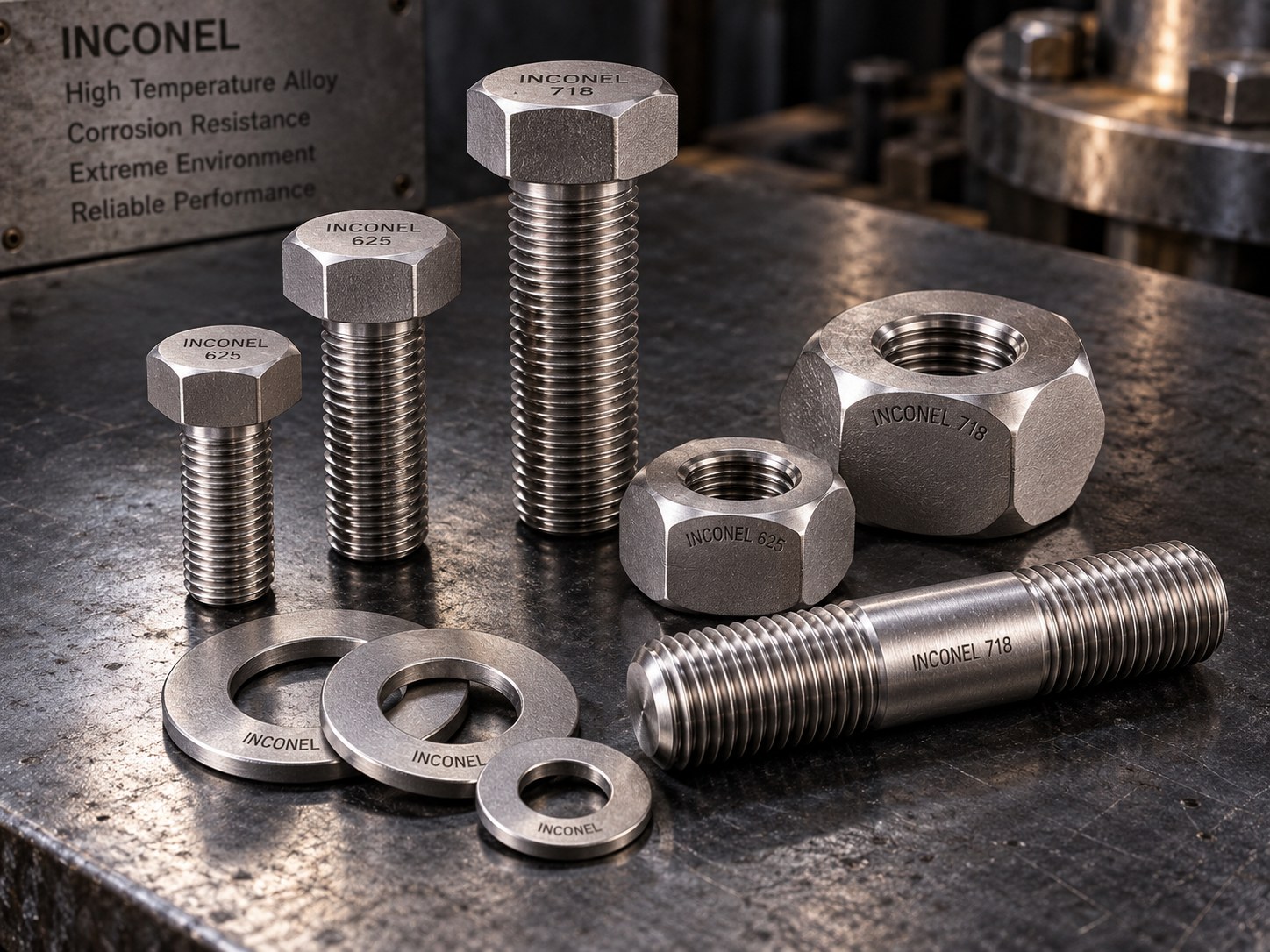
- Inconel 718 is a nickel‑chromium‑iron alloy (min 50% Ni) strengthened primarily by gamma‑double‑prime (Ni₃Nb) and gamma‑prime. Niobium is the key hardener. This gives it significantly higher strength, especially in large cross‑sections, and it retains properties to approximately 760°C (1400°F).
Both alloys rely on precipitation hardening (aging) to reach their full strength. However, the aging response and sensitivity to cooling rate after solution treatment differ, which is critical for fastener manufacturing.
2. Mechanical Properties: Room Temperature vs. Elevated Temperature
Comparing typical mechanical properties for fasteners (bars or forged studs) is essential, but the real picture emerges at temperature.
Inconel 718 is in a different league for load‑carrying capacity at temperatures above 500°C. However, that strength comes with trade‑offs in ductility and notch sensitivity that must be managed through precise heat treatment.
3. Oxidation and Corrosion Resistance
Both alloys resist oxidation through chromium‑rich protective scales. Inconel 718 generally offers superior resistance at the upper end of its temperature range due to higher nickel and chromium content, and it performs better in environments containing chlorides or sulfidation. ASTM A453 Grade 660 can suffer from accelerated oxidation above 700°C, particularly in cyclic conditions.
For applications in refinery heaters, gas turbine hot sections, and chemical plants where sulfur‑bearing atmospheres exist, Inconel 718 is often mandated. However, for clean, dry, elevated‑temperature air service up to 650°C, A286 fasteners deliver reliable performance at a significantly lower material cost.
4. Manufacturability and Fastener Production Experience
RAYCHIN's production floor works daily with both alloys, and we understand their idiosyncrasies intimately:
- A286 (Gr 660) is more forgiving during hot forging and machining. Thread rolling after aging is possible for many sizes, yielding excellent fatigue properties. It also exhibits low susceptibility to strain‑age cracking, making it a reliable workhorse for high‑temperature studs and bolts.
- Inconel 718 requires tightly controlled solution annealing and aging cycles. Even minor deviations in cooling rate from solution temperature can cause a drastic drop in tensile strength or lead to stress rupture brittleness. At RAYCHIN, we apply vacuum or protective atmosphere heat treatment and perform 100% hardness testing on every Inconel 718 fastener to ensure uniformity. Machining this alloy is challenging, and our tooling strategy is optimized specifically for it to maintain thread integrity.
5. Application Guidelines: Where Each Alloy Wins
Based on RAYCHIN's technical support to OEMs and end‑users, here is how we steer selection:
Choose ASTM A453 Grade 660 (A286) When:
- Operating temperature is 538°C–700°C (1000–1300°F) and peak load requirements are moderate.
- You need a cost‑effective, oxidation‑resistant bolting solution for steam turbine shells, exhaust manifolds, or industrial furnaces.
- Good ductility and notch toughness at intermediate temperatures are critical.
- Fastener sizes are very large (e.g., 3"–4" diameter) and Inconel 718 procurement or machinability becomes prohibitive.
Choose Inconel 718 When:
- Sustained temperature exceeds 650°C, or intermittent excursions reach 760°C.
- High clamping forces are needed to maintain gasket seating at elevated temperature (typical in HP/HT wellheads and subsea equipment).
- Sour service (NACE MR0175/ISO 15156) and hydrogen embrittlement resistance are required; Inconel 718 can be qualified per API 6ACRA.
- Aerospace or industrial gas turbine bolting demands the highest strength‑to‑weight ratio.
6. The RAYCHIN Advantage in High‑Temperature Fastener Supply
As a specialist producer and global supplier of special alloy fasteners, RAYCHIN LIMITED bridges the gap between raw material and certified, ready‑to‑install bolting. Our value proposition includes:
- Dual‑alloy competency: We manufacture A286 and Inconel 718 fasteners concurrently, allowing us to offer unbiased material recommendations and consistent quality documentation.
- Full in‑house test reports: Tensile at ambient and elevated temperature, stress rupture, hardness, PMI, and metallography are all available as standard. We also perform ASTM E112 grain size evaluations.
- Global logistics: With distribution hubs in key regions, we shorten lead times for both standard and custom high‑temperature fasteners.
- Code compliance: Material certified to ASTM A453, AMS 5662/5663, API 6A, NORSOK, and customer‑specific specifications.
7. Cost vs. Performance: The Lifecycle Perspective
While Inconel 718 raw material can be three to four times more expensive than Grade 660, the total cost of ownership must account for replacement downtime. In a turbine or refinery shutdown, a single fastener failure can overshadow any initial savings. RAYCHIN supports clients in performing a value analysis, factoring in design life, corrosion allowance, and maintenance intervals. Often, we see hybrid specifications where A286 is used for less critical flanges and Inconel 718 is reserved for the hottest, highest‑stressed joints.
Discuss Your High‑Temperature Fastener Needs
Whether you need ASTM A453 Grade 660 studs or fully traceable Inconel 718 bolts, RAYCHIN's engineering team is ready to support your next project.
Request Material Selection Support? www.ray-chin.com | ✉️ sales@ray-chin.com