
Inconel Fasteners: Bolts, Nuts, Washers & Studs – Complete Technical Guide
A definitive engineering reference for Inconel 600, 601, 625, 718 and 725 fasteners — covering material comparison, high-temperature performance, hydrogen embrittlement, galling prevention, galvanic compatibility, and application selection criteria.
Table of Contents
- Inconel Fastener Product Range
- Material Grades & Standards Overview
- Inconel 625 vs 718 vs 600 vs 601: Complete Comparison
- Mechanical Properties Data
- High-Temperature Performance & Stress Rupture
- Corrosion Resistance in Seawater & Chemical Environments
- Hydrogen Embrittlement: What Engineers Must Know
- Galling Prevention & Assembly Best Practices
- Galvanic Compatibility & Dissimilar Metal Joints
- Cost Comparison & Selection Economics
- Material Selection Decision Matrix
- Frequently Asked Questions
1. Inconel Fastener Product Range
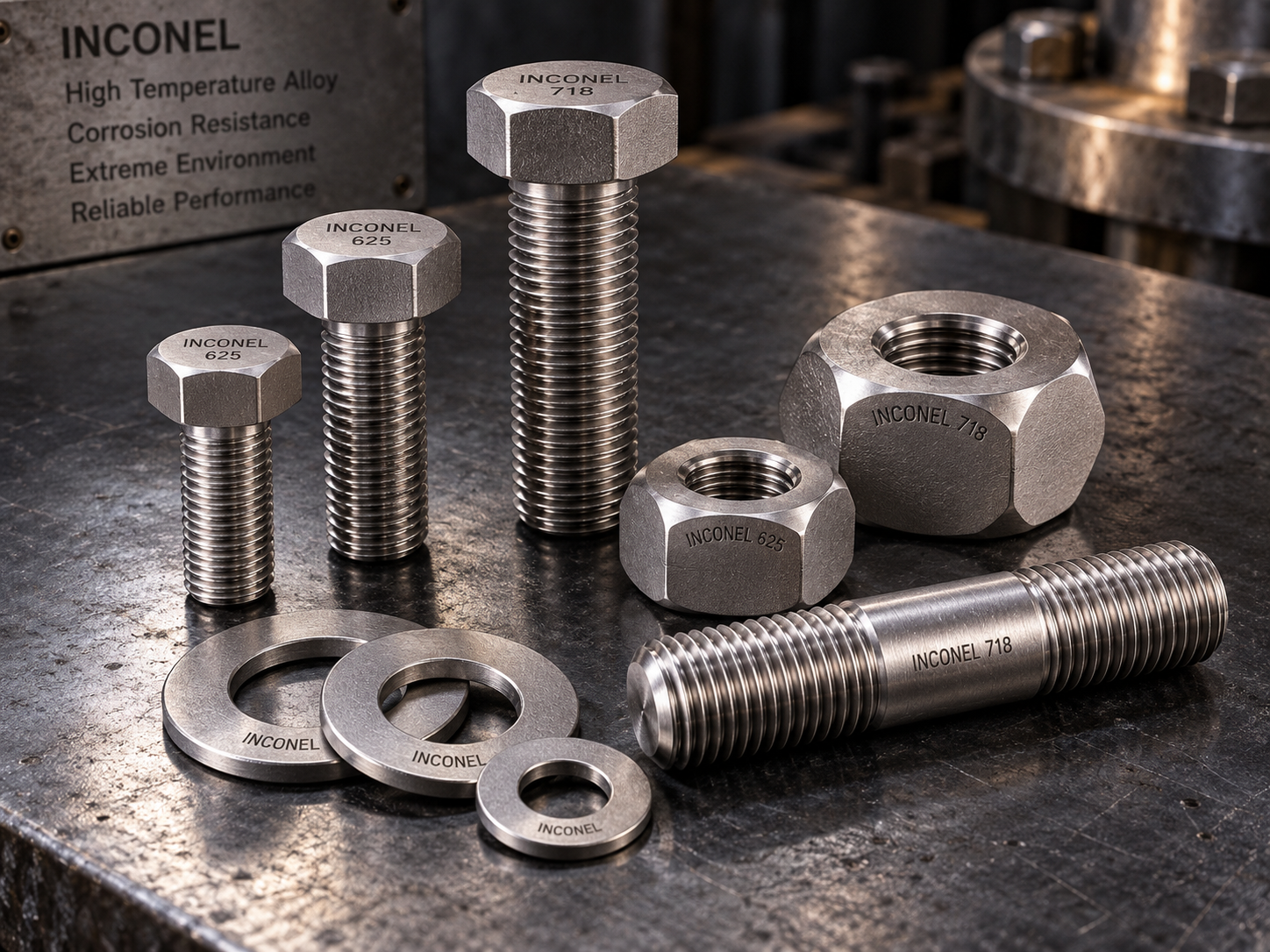
RAYCHIN LIMITED manufactures and stocks a comprehensive range of Inconel fasteners in both metric and imperial sizes. Our product portfolio includes:
Inconel Bolts
Hex bolts, heavy hex bolts, socket head cap screws, shoulder bolts. Sizes M3–M56, #0–2″. Grades: 600, 601, 625, 718, 725.
Inconel Nuts
Hex nuts, heavy hex nuts, lock nuts, nylon insert nuts. Metric and imperial. Matched grades for bolt-nut assemblies.
Inconel Washers
Plain washers, spring washers, fender washers. Custom OD/ID thickness. High-temperature stability.
Inconel Stud Bolts
Full threaded and double end studs. ASME B16.5 / B18.2.1 compliant. Continuous thread and tap-end available.
Inconel Threaded Rods
All-thread rods in 1m and 3m lengths. Metric and imperial thread forms. Cut-to-length service available.
Custom Inconel Parts
Special threads, non-standard heads, and precision-machined components per drawing or sample.
All products are manufactured to international standards including ASTM B166 (Inconel 600/601 bar), ASTM B446 (Inconel 625 bar), ASTM B637 (Inconel 718 bar), and ASME B18.2.1 / B18.2.2 for dimensional compliance. Custom sizes and grades are available upon request.
2. Material Grades & Standards Overview
Inconel alloys are nickel-chromium-based superalloys designed for extreme environments. Each grade offers a distinct balance of strength, corrosion resistance, and temperature capability.
3. Inconel 625 vs 718 vs 600 vs 601: Complete Comparison
The choice between Inconel grades is fundamentally a trade-off between strength, corrosion resistance, and temperature capability. The table below provides a comprehensive side-by-side comparison.
Inconel 718 is precipitation-hardened to much higher strength, making it the dominant superalloy for jet engine and oil-gas applications, including high-strength fasteners and downhole tools. After full heat treatment, Inconel 718 achieves tensile strengths of 185-220 ksi (approximately 1,275-1,520 MPa), roughly twice the strength of Inconel 625. Inconel 625 is not considered hardenable by the heat treatment used for 718; instead, it relies on solid-solution strengthening and cold working.
RAYCHIN Verdict: Which Inconel Grade to Choose?
- Inconel 718 — For strength-limited designs: high-load fasteners, turbine discs, downhole tools, cryogenic hardware. Yield strength above 1,034 MPa.
- Inconel 625 — For corrosion-dominated environments: seawater, chemical processing, where moderate strength (yield ~415-620 MPa) is sufficient.
- Inconel 600 — For high-temperature oxidation resistance up to 1,095°C at lower cost.
- Inconel 601 — For extreme oxidation resistance to 1,200°C, ideal for furnace components and heat treatment fixtures.
4. Mechanical Properties Data
The following table presents typical room-temperature mechanical properties for Inconel fastener grades in their standard heat-treated conditions.
Inconel 718 at room temperature achieves tensile strength of 1,375 MPa and yield strength of 1,100 MPa with 25% elongation in standard aged condition. Heat treatment significantly enhances properties: after proper aging, yield strength increases by 80% (from 732 MPa to 1,320 MPa) and tensile strength rises by 40% (from 1,037 MPa to 1,452 MPa) compared to as-built samples. This makes Inconel 718 the material of choice for critical components such as turbine blades, discs, compressor casings, fasteners, wheels, and high-temperature bolts.
5. High-Temperature Performance & Stress Rupture
Inconel fasteners are specifically engineered for high-temperature service. The critical metric is strength retention at temperature — not just room-temperature strength.
At 649°C (1,200°F), Inconel 718 retains approximately 85% of its room-temperature tensile strength, while standard 316 stainless steel loses about 60% of its strength at the same temperature. This dramatic difference explains why Inconel 718 is the standard choice for turbine housings, exhaust manifolds, and other high-temperature bolting applications exceeding 600°C.
For Inconel 625, the 100-hour stress rupture strength at 650°C is approximately 62 ksi (427 MPa), with superior grades achieving up to 74 ksi (510 MPa). Inconel 718 provides higher creep-rupture strength at 650°C, with rupture strength of approximately 520 MPa for 1,000 hours. Inconel 718 was developed for applications up to 1,200°F (649°C), and in its commonly used solution-treated and aged condition, it has a minimum tensile strength of 180 ksi (1,240 MPa). Inconel 601 offers the highest oxidation resistance, recommended for continuous service at temperatures exceeding 700°C.
6. Corrosion Resistance in Seawater & Chemical Environments
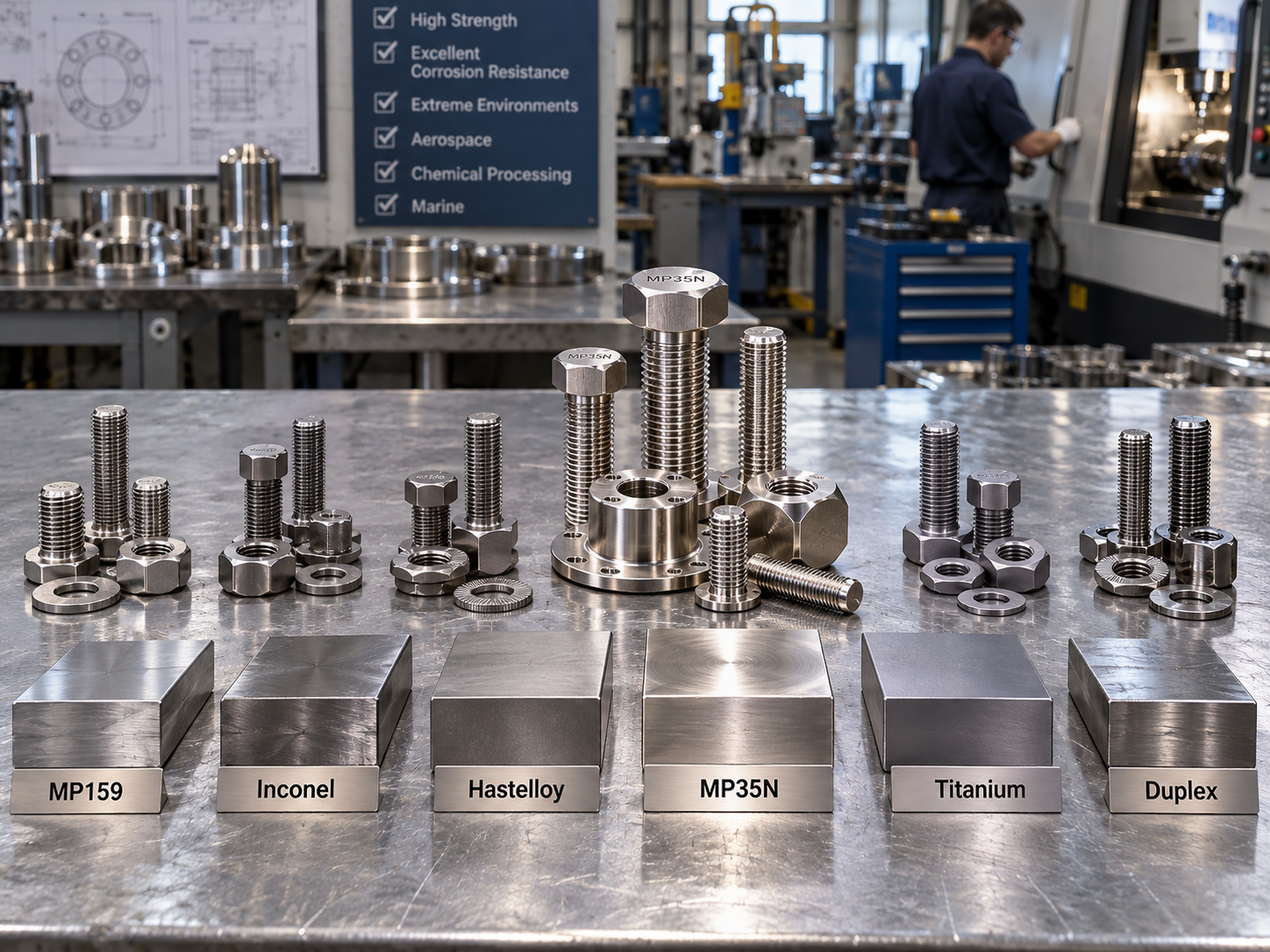
Inconel alloys are renowned for their resistance to aggressive chemical environments. In a landmark two-year seawater exposure study, Inconel 625 was classified among the "most resistant" alloys, alongside Hastelloy C-276 and MP35N. Alloy 625 is classified as slightly less resistant than Alloy C-276 but significantly more resistant than most stainless steels.
Inconel 718 proved to be an excellent choice for launch valve studs and nuts, exhibiting no attack even in carrier exposure tests. Screws made from Inconel alloys show excellent resistance to stress corrosion cracking caused by hydrogen sulfide ions and nearly complete corrosion resistance against ammonia, with high strength maintained even near 600°C.
7. Hydrogen Embrittlement: What Engineers Must Know
Hydrogen embrittlement (HE) is a critical concern for high-strength fasteners in hydrogen-rich environments, such as oil and gas wells with H₂S, hydrogen storage systems, and certain aerospace applications.
Inconel 718 shows moderate susceptibility to hydrogen embrittlement. Recent studies indicate that under hydrogen charging, strain-to-failure decreases by approximately 11.9% for certain processed conditions, while as-received samples lose both yield strength (approximately 9.2%) and ductility. Selective laser-melted Inconel 718 achieved a lowest HE sensitivity of 7.77% through optimized solution treatment at 980°C for 10 minutes.
Laser shock peening (LSP) has emerged as an effective surface treatment for suppressing hydrogen embrittlement in Inconel 718 by inducing compressive residual stresses and modifying the near-surface microstructure.
For applications where hydrogen embrittlement resistance is paramount, MP35N offers superior performance — research shows that MP35N with tensile strength exceeding 1,800 MPa does not suffer strength loss under 200 MPa hydrogen gas pressure. However, Inconel 718 remains the preferred choice when high-temperature strength is the primary requirement.
8. Galling Prevention & Assembly Best Practices
Galling — also known as cold welding or thread seizure — is one of the most common problems encountered with Inconel fasteners. The high ductility of nickel alloys causes asperities on thread surfaces to cold-weld under pressure, leading to thread damage during assembly or disassembly.
Recommended Prevention Methods:
- Apply anti-seize compound: Molybdenum disulfide (MoS₂) or nickel-based anti-seize on all Inconel threads is the single most effective prevention measure. Products specifically optimized for superalloys, such as ROCOL ANTI-SEIZE SA 610, protect fastener surfaces from galling and seizure while providing controlled release.
- Use silver-plated nuts: Silver plating on the nut creates a lubricating barrier that significantly reduces friction and galling tendency.
- Control tightening speed: Slow, steady tightening generates less heat and reduces the likelihood of cold welding.
- Avoid reusing galled fasteners: Once galling occurs, the damaged threads will continue to seize. Replace affected fasteners.
- Consider dry film lubricants: Inorganic dry film anti-gallant pastes, such as TIODIZE T8E, are suitable for Inconel and Waspaloy and function at temperatures up to 1,400°F.
Note that galling between Inconel 718 bolts and 316 stainless steel threads is a known issue in cross-material assemblies. Proper anti-seize lubrication and torque control are essential in these applications.
9. Galvanic Compatibility & Dissimilar Metal Joints
When Inconel fasteners are coupled with other metals in electrolytic environments (seawater, chemical solutions), galvanic corrosion can accelerate the corrosion rate of the less noble material.
A factor which must be considered at transition joints between Inconel 718 and 316 stainless steel is the differential thermal expansion of the materials. Bi-metallic welds may be employed between Inconel 718 and stainless steel 316 where necessary. In seawater applications, Inconel 718 requires careful cathodic protection review when coupled with less noble metals.
10. Cost Comparison & Selection Economics
Material cost is a significant factor in fastener selection, particularly for large bolting projects. The table below summarizes relative pricing for Inconel grades.
Inconel 625 costs approximately 40-60 USD/kg, while Inconel 718 costs approximately 30-50 USD/kg, making 718 generally 15-25% cheaper due to its higher iron content and lower molybdenum. However, Inconel 718 requires additional aging heat treatment, which adds processing cost.
A critical economic consideration: the wrong grade selection costs more than the right one. In one documented case, a user selected Inconel 718 for a corrosive application where Inconel 625 would have lasted a decade — the replacement cost exceeded the original material savings by a factor of twelve. RAYCHIN LIMITED provides unbiased material selection guidance to ensure optimal total cost of ownership.
11. Material Selection Decision Matrix
Use this quick-reference matrix to guide your Inconel grade selection based on primary application requirements:
12. Frequently Asked Questions
What is the difference between Inconel 625 and Inconel 718 fasteners?
Inconel 718 is precipitation-hardened to much higher strength (yield strength up to 1,034 MPa minimum), making it the dominant choice for high-load fasteners and jet engine applications. Inconel 625 is a solid-solution strengthened alloy offering superior corrosion resistance, especially in oxidizing and reducing acids, but with lower mechanical strength. Choose 718 for strength-limited designs and 625 for corrosion-dominated environments.
What is the maximum service temperature for Inconel 718 fasteners?
Inconel 718 fasteners are suitable for service temperatures up to approximately 700°C (1,300°F). At 649°C (1,200°F), Inconel 718 retains roughly 85% of its room-temperature tensile strength, while standard 316 stainless steel loses approximately 60% of its strength at the same temperature.
Is Inconel 718 susceptible to hydrogen embrittlement?
Inconel 718 shows moderate susceptibility to hydrogen embrittlement, with studies reporting strain-to-failure reductions of approximately 8-12% under hydrogen charging. Laser shock peening and optimized solution treatment temperatures (e.g., 980°C for 10 minutes) can significantly improve HE resistance, reducing susceptibility to below 8%.
How to prevent galling on Inconel fasteners?
Galling is a common issue with Inconel fasteners due to their high ductility and tendency to cold-weld. Prevention methods include applying molybdenum disulfide or nickel-based anti-seize compounds, using silver-plated nuts, controlling tightening speed, and avoiding reusing galled fasteners. Anti-seize pastes such as ROCOL ANTI-SEIZE SA 610 are specifically optimized for Inconel and other superalloys.
Which Inconel grade is best for seawater applications?
Inconel 625 and Inconel 725 are the preferred grades for seawater applications. Inconel 625 is classified among the most resistant alloys in seawater crevice corrosion tests, slightly less resistant than Hastelloy C-276 but significantly better than most stainless steels. Inconel 718 is also used in seawater with careful cathodic protection review.
What is the cost difference between Inconel 625 and 718?
Inconel 625 typically costs approximately 40-60 USD/kg, while Inconel 718 costs approximately 30-50 USD/kg. Inconel 718 is generally 15-25% cheaper due to its higher iron content and lower molybdenum. However, 718 requires additional aging heat treatment, which adds processing cost.
Can Inconel fasteners be used with stainless steel?
Inconel fasteners can be used with stainless steel, but galling between Inconel 718 bolts and 316 stainless steel threads is a known issue. Additionally, differential thermal expansion between Inconel 718 and 316 stainless steel must be considered at transition joints. Proper anti-seize lubrication and torque control are essential.
Need Help Selecting the Right Inconel Grade?
RAYCHIN LIMITED manufactures Inconel 600, 601, 625, 718, and 725 fasteners under one quality system — giving you genuinely unbiased, data-driven material recommendations.
Email sales@ray-chin.comVisit www.ray-chin.com