
PEEK Fasteners:
The Complete Guide to Polyetheretherketone Bolts, Nuts & Screws for Extreme Environments
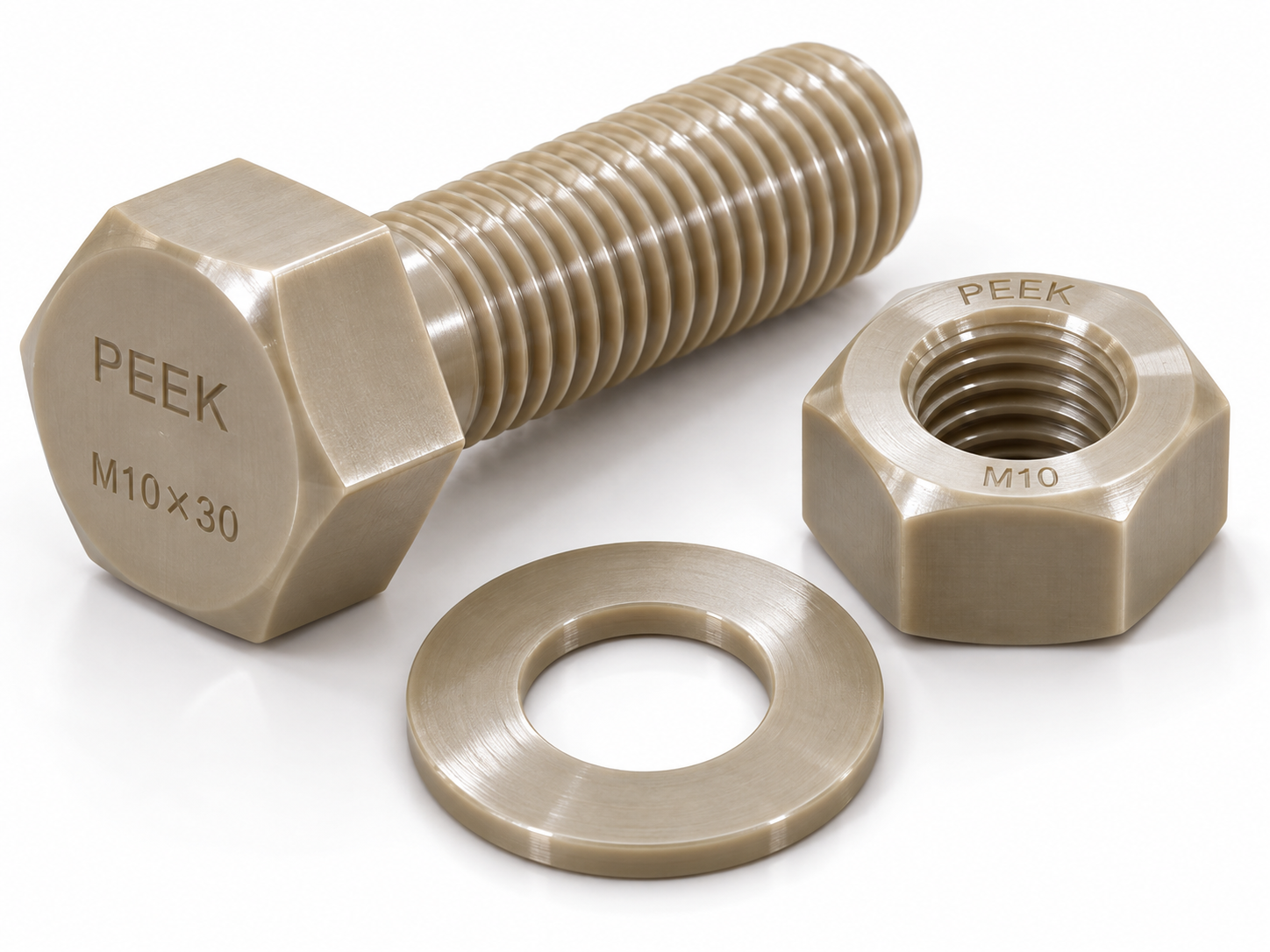
Not all high-temperature fastening challenges require metal. In applications where corrosion, electrical conductivity, weight, or outgassing are the defining constraints, PEEK fasteners deliver a combination of properties that no metal alloy can match. PEEK (Polyetheretherketone) is a semi-crystalline high-performance engineering thermoplastic that bridges the performance gap between nylon and metal — offering continuous service to 250°C, outstanding resistance to most chemicals, electrical insulation, and exceptional strength-to-weight ratio. RAYCHIN LIMITED, a global supplier of special alloy and high-performance polymer fasteners, provides the complete range of PEEK bolts, nuts, washers, screws, and custom-machined components. This guide provides the technical depth engineers need to specify the correct PEEK grade and fastener configuration for demanding applications.
1. What is PEEK and Why Use It for Fasteners?
PEEK (Polyetheretherketone) is a high-performance semi-crystalline thermoplastic developed for extreme operating environments. Unlike standard polymers, it maintains mechanical strength, dimensional stability, and chemical resistance under conditions that would quickly degrade conventional materials.[reference:0] Its unique molecular structure — a rigid aromatic backbone with flexible ether linkages — gives PEEK its exceptional combination of thermal stability, chemical resistance, and mechanical performance.
The case for PEEK fasteners rests on four core capabilities that metals cannot simultaneously provide:
- Corrosion immunity: PEEK withstands a wide range of acids, alkalis, and organic solvents, with the exception of concentrated sulfuric acid, concentrated nitric acid, and concentrated hydrofluoric acid. This makes it suitable for chemical processing, semiconductor manufacturing, and exhaust ducting where even stainless steel suffers pitting and crevice corrosion.
- Electrical insulation: PEEK is an excellent electrical insulator with volume resistivity of 10¹⁵–10¹⁶ Ohm·cm and dielectric strength of 190 kV/mm. It eliminates galvanic corrosion between dissimilar metals and prevents short circuits in electrical and electronic equipment.
- Low outgassing: PEEK fasteners are engineered for ultra-high vacuum and cleanroom environments, reducing the risk of contamination and thermal instability in sensitive equipment.
- Lightweight: With a density of only 1.26–1.32 g/cm³ — approximately one-sixth that of steel — PEEK fasteners reduce overall system mass without compromising structural integrity, critical for aerospace, portable medical devices, and handheld equipment.
2. PEEK Material Grades for Fasteners
PEEK is available in three primary grades for fastener manufacturing, each optimized for different performance requirements.
Unfilled PEEK (Natural / Black)
Base polymer: 100% PEEK, no reinforcement
Tensile Strength: 95–110 MPa (yield, 23°C)
Tensile Modulus: 3.7–4.0 GPa
Elongation at Break: 20–50%
Key Advantage: Best chemical resistance, highest ductility and impact strength, lowest outgassing. The standard choice for chemical processing, semiconductor, and medical applications.
PEEK GF30 (30% Glass Fiber Reinforced)
Composition: PEEK + 30% glass fiber
Tensile Strength: ~1.7× unfilled PEEK
Key Advantage: Significantly higher strength and stiffness, better creep resistance at elevated temperatures, improved dimensional stability. The choice for higher-load applications where chemical resistance requirements are moderate.
CF/PEEK (Carbon Fiber Reinforced)
Composition: PEEK + carbon fiber (10–40%)
Tensile Strength: Up to 1,600+ MPa (aligned fiber grades)
Key Advantage: Highest strength and stiffness of any PEEK grade, with excellent fatigue resistance. Used in aerospace structural fasteners and medical implants where radiolucency and biocompatibility are required.
3. Detailed Mechanical Properties of PEEK
4. Thermal Properties and High-Temperature Performance
Important design consideration: PEEK's coefficient of thermal expansion (CTE) is significantly higher than metals — approximately 47–108 × 10⁻⁶ /K compared to 12 × 10⁻⁶ /K for steel. Dimensional control must account for this difference during design, especially in applications involving thermal cycling or tight tolerances.
5. Chemical Resistance of PEEK
PEEK is one of the most chemically resistant polymers available. Its resistance profile is summarized below:
6. PEEK vs Metal Fasteners: Detailed Comparison
The following table compares PEEK fasteners against the most common metal fastener alternatives across the criteria that drive material selection.
7. Product Range
PEEK Hex Bolts
Metric sizes M2–M12, imperial #2–1/2″. Standard hex head and socket head configurations.
PEEK Socket Head Cap Screws
Metric M2–M10. Hex socket drive for high-torque applications. Low-head and ultra-low-head variants available.
PEEK Nuts
Hex nuts, lock nuts, and custom configurations. Precision-matched to corresponding bolts.
PEEK Washers
Flat washers, spring washers, and custom OD/ID. Available in unfilled and GF30 grades.
PEEK Threaded Rod
Continuous-thread studding for chemical processing and semiconductor equipment.
Custom PEEK Components
Special threads, non-standard heads, spacers, standoffs, and precision-machined components per drawing.
8. Applications by Industry
Aerospace & Space
PEEK fasteners are used in aircraft interior trim, seat components, and structural panel fastening where weight reduction and corrosion resistance are critical. Carbon fiber reinforced PEEK (CF/PEEK) is being evaluated for spacecraft demisable joint systems, where composite bolts are designed to burn up during atmospheric re-entry, reducing space debris risk. PEEK is also specified for aircraft hardware where galvanic corrosion between carbon fiber composites and aluminum structures is a concern.
Semiconductor & Electronics
PEEK fasteners are ideal for semiconductor manufacturing equipment, printed circuit board etching devices, and FPD production equipment. Their low outgassing, chemical resistance, and electrical insulation prevent contamination and short circuits in cleanroom environments.
Medical & Healthcare
Medical-grade PEEK (ISO 10993 compliant) is used for surgical instruments, sterilisation equipment, and orthopedic implants. PEEK fasteners resist repeated sterilisation cycles with high-temperature steam and aggressive disinfectants, and their radiolucency (transparent to X-rays and MRI) makes them ideal for imaging equipment and implantable devices. PEEK interference screws and suture anchors are widely used in orthopedic surgery.
Oil & Gas
PEEK fasteners are used in oil and gas process equipment where resistance to sour gas (H₂S), chlorides, and high temperatures is required. They replace metal fasteners that suffer corrosion and galvanic attack in offshore and downhole environments.
Chemical Processing
PEEK hex bolts and threaded rod are used in chemical plants, exhaust ducts, and chemical cleaning equipment where hydrochloric acid, caustic soda, and other aggressive chemicals corrode metal fasteners.
Ultra-High Vacuum & Cleanroom
PEEK fasteners are specified for ultra-high vacuum systems and cleanroom equipment due to their very low outgassing and particle generation.
9. Design Considerations for PEEK Fasteners
- Torque limits: PEEK fasteners have significantly lower torque capacity than metal. Use controlled torque and consider using a nut in all applications — PEEK screws should not be threaded directly into metal female threads for load-bearing joints.
- Thermal expansion: PEEK's CTE is 4–8 times higher than steel. Account for differential expansion in design, especially in applications involving thermal cycling or tight tolerances.
- Creep relaxation: PEEK exhibits creep under sustained load at elevated temperature. For high-temperature, high-load applications, specify PEEK GF30 or CF/PEEK grades and consider periodic re-tightening checks.
- Thread engagement: Use nuts rather than threading directly into metal. If threading into a metal female thread is unavoidable, limit engagement length to 20 mm or less.
- Chemical compatibility: Verify chemical compatibility for the specific environment. PEEK is attacked by concentrated sulfuric acid, concentrated nitric acid, and concentrated hydrofluoric acid.
- Grade selection: Choose unfilled PEEK for maximum chemical resistance and ductility; PEEK GF30 for higher strength and creep resistance; CF/PEEK for structural applications requiring maximum strength and stiffness.
10. RAYCHIN LIMITED: Your Partner in PEEK Fastening
RAYCHIN LIMITED manufactures and supplies PEEK fasteners in the full range of grades and configurations. Our capabilities include:
- Material grades: Unfilled PEEK (natural/black), PEEK GF30 (30% glass fiber reinforced), CF/PEEK (carbon fiber reinforced, up to 40%), medical-grade PEEK (ISO 10993), semiconductor-grade PEEK
- Product forms: Hex bolts, socket head cap screws, low-head screws, nuts, washers, threaded rod, spacers, standoffs, and custom-machined components
- Size range: M2–M12 metric, #2–1/2″ imperial
- Quality documentation: Material certificates of analysis, full traceability, ISO 10993 biocompatibility certification for medical grades, and third-party inspection
- Global supply: Serving aerospace, semiconductor, medical, oil & gas, chemical processing, and industrial customers worldwide
Our engineering team can assist with material selection, design consultation, and application-specific testing. Contact us with your application parameters — temperature, chemical environment, load requirements, and electrical/outgassing constraints — and we will recommend the optimal PEEK grade and fastener configuration.
Frequently Asked Questions
What is PEEK and why is it used for fasteners?
PEEK (Polyetheretherketone) is a high-performance semi-crystalline engineering thermoplastic known for its exceptional combination of thermal stability (continuous service to 250°C), outstanding chemical resistance, high mechanical strength, electrical insulation, and low outgassing. It is used for fasteners where metal fasteners would corrode, gall, conduct electricity, or add excessive weight.
What is the maximum service temperature for PEEK fasteners?
Unfilled PEEK can be used continuously at temperatures up to 250°C (482°F) and in hot water or steam without permanent loss of physical properties. Short-term exposure can reach 300°C. Glass fiber reinforced grades (PEEK GF30) offer higher stiffness and strength at temperature.
What chemicals is PEEK resistant to?
PEEK withstands a wide range of acids, alkalis, and organic solvents, with the exception of concentrated sulfuric acid, concentrated nitric acid, and concentrated hydrofluoric acid. It is resistant to hydrochloric acid, caustic soda, and most industrial chemicals.
Is PEEK a replacement for metal fasteners?
PEEK fasteners bridge the performance gap between nylon and metal. They are not a direct replacement for high-strength metal fasteners where high torque and high tensile loads are required. However, for applications requiring corrosion resistance, electrical insulation, lightweight, low outgassing, and moderate mechanical loads, PEEK fasteners outperform metals and conventional polymers.
What is the difference between unfilled PEEK, PEEK GF30, and CF/PEEK?
Unfilled PEEK offers the best chemical resistance, ductility, and impact strength. PEEK GF30 provides approximately 1.7 times the tensile strength of unfilled PEEK, higher stiffness, and better creep resistance. CF/PEEK offers the highest strength and stiffness, with tensile strength reaching 1,600+ MPa in some grades.
Does RAYCHIN provide material certificates for PEEK fasteners?
Yes, RAYCHIN LIMITED provides material certificates of analysis, full traceability, and can supply PEEK fasteners in medical-grade (ISO 10993 compliant) and semiconductor-grade formulations. Third-party inspection and testing are available upon request.
Need PEEK Fasteners?
Send us your application parameters — temperature, chemical environment, load, and electrical/outgassing requirements — and our engineering team will recommend the optimal PEEK grade.
Email sales@ray-chin.comVisit www.ray-chin.com