
High-Temperature Fastener Material Selection:
The Complete Engineering Guide
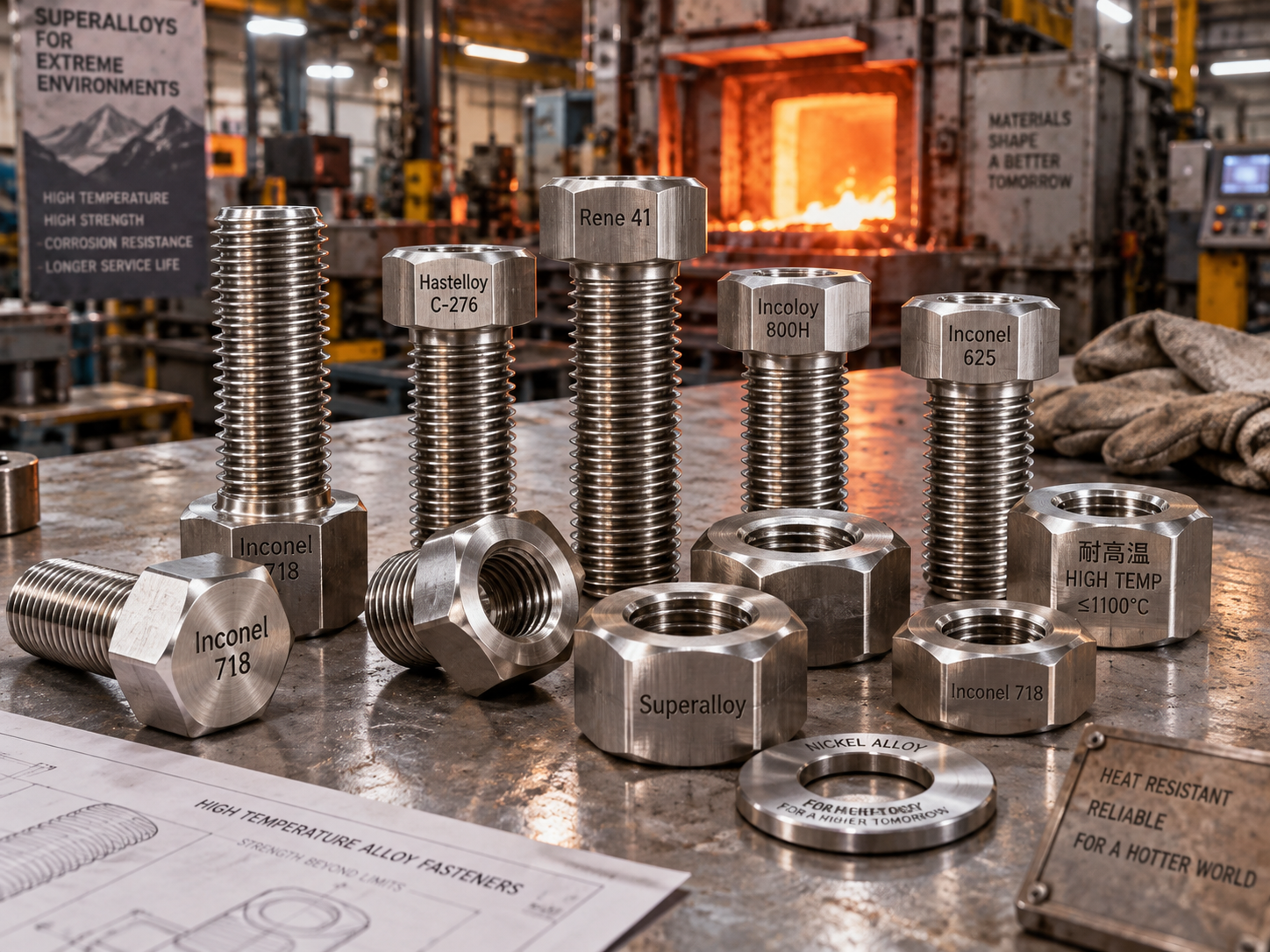
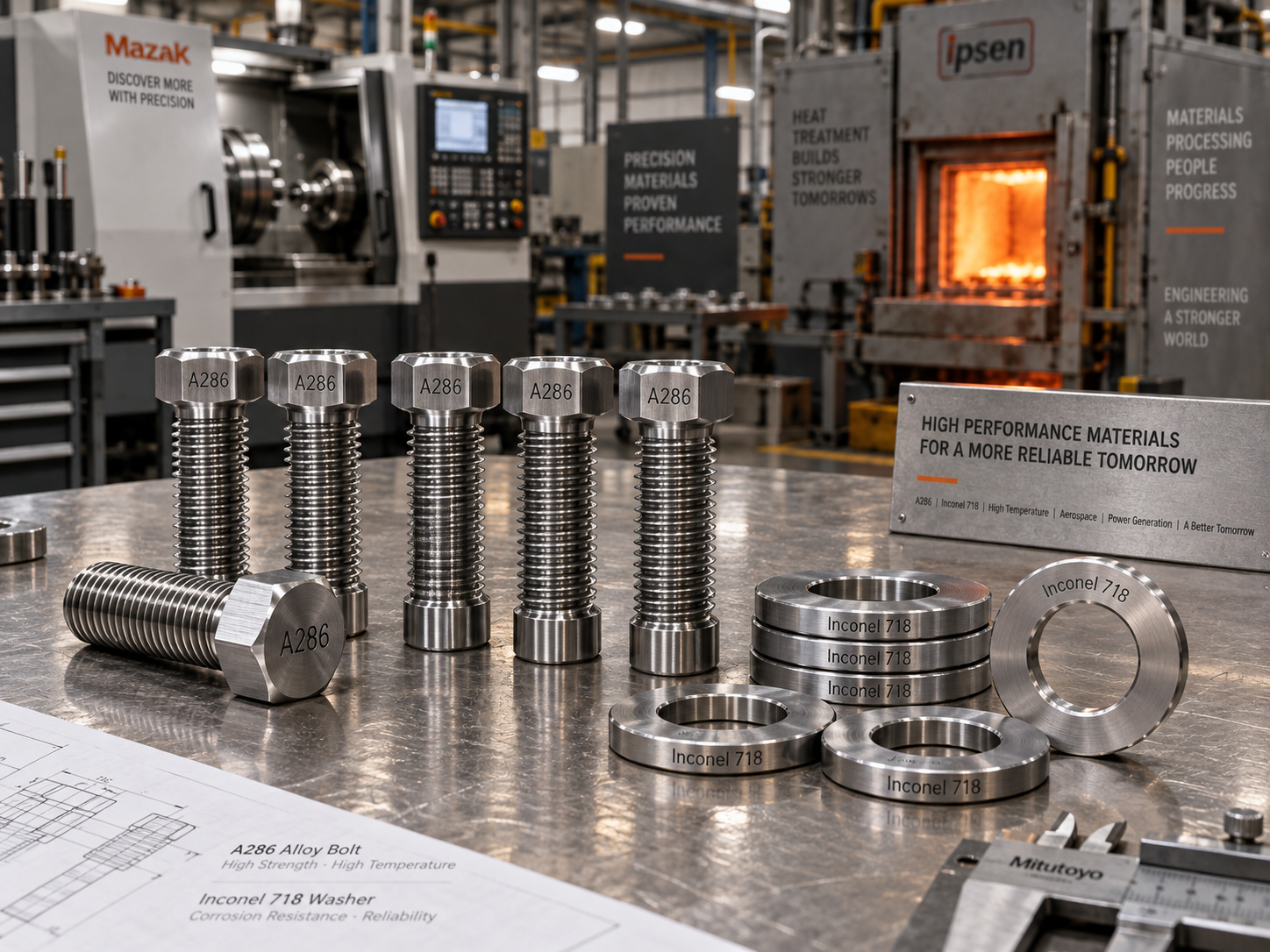
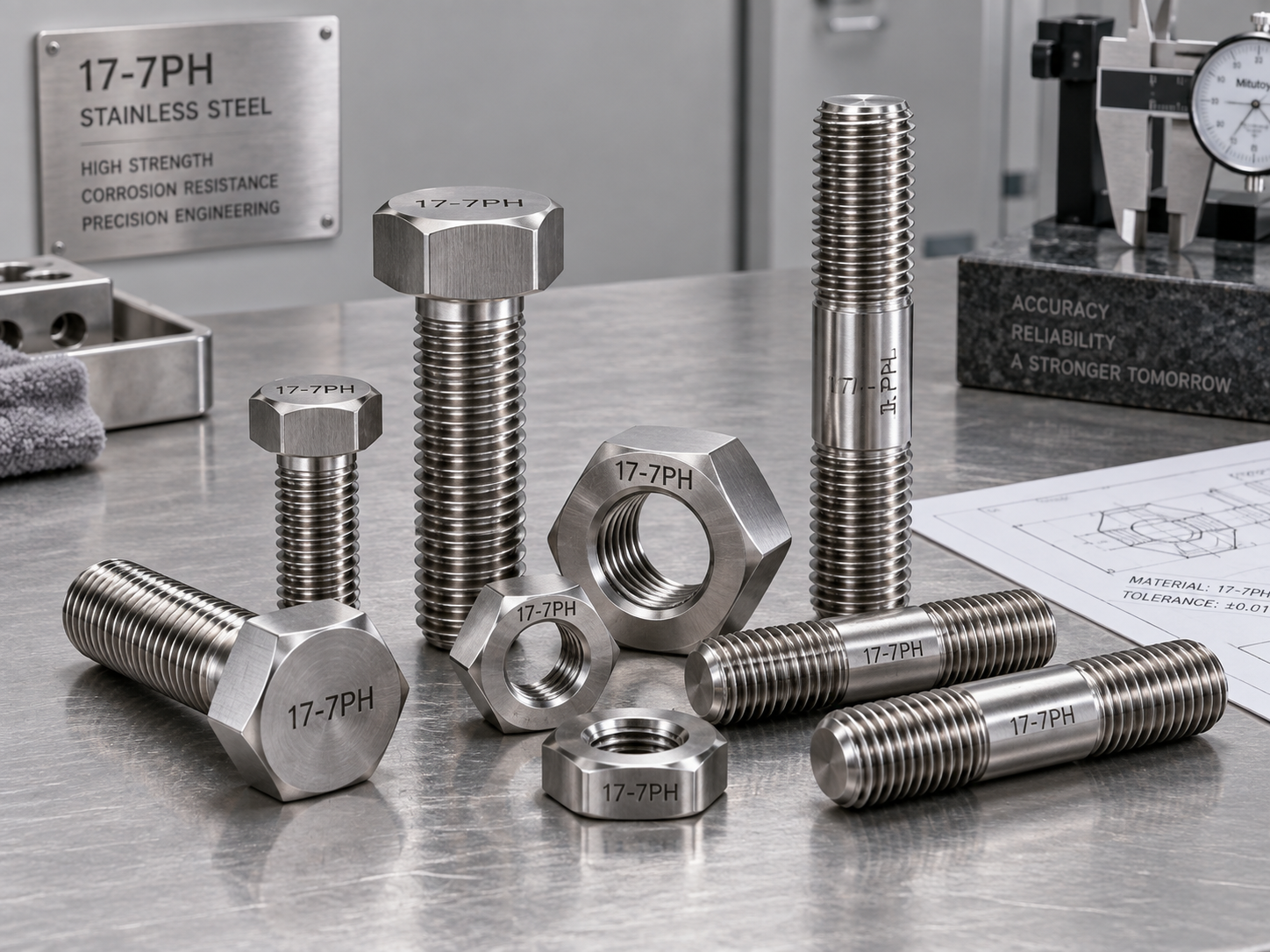
When bolted joints operate above 400°C, standard carbon alloy and stainless steel fasteners reach the limits of their metallurgical capability. Yield strength drops, clamp load bleeds off through creep relaxation, and joints that were designed to seal begin to leak. The fix is not a higher grade of the same material — it is a fundamentally different alloy with a different crystal structure, a different strengthening mechanism, and a different thermal envelope. This guide provides a systematic framework for high-temperature fastener material selection, drawing on RAYCHIN LIMITED's decades of experience manufacturing special alloy fasteners for aerospace, oil & gas, power generation, and chemical processing.
1. The Single Input That Drives Everything: Fastener Metal Temperature
The most common error in high-temperature fastener specification is using the wrong temperature. Exhaust gas temperature, flange surface temperature, and fastener metal temperature are three different numbers — and the delta between them can be several hundred degrees. The fastener shank, buried inside the joint and often insulated by the flange itself, can run significantly hotter or colder than the surface measurement suggests.
The only input that should drive alloy selection is fastener metal temperature: the temperature at the fastener shank itself, measured by thermocouple under representative operating conditions or validated against thermal modeling. If this number is not known, every downstream decision — alloy, coating, preload, locking method — is based on the wrong assumption.
2. The Temperature Capability Ladder
The table below summarizes the service temperature ranges and key mechanical properties of the major alloy families used in high-temperature fastening. These are not grades of the same material — each is a distinct metallurgy engineered for a specific temperature window.
< 370°C
~650°C
~700°C
~815°C
Up to 2200°C
3. Why Standard Fasteners Fail at Temperature
Understanding the failure mechanisms is essential to selecting the right alloy. Four mechanisms account for the majority of high-temperature fastener failures in practice.
3.1 Thermal Annealing and Strength Loss
Carbon alloy fasteners (Grade 8.8 and 10.9) derive their mechanical properties from a quench-and-temper heat treatment. That tempering step typically runs at 370–425°C. Once a fastener reaches its tempering temperature in service, the microstructure begins to soften. Yield strength and tensile strength drop rapidly. At 600°C, a Grade 10.9 bolt retains roughly 24% of its room-temperature yield strength; at 500°C, it is down to 56%. Upgrading from Grade 8.8 to 10.9 does not extend the thermal ceiling because the failure mechanism is identical.
3.2 Creep Relaxation and Clamp Load Loss
Even in a fastener that has not crossed its tempering threshold, sustained elevated temperature causes creep — the time-dependent, permanent deformation of a material under sustained stress. A fastener under clamp load slowly and permanently elongates, converting the initial elastic strain imposed by tightening into permanent creep strain. The result is rotation-free preload loss: the nut has not moved, the fastener has not stripped, but the joint has lost clamping force. This is the failure mode most commonly misattributed to vibration. If there is no nut rotation but the joint has come loose, creep relaxation is the variable to investigate.
3.3 Thermal Expansion Mismatch
When the fastener and the flange material have different coefficients of thermal expansion (CTE), the clamp load changes as the joint heats up. If the fastener expands more than the flange, preload increases — potentially beyond yield. If the flange expands more, preload decreases and the joint may leak. In aerospace and turbine applications, thermal expansion mismatch is a primary driver of preload loss and joint stiffness reduction. Matching the fastener CTE to the joint material — or accounting for the mismatch in the preload calculation — is essential.
3.4 Oxidation, Scaling, and Galling
At high temperature, stainless steel forms a protective oxide layer. Under repeated thermal cycling, this oxide scale builds on mating thread surfaces. The scale is harder and more brittle than the base material. Under contact stress at the thread interface, scale particles fracture and become abrasive, accelerating wear and making galling significantly more likely. Galling is adhesive wear where mating thread surfaces cold-weld under high contact stress — in severe cases, the fastener seizes and cannot be removed without damage.
4. Alloy Selection by Temperature Zone
A286
Type: Iron-nickel-chromium superalloy
UTS: 895 MPa min | Yield: 585 MPa min
Standards: ASTM A453 Gr 660, AMS 5731/5732/5737, DIN 1.4980
Best For: Exhaust manifold fasteners, EGR joints, turbocharger-adjacent hardware, oil & gas manifolds. Provides the best balance of cost, high-temperature capability, and corrosion resistance in this range.
Inconel 718
Type: Nickel-chromium-iron superalloy
UTS: 1,275 MPa | Yield: 1,035 MPa
Standards: AMS 5662, AMS 5663, ASTM B637, NACE MR0175
Best For: Turbocharger mounting, high-cycle diesel exhaust, fatigue-critical aerospace joints. The first recommendation for 650–700°C service. Excellent oxidation resistance to 980°C.
Nimonic 80A
Type: Nickel-chromium superalloy
UTS: 930 MPa | Yield: 620 MPa
Standards: ASTM B637, DIN EN 10269 2.4952
Best For: Turbocharger shaft hardware, extreme-duty high-cycle applications. Used where fastener operating temperatures approach 800°C.
Waspaloy
Type: Nickel-based, γ′ precipitation hardened
UTS: 1,210 MPa | Yield: 810 MPa
Standards: BS EN 3389 (NI-PH1302, 1210 MPa / 730°C), AMS 5707/5708
Best For: Higher strength than Inconel 718 above 650°C. Turbine engine bolts where stress relaxation resistance at the upper temperature range is critical.
Hastelloy X
Type: Nickel-molybdenum-chromium
Standards: AMS 5536, ASTM B572
Best For: Combustion chamber liners, industrial furnace hardware, turbojet afterburners. Good high-temperature stress rupture properties above 1450°F (790°C).
MP35N
Type: Nickel-cobalt-chromium-molybdenum
UTS: 2,000 MPa+ (cold worked)
Standards: AMS 5844/5845, ASTM F562
Best For: Highest strength alloy approved in NACE MR0175 for sour service. Medical implants, aerospace downhole tools, high-stress marine hardware. Best performance when strength, not temperature, is the primary constraint.
5. Beyond Temperature: Critical Selection Factors
5.1 Corrosive Environment and NACE MR0175
For oil and gas applications involving H₂S (sour service), NACE MR0175 / ISO 15156 compliance is mandatory. MP35N is approved as the highest strength alloy in NACE MR0175, making it the material of choice for high-strength sour service bolting. A286 (Grade 660) also complies with NACE MR0175 and is widely used in sour service valve and wellhead bolting. Inconel 718 and alloy 925 offer good sour service performance where moderate strength is acceptable.
5.2 Locking Methods at Temperature
Conventional locking methods fail well below high-temperature operating conditions. Anaerobic threadlockers (e.g., Loctite 272) are rated to approximately 232°C. Nylon-insert nuts are typically limited to 120°C. Prevailing-torque all-metal lock nuts are suitable to higher temperatures but depend on the base alloy's relaxation behavior. For applications above 400°C, the locking method must be evaluated independently of the fastener alloy — and a mechanical locking solution that has no thermal ceiling is often required.
5.3 Coating and Galling Control
High-temperature alloys — particularly nickel-based superalloys — are prone to galling at the thread interface. Silver plating, MoS₂ coatings, and specialized anti-seize compounds are commonly specified to control galling and maintain removability after thermal cycling. Coating selection must be validated for the specific temperature and chemical environment: some coatings degrade or react with the base alloy above their rated temperature.
5.4 Cost vs. Consequence
The cost comparison that matters is not fastener price versus fastener price. It is fastener price versus the cost of joint failure — including unplanned downtime, labor, and downstream damage. A $5 A286 fastener that prevents a $500,000 turbine shutdown is economically superior to a $2 carbon steel fastener that fails in service. For high-temperature joints, specifying the correct alloy from the start is almost always cheaper than engineering around failure after the fact.
6. Decision Framework: Selecting the Right Alloy
- Determine fastener metal temperature at the shank under operating conditions. This is the primary input.
- Identify the corrosive environment — H₂S, chlorides, oxidation, carburization. This may constrain alloy selection independently of temperature.
- Select the alloy family using the temperature ladder: A286 for ≤650°C, Inconel 718 for ≤700°C, Nimonic 80A for ≤815°C, Waspaloy for high-strength ≤730°C service, Hastelloy X for oxidation-dominated environments.
- Verify creep relaxation behavior at the design temperature and stress. The alloy's creep resistance determines whether the joint will maintain clamp load over the service life.
- Check thermal expansion compatibility between fastener and flange. Account for CTE mismatch in the preload calculation.
- Specify coating and locking method appropriate for the temperature and environment. Do not assume ambient-temperature solutions will work.
- Confirm standards and certification — ASTM A453 Gr 660, AMS 5662/5663, NACE MR0175, EN 10204 3.1/3.2. Ensure full traceability for critical joints.
7. RAYCHIN LIMITED: Your Partner in High-Temperature Fastening
RAYCHIN LIMITED manufactures and supplies high-temperature fasteners in the full range of alloys covered in this guide. Our capabilities include:
- Alloy coverage: A286, Inconel 718, Nimonic 80A, Waspaloy, Hastelloy X, MP35N, MP159, and custom alloys
- Product forms: Bolts, stud bolts, socket head cap screws, 12-point aerospace bolts, threaded rod, nuts, washers, and custom-machined components
- Standards compliance: ASTM A453 Gr 660, AMS 5662/5663/5707/5708, ASTM B637, NACE MR0175/ISO 15156, and customer-specific specifications
- Quality documentation: EN 10204 3.1 / 3.2 material certificates, PMI reports, mechanical testing (tensile, yield, stress rupture), hardness verification, and third-party inspection
- Global supply: Serving aerospace, oil & gas, power generation, chemical processing, and industrial customers in 40+ countries
Our engineering team can assist with alloy selection, preload calculation, coating specification, and failure analysis. Contact us with your application parameters and we will recommend the optimal solution.
Frequently Asked Questions
What temperature can standard carbon alloy fasteners withstand?
Standard carbon alloy fasteners (Grade 8.8 and 10.9) have a maximum service temperature of approximately 370°C (700°F). Above this temperature, the quench-and-temper heat treatment that provides their mechanical properties begins to reverse, causing rapid loss of yield and tensile strength. At 600°C, a Grade 10.9 bolt retains only about 24% of its room-temperature yield strength.
What is the difference between A286, Inconel 718, and Nimonic 80A for high-temperature fastening?
A286 is an iron-nickel superalloy suitable up to ~650°C with minimum UTS of 895 MPa. Inconel 718 is a nickel-chromium alloy rated up to ~700°C with excellent fatigue resistance. Nimonic 80A is a nickel superalloy capable of service up to ~815°C. Each covers a distinct temperature and performance window, not a simple hierarchy — selection depends on the specific requirements of the joint.
Why do high-temperature bolted joints lose clamp load over time?
Clamp load loss at high temperature is primarily caused by creep relaxation. Under sustained elevated temperature and load, the fastener slowly and permanently elongates, converting initial elastic strain into permanent creep strain. The result is rotation-free preload loss — the nut has not moved and the fastener has not stripped, but the joint has lost clamping force.
What is the fastener metal temperature and why does it matter?
Fastener metal temperature is the temperature at the fastener shank itself, measured under operating conditions. It is not the same as exhaust gas temperature or flange surface temperature — the delta can be several hundred degrees. It is the single input that drives correct alloy selection.
Which high-temperature fastener alloys comply with NACE MR0175 for sour service?
MP35N is approved as the highest strength alloy in NACE MR0175. A286 (Grade 660) also complies. Inconel 718, Incoloy 925, and alloy 926 are also available with NACE MR0175/ISO 15156 compliance for oil and gas applications.
What is the best material for fasteners in a 700°C turbine application?
For 700°C service, Inconel 718 is the first recommendation, offering excellent strength retention, fatigue resistance, and oxidation resistance up to 980°C. Waspaloy is a suitable alternative when higher strength is needed at the upper end of this range, with a maximum test temperature of 730°C per BS EN 3389.
Need High-Temperature Fasteners?
Send us your application parameters — temperature, environment, load — and our engineering team will recommend the optimal alloy.
Email sales@ray-chin.comVisit www.ray-chin.com