
Categories List
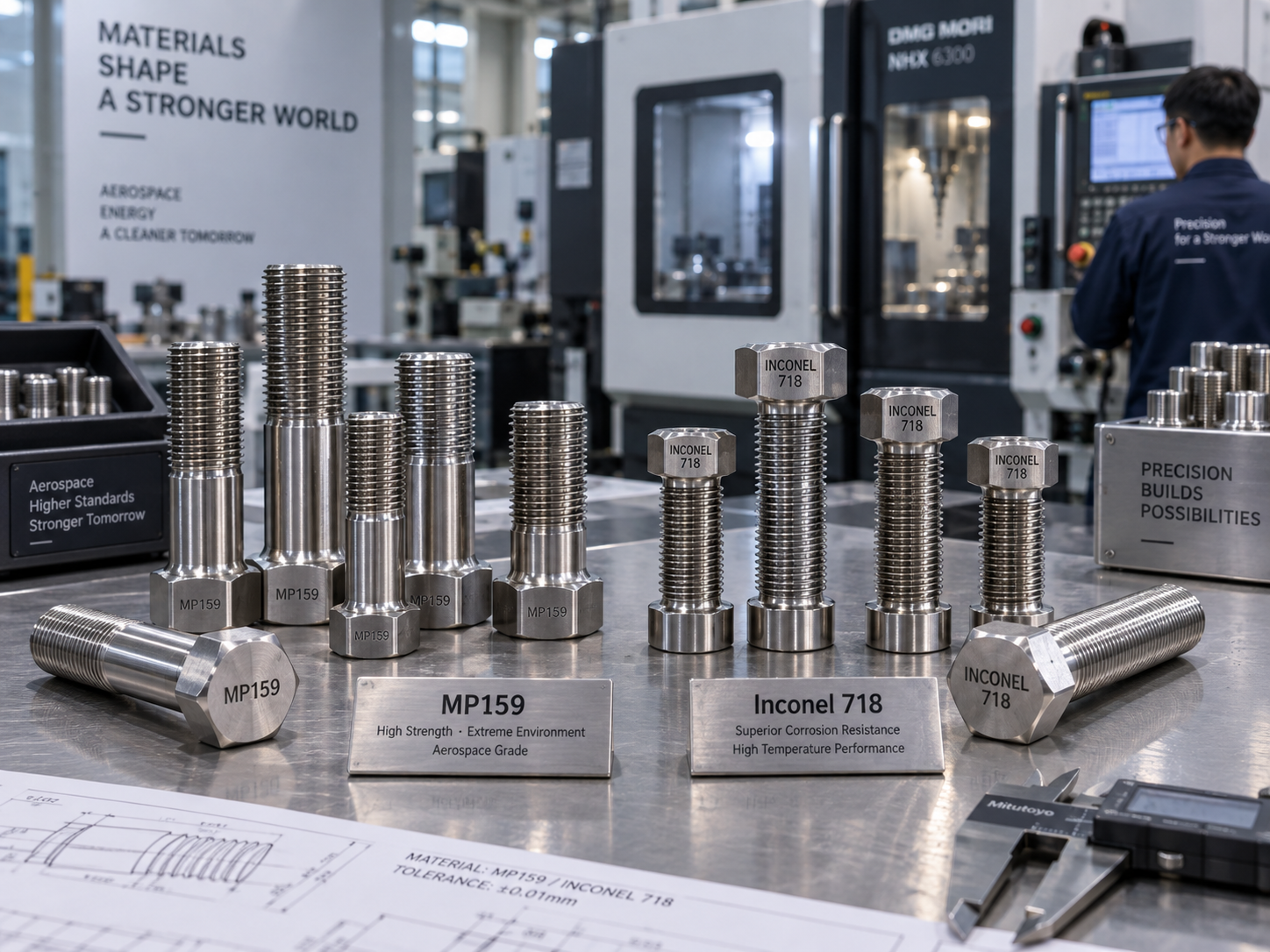

MP159 vs MP35N vs Inconel 718 vs Waspaloy vs Inconel 625: The Ultimate Superalloy Fastener Selection Guide
In the world of extreme bolting—aerospace engines, HPHT sour wells, and deepwater subsea hardware—the material decision is not merely technical. It is a strategic choice that determines whether a joint survives for decades or fails catastrophically. MP159 has emerged as a premier solution, offering an unmatched combination of ultra-high strength, exceptional corrosion resistance, and NACE compliance. But how does it compare against MP35N, Inconel 718, Waspaloy, and Inconel 625? RAYCHIN LIMITED, a specialist global manufacturer of all these superalloys, provides this definitive comparison to help you capture the highest-intent selection decisions with absolute technical confidence.
1. MP159 vs MP35N Fasteners: When the 35 ksi Yield Difference Matters
MP159 and MP35N are closely related cobalt-nickel alloys, yet their performance envelopes diverge in ways that directly affect fastener design and service life. The most critical difference lies in high-temperature strength retention, driven by MP159's deliberate titanium and aluminum additions, which form gamma-prime precipitates during aging.
1.1 Mechanical Properties Comparison
1.2 The 35 ksi Difference: What It Means in Practice
At 600°C, MP159 retains approximately 80% of its room-temperature yield strength, while MP35N retains only about 57%. This translates to a yield strength difference of roughly 35 ksi (240 MPa) at 600°C. In fastener design, this means:
- Higher preload capacity: MP159 bolts can be tightened to higher torque values, ensuring better gasket seating and joint integrity in high-temperature flanges.
- Reduced bolt count or smaller diameter: For the same load requirement, MP159 fasteners can be downsized, saving weight and space—critical in aerospace and subsea applications.
- Greater safety margin: In HPHT wells where temperatures approach 600°C, MP159 maintains a comfortable margin above the yield point, while MP35N may be operating near its limit.
1.3 Cold Work Hardening Characteristics
Both alloys rely on cold work for their initial strength, but their response differs:
- MP35N: Achieves high strength through cold reduction (typically 50–60%) followed by aging. Further cold work beyond this level yields diminishing returns and can reduce ductility.
- MP159: Contains titanium and aluminum, allowing a synergistic combination of cold work and precipitation hardening. This provides a broader processing window to fine-tune strength and toughness, and results in superior high-temperature stability.
1.4 SSC Resistance in Sour Service
Both alloys are NACE MR0175 compliant at hardness levels up to 51 HRC. However, MP159's higher strength retention at temperature means that in hot sour wells (where the metal temperature may reach 200–250°C at the wellhead), MP159 fasteners maintain a higher preload, reducing the risk of joint relaxation and subsequent leakage.
? RAYCHIN Verdict: MP159 vs MP35N
Choose MP159 when the service temperature exceeds 400°C, or when maximum preload and safety margin are required in HPHT sour wells. Choose MP35N for moderate-temperature sour service (below 300°C) where the strength difference is less critical and cost is a primary driver.
2. MP159 vs Inconel 718 vs Waspaloy for Aerospace Bolts
Aerospace engine bolting demands a careful balance of high-temperature strength, fatigue resistance, and weight efficiency. MP159, Inconel 718, and Waspaloy each offer distinct advantages, and the optimal choice depends on the specific temperature and stress profile of the joint.
2.1 High-Temperature Strength Comparison
2.2 Fatigue and Stress Rupture
- MP159: Offers the highest fatigue strength at room temperature and up to 600°C. Its rolled threads provide excellent notch fatigue resistance. Stress-rupture life is excellent up to 600°C but drops off above 650°C.
- Inconel 718: Excellent fatigue strength below 650°C. However, above 650°C, the gamma-double-prime precipitates over-age rapidly, leading to a sharp decline in both fatigue and rupture strength.
- Waspaloy: The champion for sustained creep and stress-rupture life above 700°C. Its gamma-prime precipitates are stable to approximately 870°C, making it the material of choice for the hottest turbine disc bolts.
2.3 Weight and Cost Considerations
All three alloys have similar densities (8.0–8.2 g/cm³), so weight savings come primarily from the ability to use smaller fasteners. MP159's higher strength at 600°C allows the designer to reduce bolt diameter by up to 20% compared to Inconel 718 for the same load, saving weight. Waspaloy is the most expensive of the three, followed by MP159, then Inconel 718.
? RAYCHIN Verdict: Aerospace Bolt Selection
- Up to 600°C, maximum strength and fatigue: MP159
- Up to 650°C, cost-effective: Inconel 718
- Above 700°C, creep-dominated: Waspaloy
3. MP159 vs Inconel 625 for HPHT Sour Well Fasteners
In high-pressure, high-temperature (HPHT) sour gas wells, fasteners must simultaneously resist sulfide stress cracking (SSC), chloride pitting, and high mechanical loads. MP159 and Inconel 625 represent two different approaches to this challenge.
3.1 Mechanical Strength and SSC Resistance
3.2 The HPHT Sour Well Decision
The choice between MP159 and Inconel 625 in HPHT sour wells hinges on the required preload and the presence of chlorides:
- If the well requires high preload (e.g., 15,000 psi wellhead connector): MP159 is the only choice that provides the necessary strength with NACE compliance. Inconel 625 would require a much larger bolt or higher bolt count, which may not be feasible.
- If the well is dominated by chlorides and moderate loads: Inconel 625 offers superior pitting resistance (PREN ~50) and is more cost-effective. It is the standard for subsea tree components where loads are moderate and corrosion resistance is paramount.
- If the well is both high-pressure and high-chloride: MP159 is often the optimal solution, as its PREN of ~45 is sufficient for most sour well environments, and its high strength ensures joint integrity.
3.3 Stress Corrosion Cracking (SCC) Curves
Both alloys resist chloride SCC, but their mechanisms differ. MP159 relies on its cobalt-nickel matrix and high molybdenum content to resist both SSC and SCC. Inconel 625 relies on its high nickel and molybdenum content. In NACE TM0177 testing, both alloys pass at their respective hardness levels, but MP159 provides a much higher strength-to-weight ratio for the same SSC resistance.
? RAYCHIN Verdict: HPHT Sour Well Fasteners
- High preload + sour + temperature > 200°C: MP159
- Moderate load + maximum chloride resistance: Inconel 625
- Cost-sensitive, moderate strength: Inconel 625 (annealed)
4. Summary Comparison Table
5. Why RAYCHIN is Your Superalloy Fastener Authority
RAYCHIN LIMITED is uniquely positioned to advise on superalloy selection because we manufacture all of these alloys—not just one. This means:
- Unbiased recommendations: We have no incentive to push a particular alloy. Our goal is to optimize your project's performance and cost.
- Deep technical expertise: Our metallurgists understand the subtle differences in high-temperature strength retention, cold work response, and SSC resistance that drive selection.
- Full certification: We provide EN 10204 3.1/3.2, PMI, mechanical testing, and NACE compliance statements for every shipment.
- Global supply: Strategic inventory of MP159, MP35N, Inconel, and Waspaloy bar for rapid delivery worldwide.
Send your operating temperature, pressure, H₂S concentration, and load requirements to our technical team. We'll provide a detailed, unbiased comparison and competitive quotation within 24 hours.
✉️ sales@ray-chin.com? www.ray-chin.com | MP159 · MP35N · Inconel 718 · Waspaloy · Inconel 625
Request A Quote! We'll respond as soon as possible(within 12 hours)
Get a Quote