
17-7PH Fasteners – The Complete Guide to Semi-Austenitic Precipitation-Hardening Stainless Steel Bolts, Nuts & Studs
When you need the formability of austenitic stainless steel in the annealed condition and the strength of martensitic steel after heat treatment, 17-7PH fasteners deliver a unique combination that no other alloy can match. RAYCHIN LIMITED, a specialist manufacturer and global supplier of high-performance alloy fasteners, offers the complete range of 17-7PH (UNS S17700, Alloy 631) bolts, nuts, washers, stud bolts, and custom-machined parts in all standard heat treatment conditions. This guide provides the technical depth engineers need to specify the correct condition for every critical application.
Product Range
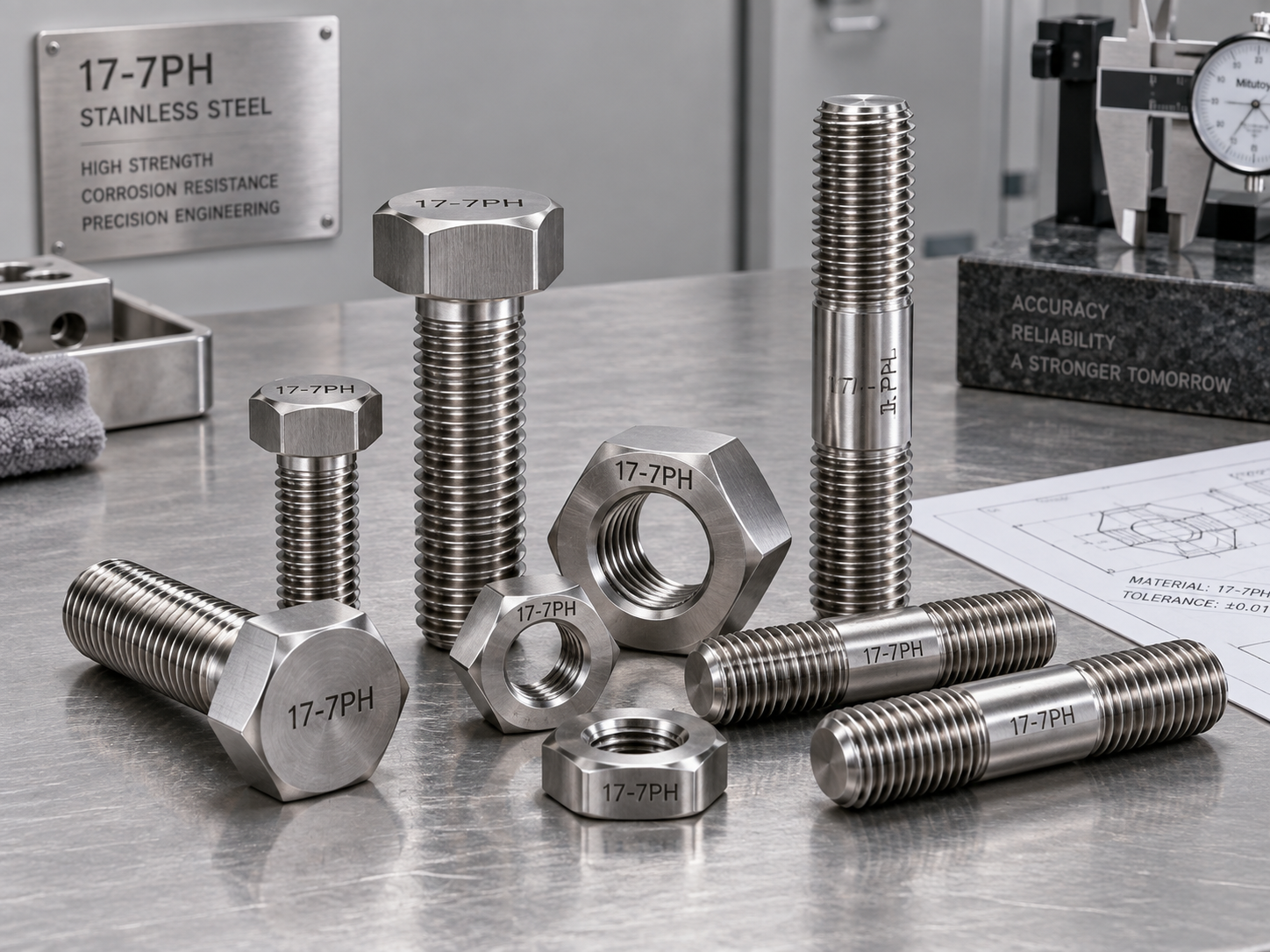
17-7PH Bolts
Hex bolts, socket head cap screws, 12-point aerospace bolts. Sizes M3–M36 and #4–1-1/2″.
17-7PH Stud Bolts
Double-end and fully threaded studs per ASME B16.5. Ideal for high-stress flange connections.
17-7PH Nuts
Heavy hex nuts and lock nuts. Proof-load matched to corresponding bolts.
17-7PH Washers
Flat and spring washers. Custom OD/ID and thickness available.
17-7PH Threaded Rod
Continuous-thread studding. Diameters 1/4″–2″ and M6–M48.
Custom 17-7PH Parts
Special threads, non-standard heads, and precision-machined components per drawing.
Material Specifications & Standards
Chemical Composition
Heat Treatment Conditions & Mechanical Properties
17-7PH is a semi-austenitic alloy that is austenitic in the annealed condition (Condition A) and transforms to martensite upon controlled cooling and aging. The following table summarizes the common heat treatment conditions and their typical mechanical properties.
Values are typical for sheet, strip, and bar products per AMS 5528 / AMS 5529 / AMS 5644. Actual properties vary by product form and section size.
Physical Properties
What is 17-7PH Alloy? (Technical Guide)
17-7PH (UNS S17700, Alloy 631, W.Nr. 1.4568) is a semi-austenitic precipitation-hardening stainless steel. Its unique characteristic is that it is austenitic in the annealed condition (Condition A), making it highly formable and weldable, but transforms to martensite upon controlled heat treatment and aging, achieving very high strength levels.
This dual nature is achieved through the addition of aluminum (0.75–1.50%), which acts as the precipitation-hardening agent. The alloy also contains approximately 17% chromium for corrosion resistance and 7% nickel for austenite stability. Unlike 17-4PH, which is martensitic from the outset, 17-7PH offers superior formability before hardening — a critical advantage for complex fastener geometries and spring components.
17-7PH vs 17-4PH: Key Differences
Key Properties of 17-7PH Fasteners
- Ultra-High Strength: Achieves tensile strength of 240 ksi (1655 MPa) in the CH900 condition, among the highest of any precipitation-hardening stainless steel.
- Excellent Fatigue Properties: Superior fatigue strength compared to 17-4PH and many other PH grades, critical for aerospace and spring applications.
- Good Corrosion Resistance: In TH1050 and RH950 conditions, corrosion resistance is superior to 410, 420, and 431 stainless steels, and approaches Type 304 in the CH900 condition.
- Minimal Distortion: Heat treatment causes minimal distortion, making it ideal for precision fasteners.
- Wide Temperature Range: Excellent mechanical properties maintained up to 315°C (600°F) for continuous service, with short-term exposure up to 482°C (900°F).
Applications of 17-7PH Fasteners
- Aerospace & Defense: Aircraft structural fasteners, engine components, landing gear parts, bulkheads, and retaining rings.
- Springs & Wire Forms: Flat springs, helical springs, and wire forms operating at temperatures up to 315°C.
- Medical & Surgical: Surgical instruments, aneurysm clips, and medical device fasteners (ASTM F899).
- Automotive & Motorsport: High-stress engine and chassis fasteners requiring fatigue resistance.
- Chemical & Petrochemical: Fasteners for mildly corrosive and oxidizing environments.
- Marine & Submarine: Components exposed to marine atmospheres (not recommended for continuous saltwater immersion).
Quality Assurance & Testing
RAYCHIN LIMITED is committed to supplying 17-7PH fasteners that meet the highest quality standards. Our rigorous quality control includes:
- Material Test Certificates (EN 10204 3.1 / 3.2)
- Full chemical analysis and mechanical testing (tensile, yield, elongation, reduction of area)
- Positive Material Identification (PMI) for alloy verification
- Hardness testing (Rockwell C, Rockwell B)
- Microstructure verification for proper martensitic transformation
- Dimensional inspection with calibrated gauges
- Third-party inspection and testing available upon request
How to Select the Right 17-7PH Fastener
- Strength Requirements: For maximum strength, specify CH900 (240 ksi tensile). For a balance of strength and ductility, choose RH950 or TH1050. For maximum formability, use Condition A.
- Corrosive Environment: 17-7PH is suitable for fresh water, industrial and marine atmospheres, and mild chemical and oxidizing environments. It should not be used in continuous saltwater immersion or strongly reducing environments.
- Temperature Requirements: Excellent properties up to 315°C (600°F) continuous. For short-term exposure, properties are maintained up to 482°C (900°F).
- Fatigue Life: 17-7PH offers superior fatigue resistance compared to 17-4PH, making it the preferred choice for dynamic and high-cycle applications.
- Size and Thread: Confirm diameter, pitch, length, and thread standard. Custom sizes and threads are available.
- Certifications & Standards: Specify AMS 5528/5529/5644, ASTM A693, or customer-specific standards. EN 10204 3.1 / 3.2 documentation is standard.
Frequently Asked Questions
What is 17-7PH stainless steel?
17-7PH (UNS S17700, Alloy 631) is a semi-austenitic precipitation-hardening stainless steel containing approximately 17% chromium, 7% nickel, and 1% aluminum. It offers high strength, excellent fatigue properties, and good corrosion resistance, with tensile strength up to 240 ksi in the CH900 condition.
What is the difference between 17-7PH and 17-4PH?
17-7PH is semi-austenitic and highly formable in the annealed condition (Condition A), then transforms to martensite upon heat treatment. 17-4PH is martensitic from the outset, offering higher strength in the H900 condition (190 ksi) and generally better corrosion resistance, but lower formability.
What heat treatment conditions are available for 17-7PH fasteners?
Common conditions include CH900 (maximum strength, 240 ksi), RH950 (high strength with good ductility, 220 ksi), TH1050 (balanced properties, 180 ksi), and Condition A (annealed, for maximum formability).
Which standards cover 17-7PH fasteners?
AMS 5528, AMS 5529, AMS 5644, ASTM A693, ASTM A564 Type 631, ASTM A313, MIL-S-25043, and DIN 1.4568.
What is the maximum service temperature for 17-7PH fasteners?
17-7PH retains excellent mechanical properties up to 315°C (600°F) for continuous service, with short-term exposure up to 482°C (900°F).
Does RAYCHIN provide material certificates for 17-7PH fasteners?
Yes, RAYCHIN LIMITED provides EN 10204 3.1 / 3.2 certificates, chemical analysis, tensile reports, PMI, hardness testing, and third-party inspection as required.
Need 17-7PH Fasteners?
Contact our experts for a quote within 24 hours.
Email sales@ray-chin.comVisit www.ray-chin.com