
Categories List
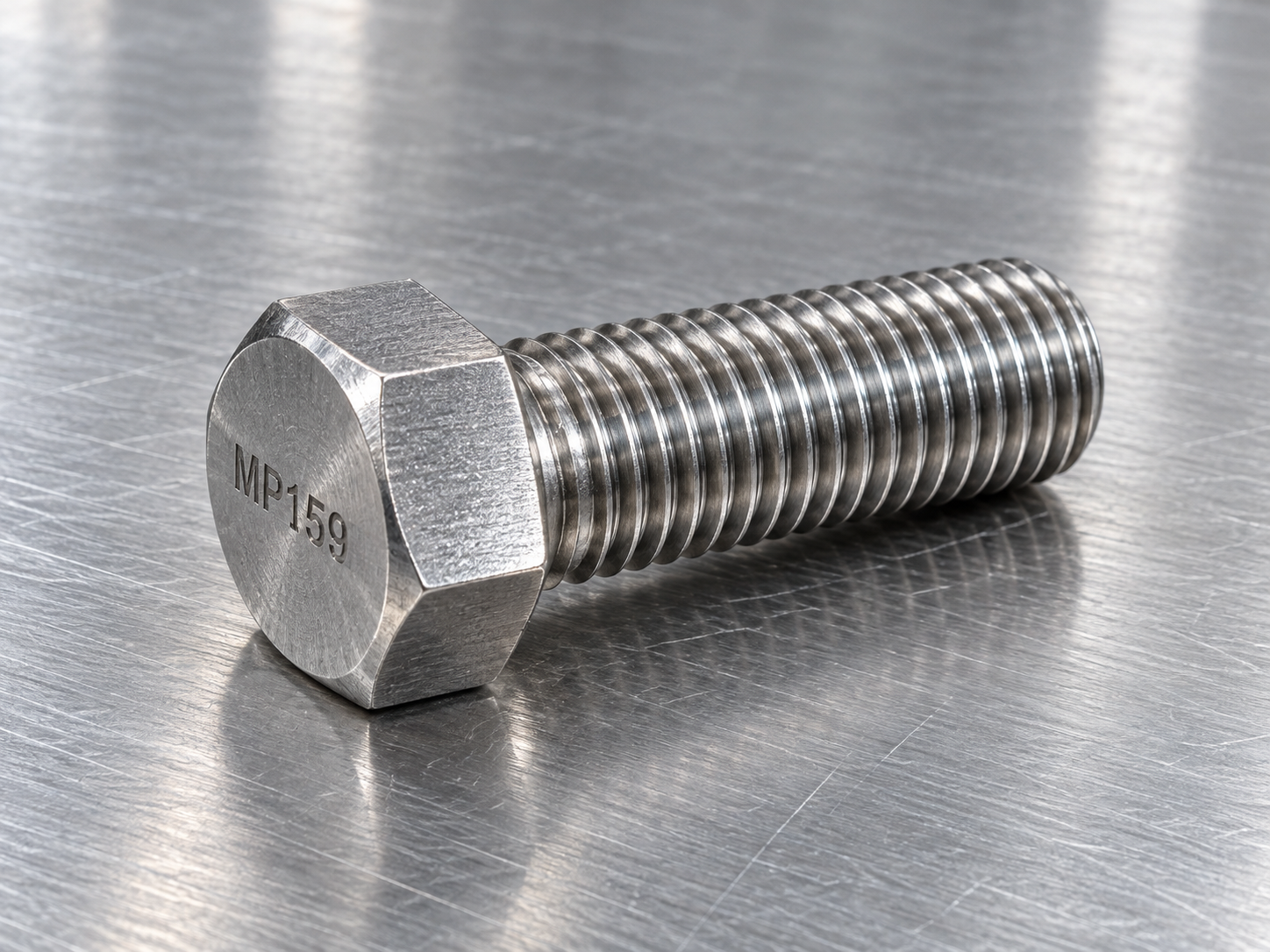
MP159 Fasteners in Extreme Environments: Aerospace Hot Sections, HPHT Sour Wells, Standards, and Failure Prevention
MP159 (UNS R30159) is not just another superalloy—it is the material that bridges the gap between ultra-high tensile strength and exceptional corrosion resistance. Where other alloys force a compromise between the two, MP159 delivers both simultaneously, making it irreplaceable in aerospace engine hot sections and 20,000 psi HPHT sour gas wells. RAYCHIN LIMITED, a specialist global manufacturer of MP159 and other high-performance fasteners, has compiled this authoritative guide to help engineers master the two most demanding applications of MP159, interpret the governing standards, prevent high-temperature failures, and source certified fasteners from a trusted manufacturing partner.
Part 1: Application Scenarios — Where MP159 Is Irreplaceable
✈️ Aerospace Engine Hot-Section Fasteners
In the combustion chamber, turbine disc, and exhaust section of a modern jet engine, fasteners face a combined assault of temperatures exceeding 600°C, high-frequency vibration, thermal cycling, and oxidizing gas streams. Standard nickel alloys such as Inconel 718 lose strength rapidly above 650°C, while Waspaloy offers excellent creep resistance but lower ultimate strength and higher weight.
The MP159 Advantage for Aerospace
- Superior strength retention at 600°C: MP159 retains approximately 80% of its room-temperature yield strength at 600°C—far exceeding Inconel 718 (~73% at 600°C) and MP35N (~57%). This allows thinner, lighter bolts for the same clamp load, directly contributing to engine weight reduction.
- Outstanding fatigue resistance: When combined with rolled threads, MP159 achieves fatigue limits 2–3 times higher than cut threads, critical for turbine disc attachments and compressor case bolts subjected to high-cycle vibration.
- Oxidation resistance to 700°C: The chromium-rich passive layer resists scaling and spalling, preserving the fastener cross-section through thousands of thermal cycles.
- Stress relaxation resistance: MP159 maintains preload in the joint far better than lower-grade alloys, preventing gasket leakage and bolted joint loosening in combustion chambers and exhaust ducting.
Typical aerospace MP159 components: combustion chamber bolts, turbine disc attachment studs, high-pressure compressor rear-stage bolts, afterburner linkage fasteners, and exhaust nozzle support hardware.
?️ Ultra-High-Pressure Sour Gas Well Tools
In a 20,000 psi (138 MPa) HPHT well with a bottom-hole temperature of 350°F (177°C) and H₂S partial pressure exceeding 10 psi, fasteners must simultaneously resist sulfide stress cracking (SSC), chloride pitting, and high tensile loads. This is the environment where MP159 separates itself from every other commercial fastener material.
The MP159 Advantage for HPHT Sour Wells
- Highest strength with NACE compliance: MP159 achieves yield strengths of 230–250 ksi (1585–1725 MPa) while remaining NACE MR0175 compliant at hardness levels up to 51 HRC. Inconel 718, by contrast, is limited to 40 HRC for NACE compliance, drastically reducing achievable preload in high-pressure equipment.
- Excellent SSC resistance: MP159 passes NACE TM0177 Method A testing at its full strength, making it the only material capable of delivering both 20,000 psi pressure containment and reliable sour gas service.
- Chloride pitting resistance: With a PREN of approximately 45 (due to its high molybdenum content), MP159 resists pitting and crevice corrosion in the chloride-rich completion brines typical of HPHT wells.
- Hydrogen embrittlement resistance: The cobalt-nickel matrix has low hydrogen diffusivity, preventing the delayed brittle fracture that plagues high-strength steels and some nickel alloys in cathodically protected subsea equipment.
Typical HPHT MP159 components: packer mandrel connection bolts, bridge plug shear screws, subsea tree valve stem fasteners, wellhead connector studs, and completion tool body bolts.
Part 2: Core Standards Deep Dive — AMS 5875/5876, API 20F, and NACE MR0175
When specifying MP159 fasteners, the material standard alone is insufficient. To ensure reliable performance in aerospace and oilfield applications, engineers must reference multiple standards covering chemistry, heat treatment, mechanical properties, and environmental cracking resistance. RAYCHIN's documentation packages are structured to satisfy all applicable standards with full traceability.
? AMS 5875 / AMS 5876 — Aerospace Material Specifications
AMS 5875 and AMS 5876 are the aerospace material specifications governing MP159 alloy in bar, forging, and fastener stock forms. They define:
- Chemical composition: Co 35.5%, Ni 25.5%, Cr 19%, Mo 7%, Ti 3%, plus trace elements, with tight limits to ensure consistent precipitation response.
- Heat treatment: Cold reduction ratio (typically 50–60% for high-strength fasteners) followed by aging at 660°C (1220°F) for 4 hours, then air cooling.
- Mechanical properties: Minimum tensile 260 ksi, yield 240 ksi, elongation 10% for cold-drawn + aged condition.
- Microstructural requirements: ASTM E112 grain size verification to ensure uniform precipitation of gamma-prime phase without detrimental grain boundary films.
- Testing requirements: Tensile, hardness, and, for aerospace programs, elevated-temperature tensile testing to verify strength retention at 600°C.
? API 20F — Oilfield Fastener Quality Standard
API 20F is the American Petroleum Institute's specification for carbon and alloy steel fasteners used in oil and gas service. While MP159 is a cobalt-nickel alloy (not covered by the carbon steel portion of API 20F), the standard's quality management framework is often invoked in oilfield procurement to ensure:
- Heat-lot traceability: Full documentation linking finished fasteners to original mill heat numbers.
- Mechanical testing: Lot-specific tensile, hardness, and impact testing.
- Surface inspection: Non-destructive examination (FPI/MPI) for surface defects.
- Documentation package: EN 10204 3.1 or 3.2 certificates, PMI reports, and heat treatment records.
RAYCHIN's MP159 fasteners for oilfield service comply with the intent of API 20F and can be supplied with the documentation package tailored to that standard.
? NACE MR0175 / ISO 15156 — Sour Service Compliance
NACE MR0175 is the mandatory standard for materials used in H₂S-containing oil and gas service. MP159 is accepted for NACE Level VII (the most severe sour service category) at hardness up to 51 HRC. RAYCHIN's compliance documentation includes:
- Hardness verification: 100% testing to ensure ≤ 51 HRC on every fastener.
- NACE TM0177 testing: Lot-specific SSC testing upon request.
- Metallurgical certification: Microstructural verification to confirm uniform precipitation and absence of detrimental phases.
- NACE compliance statement: Issued with the material certificate for every shipment destined for sour service.
MP159 Heat Treatment Window — The Critical Process
The performance of MP159 depends on a precisely controlled two-stage process: cold work followed by aging. The table below summarizes the critical parameters.
Part 3: Troubleshooting High-Temperature Failures — Galling, Seizure, and Oxidation
Even the most robust alloy can fail if not properly assembled or protected. In high-temperature service, MP159 fasteners face two primary failure modes: thread galling/seizure during assembly or maintenance, and oxidation-induced binding during prolonged service. RAYCHIN has developed proven prevention strategies for each.
? Problem 1: Thread Galling and Seizure During Assembly
Root Cause: MP159, like all high-nickel, high-cobalt alloys, has low thermal conductivity and high ductility. Under high contact pressure during tightening, the protective oxide film on the threads breaks down, causing cold welding of the mating surfaces. Once initiated, the threads tear and lock solidly, making disassembly impossible without cutting the fastener.
Contributing Factors: Dry assembly, identical material for bolt and nut, high-speed impact tools, cut (rather than rolled) threads.
? Problem 2: Oxidation-Induced Binding at High Temperature
Root Cause: In service at 600°C+, the protective chromium oxide scale on MP159 grows slowly. Over time, especially in cyclic thermal conditions, this oxide can build up in the thread clearances and prevent disassembly during maintenance. Additionally, if the fastener is exposed to sulfidizing atmospheres, the oxide scale may break down and form less protective sulfide layers.
Contributing Factors: Prolonged exposure above 600°C, thermal cycling, sulfur-containing environments, lack of thread protection.
? Problem 3: Stress Relaxation and Preload Loss
Root Cause: At sustained high temperature, all materials experience some degree of stress relaxation—the gradual conversion of elastic strain into plastic strain. While MP159 has excellent relaxation resistance compared to other alloys, it is not infinite.
Contributing Factors: Temperatures exceeding 600°C, initial preload exceeding 60% of yield, insufficient joint stiffness.
Manufacturing Capability
- In-house processes: Cold drawing, precision CNC machining, vacuum aging heat treatment, thread rolling, and 100% inspection.
- Product forms: Hex bolts, double-end studs, socket head cap screws, heavy hex nuts, washers, and custom geometries.
- Size range: 1/4″ – 2″ (imperial), M6 – M48 (metric). Larger sizes on request.
- Custom manufacturing: From your CAD drawings—stepped studs, flanged bolts, reduced-shank fasteners, and special thread forms.
Stock List and Rapid Delivery
- Strategic inventory: MP159 bar in diameters from 1/4″ to 2‑1/2″ for rapid fulfillment.
- Standard lead times: 2–4 weeks for custom manufacturing; 3–5 days for common sizes in stock.
- Expedited options: Available for urgent MRO and project requirements.
Certifications and Documentation
- EN 10204 Type 3.1 as standard; Type 3.2 with independent third-party witness on request.
- PMI (Positive Material Identification) report—OES analysis on finished fasteners.
- Mechanical test report: tensile, yield, elongation, hardness (100% verification).
- Heat treatment batch records for aging.
- NACE MR0175 compliance statement for sour service.
- Mill test certificate traceable to the original heat number.
Industries Served
- Aerospace: Engine hot-section fasteners, turbine disc bolts, exhaust components.
- Oil & Gas: HPHT sour wellhead studs, packer bolts, subsea tree fasteners.
- Medical: Surgical instrument fasteners, implant tooling.
- Motorsport: High-performance engine and suspension bolts.
Why Partner with RAYCHIN?
- Unbiased technical support: We manufacture all major superalloys, so our recommendations are based on performance, not inventory.
- Factory-direct pricing: No middlemen; competitive quotations within 24 hours.
- Global delivery: We ship to the USA, Europe, and Asia with expertise in export documentation.
- Proven track record: Trusted by major oilfield service companies and aerospace OEMs.
Send your specifications, drawings, or inquiry to our technical sales team. We'll provide a comprehensive quotation with lead time, certification details, and pricing within 24 hours. Schedule a video tour of our manufacturing facility to see your fasteners being produced.
✉️ sales@ray-chin.com? www.ray-chin.com | MP159 Manufacturer · OEM · Certified · Rapid Delivery
Request A Quote! We'll respond as soon as possible(within 12 hours)
Get a Quote