
Categories List
MP35N Fasteners: The Complete Technical Authority Guide — Long-Tail Specifications, Comparisons, Standards, Applications & Failure Prevention
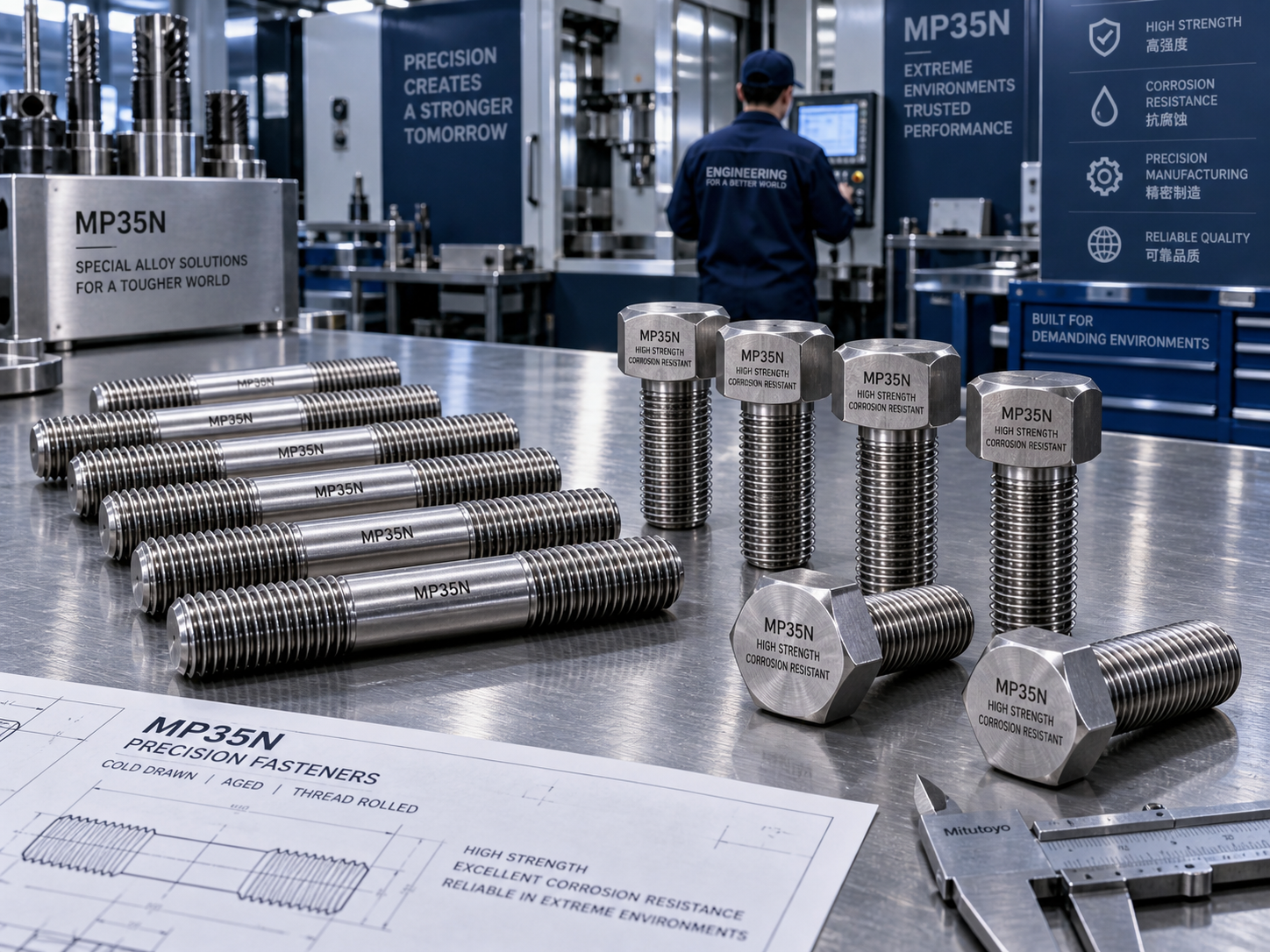
MP35N (UNS R30035) is not just another high-strength alloy. It is the cobalt-nickel superalloy that defines the upper limit of what is commercially achievable in fastener performance—up to 260 ksi tensile strength, NACE MR0175 compliance at 51 HRC, and near-immunity to chloride stress corrosion cracking. Yet specifying MP35N correctly requires more than selecting a grade. It demands a deep understanding of standard compliance, competing alloys, application-specific demands, and the failure modes that can undermine even this premium material. RAYCHIN LIMITED, a specialist global manufacturer of MP35N and other high-performance alloy fasteners, presents this authoritative technical guide to support engineers and procurement teams through every stage of the selection and sourcing process.
Part 1: High-Intent Long-Tail Specifications — Precision Page Coverage
Engineers searching for MP35N fasteners often arrive with a highly specific requirement—a particular standard, a specific application, or a defined product form. RAYCHIN has structured its technical content to answer these high-intent, long-tail queries with complete specifications and clear statements of manufacturing capability.
? MP35N Stud Bolts with API 20F for Downhole Tools
For downhole tools operating at 20,000 psi and 350°F in sour gas environments, MP35N stud bolts are the definitive solution. Our MP35N stud bolts are manufactured to:
- Material: ASTM F562 / AMS 5844 (UNS R30035), cold-drawn and aged to 260 ksi UTS / 230 ksi YS minimum.
- Dimensions: ASME B16.5 double-end studs, DIN 976 fully threaded studs; sizes 1/4″ – 2-1/2″ and M6 – M64.
- Threads: Rolled after aging for maximum fatigue life and galling resistance.
- Documentation: Full API 20F compliance package including heat-lot traceability, mechanical testing, PMI, and NACE MR0175 compliance statement.
RAYCHIN's MP35N stud bolts are specified for packer mandrel connections, bridge plug shear screws, and completion tool body joints where failure would require costly intervention.
? MP35N Socket Head Cap Screws — ASTM F562 Dimensions
RAYCHIN manufactures MP35N socket head cap screws per ASME B18.3 in sizes from #4 to 1″ (imperial) and M3 to M24 (metric). Key dimensional and performance specifications:
All MP35N socket head cap screws are supplied with full ASTM F562 certification, PMI reports, and 100% hardness testing. RAYCHIN can also manufacture custom dimensions and thread forms from your drawings.
? MP35N Fastener Manufacturer for Subsea Tree Applications
Subsea Christmas trees and manifolds demand fasteners that resist seawater corrosion, hydrogen embrittlement from cathodic protection, and high-pressure loads. RAYCHIN's MP35N fasteners for subsea tree applications include:
- Wellhead connector studs: Large-diameter MP35N studs up to 2-1/2″ (M64) for 15,000 psi wellhead connections.
- Tree cap and valve actuator bolts: High-strength hex bolts with rolled threads and WS₂ anti-galling coatings.
- Subsea control module housing fasteners: Corrosion-resistant socket head cap screws and nuts.
- Documentation: API 20F and NORSOK M-650 compliance available; full EN 10204 3.2 certification.
RAYCHIN is a qualified supplier to major subsea equipment OEMs and can support both new-build projects and urgent MRO requirements.
Part 2: Comparison Guides — Capturing High-Value Selection Traffic
MP35N is frequently compared with other high-performance alloys, and engineers need objective data to make the right choice. RAYCHIN has produced a series of technical comparison guides that provide the data and analysis required for confident selection.
? MP35N vs Inconel 718 Fasteners: When 140 ksi Yield Isn't Enough
Inconel 718 offers a yield strength of up to 150 ksi in the aged condition—impressive, but insufficient for the most demanding HPHT wellhead connectors and subsea tree studs where 15,000–20,000 psi pressures require preloads that only MP35N can deliver. At 230–250 ksi yield, MP35N provides roughly 60% more load-carrying capacity than Inconel 718, allowing smaller bolt diameters or reduced bolt counts.
RAYCHIN Verdict: Choose MP35N when the application demands the highest possible preload in a sour, chloride-rich environment, or when space and weight constraints prevent the use of larger Inconel 718 bolts. Choose Inconel 718 for high-temperature (650°C+) applications where its superior creep resistance is the deciding factor.
? MP35N vs Monel K500 for Sour Well Bolting: A Technical Deep Dive
Monel K500 is a nickel-copper alloy with excellent seawater corrosion resistance and moderate strength (yield ~100 ksi). MP35N, with its 230 ksi yield, provides more than double the load-carrying capacity and superior resistance to sulfide stress cracking in sour gas environments.
RAYCHIN Verdict: For sour gas wellhead bolting where H₂S is present and NACE compliance is mandatory, MP35N is the only safe choice. Monel K500 is suitable for non-sour seawater applications where its lower strength is sufficient.
? MP35N vs Inconel 625: Strength vs. Corrosion Resistance for Fasteners
Inconel 625 offers outstanding corrosion resistance (PREN ~50, higher than MP35N's ~45) but its yield strength is limited to 60–100 ksi in the annealed condition. MP35N provides 2–4 times the strength at a comparable level of corrosion resistance.
RAYCHIN Verdict: Choose MP35N when high strength and moderate corrosion resistance are required—for example, in HPHT wellhead studs. Choose Inconel 625 when maximum corrosion resistance is the priority and loads are moderate—for example, in subsea tree components exposed to chlorides but not extreme pressures.
Part 3: Standards and Certifications — Interpreting ASTM F562, AMS 5844, NACE, and API 20F
Understanding the standards that govern MP35N fasteners is essential for specifying the correct material and ensuring compliance. RAYCHIN's documentation packages are structured to satisfy all applicable standards with full traceability.
? Navigating ASTM F562 and AMS 5844 for MP35N Bolts
ASTM F562 is the primary material specification for MP35N (UNS R30035) bar, wire, and forging stock used in surgical implants and fasteners. It defines:
- Chemical composition: Co 35.5%, Ni 25.5%, Cr 19%, Mo 7%, with tight limits on impurities.
- Cold work and aging: Minimum 50% cold reduction, followed by aging at 660°C for 4 hours.
- Mechanical properties: Minimum tensile 260 ksi, yield 230 ksi, elongation 10% for the highest strength condition.
- Microstructural requirements: Verification of uniform precipitation and absence of detrimental phases.
AMS 5844 is the aerospace equivalent, with additional requirements for cleanliness, grain size control, and testing. RAYCHIN manufactures MP35N fasteners to both standards, with full certification.
? API 20F and NACE MR0175 — Oilfield Compliance
API 20F is the American Petroleum Institute's quality standard for fasteners used in oil and gas service. While MP35N is not a carbon steel, the standard's framework is often invoked to ensure heat-lot traceability, mechanical testing, and documentation. RAYCHIN provides API 20F-compliant documentation packages for MP35N fasteners, including:
- Full heat-lot traceability from mill to finished fastener.
- Lot-specific tensile and hardness testing.
- Non-destructive examination (FPI/MPI) for surface defects.
- EN 10204 3.1 or 3.2 certificates.
NACE MR0175 / ISO 15156 is the mandatory standard for materials in H₂S-containing service. MP35N is accepted for NACE Level VII (most severe) at hardness ≤ 51 HRC. RAYCHIN performs 100% hardness testing and provides a NACE compliance statement with every shipment destined for sour service. We can also arrange NACE TM0177 testing upon request.
Part 4: Application Scenarios — Deep-Dive Guides for Critical Industries
MP35N's unique combination of strength and corrosion resistance makes it irreplaceable in three primary industries: deepwater oil and gas, aerospace, and medical devices.
? Deepwater Oil & Gas — HPHT Sour Wells, Subsea Trees, and Downhole Tools
In a 20,000 psi HPHT well with bottom-hole temperature of 350°F and H₂S partial pressure exceeding 10 psi, fasteners must resist sulfide stress cracking, chloride pitting, and high tensile loads simultaneously. MP35N is the only commercial material that delivers 230+ ksi yield strength while remaining NACE MR0175 compliant at 51 HRC.
Typical MP35N components in oil and gas:
- Wellhead connector studs: Large-diameter studs for 15,000–20,000 psi connections.
- Subsea tree valve stem fasteners: Resistant to seawater and produced fluids.
- Packer mandrel bolts: High-strength connections that must survive setting and production loads.
- Downhole tool shear screws: Precision-machined to fail at a specific load.
- Completion tool body bolts: High-strength joints that must resist vibration and thermal cycling.
RAYCHIN supplies MP35N fasteners to major oilfield service companies and operators worldwide, with full API 20F and NACE documentation.
✈️ Aerospace — Engine Hot Sections and High-Vibration Joints
In aerospace engines, MP35N fasteners are used in combustion chamber bolts, turbine disc attachments, and high-pressure compressor rear-stage joints. The alloy's high strength-to-weight ratio allows thinner, lighter bolts, while its fatigue resistance—especially with rolled threads—ensures reliability under high-cycle vibration.
Typical MP35N components in aerospace:
- Combustion chamber bolts: Resist thermal cycling and oxidizing gases to 600°C.
- Turbine disc attachment studs: High preload for disc integrity under centrifugal load.
- Afterburner linkage fasteners: Fatigue-resistant connections in high-vibration zones.
- Exhaust nozzle support hardware: Oxidation-resistant fasteners for exhaust sections.
RAYCHIN manufactures aerospace MP35N fasteners to AMS 5844 with NADCAP-accredited heat treatment and full AS9102 FAIR documentation upon request.
? Medical Devices — Biocompatible, High-Strength Fasteners
MP35N is widely used in orthopedic implants, surgical instruments, and implantable device tooling due to its biocompatibility, corrosion resistance, and ultra-high strength. The alloy is non-magnetic and resists repeated sterilization.
Typical MP35N components in medical:
- Orthopedic implant screws: High strength and biocompatibility for bone fixation.
- Surgical instrument fasteners: Corrosion-resistant and durable through repeated sterilization.
- Implantable device tooling: Precision fasteners for catheter and stent delivery systems.
RAYCHIN supplies medical-grade MP35N fasteners to ASTM F562 with full material certification and optional electropolishing for enhanced surface finish.
Part 5: Troubleshooting MP35N Fastener Failures — Galling, Hydrogen Embrittlement, and Fatigue
Even the most robust alloy can fail if misapplied or incorrectly assembled. RAYCHIN has developed proven prevention strategies for the most common MP35N failure modes.
? Problem 1: MP35N Galling and Thread Seizure
Root Cause: MP35N has low thermal conductivity and high ductility. Under high contact pressure during tightening, the protective oxide film on the threads breaks down, causing cold welding and seizure.
Contributing Factors: Dry assembly, identical material for bolt and nut, high-speed impact tools, cut threads.
? Problem 2: MP35N Hydrogen Embrittlement
Root Cause: Atomic hydrogen can diffuse into high-strength alloys from cathodic protection, acid pickling, or electrolytic plating. In MP35N, hydrogen embrittlement is rare but possible if the alloy is exposed to severe hydrogen charging conditions and high stress.
Contributing Factors: Electrolytic plating (zinc, cadmium) that introduces hydrogen; excessive hardness; high applied stress.
? Problem 3: Fatigue Failure in High-Vibration Applications
Root Cause: Cyclic loading, especially in aerospace and downhole tool applications, can initiate fatigue cracks at thread roots if the fastener is not properly designed or if the threads are cut rather than rolled.
Contributing Factors: Cut threads (stress concentrators), insufficient preload, vibration-induced loosening.
Send your specifications, drawings, or inquiry to our technical sales team. We'll provide a comprehensive quotation with lead time, certification details, and pricing within 24 hours. Our engineers are available to support your material selection with unbiased, data-driven advice.
✉️ sales@ray-chin.com? www.ray-chin.com | MP35N Manufacturer · OEM · Certified · Rapid Delivery
Request A Quote! We'll respond as soon as possible(within 12 hours)
Get a Quote