
Categories List
Recent Posts
 Hastelloy C276 Fasteners: Bolts, Nuts, Screws, Studs & Washers for the World's Most Aggressive Corrosive Environments
 Inconel Fasteners: Bolts, Nuts, Washers, Studs – Complete Technical Guide | RAYCHIN LIMITED
 MP35N vs Inconel, Titanium, C276, Complete Material Comparison Guide for Fasteners | RAYCHIN LIMITED
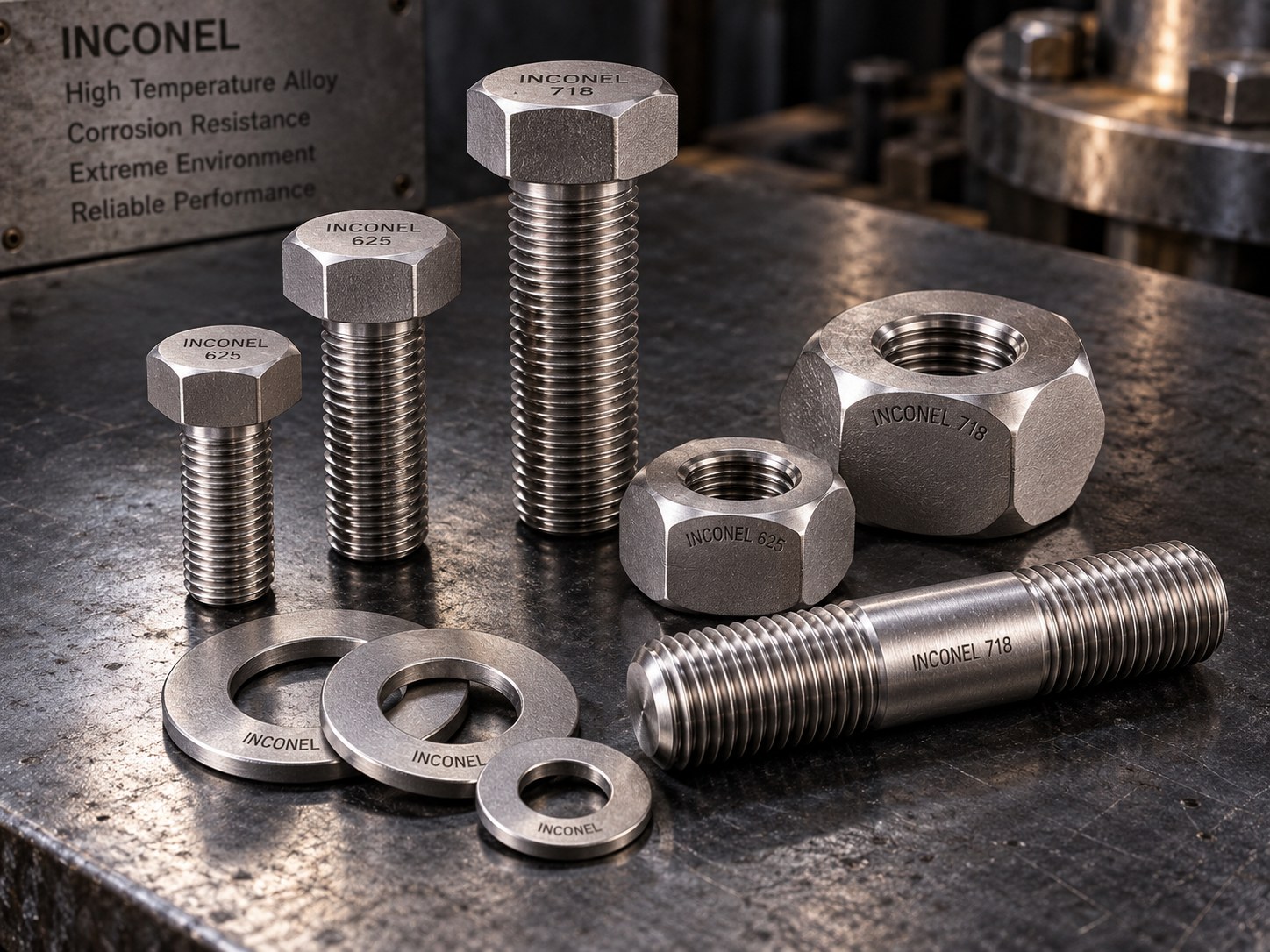
Inconel 718 vs Inconel 625 Fasteners: A Complete Technical Comparison for Critical Applications
In high‑stakes bolting applications—aerospace engines, gas turbines, deepwater wellheads, and chemical reactors—the choice between Inconel 718 and Inconel 625 is often the difference between a joint that holds for decades and one that fails prematurely. Both are nickel‑base superalloys with outstanding corrosion resistance, yet they derive their strength through fundamentally different mechanisms and serve distinct operating envelopes. RAYCHIN LIMITED, a specialist global manufacturer and supplier of high‑performance alloy fasteners with over two decades of in‑house experience, provides this definitive technical comparison to guide engineers and procurement teams toward the optimal grade for their application.
1. Chemical Composition and Strengthening Mechanisms: The Core Distinction
The most fundamental difference lies in how each alloy achieves its strength. This determines everything from temperature capability to corrosion behavior.
2. Mechanical Properties at Room Temperature
The strength hierarchy is clear: Inconel 718 is significantly stronger than Inconel 625 in the standard solution‑annealed conditions, because 718 is age‑hardened while 625 relies on solid‑solution strengthening. Typical minimum properties for fasteners are presented below.
For applications demanding maximum preload or minimal fastener size, Inconel 718 is the clear choice. However, Inconel 625's lower hardness and higher ductility provide advantages in galling‑sensitive or highly corrosion‑resistant joints.
3. Temperature Capability: High‑Temperature Strength vs Oxidation Resistance
Inconel 718 retains excellent strength up to 704°C (1300°F) under load, owing to the stability of its γ″ precipitates. Beyond 650°C, however, the precipitates begin to coarsen and strength declines rapidly. Inconel 625, while not as strong at elevated temperature, maintains its structural integrity to about 650°C under load and resists oxidation up to 982°C (1800°F) in non‑structural applications. For furnace hardware or exhaust components where oxidation dominates over mechanical load, 625 often outperforms 718.
- Use Inconel 718 for gas turbine disc bolts, compressor studs, and aerospace fasteners where high strength up to 700°C is required.
- Use Inconel 625 for exhaust ducting, combustion chamber hardware, and furnace parts where oxidation resistance and moderate strength are sufficient.
4. Corrosion Resistance: Different Environments, Different Winners
The corrosion profiles diverge based on alloying elements. Inconel 625's 8–10% molybdenum gives it outstanding resistance to pitting and crevice corrosion in seawater and chloride‑rich environments, with a PREN of approximately 50. Inconel 718, with only 3% Mo, has a lower PREN (~32) and may pit in warm, stagnant seawater. Conversely, Inconel 718 offers better resistance to high‑temperature oxidation and sulfidation, especially in turbine environments.
5. Application Domain Matrix
6. Cost and Availability
Inconel 625 is generally 20–40% more expensive than Inconel 718 due to its higher molybdenum content. However, lifecycle cost must consider replacement frequency and downtime. In corrosion‑dominated environments, 625's superior resistance can offset the higher initial cost. RAYCHIN maintains deep inventory in both alloys, enabling fast deliveries for standard and custom fasteners.
7. RAYCHIN's Manufacturing and Certification
RAYCHIN LIMITED produces both Inconel 718 and 625 fasteners with full traceability, in‑house heat treatment, and rigorous testing. We certify to AMS 5662/5663 (718), ASTM B446 (625), NACE MR0175, and EN 10204 3.1/3.2. Our application engineers provide torque tables, anti‑galling strategies, and material selection support to ensure your bolted joints perform flawlessly.
Send your temperature, pressure, media, and strength requirements to our technical team. We'll provide an unbiased alloy recommendation and competitive quotation within 24 hours.
✉️ sales@ray-chin.com? www.ray-chin.com | Inconel 718 · Inconel 625 · Certified Global Supply
Request A Quote! We'll respond as soon as possible(within 12 hours)
Get a Quote