
Categories List
Recent Posts
 Nitronic 50 vs. 254 SMO Fasteners: Strength or Seawater Immunity? A Complete Selection Guide
 Hastelloy C276 Fasteners: Bolts, Nuts, Screws, Studs & Washers for the World's Most Aggressive Corrosive Environments
 Inconel Fasteners: Bolts, Nuts, Washers, Studs – Complete Technical Guide | RAYCHIN LIMITED
Nitronic 50 vs. 254 SMO Fasteners: Strength or Seawater Immunity? A Complete Selection Guide
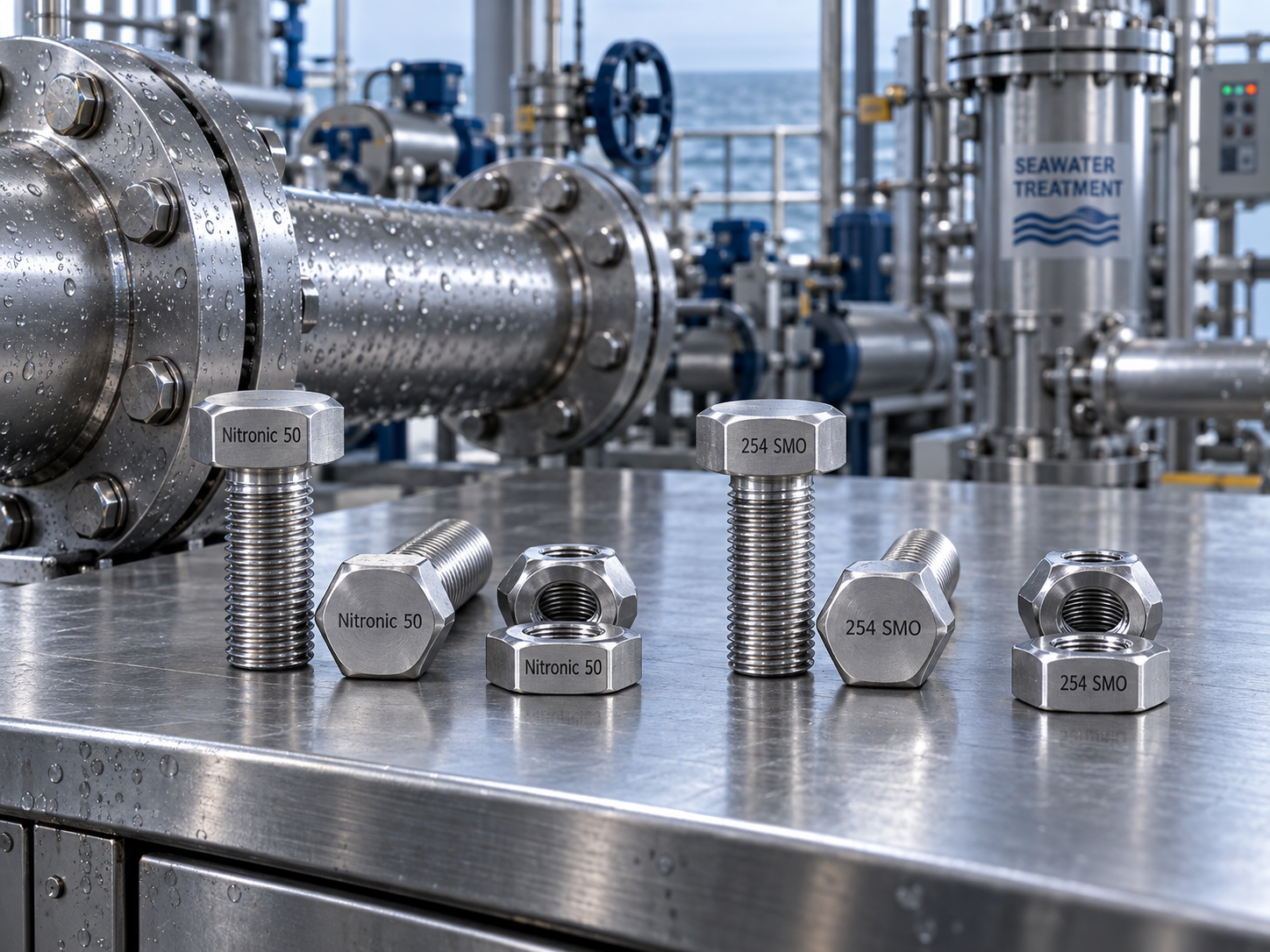
Nitronic 50 and 254 SMO are two of the most capable austenitic stainless steels available for fastener applications, yet they solve fundamentally different engineering problems. Nitronic 50 (UNS S20910) delivers yield strengths roughly double those of conventional 300-series grades while remaining non-magnetic and tough at cryogenic temperatures. 254 SMO (UNS S31254) sacrifices some strength to achieve a level of chloride pitting and crevice corrosion resistance that approaches nickel alloys. Choosing between them for bolts, nuts, screws, studs, and washers requires a clear understanding of where each alloy's advantage becomes decisive. RAYCHIN LIMITED, a specialist global manufacturer of high-performance alloy fasteners, provides this definitive comparison to support your selection.
1. Chemical Composition: The Divergence That Defines Performance
The alloying strategies behind these two grades explain their contrasting strengths and weaknesses. Nitronic 50 relies on nitrogen solid-solution strengthening combined with manganese to stabilize austenite, while 254 SMO uses a high-molybdenum, high-nickel approach to maximize corrosion resistance.
⚙️ Nitronic 50 — The Strength Play
Strengthening mechanism: Interstitial nitrogen in solid solution. No precipitation hardening is required, so the alloy remains single-phase austenitic and non-magnetic even after severe cold work.
Key alloying logic: High nitrogen + manganese replaces some nickel for austenite stability while delivering yield strengths of 380 MPa (55 ksi) minimum in the annealed condition, rising to over 1000 MPa (145 ksi) when cold-worked[reference:0].
?️ 254 SMO — The Corrosion Play
Strengthening mechanism: Solid-solution strengthening only. The alloy cannot be hardened by heat treatment, and its yield strength is 300 MPa (43.5 ksi) minimum—roughly 20% lower than Nitronic 50's annealed yield[reference:1].
Key alloying logic: 6% molybdenum and 18% nickel create a passive film that resists chloride breakdown to a far greater degree than Nitronic 50's 2–3% Mo content allows.
2. Mechanical Properties: When 80 MPa of Yield Changes the Joint Design
The strength gap between these alloys is not incremental—it is design-altering. For fasteners, yield strength determines the maximum preload that can be safely applied without thread stripping or bolt yielding.
For a standard M20 bolt, the practical consequence is significant. A Nitronic 50 bolt in the cold-drawn condition can be torqued to achieve preloads that would strip or yield a 254 SMO bolt of the same diameter. If your joint requires high clamp load in a compact envelope—such as a high-pressure flange or a structural connection—Nitronic 50 is the only viable choice between the two. Conversely, if the joint design is limited by the flange or gasket rather than the bolt, 254 SMO's lower strength may be entirely adequate.
? RAYCHIN Verdict: Mechanical Strength
Choose Nitronic 50 when maximum preload, weight reduction through smaller bolt diameters, or high fatigue resistance under vibration is required. Its cold-drawn strength (up to 145 ksi yield) is in a different class from 254 SMO.
3. Corrosion Resistance: The Chloride Reality Check
This is where the selection becomes nuanced—and where assumptions can lead to field failures. It is tempting to assume that Nitronic 50, being a "high-performance" alloy, offers better overall corrosion resistance than 254 SMO. The data does not support that assumption in chloride environments.
3.1 PREN and Critical Pitting Temperature
The Pitting Resistance Equivalent Number (PREN) provides the first indication of relative performance:
- Nitronic 50: PREN ≈ 35–38 (Cr ~22%, Mo ~2.25%, N ~0.30%)[reference:2][reference:3].
- 254 SMO: PREN ≥ 42.5 (Cr ~20%, Mo ~6.1%, N ~0.20%)[reference:4].
While a PREN difference of 5–7 points may appear modest on paper, its effect on the critical pitting temperature (CPT) in aggressive chloride media is substantial. 254 SMO's CPT is typically in the range of 50–80°C depending on surface condition and test method, whereas Nitronic 50's lower molybdenum content places its CPT significantly below that threshold.
3.2 Crevice Corrosion: The Critical Differentiator
For fasteners, crevice corrosion is often the limiting degradation mode because bolt threads, under-head surfaces, and gasketed joints create inherent crevices. In a controlled seawater immersion study, Nitronic 50 exhibited greater crevice corrosion than type 316 stainless steel, while 254 SMO performed well in both cold and warm seawater[reference:5]. The researchers attributed Nitronic 50's unexpectedly poor crevice performance to its relatively low molybdenum content (2.28%), which is insufficient to maintain passivity in deaerated, acidified crevice environments despite the alloy's high nitrogen content[reference:6].
This finding is critical for specification: Nitronic 50 is not a seawater fastener alloy in the way that 254 SMO is. Its strength and non-magnetic properties make it excellent for pump shafts, valve stems, and structural components where crevices are avoidable, but for bolted joints in continuous seawater exposure, 254 SMO offers a substantially greater margin of safety against crevice attack.
? RAYCHIN Verdict: Corrosion Resistance
Choose 254 SMO whenever the fastener will be exposed to warm, stagnant, or crevice-forming chloride environments—seawater flanges, desalination piping, FGD scrubber internals, and chemical process joints. Its 6% molybdenum content provides a level of crevice corrosion resistance that Nitronic 50 cannot match, despite Nitronic 50's higher strength.
4. Product Range: Bolts, Nuts, Screws, Studs, and Washers
RAYCHIN manufactures both alloys across the full spectrum of fastener forms, allowing you to standardize on a single supplier while selecting the optimal grade for each joint in your assembly.
? Hex Bolts
ASME B18.2.1, DIN 931/933, ISO 4014. Sizes 1/4″–2″ (M6–M48) in both Nitronic 50 and 254 SMO.
? Socket Head Cap Screws
ASME B18.3. Sizes #4–1″ (M3–M24). Available in cold-drawn Nitronic 50 for high strength and 254 SMO for corrosion-critical joints.
? Stud Bolts
Double-end studs (ASME B16.5) and fully threaded studs (DIN 976). Diameters 1/4″–2-1/2″ (M6–M64). Rolled threads for fatigue and galling resistance.
? Heavy Hex Nuts
ASME B18.2.2, DIN 934. Proof-load matched to the corresponding bolt or stud. Both grades available in the same alloy or as dissimilar pairs to reduce galling.
⬜ Flat & Spring Washers
ASME B18.22.1, DIN 125/127. Sizes 1/4″–2″ (M6–M48). Custom dimensions available to protect flange surfaces and distribute clamp load.
⚙️ Custom Fasteners
Stepped studs, flanged bolts, body-bound bolts, and proprietary geometries from your CAD drawings. Both alloys, prototype to production.
5. Application Decision Matrix: Matching Alloy to Environment
6. Why Source Both Alloys from RAYCHIN LIMITED?
- Unbiased selection support: We manufacture both Nitronic 50 and 254 SMO under one roof. Our recommendation is based on your operating conditions, not on which alloy we prefer to sell.
- Full certification: EN 10204 3.1 as standard; 3.2 with third-party witness on request. PMI and mechanical test reports included with every shipment.
- In-house manufacturing: CNC machining, thread rolling, and solution annealing are controlled in our facility, ensuring consistent quality and rapid delivery.
- Global inventory: Both alloys stocked in common diameters for fast turnaround on standard and custom fasteners.
Send your chloride concentration, temperature, strength requirement, and joint design to our technical team. We'll provide an unbiased alloy recommendation and competitive quotation within 24 hours.
✉️ sales@ray-chin.com? www.ray-chin.com | Nitronic 50 · 254 SMO · Bolts · Nuts · Screws · Studs · Washers
Request A Quote! We'll respond as soon as possible(within 12 hours)
Get a Quote