
A286 Fasteners: Bolts, Nuts, Screws, Studs & Washers — The Complete Engineering Guide
When a joint must hold at 700 °C (1,300 °F) without the cost of a nickel-base superalloy, A286 is the proven iron-nickel-chromium answer. This guide covers the metallurgy, AMS specifications, mechanical property envelopes, and application logic that engineers and procurement teams need to specify A286 fasteners with confidence.
A286 (UNS S66286, W.Nr. 1.4980, Alloy 660) is a precipitation-hardenable austenitic superalloy. It delivers up to ~1,317 MPa (191 ksi) tensile in the cold-drawn and aged condition, maintains useful strength to 700 °C, resists oxidation to ~816 °C, and remains non-magnetic down to cryogenic temperatures — at a fraction of the material cost of Inconel 718.
1. What Is A286 Alloy?
A286 — also designated Alloy 660, UNS S66286, and W.Nr. 1.4980 — is one of the original superalloys. It is an austenitic, iron-nickel-chromium alloy strengthened by titanium and aluminium additions through a controlled precipitation-hardening heat treatment. Unlike martensitic precipitation-hardening stainless grades, A286 retains its austenitic structure throughout processing, giving it non-magnetic behaviour and excellent toughness across a wide temperature range — from −196 °C up to 700 °C.
For fasteners, this combination is uniquely practical. A286 sits between conventional austenitic stainless steels (304/316) and full nickel-base superalloys (Inconel 718) in both performance and cost. It is the default high-temperature fastener alloy for aerospace airframes, gas turbine hardware, automotive exhaust systems, and oil & gas equipment where moderate-to-high temperature strength, oxidation resistance, and non-magnetic behaviour are required without paying the nickel-base premium.
2. Chemical Composition: What Makes A286 Work
The chemistry of A286 is carefully balanced to produce a stable austenitic matrix that can be precipitation-hardened without losing ductility or corrosion resistance. The table below summarises the typical composition range specified in AMS 5731 / 5732 / 5737 and ASTM A453 Grade 660.
The titanium-to-aluminium ratio is critical: it governs the volume fraction and stability of the γ′ strengthening phase. When the alloy is aged at 704–760 °C (1,300–1,400 °F) for approximately 16 hours, fine γ′ particles precipitate uniformly and raise the proof strength without embrittling the matrix.
3. Mechanical Properties: Strength, Temperature, and Heat Treatment
A286 is supplied in several heat-treatment conditions, and the properties depend heavily on the condition specified. The two-step process — solution treatment followed by aging — is the foundation of consistent fastener performance.
3.1 Heat treatment logic
Solution treatment can be performed at two temperatures, each producing a different balance of properties:
- 1,650 °F (899 °C) / 2 h / oil or water quench — favours higher tensile and yield strength. Common for ASTM A453 Grade 660 Class A / AMS 5737.
- 1,800 °F (982 °C) / 1 h / oil or water quench — favours optimum creep and stress-rupture resistance. Common for Class B / AMS 5732.
Both routes are followed by an aging treatment at 1,300–1,400 °F (704–760 °C) for 16 h, air cool.
3.2 Property envelope
The property cards below summarise the range typically achieved by commercial A286 fastener stock. Cold drawing followed by aging pushes tensile strength into the 191 ksi (1,317 MPa) class, while solution-treated-and-aged material delivers a more conservative but highly reproducible ≥900 MPa floor with better creep rupture margin.
(191,000 psi)
(171,000 psi)
(1,300 °F)
(~1,500 °F)
At cryogenic temperatures, A286 retains ductility and non-magnetic character to −196 °C, making it suitable for cryogenic equipment where magnetic interference must be avoided.
4. AMS, ASTM, and ASME Specifications
A286 fasteners are almost always procured against an AMS or ASTM specification that controls chemistry, heat treatment, and mechanical testing. The table below cross-references the most widely used standards.
4.1 ASTM A453 Grade 660 property classes
ASTM A453 Grade 660 defines four property classes. The most commonly specified are Class A and Class D.
- Classes A, B, and C — minimum tensile 130 ksi (895 MPa), minimum yield 85 ksi (585 MPa).
- Class D — minimum tensile 130 ksi (895 MPa), minimum yield 105 ksi (725 MPa). Class D is the choice where higher proof strength is needed without increasing the bolt size.
For cold-worked and aged fasteners, RAYCHIN can supply material achieving a minimum ultimate tensile strength of 160 ksi (1,100 MPa) upon request.
5. A286 Fastener Product Range
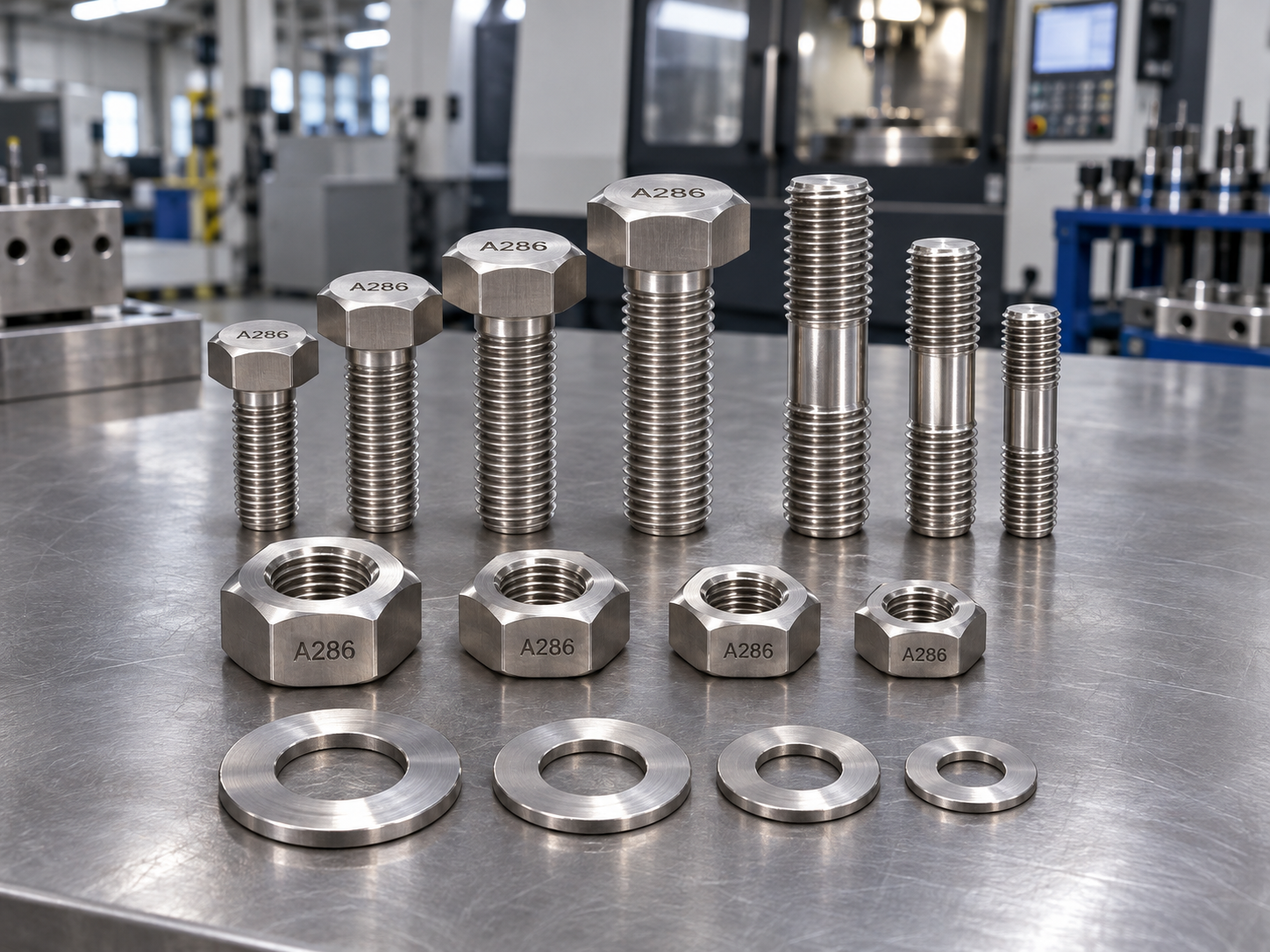
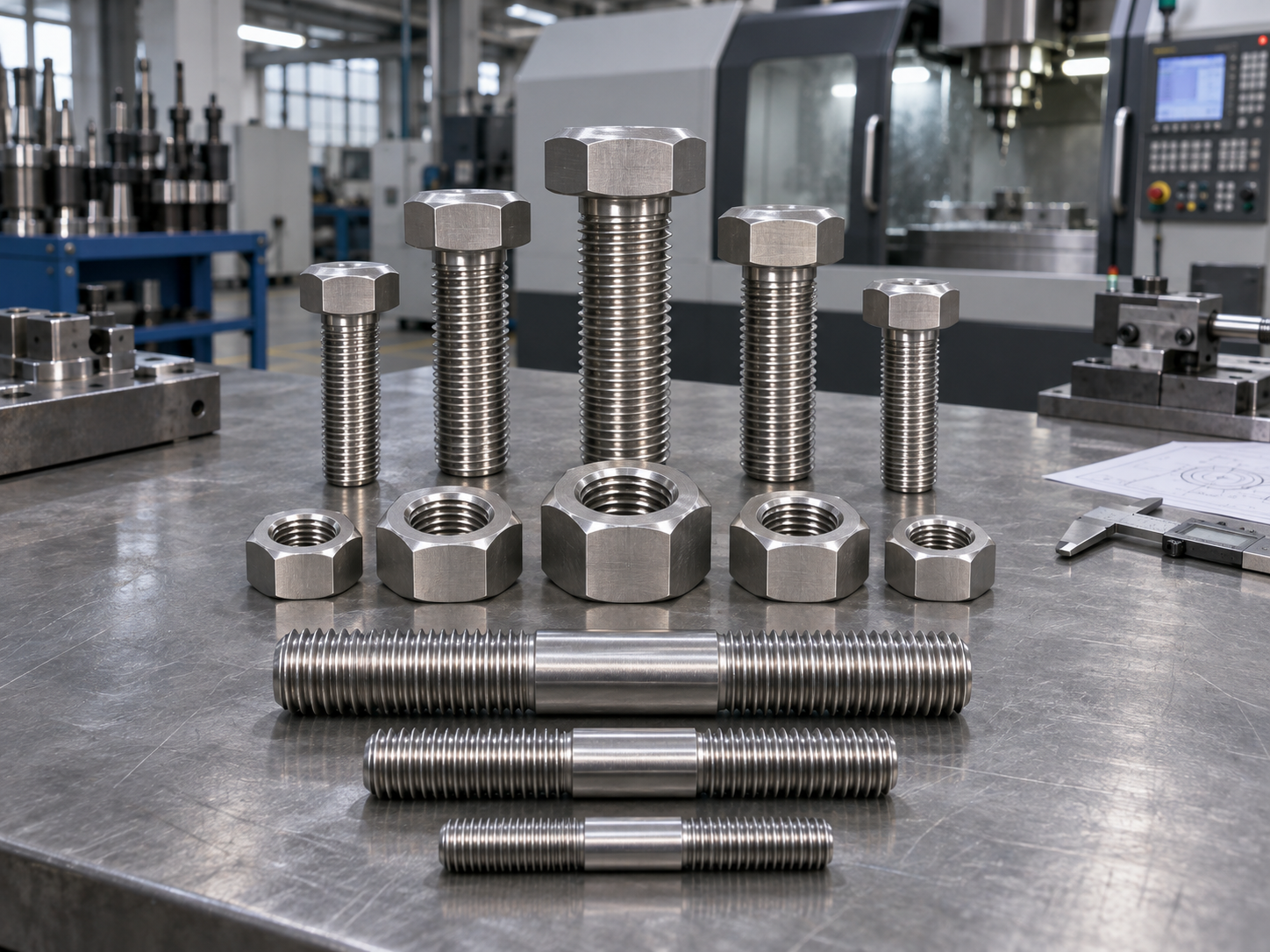
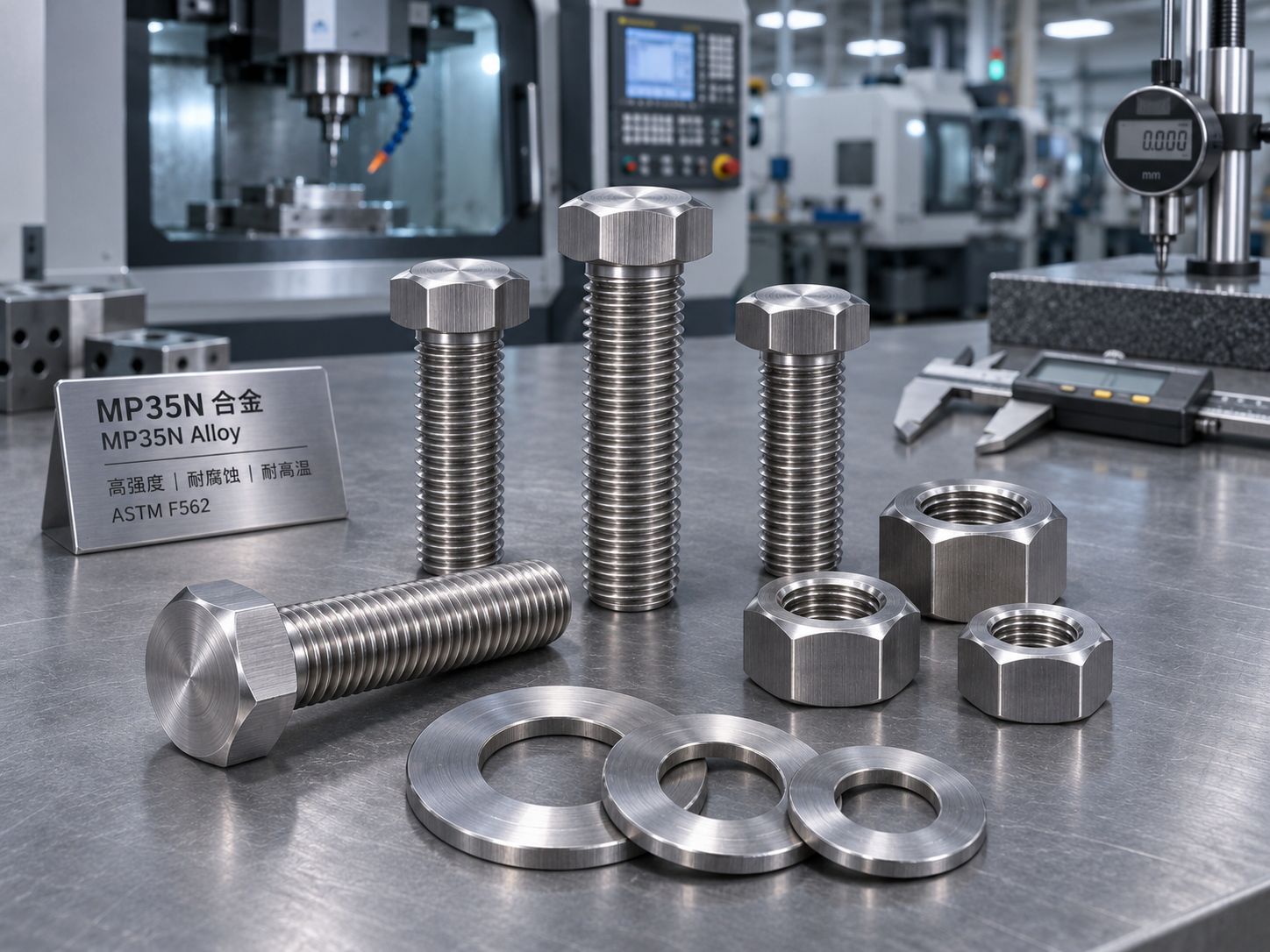
A286 is available in every major fastener form. The alloy machines well in the solution-treated condition, and final aging is performed after machining to achieve the specified strength. This allows complex geometries — 12-point heads, drilled heads, stepped shanks, and special threads — to be produced before the final hardening step.
- Hex bolts
- 12-point aerospace bolts
- Socket head cap screws
- Stud bolts & threaded rod
- Heavy hex nuts
- Standard nuts
- Washers
- Shoulder bolts
- Custom-machined parts
5.1 Size and thread capability
RAYCHIN’s A286 fastener programme covers a wide envelope, from miniature instrumentation screws to large structural bolting.
5.2 Fastener-specific notes
Bolts and stud bolts: A286 hex bolts are commonly supplied to ASME B18.2.1 / DIN 931/933, and stud bolts to ASME B16.5. Class D (130 ksi min tensile) is the standard strength class for general high-temperature service.
Aerospace 12-point bolts: The compact 12-point head allows higher torque in confined spaces. A286 12-point bolts are produced to NAS, MS, and customer airframe specifications, with magnetic permeability controlled to <1.005 for instrumentation and non-magnetic assemblies.
Nuts and washers: Nuts should be matched to the bolt material — A286 nuts with A286 bolts — to avoid galvanic mismatch and to ensure compatible thermal expansion. Heavy hex nuts are available to ASTM A194 and ASME B18.2.2.
6. A286 vs. 304 and 316 Stainless Steel Fasteners
The most common substitution question is whether a 304 or 316 stainless fastener can do the job. The answer depends almost entirely on temperature and strength retention.
The decisive advantage of A286 over 304/316 is not room-temperature strength — it is strength retention at temperature. Austenitic stainless steels soften progressively above roughly 400–500 °C, whereas A286 maintains a useful proof strength to 700 °C because the γ′ precipitates remain stable and continue to block dislocation motion. For a bolted joint, this translates directly into maintained preload and reduced relaxation.
A286 is also not a general-purpose corrosion alloy. It performs well in atmospheric, marine, and many chemical environments, but it should not be selected for strong reducing acids (such as hydrochloric acid). In hot sulphurous or chloride-bearing environments, stress corrosion cracking must be evaluated on a case-by-case basis.
7. A286 vs. Inconel 718: The Cost–Performance Decision
Inconel 718 is the natural “step-up” alloy from A286. It is stronger at temperature and retains useful strength beyond 700 °C. But it is also a nickel-base superalloy with roughly twice the nickel content and niobium additions — and a materially higher price. The comparison is therefore a classic cost–performance trade-off rather than a simple “better/worse” judgement.
Industry guidance is consistent: A286 meets the same ASME allowable stress values as Inconel 718 up to approximately 650 °C, at roughly half the material cost. Above that temperature, or where the applied load exceeds A286’s capacity, Inconel 718 becomes the rational choice. Many specifications are therefore hybrid: A286 for less critical flanges and structural joints, Inconel 718 reserved for the hottest, highest-stressed locations.
Choose A286 when the joint operates at or below 700 °C, the required strength is within the Class D / cold-worked envelope, and material cost or machinability matters. Move to Inconel 718 when the design load exceeds A286’s capacity, when fatigue life at temperature is the governing criterion, or when the service temperature pushes beyond ~700 °C.
8. Where A286 Fasteners Are Used
A286 fasteners appear across every industry where bolted joints must survive heat, load, and corrosion simultaneously. The application map below reflects RAYCHIN’s supply experience and published industry usage.
8.1 Aerospace and defence
A286 is the dominant non-magnetic precipitation-hardening fastener material on Western airframes and engine hardware. Specific applications include:
- Wing-spar splice bolts — heavy-hex A286 bolts (Boeing BACB30NW / BACB30LE spec, M16–M30) on wing root joints.
- Engine-mount lugs — 12-point flange A286 bolts (NAS 6603–6620, M16–M24) attaching engine pylons to fuselage; safety-critical primary structure.
- Fuselage frame attach — NAS 1351 / NAS 6203 socket head cap screws (M5–M10) joining frame to skin.
- Instrumentation rack mounting — NAS 1351 / MS 51957 screws where magnetic permeability < 1.005 is mandatory for avionics.
- Jet engine hardware — turbine case bolts, compressor bolts, and APU fasteners.
A286 is used on Boeing 737/747/767/777/787, Airbus A320/A330/A350, F-15/F-16/F-22/F-35, Apache, Black Hawk, V-22, and Eurocopter Tiger / NH90 platforms.
8.2 Oil, gas, and petrochemical
In oil and gas, A286 fasteners are selected for wellhead equipment, X-mas trees, manifolds, BOPs, and high-pressure valves where sulphidation resistance and strength at temperature are required. Offshore platform fasteners benefit from the alloy’s resistance to seawater and H₂S-bearing environments, subject to NACE MR0175 / ISO 15156 compliance.
Non-magnetic well-logging tools also use A286 for downhole fasteners where magnetic interference must be avoided.
8.3 Automotive and motorsport
Turbocharger housings, exhaust manifold bolts, EGR valve attachments, and other hot-end engine fasteners are classic A286 applications. The alloy retains meaningful strength through the exhaust manifold and EGR temperature range — up to approximately 650 °C — and can tolerate short-term excursions to ~900 °C in exhaust streams.
8.4 Power generation and industrial
Gas turbine bolts, nuclear reactor fasteners, boiler components, heat exchanger studs, and compressor section hardware all use A286 where the temperature is within its envelope. The alloy’s creep and stress-rupture resistance — optimised by the 1,800 °F solution treatment — is particularly valued in bolting that must maintain preload over long service intervals.
9. Tightening and Torque Considerations
A286 fasteners are typically tightened to a target preload derived from the specified tensile strength and the joint’s service requirements. Because the alloy’s strength-to-hardness relationship is well characterised, torque values can be calculated using standard bolted-joint methodology (e.g., T = K · Fi · d, where K is the nut factor, Fi is the target preload, and d is the nominal diameter).
For aerospace and critical applications, A286 torque values are often published by the airframe OEM or in NASA/MSFC standards. As an illustration of the magnitude, NASA test data for A286 fasteners at 140 ksi ultimate / 95 ksi yield list preloads and target torques that scale with diameter — for a 7/8-14 fastener, the reported target torque is in the range of 6,253–10,422 in-lb depending on the lubrication and nut factor assumed.
Three practical points dominate A286 torque behaviour:
- Lubrication matters. As with all high-strength alloys, the nut factor K varies with coating and lubricant. MoS₂ and silver anti-seize coatings are commonly specified to stabilise friction and reduce scatter.
- Galling risk. A286 can be susceptible to galling when A286 bolts are run against A286 nuts without adequate lubrication or surface treatment. Anti-seize coatings and controlled thread finishes mitigate this.
- Stress-relaxation. At sustained temperature, some preload loss is inevitable. A286’s creep resistance slows relaxation relative to 304/316, but joint design should still account for the expected relaxation over service life.
10. Limitations and Engineering Cautions
A286 is an excellent alloy, but it is not universal. A professional specification acknowledges its boundaries.
11. Quality Assurance and Traceability
A286 fasteners are safety-critical in many applications, and the alloy is vulnerable to substitution and heat-treatment shortcuts. A credible supply chain therefore depends on documented traceability and independent verification.
RAYCHIN LIMITED supplies A286 fasteners with the following quality documentation as standard or on request:
- EN 10204 3.1 / 3.2 material test certificates.
- Positive Material Identification (PMI) to verify alloy chemistry on finished parts.
- Full mechanical testing — tensile, yield, elongation, reduction of area.
- Hardness testing — typical 248–321 HB after aging.
- Stress-rupture and creep testing where the specification requires it.
- NACE MR0175 / ISO 15156 compliance for sour service.
- Third-party inspection (SGS, BV, TÜV, etc.) available on request.
A common certification pitfall is the “mill-only certification” trap: a mill certificate confirms the raw bar chemistry but does not prove that the finished fastener received the correct solution treatment and aging cycle. Procurement should require finished-part mechanical testing and, where applicable, stress-rupture testing — not just a bar certificate.
12. Frequently Asked Questions
What is A286 alloy, and is it a stainless steel or a superalloy?
A286 (UNS S66286) is an iron-nickel-chromium austenitic superalloy, not a conventional stainless steel. It contains enough chromium (13.5–16%) to provide oxidation and corrosion resistance, but its high nickel content (24–27%) and titanium/aluminium additions make it a precipitation-hardenable superalloy with strength retention to 700 °C. It is often described as a “stainless superalloy” because it bridges the gap between 316 stainless and nickel-base alloys like Inconel 718.
What is the maximum temperature for A286 fasteners?
For continuous load-bearing service, A286 fasteners are rated to approximately 700 °C (1,300 °F). Oxidation resistance extends further — to about 816 °C (1,500 °F) — for short-term or intermittent exposure where the joint is not carrying significant load. Above 700 °C under load, Inconel 718 or another nickel-base alloy should be evaluated.
What is the difference between AMS 5731, AMS 5732, and AMS 5737?
AMS 5731 and AMS 5732 are raw material specifications for bar, forgings, and rings. AMS 5731 specifies 1,650 °F solution treatment (favouring higher tensile/yield), while AMS 5732 specifies 1,800 °F solution treatment (favouring creep rupture). AMS 5737 specifies solution-treated and aged material, and is the specification most often called out for finished fasteners requiring a minimum 965 MPa tensile.
Can A286 replace Inconel 718 to save cost?
Yes — if the joint temperature is ≤ ~650–700 °C and the required strength is within A286’s capacity. A286 meets the same ASME allowable stress values as Inconel 718 up to approximately 650 °C at roughly half the material cost.[16] The substitution becomes invalid when the design load exceeds A286’s Class D or cold-worked capability, or when fatigue life at temperature governs the design.
Is A286 magnetic?
In the annealed and aged condition, A286 is essentially non-magnetic, with magnetic permeability typically controlled to < 1.005. This makes it the standard choice for aerospace instrumentation fasteners, avionics rack mounting, and non-magnetic downhole logging tools. Significant cold working can slightly increase permeability, so finished-part verification is advisable for the most sensitive applications.
Does A286 suffer from galling?
Yes, A286 can gall when A286 bolts are assembled with A286 nuts without adequate lubrication, particularly at larger diameters and coarse thread pitches. Adhesive wear can damage threads and affect preload scatter. Mitigation includes MoS₂ or silver anti-seize coatings, controlled thread surface finish, and in some cases dissimilar nut alloys where the specification permits. Galling resistance should be addressed in the assembly procedure, not left to chance.
What is the difference between Class A and Class D ASTM A453 Grade 660?
Both classes have the same minimum tensile strength of 130 ksi (895 MPa). The difference is minimum yield strength: Class A requires 85 ksi (585 MPa), while Class D requires 105 ksi (725 MPa). Class D is specified when the joint design needs higher proof strength — for example, to resist joint separation under external loads — without increasing the bolt diameter.
Need A286 fasteners to a specific AMS or ASTM specification?
RAYCHIN LIMITED manufactures A286 bolts, nuts, screws, studs, and washers to AMS 5731 / 5732 / 5737 and ASTM A453 Grade 660, with full traceability and third-party inspection available.
sales@ray-chin.com · www.ray-chin.com