
Hastelloy Fasteners: Bolts, Nuts, Screws, Studs & Washers — The Complete Engineering Guide
When a bolted joint sits in hot sulphuric acid, wet chlorine, or a mixed oxidizing–reducing stream, standard stainless steel is not a design option. and its C22, B2, and B3 siblings are the alloys that keep those joints closed. This guide gives engineers and procurement teams the chemistry, ASTM data, corrosion metrics, galling controls, and grade-selection logic needed to specify Hastelloy fasteners with confidence.
Hastelloy C276 is the only single-alloy fastener choice that delivers simultaneous resistance to oxidizing and reducing media — from wet chlorine and hypochlorite to hydrochloric, sulphuric, and phosphoric acids — with a PREN of approximately 69, nearly triple that of 316L, and immunity to chloride stress-corrosion cracking in the solution-annealed condition.
1. What Is Hastelloy, and Why Does It Matter for Fasteners?
“Hastelloy” is a trade name — originally Haynes International — for a family of nickel-based corrosion-resistant alloys developed for the chemical process industry. The most widely specified fastener grade is Hastelloy C276 (UNS N10276, W.Nr. 2.4819), a nickel-molybdenum-chromium-tungsten alloy that resists both oxidizing and reducing environments. C22 (UNS N06022) leans toward oxidizing media, while B2 (UNS N10665) and B3 (UNS N10675) are optimised for pure reducing acids, especially hydrochloric.
For fasteners, this matters because a bolted joint is a crevice by design. The thread roots, under-head contact, and nut-to-washer interfaces are all tight gaps where chlorides concentrate and oxygen becomes scarce. Alloys that rely on a passive oxide film — including 316L and duplex stainless steels — are vulnerable to crevice corrosion precisely at those locations. Hastelloy C276’s Mo + W synergy and high nickel content suppress both crevice attack and chloride stress-corrosion cracking, making it one of the few materials that can be trusted in a threaded assembly exposed to aggressive chemistry.
2. Chemical Composition: The Metallurgical Logic of C276
Hastelloy C276 is a solid-solution strengthened alloy — it is not hardened by heat treatment or aging. Its properties come from the chemistry of the matrix, not from precipitates. The table below gives the composition limits per ASTM B574.
The ultra-low carbon (≤0.010%) and silicon (≤0.08%) are not incidental — they prevent the formation of intermetallic phases and grain-boundary carbides in the weld heat-affected zone, allowing C276 to be used as-welded without a post-weld anneal. For fasteners, this translates into predictable corrosion performance at thread roots and under-head fillets where cold working and local heating can alter microstructure.
3. Mechanical Properties and Temperature Capability
Hastelloy C276 fasteners are supplied in the solution-annealed condition. The alloy is not age-hardenable; strength comes from solid-solution strengthening and, where required, cold working. The property table below compares the two governing standards for rod and finished fasteners.
Nut requirements per ASTM F467 specify a minimum proof stress of 110 ksi (758 MPa) for hex and hex-flange nuts, and 119 ksi (820 MPa) for heavy hex and thick nuts, with a minimum hardness of 20 HRC.
3.1 Temperature limits
A critical distinction governs temperature selection for C276 fasteners:
- Continuous service under load: approximately 600 °C (1112 °F). Above this, creep and microstructural instability become limiting.
- Non-load-bearing oxidizing atmospheres: resists scaling to about 1100 °C (2012 °F).
For joints that require both high temperature and high strength — above roughly 650 °C under significant preload — nickel-base precipitation-hardened alloys such as Inconel 718 or Waspaloy are the appropriate step-up, not C276. Hastelloy is a corrosion-first alloy; its temperature ceiling under load reflects that design intent.
4. Corrosion Resistance: The Defining Advantage
The reason engineers specify Hastelloy C276 fasteners is simple: the alloy survives environments that destroy every stainless steel, including super-duplex and 6Mo grades. The table below summarises the media coverage and the key corrosion metrics.
A bolted connection is an engineered crevice. Hastelloy C276’s combination of PREN ~69, high Mo, and high Ni is specifically suited to the thread-root and under-head geometries where chloride concentration cells form. This is why the alloy is a default choice for flange bolting in FGD absorbers, chlorine drying towers, and sour-gas wellheads — applications where a leak is not an option.
5. Specifications, Standards, and Equivalents
Hastelloy fasteners are procured against a layered set of specifications: the rod standard, the fastener standard, and application-specific compliance requirements.
5.1 International equivalents
C276 is designated UNS N10276, W.Nr. 2.4819, EN NiMo16Cr15W, and JIS NW 0276. C22 is UNS N06022 / W.Nr. 2.4602; B2 is UNS N10665; B3 is UNS N10675. When a purchase order cites a European or Japanese designation, RAYCHIN cross-checks the chemistry against the ASTM limits to ensure equivalence.
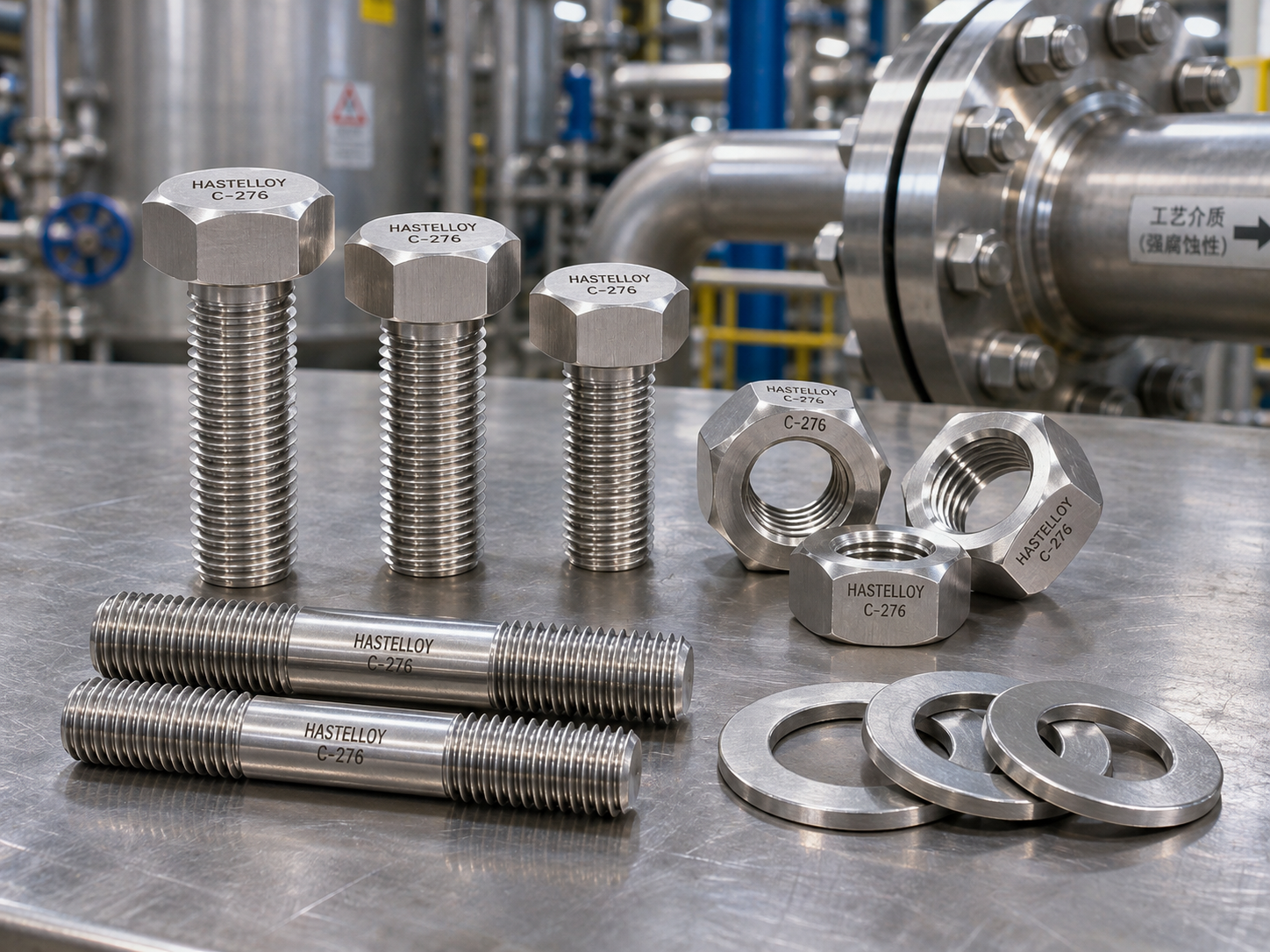
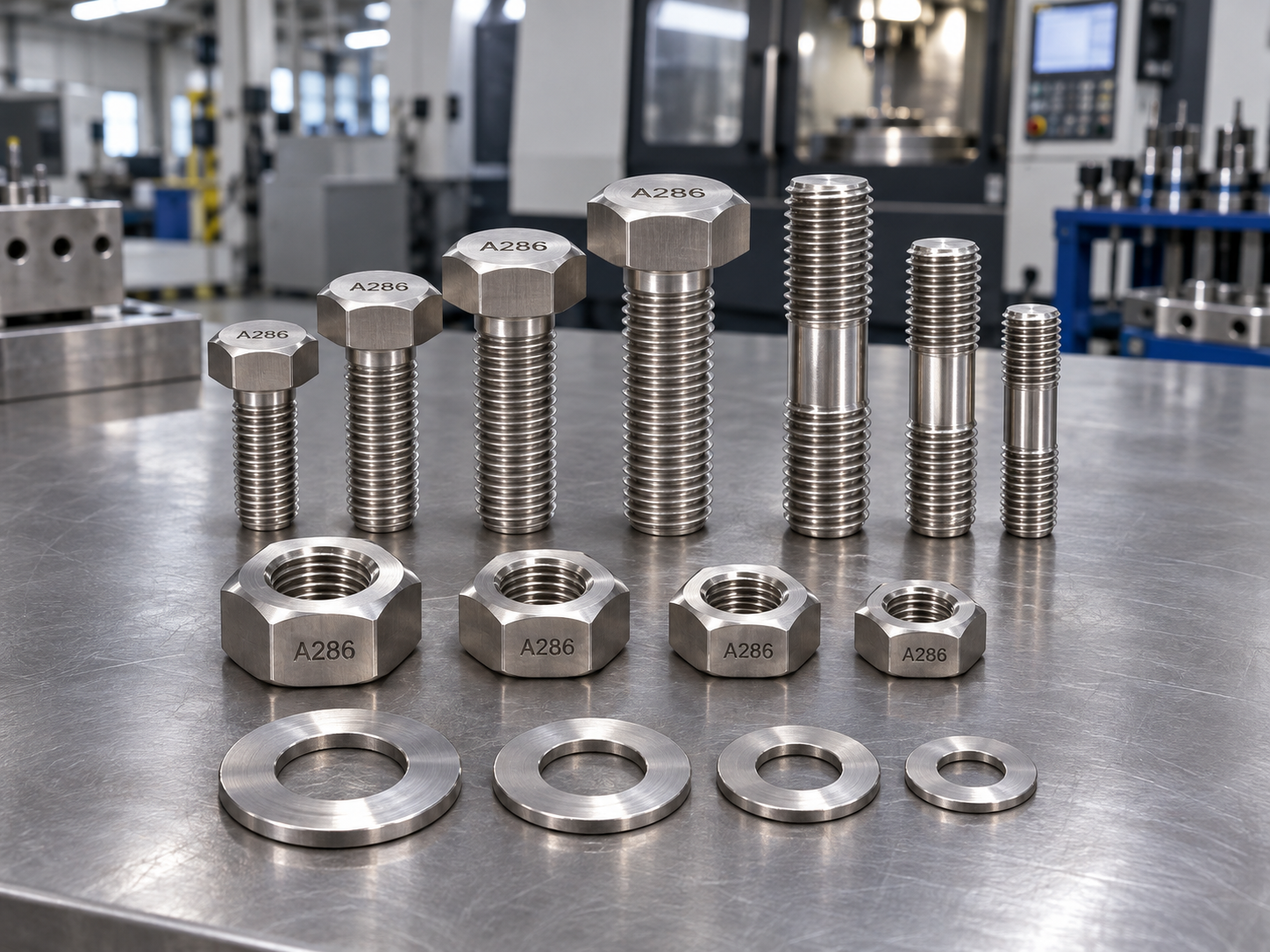
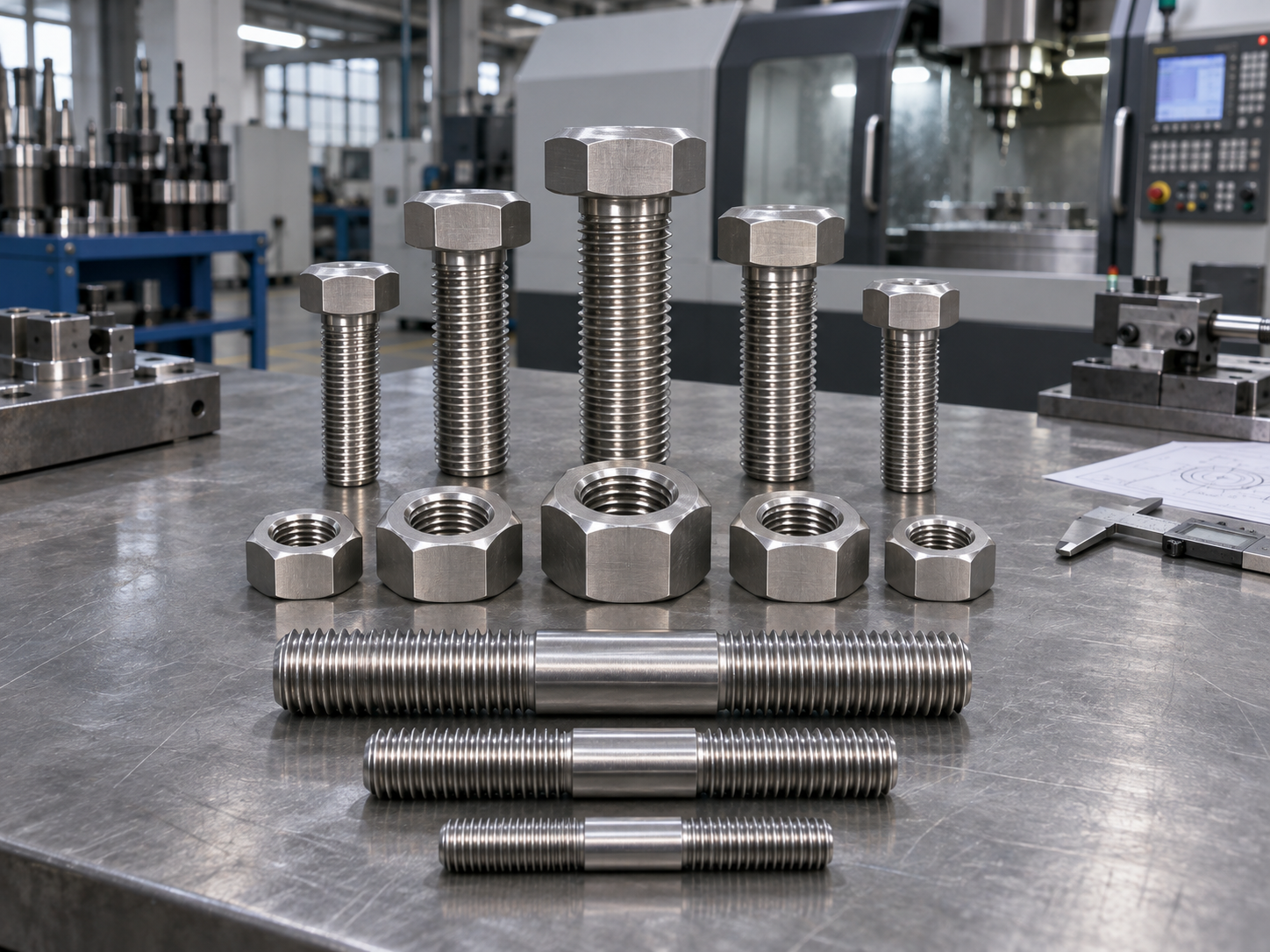
6. Complete Product Range: Bolts, Nuts, Screws, Studs, and Washers
RAYCHIN manufactures the full spectrum of Hastelloy fasteners in both metric and imperial sizes. The table below summarises the standard capability envelope; custom geometries and sizes beyond these ranges are available on request.
- Hex bolts
- Heavy hex bolts
- Socket head cap screws
- Set screws
- Fully threaded studs
- Double-end studs
- Heavy hex nuts
- Lock nuts
- Flat washers
- Spring washers
- Threaded rod
- Custom CNC parts
7. C276 vs. C22 vs. B2 vs. B3: Which Hastelloy Grade for Your Joint?
The C-family and B-family Hastelloys are not interchangeable. Each is optimised for a different corrosion mechanism. The grade cards below give the selection logic at a glance.
Best for: Mixed oxidizing–reducing media, wet chlorine, hypochlorite, contaminated sulphuric and hydrochloric acids, FGD scrubbers, sour gas. The default “universal” choice when the process chemistry is variable or not precisely defined.
Best for: Strongly oxidizing media, nitric acid, ferric chloride, and mixed acids where higher chromium (20–22.5%) is advantageous. Preferred in pharmaceuticals and fine chemicals where oxidizing conditions dominate.
Best for: Pure reducing acids — hydrochloric, hydrofluoric, and phosphoric — at all concentrations and temperatures. Not suitable where oxidizing species are present. Highest yield strength in the family (~350 MPa min).
Best for: The same reducing-acid service as B2, with improved thermal stability and fabricability. Specified for high-temperature acidic processes where B2’s microstructure may be less stable over long exposures.
If the media is mixed or unknown, choose C276. If it is strongly oxidizing (nitric, ferric), choose C22. If it is purely reducing HCl or H₂SO₄, choose B2 or B3. When the joint must also carry significant load at temperature, confirm that the chosen grade’s strength envelope meets the design preload — and step to a precipitation-hardened nickel alloy if it does not.
8. Hastelloy C276 vs. Inconel 625, Inconel 718, and Monel 400
Hastelloy is one of three nickel-alloy families used for severe-service fasteners. The distinction is fundamental: Hastelloy is corrosion-first, Inconel is strength-at-temperature-first, and Monel is seawater-and-cost-first.
The practical implication: do not specify Hastelloy C276 for a joint whose governing requirement is strength at 700 °C. Inconel 718 will carry more load at that temperature. Conversely, do not specify Inconel 718 for a wet-chlorine or mixed-acid joint where C276’s corrosion resistance is the design driver. The alloy choice follows the failure mode you are designing against.
9. Galling, Torque, and Assembly: The Practical Challenges
Hastelloy fasteners are more prone to thread galling than carbon steel or standard 300-series stainless steel. The nickel-rich, solid-solution matrix can cold-weld under the pressure and friction of assembly, seizing the thread before the joint reaches its target preload. This is not a defect in the alloy — it is a characteristic that must be engineered around.
9.1 Galling mitigation
- Anti-seize lubrication is mandatory for Hastelloy-to-Hastelloy assemblies. Molybdenum-disulfide (MoS₂) or PTFE-based compounds formulated for nickel alloys give the most consistent results.
- Rolled threads are preferred over cut threads for fatigue life and surface integrity.
- Controlled thread finish and appropriate assembly speed reduce the risk of cold welding.
- Where the specification permits, dissimilar nut pairing can reduce galling risk, but galvanic and thermal-expansion compatibility must be verified.
9.2 Torque and preload
C276’s moderate yield strength (283 MPa minimum per ASTM B574) limits the achievable preload compared with higher-strength nickel alloys. As an order-of-magnitude reference, a lubricated M20 C276 bolt is typically tightened to approximately 170 Nm. The nut factor K for well-lubricated Hastelloy threads with anti-seize falls in the range of 0.12–0.16; dry or lightly oiled threads sit at 0.20–0.30. Because the preload ceiling is lower than for high-strength alloy steels, joint design must be checked against the proof load of the fastener, not simply the bolt’s ultimate tensile strength.
Hastelloy fasteners should be assembled with a calibrated torque procedure and a verified lubricant. RAYCHIN can supply fasteners with pre-applied anti-seize coatings and provide torque recommendations based on the specified coating, thread condition, and target preload.
10. Industries and Applications
Hastelloy fasteners are specified wherever a bolted joint is exposed to chemistry that would destroy stainless steel. The application map below reflects RAYCHIN’s supply experience and published industry usage.
10.1 Chemical processing
Reactor flanges, heat-exchanger covers, column internals, and piping connections handling sulphuric, hydrochloric, phosphoric, and mixed acids are the core C276 application. C22 is preferred where nitric acid or strongly oxidizing streams are present; B2/B3 are specified for pure HCl service.
10.2 Flue gas desulfurization (FGD) and pollution control
Absorber internals, spray headers, mist eliminators, damper linkages, and stack liners are exposed to acidic chloride slurries and wet chlorine. C276 is a benchmark material for these locations because of its resistance to crevice corrosion under deposits and in threaded assemblies.
10.3 Oil & gas — sour service
Wellhead flanges, X-mas trees, manifolds, and refinery overhead systems exposed to H₂S and chlorides use C276 fasteners in the solution-annealed condition, compliant with NACE MR0175 / ISO 15156.
10.4 Pulp & paper, pharmaceutical, and marine
Bleach-plant washers, chlorine-dioxide stages, API synthesis reactors, and marine exhaust-scrubber wash-water systems all rely on C276 where wet chlorine, hypochlorite, or mixed oxidizing–reducing media are present. Pharmaceutical reactors often specify C22 where oxidizing acids and solvent mixtures dominate.
11. Quality Assurance and Traceability at RAYCHIN
Hastelloy fasteners are a high-value, safety-critical purchase, and the market contains both genuine UNS N10276 and lower-grade substitutes. Traceability and independent verification are therefore non-negotiable.
RAYCHIN LIMITED is a true manufacturer — CNC machining, solution annealing, thread rolling, and final inspection are controlled under one roof. Every shipment includes:
- EN 10204 Type 3.1 material certificate as standard; Type 3.2 with third-party witness on request.
- Positive Material Identification (PMI) by optical emission spectrometry on finished fasteners, not just the raw bar.
- Full mechanical test data — tensile, yield, elongation, hardness (20–32 HRC).
- NACE MR0175 / ISO 15156 compliance documentation for sour service.
- NORSOK M-650 qualification available for North Sea projects.
The PMI-on-finished-fasteners step is particularly important. A mill certificate for the bar confirms the heat chemistry, but it does not prove that the delivered fasteners were machined from that heat. Finished-part PMI closes that gap.
12. Frequently Asked Questions
What is Hastelloy C276, and why is it used for fasteners?
Hastelloy C276 (UNS N10276) is a nickel-molybdenum-chromium-tungsten alloy with approximately 16% Mo and 15.5% Cr. It is used for fasteners because it resists both oxidizing and reducing media — including wet chlorine, hypochlorite, sulphuric acid, hydrochloric acid, and mixed acids — and has a PREN of ~69, giving it exceptional resistance to chloride pitting and crevice corrosion in threaded joints. It is also effectively immune to chloride stress-corrosion cracking in the solution-annealed condition.
What is the maximum temperature for Hastelloy C276 fasteners?
For continuous service under load, C276 is limited to approximately 600 °C (1112 °F). In non-load-bearing oxidizing atmospheres, it resists scaling to about 1100 °C. For joints requiring both high temperature and high strength above ~650 °C under load, a precipitation-hardened nickel alloy such as Inconel 718 is the appropriate choice.
What is the difference between Hastelloy C276 and C22 fasteners?
C276 has higher molybdenum (15–17%) and tungsten (3–4.5%), giving it superior performance in reducing acids such as hydrochloric and contaminated sulphuric acid. C22 has higher chromium (20–22.5%), giving it better resistance in strongly oxidizing media such as nitric acid and ferric chloride. Both handle mixed acids, but the optimal choice depends on the specific process chemistry.
Can Hastelloy C276 fasteners be used in seawater?
Yes — C276 offers excellent resistance to seawater pitting and crevice corrosion, with a PREN of approximately 69. However, for continuous seawater immersion, super-duplex stainless steels or AL6XN may offer a more cost-effective balance of performance and price. C276 is typically specified for seawater applications where chlorides are combined with elevated temperature or other aggressive species.
Do Hastelloy fasteners gall, and how can it be prevented?
Yes — Hastelloy threads gall more readily than carbon steel or standard stainless steel because of the nickel-rich, solid-solution matrix. Prevention includes using a molybdenum-disulfide (MoS₂) or PTFE-based anti-seize lubricant formulated for nickel alloys, specifying rolled threads, controlling thread surface finish, and using a calibrated assembly procedure. RAYCHIN can supply fasteners with pre-applied anti-seize coatings.
What is the difference between ASTM B574 and ASTM F468 for Hastelloy fasteners?
ASTM B574 is the raw-material specification for low-carbon nickel-chromium-molybdenum alloy rod — it controls the chemistry and the properties of the bar from which fasteners are machined. ASTM F468 is the finished-fastener specification for nonferrous bolts, hex cap screws, and studs; it sets the mechanical property requirements (110–140 ksi tensile, 45 ksi yield) for the completed part. A compliant purchase order typically references both: B574 for the input material and F468 for the finished fastener.
Is Hastelloy C276 NACE MR0175 compliant for sour service?
Yes — Hastelloy C276 is suitable for NACE MR0175 / ISO 15156 sour service in the solution-annealed condition, with a hardness of ≤ 100 HRB. RAYCHIN supplies C276 fasteners with NACE compliance documentation, including hardness verification and material certification.
Need Hastelloy fasteners to ASTM B574 / F468, NACE MR0175, or a custom specification?
RAYCHIN LIMITED manufactures C276, C22, B2, and B3 bolts, nuts, screws, studs, and washers with finished-part PMI, EN 10204 3.1/3.2 certification, and global delivery.
sales@ray-chin.com · www.ray-chin.com