
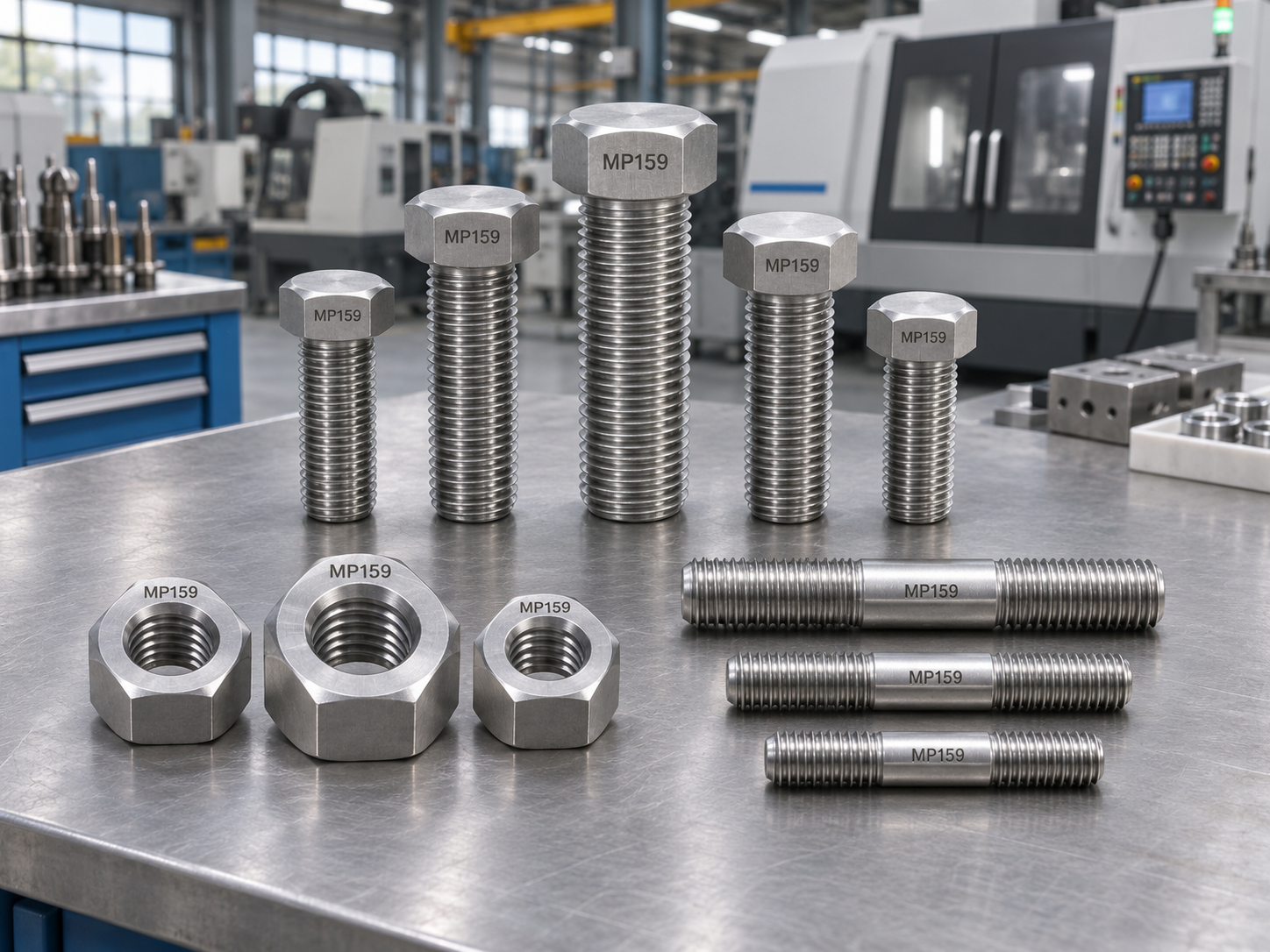
MP159 Fasteners: Bolts, Nuts, Screws, Studs & Washers
An engineering guide to MP159 (UNS R30159) bolting: the cobalt-nickel alloy specified when 260–275 ksi tensile strength, bolt preload retention, chloride stress-corrosion resistance and non-magnetic behaviour must coexist in the same fastener.
Why MP159 Exists — and Why It Is Not Simply a Stronger Inconel
Most bolting specifications stop at Inconel 718. It is an excellent alloy, with roughly 185 ksi tensile strength and creep capability to about 650 °C. However, a bolted joint has a failure mode that tensile data does not capture: stress relaxation. At elevated temperature, the strengthening precipitates in nickel-based alloys slowly coarsen, the bolt loses clamp load, and the joint loosens even though the bolt has not fractured.
MP159 was developed for this problem. It is a cobalt-nickel-chromium-molybdenum alloy, the higher-strength companion to MP35N. It is strengthened by a combination of cold-work-induced ε-phase transformation and a fine γ′ precipitation reaction during aging. The result is a fastener material with 260–275 ksi (1790–1895 MPa) tensile strength and preload retention that outperforms Inconel 718 and A286 in the temperature range where bolted joints are most sensitive to relaxation.
RAYCHIN LIMITED manufactures MP159 bolts, nuts, screws, studs and washers from certified AMS 5841, AMS 5842 and AMS 5843 bar stock. Each lot is PMI-verified, hardness-tested and supplied with EN 10204 3.1 material certification. This guide summarises the engineering logic our team applies when a customer asks whether MP159 is genuinely required for a given joint.
1. MP159 Chemistry: The Cobalt-Nickel Skeleton
MP159, UNS R30159, is nominally 35.7% Co, 25.5% Ni, 19% Cr, 9% Fe, 7% Mo, 3% Ti and 0.6% Nb, with minor elements balanced. Each element has a specific bolting function.
- Cobalt, 34–38% — the base element. It lowers stacking-fault energy, which enables the cold-work ε-phase to form and resist dislocation motion at temperature.
- Nickel, 28–32% — stabilises the austenitic matrix and contributes toughness and corrosion resistance.
- Chromium, 18–20% — the passivating element. It forms the Cr₂O₃ surface film that resists chlorides, seawater and oxidising acids.
- Molybdenum, 8.5–10% — improves pitting and crevice-corrosion resistance in chloride-bearing environments.
- Titanium, 2.5–3.5%, plus niobium, 0.2–0.8% — precipitation formers. During aging at about 675 °C they form fine γ′ particles, adding the second strengthening mechanism on top of cold work.
Nominal ranges for engineering reference. Purchase-order limits must follow the applicable AMS or ASTM specification.
2. How MP159 Achieves Its Strength — and Why That Matters for a Bolt
MP159 does not rely on a single strengthening mechanism. It uses a three-stage sequence that has direct consequences for how a fastener must be specified and purchased.
- Solution treatment at approximately 1038–1052°C, followed by water quenching, produces a soft austenitic matrix suitable for cold forming.
- Cold work, typically around 48% reduction, induces a strain-driven transformation from face-centred-cubic austenite to a body-centred-cubic ε-phase. This is the first major strengthening step and is why MP159 fastener bar is supplied in the cold-drawn condition.
- Aging at approximately 649–677 °C for about four hours precipitates fine γ′ particles within the cold-worked structure, completing the second strengthening step.
This is the reason MP159 fasteners are machined from cold-worked and aged bar rather than formed from annealed stock. The mechanical property progression is shown below.
Design note. The 6–8% elongation is not a defect. It is the ductility budget that allows a threaded fastener to be tightened without brittle fracture. MP159 is strong and tough, but it is not a field-bendable alloy. Rolled threads are preferred over cut threads for fatigue life.
3. The Real Differentiator: Bolt Preload Retention
A bolted joint fails when it loses clamp load, not necessarily when the bolt breaks. MP159’s advantage over Inconel 718 and A286 is clearest in stress-relaxation testing, which measures how much preload a bolt retains after hours at temperature.
Published bolting data for MP159, including tests conducted to MIL-STD-1312 test method 17, show the alloy retaining a higher fraction of initial preload than nickel-based alternatives at temperatures up to about 649 °C. Independent literature describes MP159 as offering the highest strength and creep resistance among fastener materials in this temperature range.
For joint design, this translates into three practical benefits:
- Fewer re-torques over service life.
- Higher retained clamp load in thermal-cycling assemblies such as turbine casings, exhaust joints and downhole tools.
- Smaller fastener envelope for a given preload, because the higher strength permits a reduced bolt count or bolt diameter.
4. MP159 Versus Inconel 718: When the Premium Is Justified
This is the specification decision most engineers actually face. Inconel 718 is more widely available, easier to machine and lower in material cost. MP159 is stronger, more resistant to relaxation and more resistant to chloride stress-corrosion cracking. The correct question is not which alloy is better, but which failure mode the joint is being designed against.
Choose MP159 when:
- Bolt preload retention at temperature is the primary design driver.
- The joint requires more than about 230 ksi tensile strength in fastener form.
- The environment contains chlorides, seawater or sour service where stress-corrosion resistance is mandatory.
- Weight or envelope reduction justifies the higher material and machining cost.
- Non-magnetic behaviour is required.
Inconel 718 may be sufficient when:
- About 185 ksi tensile strength meets the joint requirement.
- Service temperature is at or below about 650 °C and relaxation is not the limiting failure mode.
- Broader availability and shorter lead time are decisive.
- The corrosion environment is moderate, without concentrated chlorides or sour service.
- Machining cost is a dominant constraint, since cold-worked MP159 is more demanding to machine.
Cobalt-nickel alloys such as MP159 are generally reported to offer higher strength and better chloride corrosion resistance than Inconel 718, at the cost of higher material and processing expense. For critical aerospace and sour-service joints, that trade-off is often recovered through reliability and reduced maintenance intervention.
5. Galling and Hydrogen Embrittlement: Designing the Interface
MP159 shares the galling susceptibility of the cobalt-nickel family. Under relative motion between a loaded MP159 bolt and its mating component, severe adhesive wear can initiate and progress to preload loss and loosening. This is a design and installation issue, not a reason to avoid the alloy.
5.1 Galling mitigation
- Solid-film lubricants. Molybdenum disulfide or tungsten disulfide dry films applied to threads and under-head bearing surfaces reduce friction and prevent direct metal-to-metal contact. These are preferred for aerospace and high-vacuum applications.
- Anti-seize pastes. Nickel-based or MoS₂ pastes are used for industrial and oilfield bolting. Confirm compatibility with the service environment before selection.
- Surface engineering. Plasma nitriding and sputtering-nitriding duplex coatings have been reported to reduce the friction coefficient and wear rate of MP159 substantially, with laboratory wear-rate reductions exceeding 90%.
- Thread geometry and installation. Rolled threads, controlled tightening speed and an appropriate thread fit reduce the asperity contact pressure that triggers galling.
5.2 Hydrogen embrittlement control
High-strength MP159 is sensitive to hydrogen embrittlement if hydrogen is introduced during finishing. If a protective coating requiring electroplating is specified for a corrosive application, a bake-out at approximately 230 °C for at least 24 hours before plating is essential. RAYCHIN reviews coating specifications for this risk before releasing an order to production, and we recommend that the bake-out requirement be stated explicitly on the purchase order rather than left to the coating supplier.
Fastener specification point. The combination of a 44–54 HRC substrate and an electroplated coating is a recognised hydrogen-embrittlement risk. Where corrosion protection is required, solid-film lubricants, zinc-flake or other non-electrolytic systems are generally preferred for MP159 bolting.
6. Where MP159 Fasteners Are the Right Answer
6.1 Aerospace propulsion and airframes
MP159 is used in gas turbine engines, airframes, landing gear and rocket propulsion hardware. Its combination of ultra-high strength, fatigue resistance and non-magnetic behaviour makes it a candidate for load-bearing bolts where a single fastener failure is unacceptable. The alloy maintains useful strength to approximately 593–649 °C, covering compressor and hot-section bolting requirements.
6.2 Oil and gas downhole and subsea bolting
In high-pressure, high-temperature wells, measurement-while-drilling tools and subsea equipment, MP159 fasteners address a three-way requirement that is difficult to satisfy with one alloy: high strength, resistance to H₂S, CO₂ and chlorides, and preload retention across thermal cycles. The alloy is NACE MR0175 compliant and has been evaluated for resistance to galvanically induced hydrogen embrittlement in salt-spray bolt tests loaded to 75% of ultimate tensile strength.
6.3 Racing and specialised industrial equipment
Formula 1 and top-fuel racing use MP159 in critical engine, transmission and turbocharger fasteners where strength-to-weight ratio and reliability dominate. Industrial applications include high-cycle, high-vibration machinery where conventional high-strength fasteners would fatigue or relax.
7. MP159 Fastener Specifications: What to Put on the Purchase Order
A compliant MP159 fastener begins with a compliant bar specification. The specification chain below is the one RAYCHIN uses when reviewing incoming orders.
RAYCHIN documentation package. EN 10204 3.1 mill certificate, PMI report covering Ni, Co, Cr, Mo, Ti and Nb, hardness survey, tensile test results and heat-treatment record. For sour service we also supply hardness mapping and a NACE compliance statement.
8. Machining and Fabrication Notes for MP159 Fasteners
MP159 in the cold-worked and aged condition is hard, typically 44–54 HRC, and strongly work-hardening. It is not a material for high-speed steel tooling or aggressive feeds.
- Tooling. Carbide tooling with positive rake geometry and generous coolant. Expect lower surface speeds than Inconel 718 or 625.
- Threading. Rolled threads are strongly preferred for fatigue life. Cut threads are acceptable for non-critical joints but require sharp tooling and careful chip control.
- Heat treatment after machining. Final aging must be performed after thread rolling or machining if the fastener is not produced from pre-aged AMS 5843 bar. RAYCHIN machines from certified AMS 5843 stock to avoid heat-treatment variability across the supply chain.
- Welding. MP159 is weldable, but the heat-affected zone returns to a solution-treated strength level of roughly 850 MPa and the cold-work contribution is lost. Fasteners should be designed as machined, non-welded components. Welding is not an acceptable repair strategy for MP159 bolting.
9. Frequently Asked Questions
What is the difference between MP159 and Inconel 718 for bolting?
MP159 typically offers 260–275 ksi tensile strength compared with about 185 ksi for Inconel 718, and it retains bolt preload better at elevated temperature. Inconel 718 is more widely available and easier to machine. MP159 is selected when relaxation resistance, chloride stress-corrosion resistance or non-magnetic behaviour are critical to the joint.
Which specifications cover MP159 fasteners?
Bar stock is specified under AMS 5841 for solution-treated material, AMS 5842 for solution-treated and cold-worked material, and AMS 5843 for solution-treated, cold-worked and aged material. ASTM F562 is the core wrought alloy standard. NACE MR0175 / ISO 15156 applies for sour service. Fastener dimensions follow the customer drawing or the applicable fastener standard.
Is MP159 suitable for sour service and subsea bolting?
Yes. MP159 is NACE MR0175 compliant and is used for downhole tools, subsea equipment and wellhead hardware where high strength, sulfide stress-cracking resistance and chloride stress-corrosion resistance must coexist. Hardness and heat-treatment condition must be verified on every lot.
How do you prevent galling in MP159 fasteners?
Use a qualified solid-film lubricant such as MoS₂ or WS₂, or a nickel-based anti-seize paste. Control tightening speed, specify rolled threads and an appropriate thread fit, and consider surface treatments such as plasma nitriding. Avoid electroplating without a documented bake-out because of hydrogen embrittlement risk in high-strength MP159.
Specifying MP159 Bolting? Start With the Joint, Not the Bolt.
Send RAYCHIN your bolting drawing, preload requirement, service temperature and corrosion environment. Our engineers will confirm the heat-treatment condition, review galling and hydrogen-embrittlement risks, and quote a fully traceable MP159 fastener package.
RAYCHIN LIMITED — manufacturer and global supplier of MP159 bolts, nuts,screws, studs and washers. ISO 9001 · EN 10204 3.1 · AMS 5841 / 5842 / 5843 · ASTM F562 · NACE MR0175 / ISO 15156.
MP159 is a registered trademark of its respective owner. This guide is provided for engineering reference. Always confirm material selection against the applicable specification and a qualified metallurgist for the specific joint design and service environment.