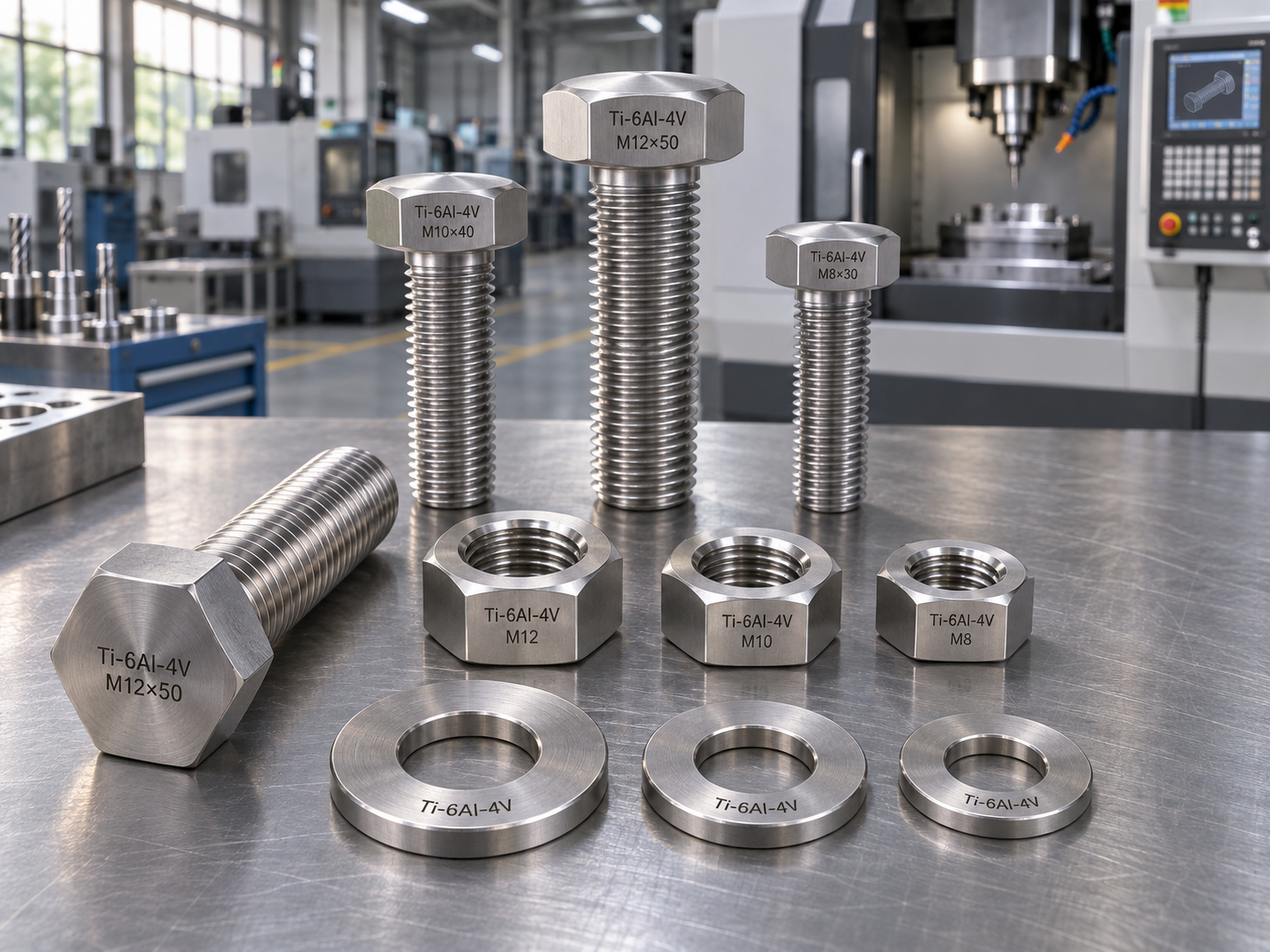
Titanium Bolts
Hex, socket-head, flange, and 12-point configurations for structural and high-preload joints.
M2–M64 · 1/4″–2″ · DIN 931/933 · ISO 4014/4017 · ASME B18.2.1
Categories List
A technical reference for specifying titanium alloy fasteners: grades, standards, torque practice, galvanic isolation, and application fit — from the engineering desk at RAYCHIN LIMITED.
Titanium fasteners are not a premium substitute for steel — they solve a different class of problem. The metal’s combination of high specific strength, near-total immunity to chloride attack, non-magnetic behaviour, and biocompatibility makes it the default choice where weight, corrosion, or material compatibility would otherwise force a design compromise.
Compared with 316 stainless steel of the same size, Grade 5 titanium bolts deliver roughly 45% weight reduction while maintaining tensile strength in the 1,100 MPa class; pitting resistance in chloride and seawater environments can be up to 3× better. Titanium also retains clamping force and resists vibration loosening at temperatures where polymer-based locking features would degrade — stable performance is reported up to around 400 °C in suitable alloys.
Specification note. Titanium fasteners are supplied against a material grade and a fastener dimensional standard. ASTM F468 covers nonferrous bolts, hex cap screws, and studs for general service; dimensional conformity is separately referenced through ASME B18.2.1, DIN 931/933, ISO 4014/4017, and related standards. Always specify both on the purchase order.
Four grades cover the overwhelming majority of fastener demand. The choice is driven by three variables: strength requirement, corrosion severity, and whether the joint is safety-critical or implantable.
Values are indicative and depend on product form, heat treatment, and governing specification. Confirm against the material certificate for the specific lot.
Titanium fasteners are not a single commodity. Each family has distinct design intent and installation behaviour. RAYCHIN manufactures the full set in Grades 2, 5, 7, and 23, in both imperial and metric threads, standard and to drawing.
Hex, socket-head, flange, and 12-point configurations for structural and high-preload joints.
M2–M64 · 1/4″–2″ · DIN 931/933 · ISO 4014/4017 · ASME B18.2.1Hex, lock, and flange nuts matched to bolt grade and thread class. Prevailing-torque styles require careful galling management.
DIN 934 · DIN 985 · ISO 4032 · ASME B18.2.2Machine, cap, flat-head, button-head, and self-tapping screws. Rolled threads are preferred for fatigue life.
M2–M24 · DIN 912 · ISO 4762 · DIN 7991 · ANSI/ASMEFully threaded, double-end, and tap-end studs for flanged and high-pressure connections where clamping distribution matters.
ASTM F468 · ASME B18.31.2 · DIN 938 · NACE MR0175 on requestFlat, spring, and lock washers. A washer can also serve as a galvanic isolation barrier when correctly specified.
DIN 125 · DIN 127 · ISO 7089 · ASME B18.22.1Continuous-thread rod, U-bolts, J-bolts, and custom geometries machined to drawing.
DIN 975 · customer print · small batch to production volumeThe application logic is consistent across industries: titanium is chosen where the life-cycle cost of corrosion or weight exceeds the material premium.
Titanium fasteners fail in service for the same reason steel fasteners do — but the failure modes during installation are distinctly titanium. Three controls determine joint integrity.
Titanium’s protective oxide layer makes it prone to thread galling — cold welding of mating surfaces under pressure and relative motion. The practical mitigations are straightforward: apply a high-pressure lubricant or anti-seize compound to the threads and under-head contact surfaces; avoid dry assembly; and tighten slowly and evenly, particularly with fine threads. Dry-film lubricants such as MoS₂-based coatings are also used in production environments where wet lubricants are undesirable.
Because titanium’s friction coefficient differs from steel, applying the steel torque specification directly risks over-preload and thread yielding. Industry practice is to reduce the comparable steel dry-torque value by approximately 10–15% when installing titanium fasteners, then verify against the joint’s actual lubrication condition and the fastener manufacturer’s data. For critical joints, torque should be validated by tension measurement rather than assumed from tables.
Titanium is cathodic relative to aluminium, magnesium, and most steels. In a wet or marine environment, a titanium fastener in contact with an aluminium structure will accelerate corrosion of the aluminium, not the titanium. Where dissimilar-metal contact is unavoidable, isolate the joint with an insulating washer, sleeve, sealant, or wet primer, and avoid unfavourable couples without a barrier layer. Titanium-to-stainless couples are far less aggressive but still warrant review in immersed service.
Field rule of thumb. If the joint will see chloride, humidity, or immersion and the mating structure is aluminium or carbon steel, design the isolation in from the start. Retrofitting isolation to a galled or corroded joint is significantly more expensive than specifying it.
RAYCHIN LIMITED is a specialty metals fastener manufacturer and global supplier whose engineering focus is the intersection of exotic alloy metallurgy and fastener design. Titanium is not an add-on to a carbon-steel catalogue — it sits alongside Inconel, Hastelloy, Monel, MP35N, and duplex stainless in a portfolio built specifically for corrosive, high-temperature, and safety-critical service.
The company operates under ISO 9001:2015 and ISO 14001:2015 certification, maintains in-house material inventory and traceability, and supplies both standard and fully custom fasteners in small batches or production volumes. For titanium fasteners specifically, RAYCHIN’s engineering team supports grade selection, thread and dimensional standard matching, and documentation packages for aerospace, oil and gas, medical, and marine end uses.
Grade 2 is commercially pure titanium: lower strength (≈350 MPa tensile) but excellent formability, weldability, and broad corrosion resistance. Grade 5 (Ti-6Al-4V) is an alloyed grade with roughly three times the tensile strength (≈1,100 MPa) and a superior strength-to-weight ratio, at the cost of reduced ductility and higher material price. Choose Grade 2 where corrosion resistance and cost dominate; choose Grade 5 where load and weight dominate.
Titanium-to-stainless couples are generally tolerable in many environments because the galvanic potential difference is moderate. Titanium-to-aluminium couples are the higher-risk case: in the presence of moisture, the aluminium becomes the anode and may corrode preferentially. Isolate the joint with a barrier — an insulating washer, sleeve, sealant, or coating — and avoid direct titanium-on-aluminium contact in immersed or humid service.
Galling is cold welding between mating thread surfaces, promoted by titanium’s stable oxide film and by high contact pressure during tightening. Prevention is lubrication-based: apply anti-seize or a high-pressure thread lubricant, avoid dry installation, and tighten slowly and evenly. In production, dry-film coatings can be specified. If a joint must be repeatedly assembled and disassembled, a lubricated thread is the baseline requirement.
No. Titanium’s friction behaviour differs from steel, and applying steel torque values directly can over-preload the fastener. The common industry adjustment is to reduce the equivalent steel dry-torque by about 10–15%, then confirm against the specific lubricant, thread condition, and manufacturer guidance. For safety-critical joints, torque should be verified by tension measurement rather than taken from a generic table.
Specify both the material/mechanical specification and the dimensional standard. For nonferrous bolts, hex cap screws, and studs, ASTM F468 is the common material reference. For dimensions, reference the relevant ASME B18, DIN, or ISO standard — for example ASME B18.2.1, DIN 931/933, ISO 4014/4017 for hex bolts; DIN 912/ISO 4762 for socket head cap screws. Application-specific standards (NACE MR0175, ASTM F136 for medical) are added where required.
Titanium fasteners maintain useful mechanical properties at moderately elevated temperatures and resist vibration loosening better than many polymer-locking alternatives. Stable clamping force is reported around 400 °C for suitable grades, and some titanium fasteners are rated for service from cryogenic temperatures up to roughly 400 °C depending on alloy and condition. Above these ranges, nickel-based superalloys become the appropriate choice.
Send the grade, the dimensional standard, the quantity, and the service environment. RAYCHIN’s engineering team will respond with a quotation, a material certificate review, and any specification clarification needed before the order is released.
Technical data in this guide is provided for engineering reference and is subject to the governing material and dimensional specification on the purchase order. Fastener performance depends on grade, heat treatment, thread form, lubrication, and joint design. For application-specific validation, contact RAYCHIN LIMITED engineering at sales@ray-chin.com.
Request A Quote! We'll respond as soon as possible(within 12 hours)
Get a Quote