
Inconel Fasteners for Oil & Gas: Bolts, Nuts, Screws, Studs and Washers in Sour, HPHT and Subsea Service
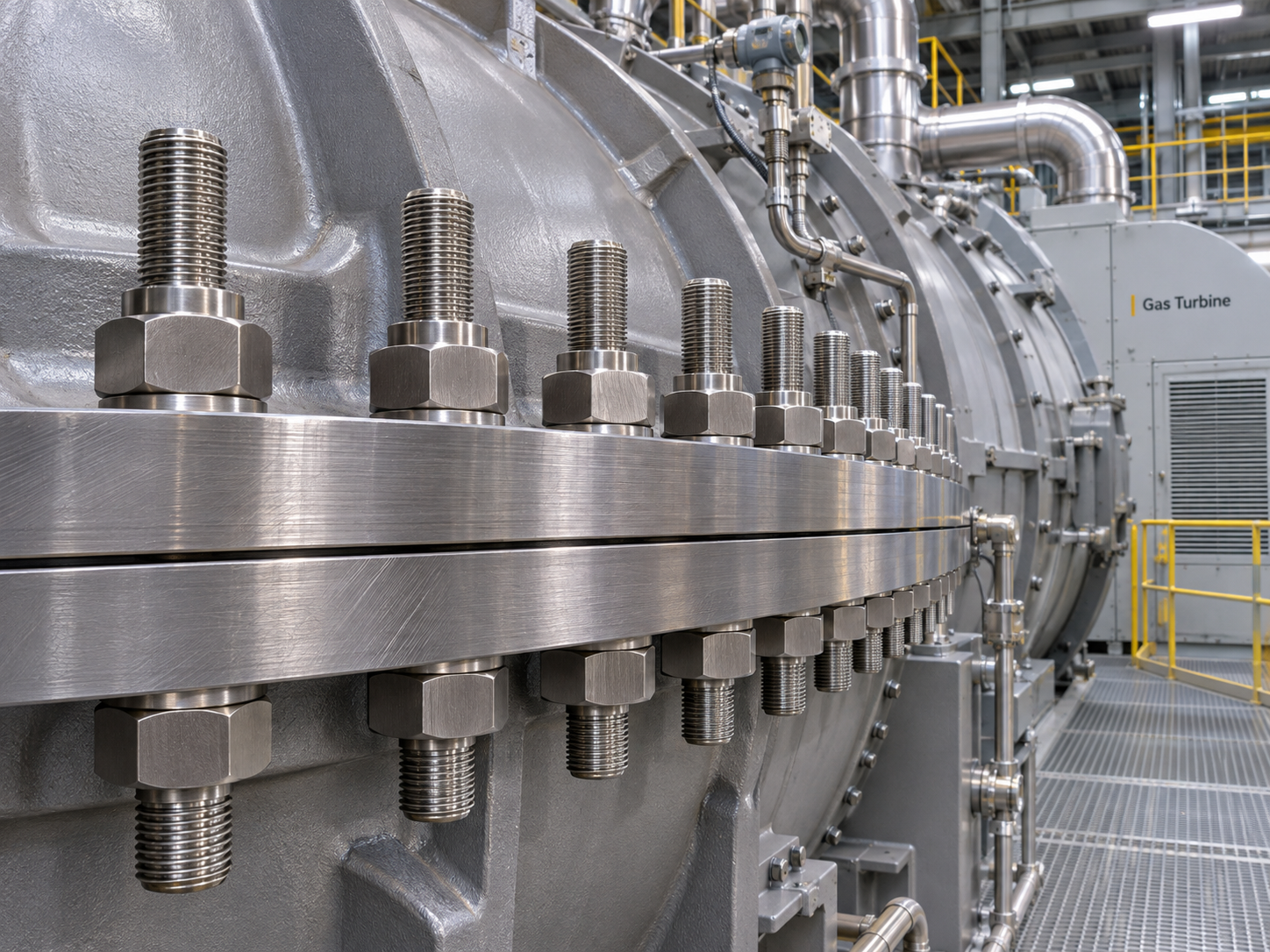
A wellhead stud that fails a hardness check. A subsea flange bolt that embrittles under cathodic protection. A turbine casing fastener that loses preload at 650 °C. In oil and gas, Inconel fasteners are not selected by alloy name alone — they are selected by the failure mode the joint must survive. This guide sets out the engineering logic RAYCHIN applies every day: grade selection between 625 and 718, NACE MR0175 compliance, galling, hydrogen embrittlement, preload relaxation, and the certification realities that decide whether a fastener actually reaches the site.
1. Why “Inconel” Is Not One Decision
Inconel is a family, not a specification. In bolting for oil and gas, four grades cover the overwhelming majority of demand — 718, 625, 600 and X-750 — and each exists because a different operating envelope breaks ordinary stainless and low-alloy bolting[reference:0]. Carbon steel, duplex stainless and 316L all have a place; the Inconel family begins where those materials stop: chloride stress-corrosion cracking, seawater pitting, reducing acids, sour gas, and creep at temperature.
The most consequential specification error in the field is treating 625 and 718 as interchangeable because both carry the Inconel name. They are built on different strengthening mechanisms and make opposite trade-offs between corrosion resistance and strength. Getting that choice wrong means either paying for strength the joint does not need, or specifying a high-strength fastener that cannot pass the sour-service hardness gate.
2. The Core Selection Decision: 625 vs 718
UNS N06625. Solid-solution strengthened by molybdenum and niobium. No precipitation-hardening package, so strength is stable through welding and heat exposure. Molybdenum at 8–10 % gives it the higher pitting and crevice-corrosion resistance of the two.
Annealed tensile strength typically 830–1,000 MPa (120–145 ksi). Supplied to ASTM B446 as Grade 1 (annealed, service to ~593 °C) or Grade 2 (solution annealed, for higher-temperature creep and rupture resistance). NACE MR0175 / ISO 15156 compliant for sour service, and commonly paired with 718 studs in dissimilar-alloy flange joints.
Choose 625 when the environment, not the load, is the limiting factor: seawater, wet chlorine, subsea manifolds, sour-gas flowlines and corrosive valve trim.
UNS N07718. Precipitation-hardened by γ″ (gamma-double-prime) and γ′, driven by niobium, titanium and aluminium. Solution treat at 1,700–1,850 °F followed by a double age delivers 185 ksi (1,275 MPa) tensile and 150 ksi (1,034 MPa) yield at room temperature, with stress-rupture capability to 650 °C (1,200 °F).
Supplied to ASTM B637 (bar and forgings) and AMS 5662 / 5663. Age-hardened tensile strength reaches roughly 1,250–1,400 MPa — approximately double annealed 625 — allowing smaller cross-sections for the same load. Sour-service versions are aged to a maximum 40 HRC for sulfide stress-cracking resistance under NACE MR0175.
Choose 718 when preload retention and high strength govern: HPHT wellhead valves, gas-turbine bolting, hangers, completion tools and high-load flange joints.
The 718 sour-service trap. 718 only achieves its strength after aging — and aging is exactly the step that can push hardness beyond the NACE ceiling. An over-aged or improperly solution-treated 718 part can lose strength or develop delta-phase networks; a 625 part does not carry that sensitivity because it is not precipitation-strengthened. Specifying 718 for a sour wellhead without controlling the aged condition is a classic non-compliance route. If the joint needs both high strength and sour resistance, Inconel 725 — roughly twice the strength of 625 with comparable corrosion resistance and NACE MR0175 compliance — is the engineered alternative.
3. Grade-to-Service Map for Bolting
Chemistry and mechanical ranges are indicative; purchase-order limits are governed by the applicable ASTM / AMS specification. RAYCHIN verifies chemistry by PMI on every lot.
4. The Failure Modes That Define the Specification
A bolted joint does not fail the way a pressure boundary fails. It fails by losing preload, by seizing on disassembly, or by cracking at a stress concentration under a corrosive or hydrogen-charged environment. These four mechanisms sit behind most oil-and-gas fastener specifications.
Galling — cold welding on the thread
Inconel fasteners are intrinsically prone to galling. It is not a manufacturing defect; it is the same ductility and corrosion resistance that make the alloy desirable expressing itself as cold welding under thread friction. The result is seized threads, damaged flanges and unpredictable make-up torque — a particular problem in subsea and wellhead joints where disassembly access is limited. Mitigation is a design decision: controlled thread geometry, dissimilar hardness pairing (e.g. 625 nut on 718 stud), and a qualified high-temperature anti-seize such as a superalloy-grade paste rated to 1,000 °C or a PTFE / Xylan coating where service conditions allow.
Hydrogen embrittlement under cathodic protection
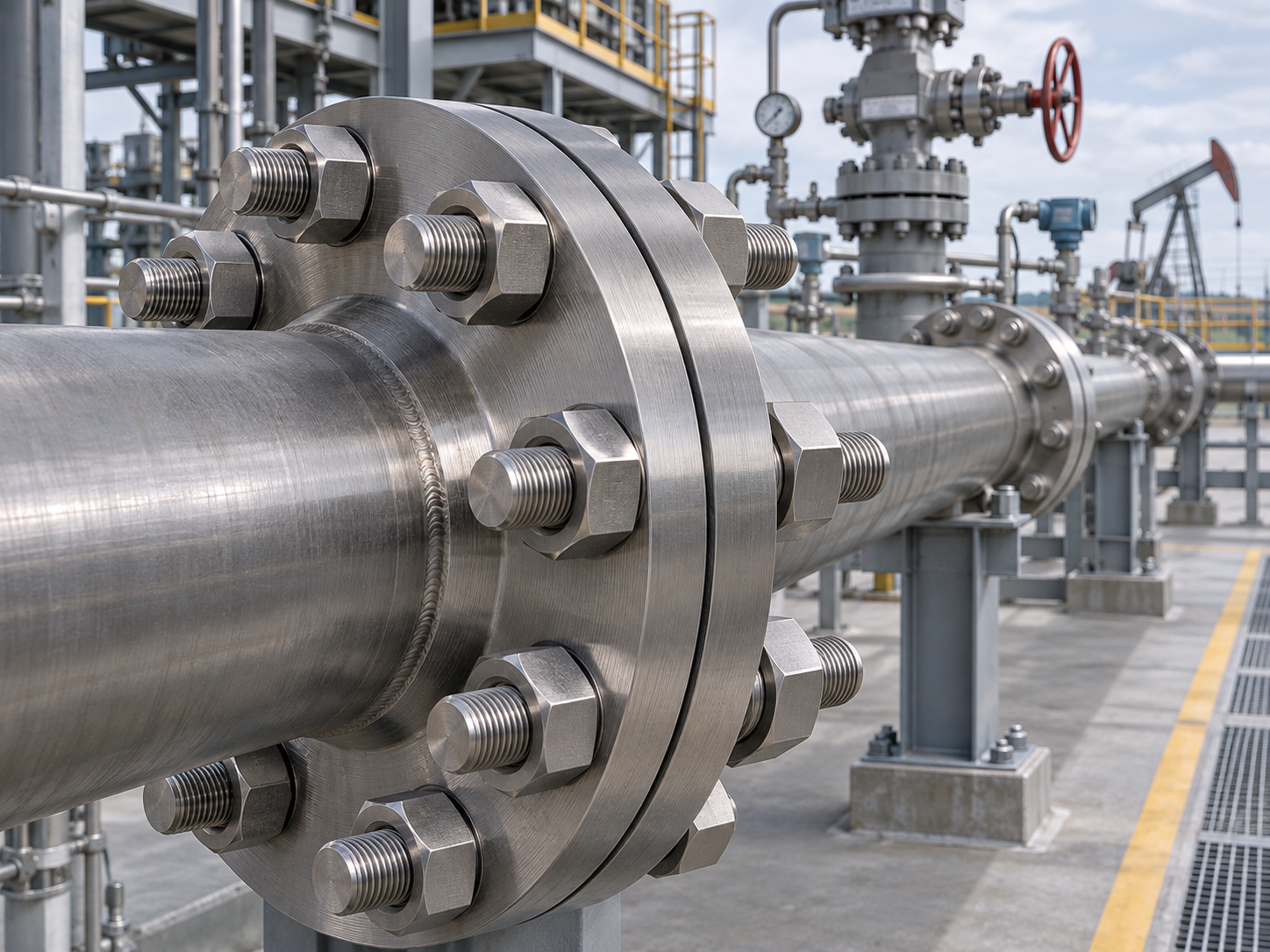
Subsea fasteners are often electrically connected to a cathodic-protection system. Under CP, hydrogen evolves at the fastener surface, and high-strength alloys — including Inconel 718 — can embrittle and crack. A BSEE safety alert specifically identifies Inconel 718 fasteners in subsea CP service as susceptible to hydrogen embrittlement and directs compliance with API bolting standards to mitigate the risk. Nickel alloys 718 and 725 are among the better performers, but the risk is not zero: strength level, microstructure and CP potential all matter. This is why subsea bolting is increasingly specified under API 20E / 20F with defined bolting specification levels (BSL 1–3) rather than by alloy name alone.
Preload relaxation and creep at temperature
At elevated temperature, bolted joints lose clamping force over time — even without external loosening. Carbon and alloy steel bolts become creep-sensitive above roughly 300 °C; the higher the temperature, the faster the relaxation. 718 maintains high bolt preload up to 650 °C, which is why it is the first choice for HPHT valve-flange bolting where preload retention is critical; X-750 is selected where relaxation resistance is the governing property[reference:17][reference:18]. Specification must match the actual metal temperature, not the process-fluid temperature.
Over-torque plus corrosion — the compound failure
Failure investigations repeatedly find that Inconel bolts do not fail from alloy inadequacy but from the concurrence of stress above yield and a localised corrosion condition — pitting or crevice attack at a thread root or flange face. A material upgrade alone does not fix a joint whose make-up torque, gasket seating stress and surface condition are not engineered together. Fastener specification and bolting procedure are one system.
5. Sour Service and the Certification Chain
In oil and gas, NACE MR0175 / ISO 15156 is a compliance floor, not a quality bonus. It limits hardness and mandates qualified alloys with documented heat treatment and melting route for materials exposed to H₂S. For wellhead, subsea and flowline flanges, 625 is widely specified for corrosion resistance, while 718 aged to ≤40 HRC and 725 are used where strength plus sour resistance is required. Hardness is the gatekeeper: a compliant alloy with uncontrolled heat treatment is still a non-compliant fastener.
The certification chain extends well beyond a single NACE line on a mill certificate. Oil-and-gas buyers typically require:
- EN 10204 3.1 material certification as a baseline, with 3.2 third-party-witnessed reports for critical or NORSOK-qualified supply.
- Heat-lot traceability from raw material to finished fastener, with a heat-number traceability matrix on the shipment.
- PMI and mechanical test reports per lot — chemistry cannot be assumed from the mill grade name.
- API Q1 or ISO 9001:2015 at the manufacturer level, with API 6A / API 20E / API 20F and NORSOK M-650 as project-specific adders.
For a single import shipment into a GCC or North Sea project, the documentation burden can include a mill test certificate, heat-lot traceability matrix, third-party NDT report and declaration of conformity — and failure to provide any one of them can disqualify a supplier regardless of price or technical capability. Certification is not paperwork attached to a fastener; it is part of the product.
6. Procurement Realities Buyers Must Plan Around
Lead times are structural, not temporary
Certified offshore-grade fasteners remain extended: 8–16 weeks for standard alloy grades and 20–30 weeks for exotic materials, which complicates maintenance planning on assets with unpredictable inspection outcomes. Nickel-based custom stud bolts often run 8–12 weeks at modest MOQs, with material procurement and heat treatment — not machining — driving the critical path. A maintenance window that requires delivery in 18 working days cannot be met from mill lead time alone; it requires either certified stock in the supply chain or a supplier with qualified inventory access.
Counterfeit and non-certified material remains a live risk
Counterfeit and non-certified fastener infiltration is a persistent procurement risk. Enforcing strict traceability protocols and third-party testing adds 10–20 % to effective procurement cost, but the alternative is a wellhead or subsea joint built from material whose heat history cannot be verified. Premium and certified grades already command 3–6× the price of standard carbon steel equivalents, reflecting traceability, testing and certification costs that are mandatory offshore.
The specification is often incomplete at RFQ stage
Fastener RFQs frequently specify “Inconel 625” or “Inconel 718” without stating the governing failure mode, hardness ceiling, heat-treatment condition, coating or bolting standard. The supplier then quotes to the most literal reading, and the non-compliance surfaces at inspection. Buyers should state NACE / API requirements up front rather than after PO issue, and should require mill certificates with batch traceability as a condition of quote, not a post-award negotiation.
What RAYCHIN Brings to an Oil & Gas Fastener Package
- Full Inconel spectrum — 718, 625, 725, 600, 601, X-750 and 825 — as bolts, nuts, screws, studs and washers, plus custom forgings to drawing.
- Grade selection support based on the joint’s governing failure mode: corrosion, strength, relaxation, or sour-service hardness.
- Heat-treat cycles digitally recorded and hardness verified on every lot; 718 sour-service material aged to ≤40 HRC where specified.
- EN 10204 3.1 as standard; 3.2, NACE MR0175, API 6A / 20E / 20F and NORSOK M-650 documentation packages arranged on order.
- PMI and mechanical test reports on every lot; full heat-number traceability from mill to finished part.
- Galling-control guidance: thread pairing, dissimilar-hardness strategy and qualified anti-seize / coating selection.
Frequently Asked Questions
Is Inconel 625 or 718 better for sour gas wellhead fasteners?
Neither is universally “better.” 625 is the corrosion-first choice for sour environments because its solid-solution molybdenum content gives higher pitting and crevice resistance, and it is not hardness-sensitive in the way 718 is. 718 is chosen where high strength and preload retention are required, but the aged condition must stay within the NACE MR0175 hardness ceiling — typically ≤40 HRC. If both strength and sour resistance are required, Inconel 725 is the engineered alternative.
Why do Inconel fasteners gall, and how is it prevented?
Galling is cold welding under thread friction, driven by the same ductility and corrosion resistance that make Inconel desirable. Prevention is a design decision: controlled thread geometry, dissimilar-hardness nut-and-stud pairing, and a qualified high-temperature anti-seize or PTFE / Xylan coating appropriate to the service temperature and fluid.
Can Inconel 718 be used subsea with cathodic protection?
718 is among the better-performing nickel alloys for hydrogen embrittlement resistance and is widely used subsea, but it is not immune. Under cathodic protection, hydrogen can evolve at the fastener surface and embrittle high-strength material. Subsea bolting is therefore increasingly specified under API 20E / 20F with defined bolting specification levels, rather than by alloy name alone.
What lead time should be planned for certified Inconel fasteners?
Plan for 8–16 weeks for standard alloy grades and 20–30 weeks for exotic or custom items from mill order. Nickel-based custom stud bolts commonly run 8–12 weeks. If a maintenance window is shorter, the practical route is a supplier holding certified stock with full traceability, not an expedited mill order.
What certifications should accompany an oil-and-gas Inconel fastener order?
At minimum: EN 10204 3.1 material certification, PMI reports, mechanical test results, and heat-lot traceability from mill to finished part. Project-specific additions typically include NACE MR0175 / ISO 15156 compliance, EN 10204 3.2 third-party witness, API 6A or API 20E / 20F, and NORSOK M-650 where North Sea qualification is required.
Technical content is reviewed against the applicable purchase specification, standard edition and service conditions before project use. Inconel® is a registered trademark of Special Metals Corporation. This guide is for engineering and procurement reference; it does not replace a project-specific material selection study or the governing standard. © RAYCHIN LIMITED — Global Specialist in Nickel-Alloy Fasteners.