
When Fasteners Live Inside the Process, Ordinary Alloys Are Not an Option
RAYCHIN LIMITED manufactures Inconel 718 and Inconel 625 bolts, nuts, screws, studs, and washers for semiconductor process equipment, vacuum chambers, CVD and etch tools, and precision assemblies where corrosion, outgassing, particle generation, and thermal cycling determine yield — not just uptime.
Inconel Fasteners: Bolts, Nuts, Screws, Studs, and Washers
Inconel is a family of nickel-chromium superalloys built for environments that destroy conventional fastener materials. In the fastener forms most relevant to semiconductor and precision manufacturing — bolts, nuts, screws, studs, and washers — two grades dominate specification activity: Inconel 718 (UNS N07718) and Inconel 625 (UNS N06625).
Inconel 718 (UNS N07718)
A precipitation-hardenable nickel-chromium alloy containing niobium and molybdenum. Aged Inconel 718 reaches tensile strengths in the range of ≥1,034 MPa, with useful strength retention to roughly 700°C and excellent creep rupture resistance. It is the grade specified when the fastener must carry load, hold preload through thermal cycling, and resist relaxation in high-vibration assemblies.
Inconel 625 (UNS N06625)
A solid-solution-strengthened nickel-chromium-molybdenum alloy with niobium. It offers superior corrosion resistance across oxidizing and reducing chemistries, resistance to pitting and crevice attack, and fatigue resistance at elevated temperature. Inconel 625 is frequently selected for process-wetted fastening points where chemical exposure is more severe than mechanical load.
Product forms supplied. Hex head bolts, socket head cap screws, button head screws, flat head screws, set screws, hex nuts, heavy hex nuts, lock nuts, flat washers, spring washers, threaded rods, and continuous-thread studs. Diameters span 1/8"–3" (M3–M76) depending on form and grade, with standard inventory concentrated in M3–M16 and equivalent inch sizes for semiconductor equipment OEM requirements.
Typical reference values. Final selection must account for thread form, section size, and customer specification.
Inside the Semiconductor Tool: Why Inconel Fasteners Are Specified
A fastener in a wafer fab is not judged by whether it holds a flange together. It is judged by what it releases, what it sheds, what it conducts, and whether it still holds its clamp load after thousands of thermal cycles. Inconel addresses each of these failure vectors, but only when the fastener is manufactured and finished to match the process environment.
Corrosion and particle generation are yield risks
Process gases, plasma, wet cleans, and elevated temperature degrade unsuitable fasteners. The contamination pathway is not always obvious: pitting, crevice corrosion, and wear release material over time, and even a mechanically intact fastener can become a particle source after thermal cycling changes dimensions or joint integrity.
Cleanliness is a procurement specification
In process chambers and vacuum service, procurement specifications frequently reference SEMI F57 and related cleanliness guidelines covering surface cleanliness, outgassing, and particle generation. RAYCHIN works to these requirements where the application demands it, including controlled cleaning and packaging protocols.
Preload loss is a mechanical failure, not a cosmetic one
Repeated heating and cooling produces differential expansion at threaded joints. Thermal instability leads to loss of preload, joint deformation, and accelerated wear — which in turn reconnects to contamination as loosened or degraded components release particles or disturb alignment.
CVD and etch environments test the alloy, not the label
CVD exposes fasteners to reactive gases, corrosive byproducts, elevated temperature, and repeated cleaning. Nickel, chromium, and molybdenum each contribute a different protective mechanism; the correct Inconel grade depends on whether the dominant threat is oxidizing, reducing, or localized pitting attack.
Typical semiconductor equipment fastener locations
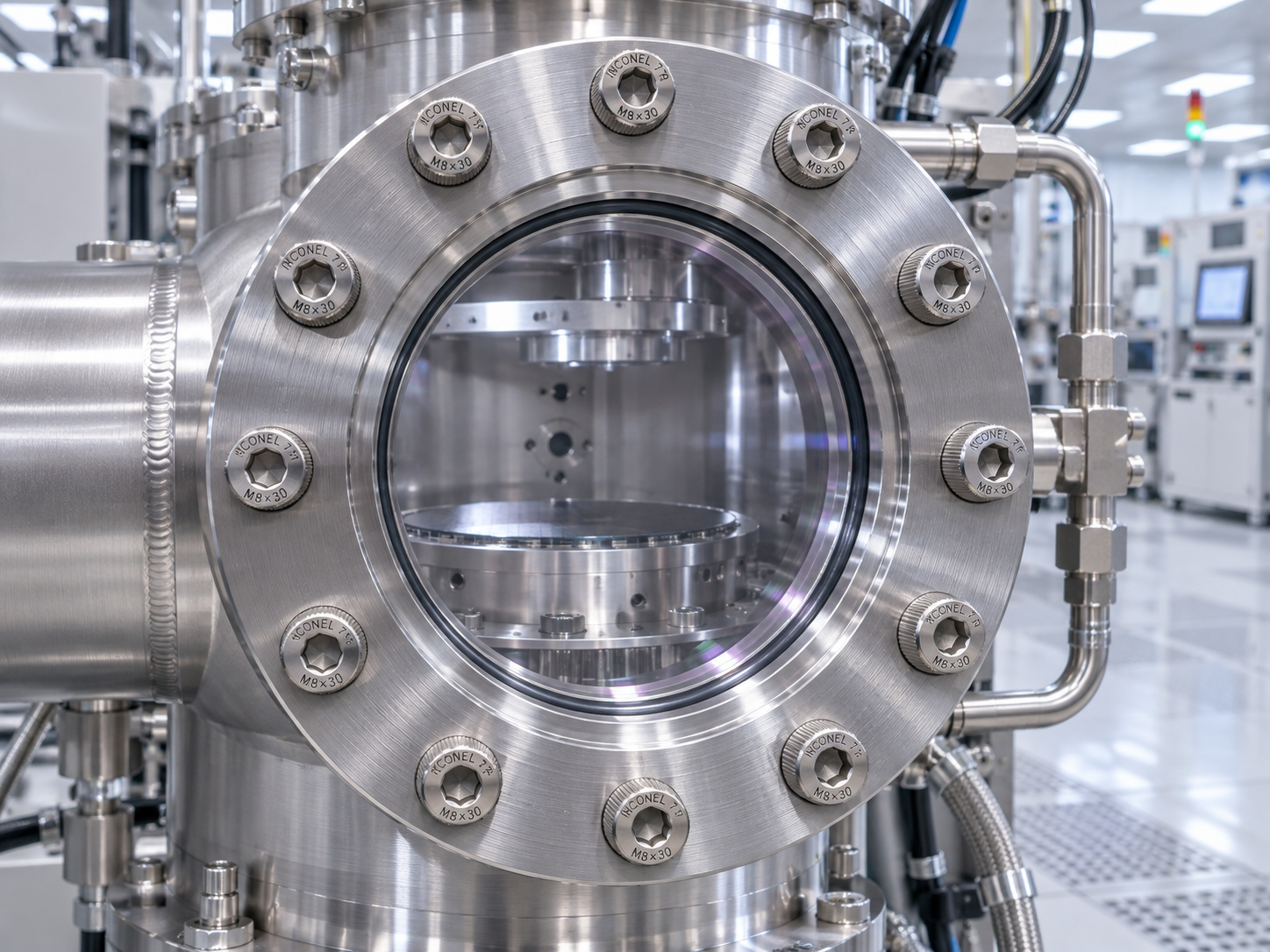
- Vacuum chamber and viewport hardware — socket head cap screws, vented screws where virtual leaks must be eliminated.
- Gas delivery and foreline connections — studs and nuts exposed to corrosive byproducts and cyclic thermal load.
- CVD / PVD / etch chamber internal hardware — bolts and washers in plasma-exposed zones where particle generation and corrosion products are unacceptable.
- Wafer handling and load-lock assemblies — fasteners requiring low outgassing, non-magnetic behavior, and dimensional stability.
- Precision metrology and inspection stages — fastening points where thermal drift must not be amplified by joint relaxation.
What Customers Actually Struggle With: Inconel Fastener Pain Points
Inconel is specified because the environment is unforgiving. But the material itself introduces manufacturing and assembly challenges that generic fastener suppliers routinely underestimate. These are the issues RAYCHIN engineering addresses at the process level, not after the parts fail.
Pain Point 1: Galling and Thread Seizure During Assembly
Nickel alloys are notorious for galling. Under high contact pressure, clean Inconel threads can cold-weld at a microscopic scale and tear apart during tightening, stripping threads and scrapping parts. Contributing factors include machined threads with rough surface finish, identical bolt-and-nut hardness, high-speed power-tool assembly that cannot dissipate frictional heat, and dry or contaminated threads.
Thread rolling after solution annealing and aging produces a work-hardened, exceptionally smooth thread surface with compressive residual stress, dramatically reducing galling tendency compared with cut threads. Where required, we apply nickel-compatible anti-seize coatings — tungsten disulfide (WS2) or silver-based solid film lubricants — that maintain a low friction coefficient at high temperature without contaminating sensitive process streams. Dissimilar nut material or controlled hardness pairing interrupts the metal-to-metal adhesion path.
Pain Point 2: Hydrogen Embrittlement in High-Strength 718
Inconel 718's precipitation-hardened microstructure can be susceptible to hydrogen embrittlement when atomic hydrogen diffuses into the metal and accumulates at grain boundaries or carbide interfaces, causing delayed brittle fracture at loads far below yield. Electrolytic plating processes, sour service exposure, cathodic protection systems, and certain high-temperature hydrogen atmospheres are recognized hydrogen sources.
RAYCHIN avoids electrolytic plating routes on high-strength Inconel 718 and specifies strictly physical coating methods where a coating is required. We control hardness pairing, thread rolling parameters, and post-processing thermal history to keep the microstructure within the intended condition. Every lot is backed by in-house testing and full certification.
Pain Point 3: Passivation Doesn't Behave the Same Way on Nickel Alloys
Passivation is routinely specified for stainless steel fasteners in semiconductor and cleanroom contexts. For nickel alloys such as Inconel, the situation is different: the alloy is inherently corrosion resistant through its nickel-chromium-molybdenum composition, and conventional passivation does not deliver the same surface improvement it provides on stainless steel. Applying a stainless steel treatment template to an Inconel fastener can add cost without adding performance.
Where enhanced surface performance is genuinely required, surface modification — not conversion coating — is the more appropriate path. Plasma carburizing and nitriding processes modify the surface of nickel alloys to improve wear resistance and galling prevention without compromising corrosion resistance, and can operate without liquid lubricants in cleanroom and vacuum environments. RAYCHIN evaluates each requirement against the actual failure mechanism rather than defaulting to a passivation callout.
Pain Point 4: Thermal Cycling, Vibration, and Preload Loss
Thermal cycling and high vibration cause bolted joints to loosen and lose clamp load. The problem is amplified in Inconel because the alloy is often selected for the very environments that produce severe cycling — CVD chambers, etch tools, and high-temperature process modules. A fastener that performs well in a single-temperature tensile test can still relax in service if the joint design and installation procedure are not matched to the material.
RAYCHIN supplies lubricated K-factor values specific to the coating applied and recommends slow, steady wrenching with calibrated torque wrenches — no impact tools — to preserve preload and avoid frictional heating during installation.
Pain Point 5: Specification Ambiguity and Traceability Gaps
Inconel fasteners for semiconductor equipment are frequently ordered to proprietary customer specifications that exceed standard grade requirements. Procurement specifications may reference SEMI standards for surface cleanliness, outgassing, and particle generation, while general mechanical requirements fall back to ISO 898 and ISO 965 thread tolerances. Import and quality documentation typically requires a certificate of conformity, material test report, and country of origin statement.
RAYCHIN ships every Inconel fastener with full lot traceability to the mill heat, dimensional inspection records, and certification matched to the purchase specification. We work from customer drawings rather than assuming a catalogue part will satisfy a process-critical application.
Inconel Fastener FAQ for Semiconductor and Precision Manufacturing
Which Inconel grade should I specify for a semiconductor chamber fastener — 718 or 625?
How does RAYCHIN prevent galling in Inconel bolts and nuts?
Does Inconel need passivation for semiconductor cleanliness?
What documentation accompanies RAYCHIN Inconel fasteners?
Can RAYCHIN supply vented Inconel screws for vacuum service?
What sizes and forms are available?
The Hidden Cost of the Wrong Fastener Inside a Wafer Fab
Fastener selection in semiconductor equipment often follows a path of least resistance: stainless steel unless something fails, then a higher grade, then Inconel when the failures become expensive enough. The problem with this sequence is that the cost of a wrong fastener is not paid at the fastener line item. It is paid in yield loss, chamber requalification, and unplanned downtime.
Contamination Does Not Announce Itself
A corroding fastener inside a CVD tool does not fail dramatically. It releases corrosion products and particles slowly, and the first indication is often a yield excursion that takes days to trace. Replacing contaminated or worn fasteners is time-consuming, requires recalibration, and in many cases triggers cleanroom recertification. By the time the fastener is identified as the source, the cost has already moved far beyond the price of the part.
Preload Loss Is a Process Drift Mechanism
Thermal cycling causes bolted joints to lose preload. When preload drops, alignment shifts, sealing performance changes, and vibration response degrades. In a deposition or etch chamber, a small alignment shift can change process uniformity across the wafer. The fastener is still “there,” but the joint is no longer doing its job. Inconel 718's creep and relaxation resistance is one reason it is specified for these locations — but only when the thread form, coating, and installation torque are controlled together.
Material Grade Is Not a Substitute for Manufacturing Discipline
Two suppliers can both claim “Inconel 718 fasteners” and deliver very different field performance. The difference is in thread manufacturing method, hardness pairing, coating selection, heat-treatment condition, and documentation integrity. Galling and hydrogen embrittlement are not material selection problems alone — they are process-control problems. That is where RAYCHIN's experience in failure analysis translates directly into manufacturing decisions.
A Practical Specification Checklist
- Define the dominant failure mode first — corrosion, preload loss, galling, particle generation, or hydrogen embrittlement — then select grade and treatment to address it.
- Specify thread manufacturing method — rolled threads rather than cut threads for galling-prone nickel alloys.
- Address the nut as part of the system — dissimilar material or hardness offset interrupts adhesion.
- Control installation — calibrated torque, no impact tools, and a K-factor matched to the coating.
- Require traceability and test reports — mill heat traceability and dimensional records are not optional in process-critical applications.
Send RAYCHIN Your Inconel Fastener Requirement
Share the grade, size, quantity, process environment, and any cleanliness or documentation standard that applies. RAYCHIN engineering reviews every semiconductor and precision manufacturing inquiry and responds with a manufacturing plan.
Contact RAYCHIN Engineering →