
Inconel Fasteners for Power Generation: A Scenario-by-Scenario Engineering Diagnosis
A gas turbine casing bolt and a reactor pressure vessel stud both carry the name “Inconel fastener.” They share almost nothing else. One is selected for preload retention at 650 °C; the other for 100% volumetric NDE, documented grain size and a 60-year service pedigree. Energy is not one market — it is a set of operating envelopes, and the fastener decision changes at every boundary. This diagnosis works through five of those envelopes, and the field failures that define each.
The Fastener Question Changes With the Asset
In oil and gas, the governing question is often sour service or cathodic protection. In power generation, the governing question is different at every asset class. A gas turbine hot-section bolt is judged on creep and relaxation above 600 °C. A nuclear Class 1 stud is judged on code compliance, irradiation stability and documented pedigree before strength is even discussed. A steam turbine casing bolt is judged on what happens to clamping force across a decade of thermal cycles. An ultra-supercritical valve bolt is judged on whether the heat treatment was correct enough to resist grain-boundary oxidation.
Treating these as one “power generation fastener” problem is how specification errors enter the supply chain — and how a material that performs flawlessly in one envelope becomes the root cause of a forced outage in another.
Gas Turbine Hot Section: 718 as the Preload-Critical Default
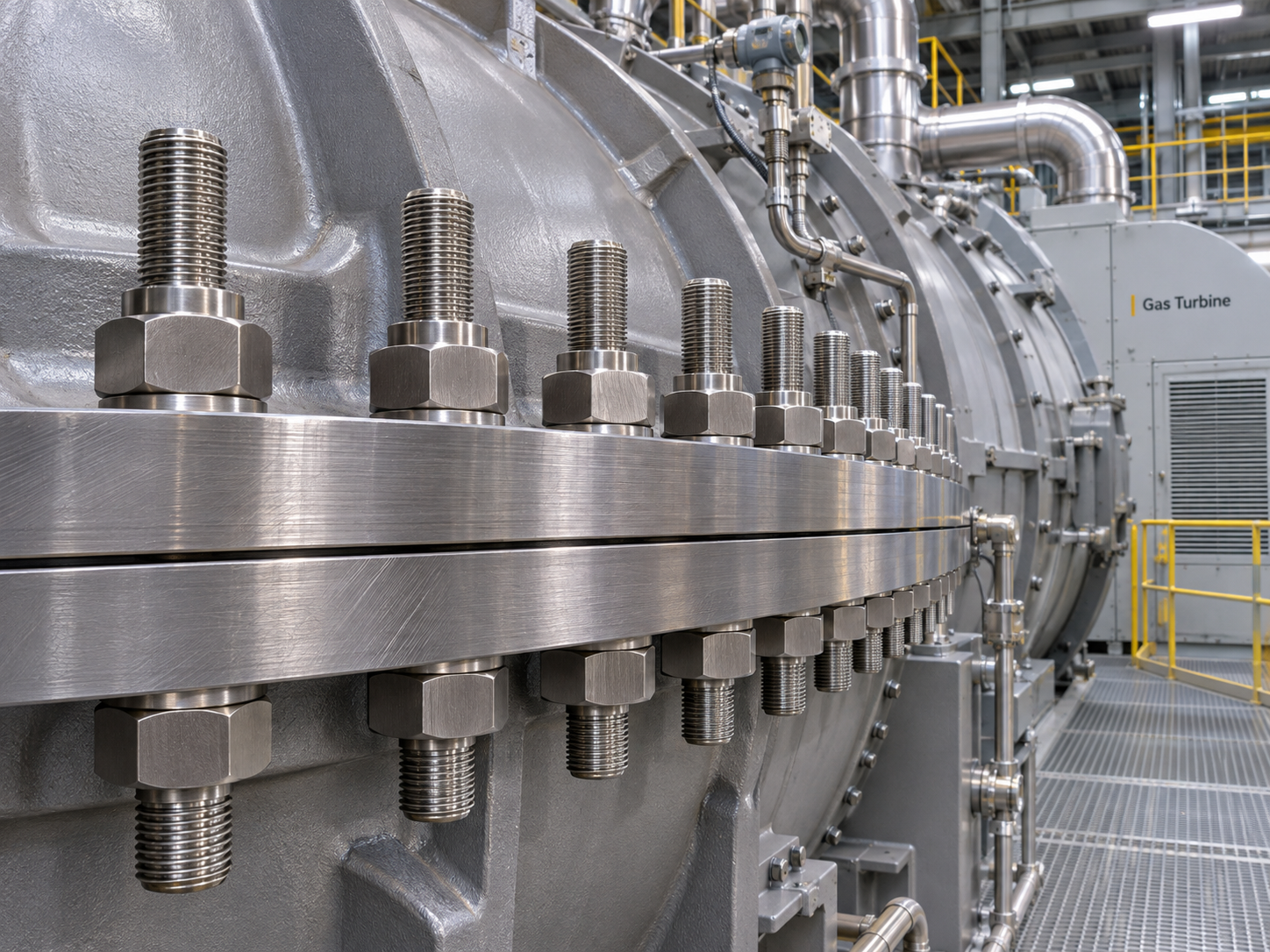
Casing split-line and hot-section bolting routinely sees metal temperatures of 600–650 °C under multi-megawatt aerodynamic thrust and pressure-separating loads. Ordinary alloy steel bolting begins to relax and lose clamp load above roughly 600–800 °F (315–425 °C); superalloy bolting is selected because it holds meaningful clamp load to 1,200 °F and beyond. Inconel 718, age-hardened, is the standard high-temperature structural fastener alloy in gas-turbine hot sections, with yield strengths at or above 1,000 MPa at these temperatures.
718 is chosen here because the joint’s failure mode is preload loss, not corrosion. Its γ″/γ′ precipitation-hardened structure resists relaxation and creep-rupture to 650 °C, and it can be torqued to the high preloads that compact, high-power-density casings require. 625 is solid-solution strengthened and offers excellent oxidation resistance and weldability, but it trades away peak strength and relaxation resistance — it is favored where weldability or corrosion immunity governs, not where maximum bolt preload is the design driver. Specifying 625 for a high-pressure casing split line to “get more corrosion margin” can mean carrying a larger bolt envelope or accepting a lower preload margin than the joint was designed around.
The field problem is not the grade — it is the joint system. Even superalloys creep and relax at temperature, and a nickel-alloy bolt clamping a flange with a different coefficient of thermal expansion will see preload swing as the assembly heats and cools. This drives matched-alloy strategies and, in some designs, Belleville washer stacks to maintain clamp load through thermal cycles. A material upgrade alone does not fix a joint whose preload and thermal-expansion mismatch were not engineered together.
Nuclear Class 1: Where the Code Defines the Fastener Before the Load Does
Nuclear bolting is the clearest case in power generation where “strength is not the specification.” ASME BPVC Section III divides pressure-retaining threaded fasteners into Class 1, 2 and 3, with Class 1 covering the primary reactor coolant pressure boundary — where a fastener failure could lead to an uncontrolled loss-of-coolant event. A Class 1 fastener is subject to 100% volumetric NDE, and the quality programme is governed by ASME NQA-1 and 10 CFR 50 Appendix B rather than a general ISO certificate.
The material decision is segmented by location, not by a single “nuclear grade.” A193 B7 remains common for general pressure-boundary duty, while Alloy 718 (SB-637) with yield strength ≥150 ksi is used for high-stress, high-temperature components such as control-rod drive mechanism fasteners, and A453 Gr 660 (A286) covers 300–330 °C primary-loop components such as pressurizer and reactor coolant pump studs. Inconel X-750 is specified for baffle-former bolting, where the joint must maintain clamping preload across a 40-year design life under neutron fluences exceeding 10²¹ n/cm². For primary water stress corrosion cracking (PWSCC), specially heat-treated Alloy 718 and Inconel 690 are specified over older alloys to resist intergranular attack in high-purity deoxygenated borated reactor water.
Low cobalt. Trace cobalt-59 in stainless and nickel-alloy fasteners activates under thermal neutrons to cobalt-60, a gamma emitter with a 5.27-year half-life. To limit worker dose during refuelling outages, fasteners in contact with reactor water are specified to ≤0.05 % Co — a chemistry restriction that must be verified heat-by-heat. Irradiation embrittlement. High-energy neutron displacement damage raises yield strength while reducing fracture toughness, so nuclear studs are forged from vacuum-degassed alloys with ultra-low phosphorus and copper impurities, and the full digital pedigree — melt records, VAR certificates, dimensional records — is archived for the 60-year reactor life.
The procurement consequence. A supplier who can produce a dimensionally correct 718 stud to SB-637 may still be unable to deliver a nuclear Class 1 item, because the difference is NQA-1 programme control, 100% UT and surface NDE, low-cobalt heat verification and a 60-year document archive — not machining capability. Nuclear fasteners are qualified supply-chain products, not catalogue parts.
Steam Turbine and Boiler Bolting: Relaxation Is the Design Variable
In fossil and combined-cycle steam cycles, the dominant in-service degradation mode for high-temperature casing and valve bolting is stress relaxation — the progressive loss of clamping force under sustained load at temperature. Steam turbine high-pressure casing, main steam stop valve and intercept valve bolts are routinely re-tightened during scheduled overhauls and irregular inspections specifically because relaxation has reduced their sealing force. The engineering question is not whether relaxation will occur, but how much preload margin the joint carries and how the re-tightening interval is planned.
Reloading studies on high-temperature bolting steels show that re-tightening improves relaxation resistance — residual stress after reloading is higher than after a single loading — but the benefit increases with the number of loadings and then levels off beyond a certain number of cycles. In practical terms, this means a bolting strategy built around a defined re-tightening interval is more reliable than one that assumes a single initial torque will hold for the entire campaign. The material selection must support that strategy: 718 is chosen where preload retention to 650 °C is the governing property, while lower-alloy high-temperature bolting steels remain appropriate where the temperature and joint design allow.
Steam-cycle bolting does not see constant temperature. Start-stop cycling, load following and attemperation transients impose thermal fatigue on the thread roots and head fillets. A joint that is correctly preloaded but has a sharp thread-root geometry or a surface defect becomes a fatigue initiation site — and relaxation that increases the dynamic stress amplitude makes that initiation more likely. Surface condition and thread geometry are therefore part of the material specification, not a secondary finishing concern.
Ultra-Supercritical Valve Bolting: A Case Where Heat Treatment Decides the Outcome
The ultra-supercritical steam parameter envelope pushes metal temperatures into the range where oxidation-assisted cracking becomes a credible bolt failure mode, and the documented failure of Inconel 783 bolts in the intermediate-pressure main steam valve of a 660 MW ultra-supercritical unit is the clearest technical lesson available on this point.
The failure sequence
Failure analysis identified a three-stage process: fatigue initiation from a surface scratch to approximately 1 mm depth; crack propagation dominated by Stress-Accelerated Grain Boundary Oxidation (SAGBO); and final overload fracture when the crack reached roughly 15 mm. SAGBO is not a generic “corrosion” mechanism — it is oxygen ingress along grain boundaries under sustained stress, and it converts a fatigue crack into a fast-propagating failure path.
Root cause: incomplete β-phase precipitation from improper heat treatment
The primary metallurgical cause was improper heat treatment during manufacturing, leading to insufficient precipitation of the protective secondary β phase (NiAl) along grain boundaries. That β phase is what gives Inconel 783 its SAGBO resistance; without it, the grain boundaries become an oxidation path rather than a barrier. The alloy was capable; the process was not.
Aggravating factor: negative creep and preload overshoot
The as-received material also showed incomplete γ′ precipitation, producing a negative creep phenomenon that raised the actual service stress by approximately 22.3 %, accelerating both fatigue initiation and SAGBO-driven growth. Separate analyses of the same failure family found thread-root stress concentration factors as high as 3.2, with excessive preload identified as a key crack-initiation factor. The lesson generalizes: on high-temperature nickel-alloy valve bolting, heat-treatment condition, preload accuracy and thread geometry are one coupled system, and a non-compliant heat treatment is indistinguishable in the warehouse from a compliant one without metallurgical verification.
What this means for the purchase specification. For 783-class low-expansion bolting in ultra-supercritical service, the purchase order must define the solution treatment, β aging and γ′ aging sequence, require metallurgical verification of grain-boundary β-phase continuity on a per-heat basis, and control preload through a calibrated tensioning method rather than torque alone. “Inconel 783 to mill certificate” is not a sufficient specification for this service.
sCO₂ Cycles and Hydrogen Service: The Emerging Envelopes
Two energy technologies are pushing fastener selection beyond the conventional steam and gas-turbine envelope: supercritical CO₂ (sCO₂) closed Brayton cycles and hydrogen-containing service. Both change the degradation physics, not just the temperature number.
Compact sCO₂ turbomachinery operates at 600–700 °C and pressures of 25–30 MPa, with a fluid density approaching 500 kg/m³ and near-zero surface tension. That combination creates two fastener-specific problems: massive hydrostatic separating force on casing split flanges, and aggressive fluid penetration into micro-gaps beneath bolt heads and gaskets, producing erosion and, above 600 °C, localised carburization and oxide-scale exfoliation at thread roots. Conventional creep-resistant ferritic bolting undergoes rapid stress relaxation at 650 °C, losing preload within hundreds of operating hours, which is why the material set shifts to Haynes 282, Inconel 625 and Inconel 718 — 718 for high-torque casing studs and socket-head cap screws at ≥1,000 MPa yield, 625 where sCO₂ erosion and stress-corrosion cracking resistance govern.
Inconel 718 is among the better-performing nickel alloys for hydrogen embrittlement resistance, but it is not immune, and the sensitivity is heat- and heat-treatment-dependent. Hydrogen-environment testing of multiple 718 heats has shown a considerable effect of heat and heat treatment on the degree of embrittlement. At elevated temperature, carbon vacancies within the strengthening precipitates can trap hydrogen and set off a damage cascade — the same carbides that provide high-temperature strength become a vulnerability in hot hydrogen environments. In hydrogen service, the purchase specification must capture the heat-treatment condition and, where possible, hydrogen-environment test data for the specific heat, not just the alloy grade.
Selection Matrix by Energy Scenario
Cross-Cutting Procurement and Field Realities
Outage windows do not wait for mill lead times
Standard lead times for power-plant fasteners run 8–16 weeks, compressing to 72–120 hours in genuine emergency protocols — but only if the supplier holds a pre-certified raw-material inventory and has in-house hot-forging capacity. In power generation, one day of unplanned downtime costs roughly $50,000 for a small peaking plant to over $500,000 for a baseload combined-cycle installation, which inverts the procurement logic: speed becomes dominant and unit price nearly irrelevant. The practical answer is not “find a faster mill” but qualifying a supplier who already holds certified stock.
Documentation acceleration is the actual bottleneck
In a substantial share of emergency fastener requests, the constraint is not machining — it is documentation. Material test reports and PMI verification must run in parallel with production, not after it, for an emergency order to actually ship. A supplier whose quality system treats certification as a post-production step cannot meet a 72-hour outage window no matter how much stock it holds.
Galling and assembly damage in nickel alloys
Nickel superalloys gall severely: their toughness and work-hardening tendency cause threads to cold-weld under installation load, and a dry Inconel nut on an Inconel bolt can seize before reaching torque and shear on removal. In power generation, this is not only an assembly problem — a seized or damaged fastener during a maintenance outage can extend the outage. Mitigation is a system: thread-rolling rather than cutting, dissimilar hardness pairing, controlled wrenching without impact tools, and a high-temperature anti-seize or silver/WS₂ solid-film coating rated to the actual service temperature.
RAYCHIN in Power Generation
- Inconel 718, 625, X-750 and 783 bolting to ASTM B637 / B446 / AMS specifications, plus advanced 9–12 % Cr and A286 alternatives where the joint economics favour them.
- Heat-treatment documentation at the level the scenario demands — including β/γ′ aging records for 783-class bolting and heat-specific condition verification for hydrogen service.
- Nuclear-grade documentation packages arranged to order: ASME Section III, NQA-1, 10 CFR 50 Appendix B, low-cobalt heat verification and 60-year archival pedigree.
- Galling-control engineering: thread-rolling, dissimilar-hardness nut pairing, and qualified WS₂ / silver solid-film coatings with supplied K-factor data.
- Emergency supply supported by pre-certified raw-material inventory and parallel documentation, not post-production paperwork.
- Scenario-level selection review before quotation — gas turbine, nuclear, steam cycle, ultra-supercritical or sCO₂/hydrogen — so the grade and condition match the failure mode the joint must survive.
Scenario-Based Questions
For gas turbine hot-section bolting at 600–650 °C, should I specify 718 or 625?
Specify 718 when the governing failure mode is preload relaxation and the joint requires maximum bolt strength and clamping force at temperature. 625 is a corrosion-first, solid-solution alloy — it is selected where weldability, oxidation resistance or corrosion immunity governs, not where peak preload retention is the design driver. For a high-pressure casing split line, 625 can force a larger bolt envelope or a lower preload margin than the joint was designed around.
What makes a nuclear Class 1 Inconel fastener different from a commercial 718 stud?
Class 1 designation under ASME BPVC Section III places the fastener on the primary reactor coolant pressure boundary, requiring 100% volumetric NDE, an NQA-1 / 10 CFR 50 Appendix B quality programme, low-cobalt chemistry verification (≤0.05 % Co for reactor-water contact), irradiation-resistant melting and forging practice, and a document pedigree archived for the 60-year reactor life. A commercial mill certificate to SB-637 does not satisfy these requirements; the difference is programme control and documentation, not dimensional capability.
Why did Inconel 783 bolts fail in an ultra-supercritical steam valve?
The documented failure sequence was fatigue initiation from a surface scratch, crack propagation dominated by Stress-Accelerated Grain Boundary Oxidation (SAGBO), and final overload fracture. The primary cause was improper heat treatment leading to insufficient protective β-phase precipitation along grain boundaries; an incomplete γ′ precipitation also produced negative creep that raised actual service stress by approximately 22.3 %. Thread-root stress concentration and excessive preload contributed to crack initiation. The alloy was capable; the heat-treatment and preload control were not.
How should steam turbine bolting be planned around stress relaxation?
Plan for relaxation, not around it. High-temperature steam turbine bolts lose clamping force over time and are re-tightened during overhauls. Reloading studies show that re-tightening improves residual stress and relaxation resistance, with the benefit increasing over a number of loadings before levelling off. The bolting specification should define a re-tightening interval and require a material — such as 718 where 650 °C preload retention governs — that supports the intended interval rather than assuming a single initial torque will hold for the campaign.
Is Inconel 718 suitable for hydrogen service in power generation?
718 is among the better-performing nickel alloys for hydrogen embrittlement resistance, but it is not immune, and sensitivity varies significantly with heat and heat treatment. Hydrogen-environment testing has shown considerable heat-to-heat differences, and at elevated temperature the carbide phases that provide strength can trap hydrogen and initiate damage. For hydrogen service, the purchase specification should capture the heat-treatment condition and, where available, hydrogen-environment test data for the specific heat — grade-level assumptions are not sufficient.
Technical content is reviewed against the applicable code edition, purchase specification and service conditions before project use. Inconel® is a registered trademark of Special Metals Corporation. This diagnosis is for engineering and procurement reference; it does not replace a project-specific design review or the governing code. © RAYCHIN LIMITED — Global Specialist in Nickel-Alloy Fasteners.