
Categories List
Recent Posts
 MP159 Fasteners in Sour Deep Wells: Why Sulfide Stress Cracking and Hydrogen Embrittlement Demand a Different Alloy Class
 MP159 Fasteners in Aerospace: Where Ultra-High Strength, 593°C Capability and Stress-Corrosion Resistance Converge
 Inconel Fasteners for Power Generation: Gas Turbine, Nuclear, Steam Cycle and SCO₂ Bolting | RAYCHIN LIMITED
MP159 Fasteners in Aerospace: Where Ultra-High Strength, 593°C Capability and Stress-Corrosion Resistance Converge
Bolts · Nuts · Screws · Studs · Washers · Threaded Rods — AMS 5841 / 5842 / 5843 | Manufactured by RAYCHIN LIMITED | www.ray-chin.com
Aerospace fastening is rarely a “strength-only” problem. A bolted joint on a jet engine compressor casing must carry preload at 500–600°C without relaxing; a landing-gear bolt must survive impact loads while facing runway de-icing salts; a solid rocket booster fastener must endure vibration, thermal shock and hydrogen-rich environments without cracking. MP159 — a multiphase cobalt–nickel–chromium superalloy (UNS R30159) — occupies a narrow but decisive position in this trade space: it delivers yield strengths in the 240–265 ksi (1650–1830 MPa) range after cold work and aging, retains useful strength to 1100°F (593°C), and resists stress-corrosion cracking and hydrogen embrittlement in conditions where high-strength steels and lower-alloy superalloys fall short. This article examines, in engineering detail, exactly where MP159 fasteners are specified in aerospace, what each application demands of the fastener, and how RAYCHIN LIMITED manufactures and certifies these components for global aerospace supply chains.
1. Why MP159 Exists: The Metallurgical Case for Aerospace Fasteners
MP159 is not a general-purpose alloy. It was developed specifically to extend the strength-and-corrosion advantages of MP35N to higher operating temperatures. The chemistry is deliberate: a Co–25–27Ni–18–20Cr–8–10Fe–6–8Mo matrix, with controlled additions of Ti (2.5–3.3%) and Al (0.1–0.3%) that form gamma-prime precipitates during aging, plus Nb/Ta for carbide strengthening. The alloy is processed by vacuum induction melting followed by vacuum-arc remelting, then cold-worked (typically 48% reduction) and age-hardened to develop its property set.
The practical consequence for aerospace joint design is a rare combination: ultra-high yield strength without the notch sensitivity and hydrogen-embrittlement susceptibility that accompany many 300-ksi-class steels, and corrosion resistance that remains relevant in marine, chloride and sour-service exposure.
Compared with Inconel 718 — the workhorse aerospace bolting alloy — MP159 offers a higher minimum yield strength in the fastener condition (≈250 ksi versus ≈200 ksi for aged + cold-worked 718) and a comparable or higher usable temperature ceiling, while adding the stress-corrosion resistance of a Co–Ni–Cr system. Compared with A286, the yield-strength advantage is roughly double (≈250 ksi versus ≈120 ksi). This is why MP159 is selected not for general airframe bolting, but for joints where a combination of yield strength, temperature and environmental resistance is non-negotiable.
2. Aerospace Applications of MP159 Fasteners — A Component-Level Breakdown
MP159 fasteners appear across four aerospace application clusters. In each case, the alloy is chosen because one or more competing materials cannot simultaneously meet the mechanical, thermal and environmental requirements without a weight or reliability penalty.
2.1 Jet Engine Hot-Section and Compressor Bolting
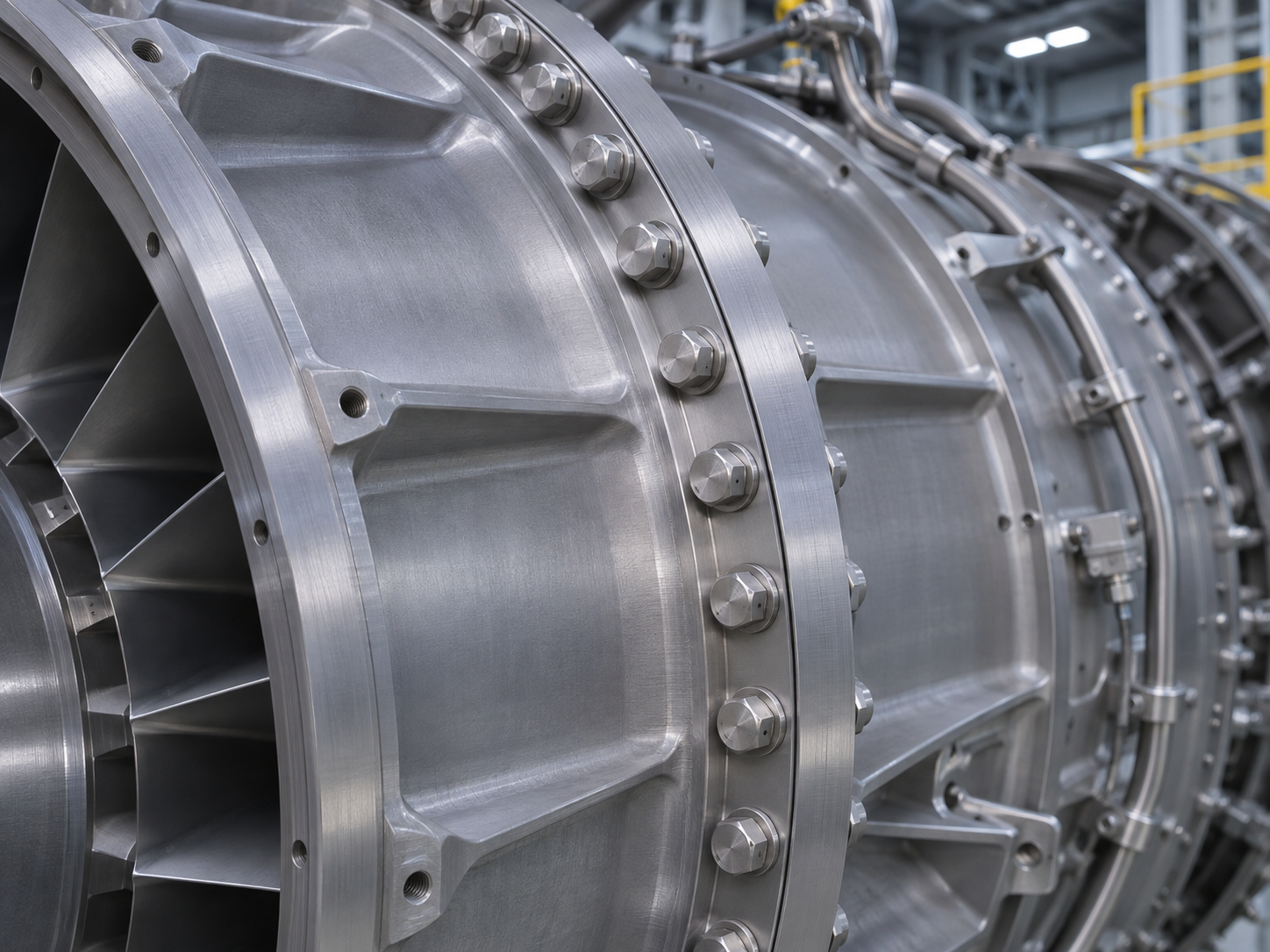
The gas turbine engine is the most established aerospace application for MP159. Compressor casing bolts, turbine shaft bolts, and high-stress fasteners in the hot section operate at metal temperatures that routinely exceed 500°C, where A286 begins to lose a meaningful fraction of its room-temperature strength and where standard high-strength steels would require thermal isolation or active cooling. MP159 maintains a significant percentage of its room-temperature strength above 600°F (315°C) and is usable to 1100°F (593°C), making it suitable for bolted flanges and shaft connections that see sustained elevated temperature plus vibratory loading.
From a joint-integrity standpoint, the relevant properties are creep resistance and fatigue strength at temperature. MP159 is reported to offer excellent fatigue resistance and creep strength at elevated temperatures, which is precisely what a compressor or turbine bolt needs: it must hold preload across thermal cycles without relaxing, and it must resist high-cycle vibration without initiating a crack at thread roots or head fillets. RAYCHIN manufactures MP159 bolts and screws with precision-rolled threads, a process that introduces compressive residual stress at the thread root and improves fatigue life relative to cut threads.
2.2 Landing Gear and High-Load Airframe Joints
Landing gear is a different loading regime: very high ultimate loads (touchdown, taxi, braking), large shear and bending moments, and an aggressive external environment (runway salts, de-icing fluids, humidity). MP159 landing gear bolts have been specified on commercial aircraft because the alloy allows a smaller bolt envelope for a given load while providing corrosion resistance that reduces the need for sacrificial coatings or frequent re-protection. The same logic applies to high-stress structural joints in the airframe, where MP159’s strength-to-weight ratio permits fastener downsizing without reducing safety margins.
The stress-corrosion-cracking (SCC) performance is directly relevant here. MP159 has been evaluated in accordance with MIL-STD-1312, with bolts loaded to 75% of minimum ultimate tensile strength and alternately immersed in 3.5% NaCl solution; the alloy demonstrates resistance to SCC and crevice corrosion in chloride media[reference:16]. For a landing-gear bolt that is simultaneously highly stressed and exposed to salt, this is a material-selection driver, not a secondary benefit.
2.3 Rocket Boosters, Missiles and Spacecraft Structures
Solid rocket boosters and jet propulsion systems present a severe combination of high vibration, thermal gradients, and hydrogen-rich exhaust environments. High-strength steel fasteners in these locations are susceptible to hydrogen embrittlement; MP159 is reported to offer excellent resistance to hydrogen embrittlement alongside high strength and toughness. The alloy has documented use in solid rocket boosters and in securing the Space Shuttle orbiter during ferry operations, reflecting its qualification for critical, failure-intolerant joints.
For spacecraft and missile structures, the appeal is threefold: (i) high specific strength allows lightweight joint design; (ii) the alloy remains tough and ductile at cryogenic temperatures, with aged MP159 showing tensile strength around 1710 MPa and tensile strain near 45% at cryogenic conditions in published studies]; and (iii) the non-magnetic nature of the Co–Ni–Cr system avoids interference with sensitive instrumentation and magnetic anomaly detection systems.
2.4 Engine Mounts and High-Stress Structural Assemblies
Engine mount fittings and pylon attachments transfer thrust and maneuver loads into the airframe. These joints are stiffness-critical and fatigue-critical: the fastener must maintain clamp load under spectrum loading without fretting or preload loss. MP159’s combination of high yield strength, good ductility (6–10% elongation even at 260+ ksi yield) and fatigue resistance makes it a candidate where Inconel 718 would otherwise be marginal on strength or where a cobalt-alloy system offers better environmental compatibility with adjacent materials. RAYCHIN supplies MP159 hex bolts, socket-head cap screws, stud bolts and threaded rods for these structural joints, in both standard and custom configurations, to NAS, MS, ANSI and ISO dimensional standards.
3. MP159 Versus Competing Aerospace Fastener Alloys — Where It Wins and Where It Does Not
No alloy is universally superior. A technically honest comparison helps engineers place MP159 correctly.
The key differentiator is not simply “MP159 is stronger.” It is that MP159 delivers its 250-ksi yield strength in a cobalt–nickel–chromium matrix that remains corrosion-resistant and SCC-resistant in the same condition. A 300-ksi steel might match the strength, but it cannot match the environmental performance without coatings that add process risk and inspection burden. Conversely, MP35N matches the corrosion resistance but loses 300°F of usable temperature capability[reference:26]. MP159 is therefore specified where temperature and corrosion coexist with high stress — the classic “hot and wet and highly loaded” joint.
4. What Aerospace-Grade MP159 Fasteners Require — and How RAYCHIN Delivers
The property levels that make MP159 attractive are process-dependent. Cold reduction must be controlled (typically 48 ± 1%), aging parameters must be tightly held, and thread rolling must be performed in the correct condition to develop fatigue-resistant residual stresses. A fastener that meets chemistry but misses the thermomechanical schedule will not reliably achieve the 250-ksi yield class.
RAYCHIN LIMITED operates as a true manufacturer rather than a trading intermediary. The company controls cold drawing, aging heat treatment, thread rolling and final inspection under one roof, and ships every MP159 fastener with an EN 10204 3.1 material certificate, mill test certificate traceable to the heat number, positive material identification (PMI) report, and full mechanical test data (tensile, yield, elongation, hardness). For aerospace programs requiring third-party witness, 3.2 certification is available.
The manufacturing scope covers the complete fastener family:
- Bolts: hex head, heavy hex, socket head cap, flange head; #2 to 1½″ (M2–M36); UNC, UNF, UNJF-3A threads; AMS 5843 condition with 260 ksi minimum UTS.
- Nuts: hex, heavy hex, jam, all-metal lock, slotted and castle; Class 2B/3B fit; ASME B18.2.2 / ISO 4032.
- Screws: socket cap, flat head (82°/100°), button head, set screws; precision-rolled threads; #0 to 1″ (M1.6–M24).
- Washers: flat, split lock and spring (Belleville/curved); load distribution and locking in extreme environments.
- Studs and threaded rods: double-end and fully threaded; AMS 5843 / API 20F; NACE MR0175 compliance for sour service.
RAYCHIN manufactures to NAS, MS, AN, ANSI, ASTM, ASME, SAE, API, NACE, ISO and DIN standards, and also produces fully custom geometries to customer drawings. The quality system is ISO 9001:2015 and AS9100 certified, with NADCAP-accredited special processes and in-house metallurgical and mechanical testing capability. This vertical integration matters for aerospace sourcing: it eliminates the quality gaps that arise when cold drawing, heat treatment and thread rolling are subcontracted across separate suppliers.
5. Aerospace MP159 Fastener Selection Checklist
When specifying MP159 for an aerospace joint, the following engineering and procurement checks are recommended:
Frequently Asked Questions
What is the maximum service temperature of MP159 fasteners?
MP159 fasteners are rated for continuous use up to 1100°F (593°C), with short-term capability beyond this limit[reference:39]. This represents a 300°F advantage over MP35N, which is generally limited to about 800°F (427°C) in fastener applications. For aerospace bolting, the practical temperature ceiling also depends on stress level, load duration and environmental exposure; creep and stress-rupture data should be reviewed for the specific joint.
Is MP159 magnetic?
No. MP159 is a non-magnetic cobalt–nickel–chromium alloy, which is advantageous for aerospace instrumentation, magnetic anomaly detection and certain medical device applications where ferromagnetic fasteners would interfere.
Can MP159 fasteners be used in landing gear?
Yes. MP159 has documented use in commercial aircraft landing gear bolts and high-strength landing-gear components, where its combination of ultra-high strength, chloride SCC resistance and hydrogen-embrittlement resistance supports safe, weight-efficient joint design.
What standards govern MP159 fasteners?
The primary aerospace material specifications are AMS 5841 (bars/forgings/rings), AMS 5842 (material specification) and AMS 5843 (fastener specification for solution-treated, cold-worked and aged condition). The alloy designation is UNS R30159. RAYCHIN manufactures to these specifications and can supply fasteners compliant with NAS, MS, AN and other aerospace dimensional standards.
Source Aerospace MP159 Fasteners from a Manufacturer, Not a Middleman
RAYCHIN LIMITED controls cold drawing, aging, thread rolling and inspection in-house. Every shipment is backed by full material and mechanical certification, with competitive factory-direct pricing and rapid delivery to aerospace programs in the USA, Europe and Asia.
Send your specifications, drawings or part numbers for a technical review and quotation — response within 24 hours.
Request A Quote! We'll respond as soon as possible(within 12 hours)
Get a Quote