
Categories List
Recent Posts
 MP159 Fasteners in Sour Deep Wells: Why Sulfide Stress Cracking and Hydrogen Embrittlement Demand a Different Alloy Class
 MP159 Fasteners in Aerospace: Where Ultra-High Strength, 593°C Capability and Stress-Corrosion Resistance Converge
 Inconel Fasteners for Power Generation: Gas Turbine, Nuclear, Steam Cycle and SCO₂ Bolting | RAYCHIN LIMITED
MP159 Fasteners in Sour Deep Wells: Why Sulfide Stress Cracking and Hydrogen Embrittlement Demand a Different Alloy Class
Bolts · Nuts · Screws · Studs · Washers | Wellheads · Christmas Trees · MWD/LWD · Safety Valves · Subsea Flanges | NACE MR0175 / ISO 15156 | Manufactured by RAYCHIN LIMITED
The defining constraint in sour deep-well fastening is not static strength. It is whether a highly preloaded bolt can survive H₂S, chlorides, CO₂ and cathodic hydrogen without cracking — after months or years in service, at pressures and temperatures that leave little margin for error. High-strength low-alloy steels and martensitic stainless steels achieve impressive tensile numbers, but in sour service they are limited by sulfide stress cracking (SSC) and hydrogen embrittlement thresholds that force designers to accept lower preload, thicker flanges or exotic coatings that introduce new risks. MP159 (UNS R30159) enters this problem from a different metallurgical direction: a cold-worked and aged cobalt–nickel–chromium–molybdenum superalloy that combines yield strength in the 240–265 ksi (1650–1830 MPa) class with NACE MR0175 compliance at hardness levels up to 51 HRC and exceptional resistance to both SSC and hydrogen embrittlement. This article examines, application by application, where MP159 fasteners are specified in oil and gas deep-well and sour-service engineering, what each location demands, and how RAYCHIN LIMITED manufactures and certifies these fasteners for global oilfield service companies.
1. The Sour Deep-Well Fastener Problem: Three Failure Modes That Redefine Material Selection
Before mapping MP159 onto specific equipment, it is worth stating precisely what “sour service” does to a fastener. Three mechanisms dominate, and they interact.
Sulfide Stress Cracking (SSC)
In the presence of wet H₂S, atomic hydrogen enters the steel at corrosion pits or crack tips. Under sustained tensile stress — which a tightened bolt supplies by definition — the combined action can cause brittle cracking at stress levels far below the material’s yield strength. NACE MR0175 / ISO 15156 exists precisely to define safe hardness, chemistry and stress limits for metallic materials in H₂S-containing environments.
Hydrogen Embrittlement (HE)
Hydrogen can be introduced not only by H₂S corrosion but also by cathodic protection (CP) systems on subsea equipment and by electroplating processes. For a high-strength fastener under preload, absorbed hydrogen can cause delayed brittle failure. The risk increases with strength level — which is why ultra-high-strength steels are so tightly restricted in sour and CP-protected service.
Chloride Stress-Corrosion Cracking (Cl-SCC)
Deep wells frequently produce formation water with high chloride content, often at elevated temperature. Chloride SCC affects certain austenitic stainless steels and nickel alloys under tensile stress, and is a separate selection driver from SSC. A material that resists H₂S but cracks in hot chloride brine is not a complete sour-service solution.
MP159 addresses all three because its strengthening mechanism is not based on a martensitic microstructure. The alloy is a multiphase Co–Ni–Cr system: cold working transforms part of the FCC austenitic matrix to HCP platelets, and aging precipitates gamma-prime (Ni₃(Al,Ti)) on those platelets, creating an exceptionally stable high-strength microstructure. The cobalt-rich matrix is inherently resistant to hydrogen embrittlement, and the Cr–Mo content supports a stable passive film that resists pitting and crevice corrosion in chloride media. The practical outcome is that MP159 can be preloaded to levels that high-strength steels cannot safely reach in sour service, without relying on coatings that may themselves increase hydrogen risk.
2. MP159 Fastener Applications in Oil & Gas Deep Wells and Sour Service — A Location-by-Location Breakdown
MP159 fasteners are not a blanket replacement for every oilfield bolt. They are selected at specific locations where high preload, sour exposure, and often a non-magnetic or temperature requirement converge. The following four application clusters cover the majority of field usage.
Surface & Subsea Wellhead and Christmas Tree Flange Bolting
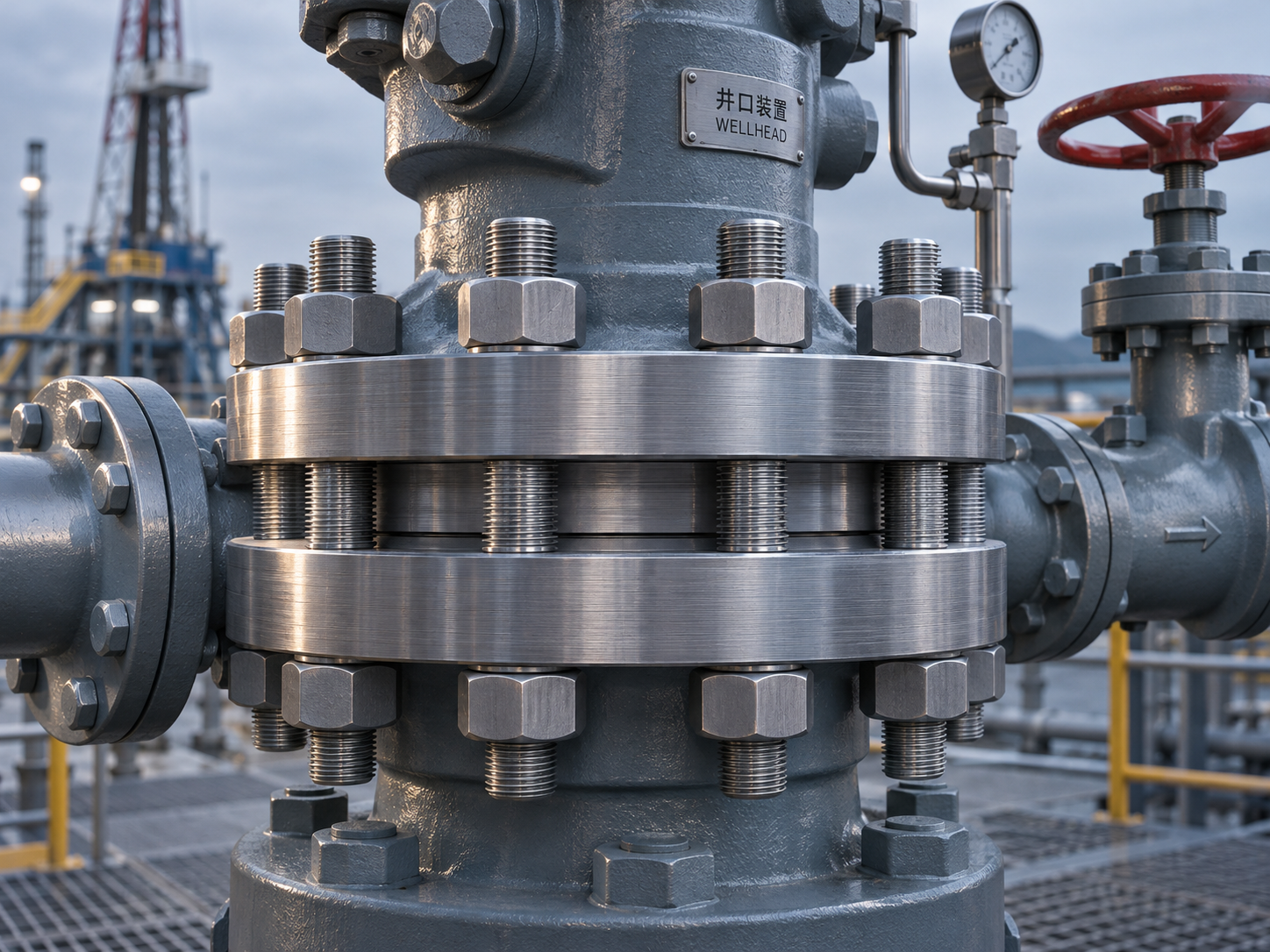
The wellhead and Christmas tree are the first pressure-containing boundaries at the surface (or mudline, in subsea completions). Flange bolting here must maintain clamp load against wellbore pressure, thermal cycling and vibration, while exposed to produced fluids that may contain H₂S, CO₂ and chlorides. In sour wells, the bolting is governed by NACE MR0175, and the maximum allowable hardness — and therefore the maximum allowable strength and preload — is capped for conventional steels. MP159 is NACE MR0175 compliant at hardness levels up to 51 HRC, which allows a significantly higher preload than a hardness-capped low-alloy or martensitic stainless bolt can safely carry in the same sour environment.
The engineering consequence is flange and bolt-circle optimization: for a given sealing requirement, a higher-preload bolt can allow a more compact flange or a reduced bolt count, which matters in subsea trees where every kilogram and every millimeter of envelope has cost and installation implications. MP159 wellhead and Christmas tree fasteners — stud bolts, hex bolts and nuts — are specified where this trade-off justifies the alloy premium. RAYCHIN manufactures these in stud bolt and hex bolt configurations with controlled thread rolling and full traceability, and supplies to wellhead equipment OEMs and subsea contractors.
Downhole · Non-Magnetic MWD / LWD Tools and Directional Drilling Equipment
Measurement-While-Drilling (MWD) and Logging-While-Drilling (LWD) tools carry magnetometers, accelerometers and directional sensors that must function inside a steel drill collar, in close proximity to the drill string and mud motors. Any ferromagnetic fastener in the tool housing can distort the local magnetic field and corrupt survey data. This is why non-magnetic fasteners are mandatory in MWD/LWD tool assemblies, and why MP159 — with permeability below 1.005 even after cold work and aging — is a natural fit.
The downhole environment adds a second constraint: high pressure, elevated temperature, and sour gas (H₂S). MP159 fasteners are used in deep-well drilling equipment including MWD/LWD tools, where they must withstand high downhole pressures and corrosive sour gas while remaining non-magnetic. The combination of non-magnetic behavior and SSC/HE resistance is difficult to achieve with austenitic stainless steels (which may be non-magnetic but are strength-limited) or with high-strength nickel alloys that may be marginally magnetic after cold work. MP159 fasteners for downhole tools are typically supplied as socket-head cap screws, hex bolts and custom geometries to tool OEM drawings.
Completion Downhole Safety Valves and Completion Tool Fastening
Subsurface safety valves (SSSVs) and completion tools are installed in the production string and must function reliably for years without intervention. Their bolted and threaded connections see production fluids at bottomhole temperature and pressure, including H₂S in sour wells. MP159 is used in downhole safety valve bolts in sour oil and gas fields, precisely because it maintains high preload and resists hydrogen embrittlement in wet H₂S where high-strength steel fasteners would be at risk of delayed failure.
The fatigue dimension also matters: completion tools experience vibration during installation and flow-induced cycling in service. MP159 offers excellent fatigue resistance and creep strength at elevated temperatures, and its rolled threads carry compressive residual stress at the thread root that improves fatigue life relative to cut threads. RAYCHIN produces MP159 fasteners for completion tool applications in bolt, screw and stud forms, with mechanical test data and NACE compliance documentation supplied per heat.
Subsea / Deepwater Subsea Production Equipment, Flanges and Connectors
Subsea equipment introduces a failure mode that is often overlooked in surface sour-service design: hydrogen generated by cathodic protection. Subsea structures are protected by sacrificial anodes that polarize the steel to a negative potential, which can generate atomic hydrogen at fastener surfaces. For a high-strength bolt under preload, this is a classic hydrogen-embrittlement scenario. MP159 has been tested under conditions that promote cathodic hydrogen generation on the bolt surface — with no bolt failures after 1000 hours of severe exposure — indicating exceptional resistance to galvanically induced hydrogen embrittlement.
This is why MP159 fasteners appear in subsea wellheads, subsea tree flange connections, subsea pipeline flanges, underwater connectors and deepwater structural fastening. In deepwater, where intervention costs are orders of magnitude higher than the fastener cost, the value proposition is not the bolt itself — it is the avoidance of a single subsea leak or connector failure. RAYCHIN supplies MP159 fasteners for subsea applications with EN 10204 3.1 certification, mill test certificates and full mechanical data, and can provide 3.2 third-party witness certification when the project specification requires it.
3. MP159 in the Sour-Service Fastener Landscape: A Technically Honest Comparison
MP159 is a premium alloy. Specifying it correctly requires understanding where it outperforms alternatives and where another material remains the better commercial or technical choice.
4. What Sour-Service MP159 Fasteners Require — and How RAYCHIN Delivers
The NACE MR0175 compliance of MP159 is not automatic from chemistry alone. It depends on achieving the correct cold-work + aging condition and controlling final hardness within the qualified envelope. A fastener that is over-aged or improperly cold-worked may fall outside the qualified hardness range, or may not reach the yield strength needed for the preload calculation. This is why sourcing MP159 fasteners for oil and gas requires a manufacturer that controls the full thermomechanical route.
RAYCHIN LIMITED is a true manufacturer, not a trading company. Cold drawing, aging heat treatment, thread rolling and final inspection are performed under one roof. For oil and gas sour-service orders, every MP159 fastener is supplied with:
The product scope covers the fasteners that sour-service equipment actually uses: stud bolts for wellhead and flange connections, hex bolts for tree and manifold assemblies, socket-head cap screws for MWD/LWD and completion tools, nuts matched to the bolt grade, and washers for load distribution. RAYCHIN also produces custom MP159 fasteners to OEM drawings, with full certification. The company is an approved MP159 fastener vendor for major oilfield service companies, with rapid delivery supported by strategic MP159 bar inventory.
5. Sour-Service MP159 Fastener Specification Checklist
Frequently Asked Questions
Is MP159 compliant with NACE MR0175 / ISO 15156?
Yes. MP159 is NACE MR0175 compliant at hardness levels up to 51 HRC, which allows it to be used at high preload in sour service where lower-hardness-capped materials would require reduced bolt stress or larger flanges. Compliance should always be confirmed against the specific project specification, H₂S partial pressure and temperature, and documented in the material certification.
Why is MP159 preferred over high-strength steel for sour wellhead bolts?
High-strength steels achieve their strength through martensitic microstructures that are susceptible to sulfide stress cracking and hydrogen embrittlement in wet H₂S. NACE MR0175 therefore imposes hardness caps that limit their usable preload. MP159 achieves its strength through a cold-worked and aged Co–Ni–Cr multiphase structure, with documented resistance to SSC and hydrogen embrittlement, and remains compliant at higher hardness — allowing higher preload in the same sour environment.
Can MP159 fasteners be used in subsea equipment with cathodic protection?
Yes. MP159 has demonstrated exceptional resistance to galvanically induced hydrogen embrittlement in tests where cathodic conditions generate hydrogen on the bolt surface, with no failures after 1000 hours of severe exposure[reference:13]. This makes it a candidate for subsea wellhead, tree and connector fastening where CP is active and high-strength steels would carry HE risk.
Is MP159 magnetic — and why does that matter in oil & gas?
MP159 is essentially non-magnetic (permeability < 1.005 even after cold work and aging). This is critical for MWD/LWD tools and directional drilling equipment, where ferromagnetic fasteners can distort magnetic survey readings and compromise wellbore placement accuracy.
Specify Sour-Service MP159 Fasteners with Full NACE Documentation
RAYCHIN LIMITED manufactures MP159 bolts, studs, screws, nuts and washers for wellhead, subsea, downhole and completion applications — with in-house cold drawing, aging, thread rolling and inspection, and full EN 10204 3.1 / NACE MR0175 certification. Factory-direct pricing, 24-hour quotation response, and global delivery to oilfield service companies.
Send your wellhead or downhole fastener specification, drawing or part number for a technical review and quotation.
Request A Quote! We'll respond as soon as possible(within 12 hours)
Get a Quote