
Hastelloy C-276 Fasteners in Chemical Processing and Oil & Gas
Hastelloy C-276 is the alloy engineers reach for when the process stream contains chlorides, reducing acids and wet sour gas simultaneously — a combination that defeats stainless steels and pushes even nickel alloys to their limits. This guide examines why C-276 bolts, nuts, screws, studs and washers are specified in chemical reactors, heat exchangers, wellheads and sour-gas piping, the standards that govern them, and the manufacturing disciplines that separate a reliable C-276 fastener from a corrosion-related failure.
1. Why Hastelloy C-276 Is the Benchmark Fastener Alloy for Severe Chemical and Sour Service
Chemical processing and oil and gas share a common failure mode that does not show up on a tensile test report: environment-assisted cracking. In a sour well or a hydrochloric acid reactor, the governing limit is not simply how much load the fastener can carry, but whether it can carry that load for years without pitting, crevice attack, stress-corrosion cracking or sulfide stress cracking initiating at a thread root or under a washer face. A fastener is a geometric stress concentrator by design, and it is often the first component in a bolted assembly to show environment-assisted failure.
Hastelloy C-276 (UNS N10276) was the first wrought nickel–chromium–molybdenum alloy to alleviate welding concerns through extremely low carbon and silicon contents, and it has a track record of more than 50 years in corrosive chemical service. Its high molybdenum content (nominally 16%) combined with chromium (16%) and tungsten (4%) gives it the ability to withstand both oxidizing and non-oxidizing acids, with outstanding resistance to pitting and crevice attack in the presence of chlorides and other halides. For fasteners, that property combination translates directly into a joint that can be tightened to a working preload and left in a chloride-bearing, acid-bearing or sour environment without the corrosion front advancing into the thread.
2. Corrosion Performance: What C-276 Resists and Where the Limits Lie
C-276’s corrosion performance is best understood as a combination of three capabilities that rarely coexist in one alloy: resistance to reducing acids, resistance to oxidizing media, and resistance to localized chloride attack. The molybdenum and tungsten provide the reducing-acid and pitting resistance; the chromium provides the oxidizing resistance.
2.1 Reducing acids: hydrochloric and sulfuric
In hydrochloric and sulfuric acid service, C-276 provides a step-change improvement over austenitic stainless steels and substantially outperforms lower-molybdenum nickel alloys such as 625. At hydrochloric acid concentrations above approximately 5%, C-276 provides a quantum improvement over stainless steels, and it offers much greater resistance to higher concentrations of both acids than alloy 625. RAYCHIN application data describe C-276 resisting 40% HCl at 60 °C with a corrosion rate below 0.05 mm/year, and 50% H₂SO₄ at 90 °C. For a chemical reactor or heat-exchanger flange in acid service, these are the conditions that determine whether the bolted joint remains a bolted joint.
2.2 Oxidizing media and mixed acids
Unlike Ni–Mo alloys that are limited to reducing service, C-276 also handles oxidizing conditions. It is resistant to strong solutions of oxidizing salts such as ferric and cupric chlorides, and it resists both oxidizing and non-oxidizing acids. This is why C-276 appears in processes where the chemistry shifts between reducing and oxidizing, or where an oxidizing contaminant is present — a situation that would require a different alloy choice if the service were purely reducing.
2.3 Chlorides, halides and localized attack
C-276 exhibits outstanding resistance to pitting and crevice attack in the presence of chlorides and other halides, and possesses exceptional resistance to stress-corrosion cracking in chloride-bearing solutions — the form of degradation to which austenitic stainless steels are especially prone. It is one of the few alloys resistant to wet chlorine gas, hypochlorite and chlorine dioxide solutions. For fasteners, this matters because a thread root, a washer-to-flange crevice or a nut-to-stud interface is precisely where chlorides concentrate and where localized attack would begin.
2.4 Sour oilfield environments
C-276 is very resistant to sulfide stress cracking and stress-corrosion cracking in sour oilfield environments. It is specifically selected for wet sour gas containing chlorides and elemental sulphur, where the selection driver is the highest general corrosion resistance of the Ni–Cr–Mo family combined with tolerance of oxidizing contaminants. This combination — sour gas plus chlorides plus elemental sulphur — is one of the most demanding environments in oil and gas, and it is the reason C-276 appears in high-integrity gas processing hardware.
3. NACE MR0175 and Sour Service: The 35 HRC Discipline
For oil and gas fasteners, “Hastelloy C-276” without a NACE condition is an incomplete specification. Sour service is governed by NACE MR0175 / ISO 15156, which sets hardness limits, environmental limits and heat-treatment requirements grade by grade rather than treating “sour” as a single condition. For C-276, the relevant entry is a maximum hardness of 35 HRC in the solution-annealed condition, listed in ISO 15156-3 Annex A.
In practice, C-276 naturally falls well below this threshold. RAYCHIN’s technical guide notes that C-276 hardness is typically a maximum of 100 HRB (approximately 248 HBW) in the solution-annealed condition, and that for NACE MR0175 / ISO 15156 sour service the hardness is further restricted to ≤35 HRC when required by the specification, although C-276 naturally falls well below this threshold. This is one reason C-276 is a practical sour-service fastener material: the required hardness ceiling is not a manufacturing constraint that forces a property compromise, as it can be with higher-strength precipitation-hardening alloys.
The condition specification still matters. C-276 fasteners for sour service should be supplied solution-annealed, with hardness verified and certified against the 35 HRC limit. A gas processing facility handling highly corrosive wet H₂S and CO₂ environments required C-276 fasteners for critical valve and piping connections with full NACE MR0175 sour service compliance, and the supplied fasteners achieved zero corrosion-related failures. The certification package for such projects commonly includes EN 10204 3.1 material certification, NACE MR0175 compliance, and pitting-resistance testing per ASTM G48.
4. Chemical Processing Applications
C-276’s chemical processing footprint is broad because the alloy was developed for exactly this industry. Haynes lists typical chemical process industry applications as reactors, heat exchangers and columns. The following sections break that down by equipment type and the fastener forms used.
4.1 Reactors and pressure vessels Reactors
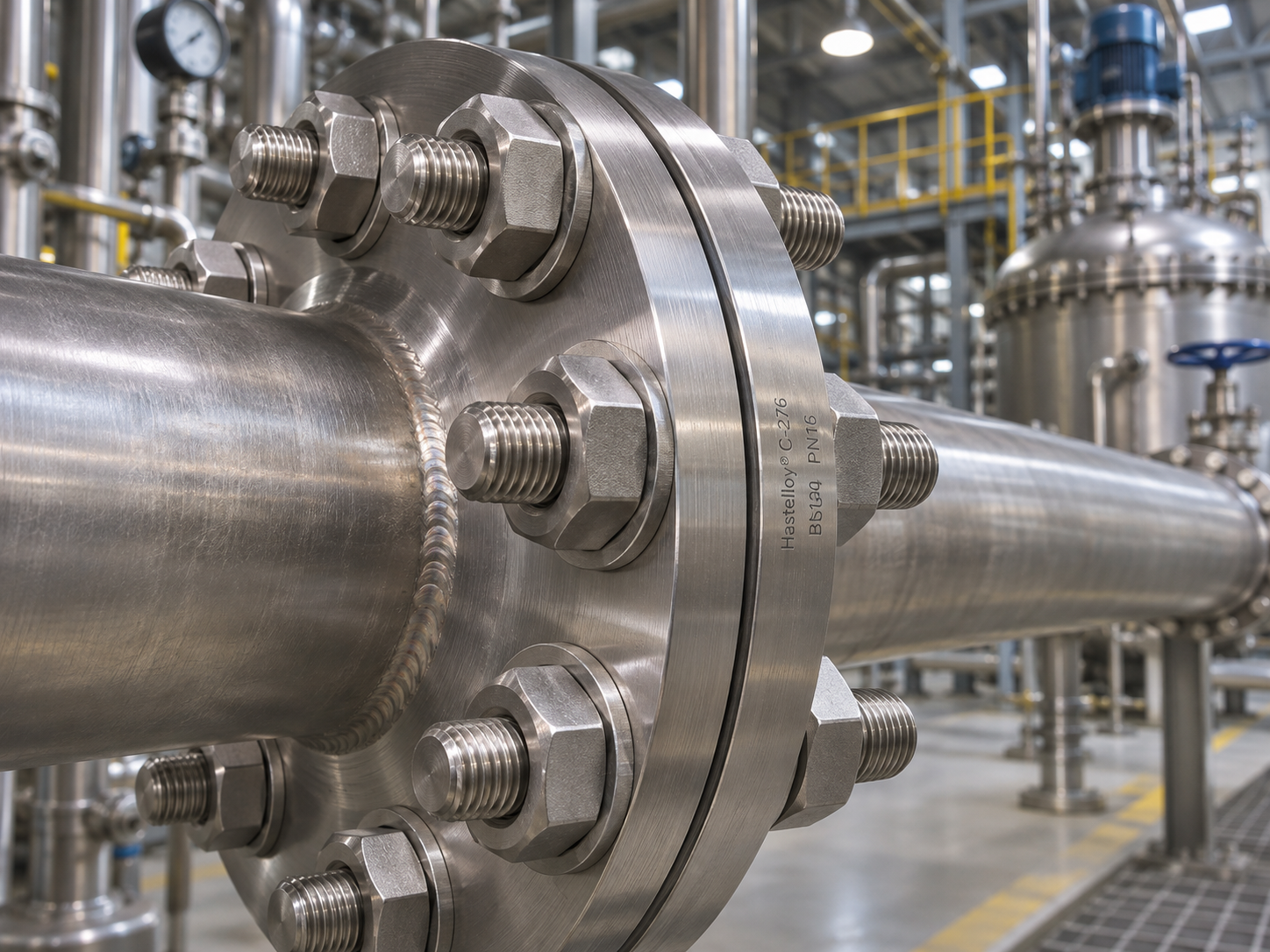
Reactors handling hydrochloric acid, sulfuric acid, mixed acids or organic chloride processes are a core C-276 application. C-276 fasteners are used on reactor flanges, manways, agitator mounts and internal attachment points. In these locations, the fastener is exposed to both the process chemistry and the external environment, and the joint must remain leak-tight across thermal cycles. C-276 is identified specifically for acetic acid and acidic product reactors, and for equipment components in organic chloride processes and processes using halide or acid catalysts.
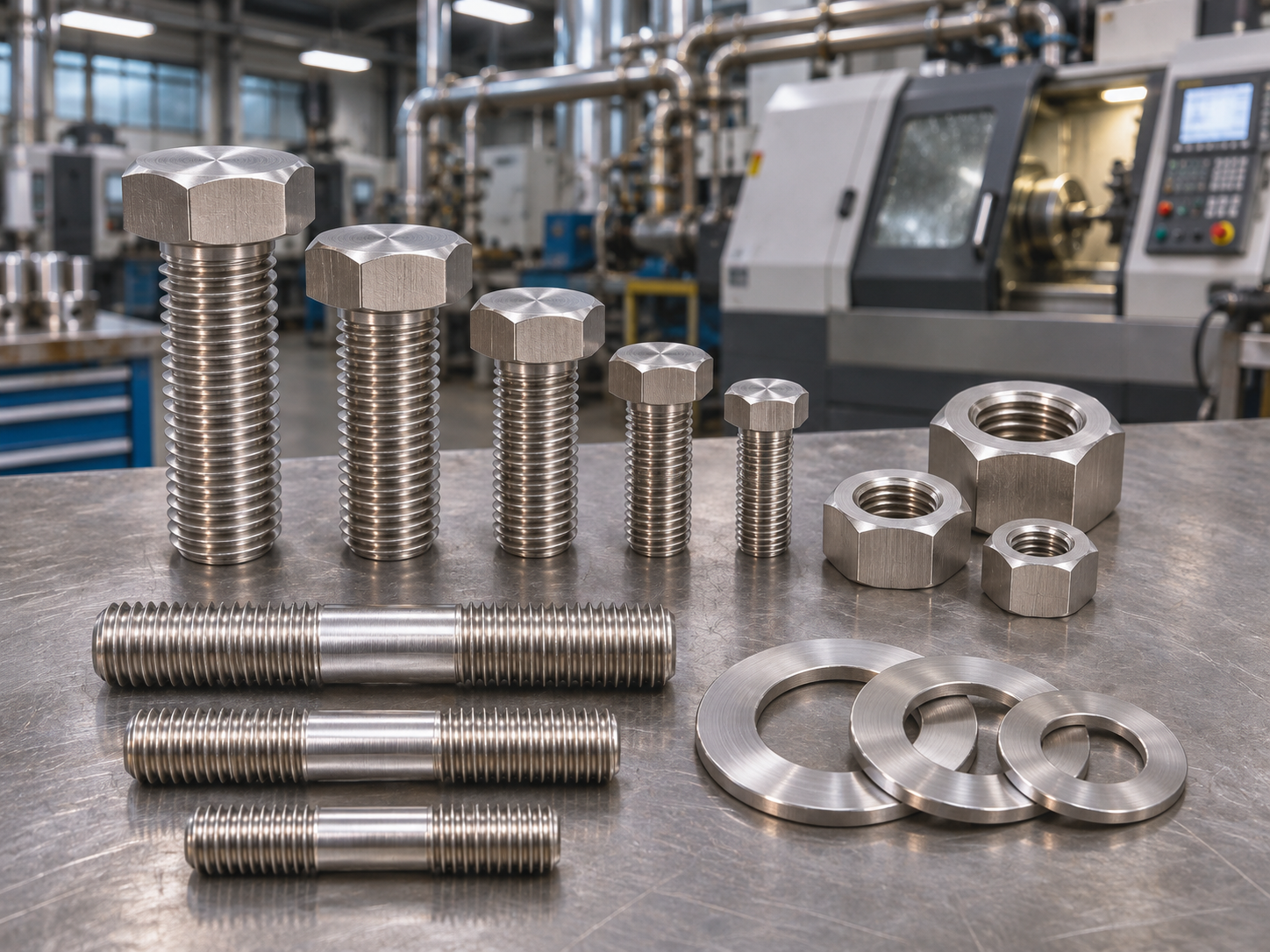
The fastener forms are typically heavy hex bolts and nuts, studs and threaded rod, and washers sized to distribute the preload without over-stressing the flange face. Because C-276 is a solid-solution alloy, the bolts are supplied solution-annealed, and the preload is limited by the gasket and flange design rather than by a heat-treatment strength tier.
4.2 Heat exchangers and columns Heat exchangers / Columns
Heat exchangers and columns are the other two canonical C-276 chemical processing applications. In heat exchangers, C-276 fasteners appear on channel and shell flanges, tube-sheet covers and bonnet connections, where the process side may be an acid or chloride stream and the cooling side may be seawater or brine. In columns, C-276 bolting is used on tray supports, packing restraint and manway covers. The alloy is also used in evaporators, filters, mixers and pipe linings in wet and dry zones of chemical plants.
4.3 Flue-gas desulfurization and pollution control FGD / Scrubbers
Flue-gas desulfurization scrubbers and ducting are a well-established C-276 application, where chlorides, SO₂ and acidic condensates create a combined corrosion environment that stainless steels cannot tolerate. Fasteners in these systems are exposed to both the process gas and the cleaning chemistry, and C-276 is selected for absorber internals, damper and expansion-joint bolting, and reheat components.
4.4 Pulp and paper bleach plants Pulp / Bleach
In the pulp and paper industry, C-276 is used in digesters and bleach plants, including chlorine injection nozzles, bleach washers and piping. Fasteners in these areas face wet chlorine, hypochlorite and chloride-bearing liquors — a combination for which C-276 is one of the few viable metallic options. The alloy is specifically noted as one of the few resistant to wet chlorine gas, hypochlorite and chlorine dioxide solutions.
4.5 Piping flanges, valves and pumps Piping / Valves / Pumps
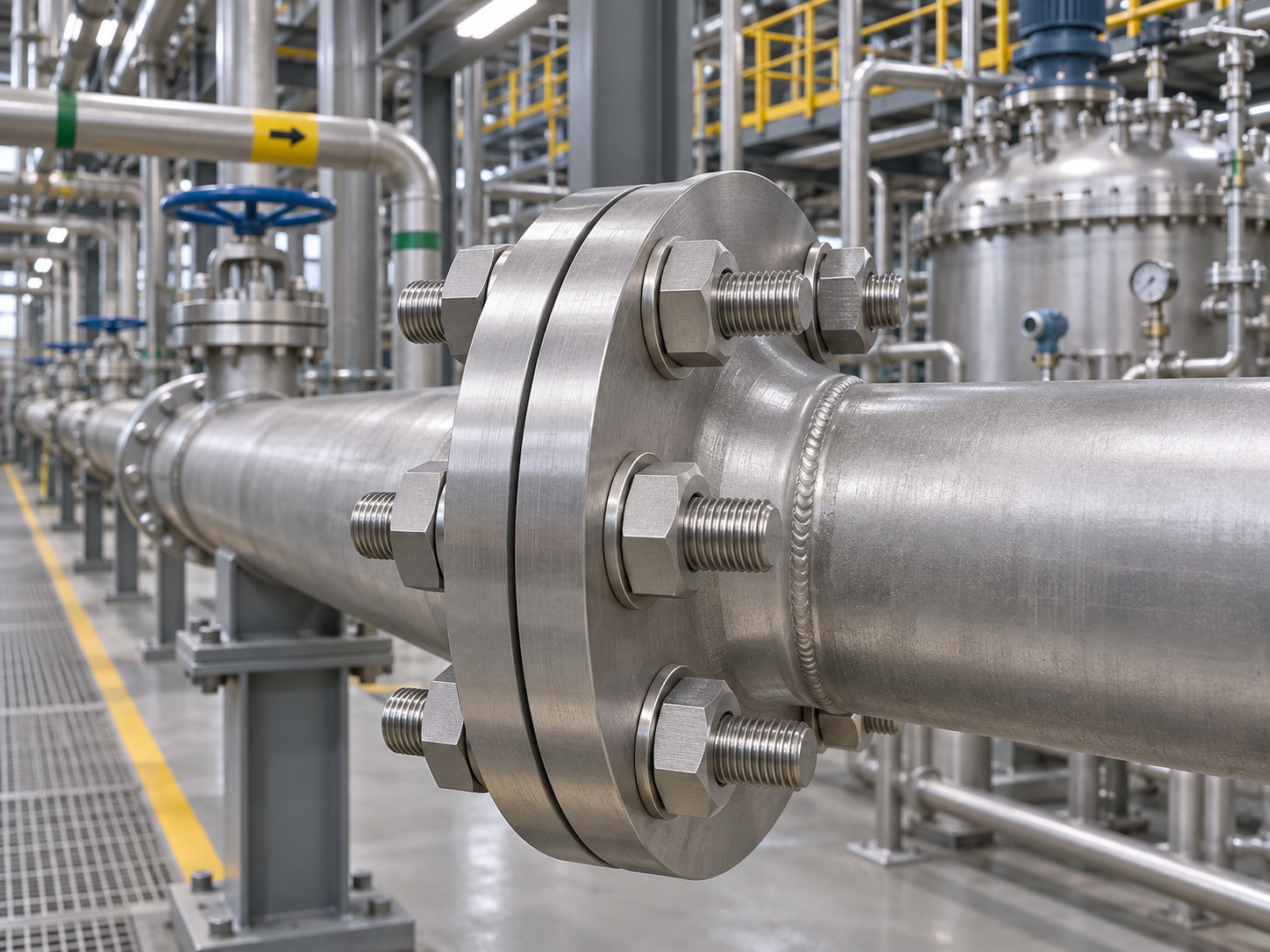
C-276 fasteners are used on piping flanges, valve bodies and pump casings in acid and chloride service. The fastener’s role is to maintain gasket compression across a joint that may be subject to thermal cycling and vibration. C-276’s resistance to crevice attack is directly relevant at the flange-to-gasket interface and under the washer face, both of which are classic crevice sites. The alloy is also used in mixers and pipe linings in chemical engineering wet and dry zones.
5. Oil and Gas Applications
In oil and gas, C-276 fasteners are concentrated in wet sour gas service with chlorides and elemental sulphur, and in wellhead, valve and piping connections where a corrosion-related leak or failure is unacceptable. The alloy is not the default for every oilfield fastener — Inconel 718 and 925 dominate high-strength wellhead and completion tools, and 625 is the standard weld-overlay alloy for sour lines. C-276 occupies the niche where the combination of reducing acids, chlorides and sour gas exceeds what those alloys can handle.
5.1 Wet sour gas with chlorides and elemental sulphur Sour gas
The selection driver for C-276 in oil and gas is explicitly “wet sour gas with chlorides and elemental sulphur,” where it offers the highest general corrosion resistance of the Ni–Cr–Mo family and tolerates oxidizing contaminants. Elemental sulphur above approximately 60 °C attacks even alloys that perform well in clean sour gas, and chlorides add chloride stress-corrosion cracking to the list of failure modes[reference:28]. C-276’s combination of Mo, Cr and W is what allows it to operate in this regime. For a gas processing facility handling highly corrosive wet H₂S and CO₂, C-276 fasteners were specified for critical valve and piping connections specifically for unmatched resistance to pitting, crevice corrosion and stress-corrosion cracking.
5.2 Wellhead and valve connections Wellhead / Valves
C-276 is specified in oil and gas wellhead components and in valve and piping connections in sour service. Wellhead bolting is a high-consequence joint: it must maintain preload under pressure and thermal cycling, and it is exposed to the produced fluid on the bore side and to the external environment on the outside. C-276 studs and nuts are used in these connections where the fluid composition includes chlorides and H₂S, and the fasteners are supplied to NACE MR0175 with hardness verification at the 35 HRC limit.
5.3 Refinery heat exchangers and petrochemical units Refinery / Petrochemical
C-276 fasteners are used in refinery heat exchangers and petrochemical reactors, where process streams may contain naphthenic acids, chlorides and sour components. In refineries, the fastener may be exposed to a combination of high temperature and corrosive media, and the alloy selection has to account for both. C-276’s useful strength in load-bearing fastener applications is generally maintained up to around 600 °C; above that, stress rupture and oxidation scaling accelerate, and alloys such as Hastelloy X or Inconel 718 may be more appropriate.
5.4 Subsea and offshore bolting Subsea / Offshore
C-276 fasteners are supplied to API 20E for subsea bolting and API 6A for wellhead service, alongside NACE MR0175 and NORSOK M-650 certification packages. In subsea service, the fastener is exposed to seawater externally and to produced fluids internally, and the consequences of a failed joint are severe. C-276’s resistance to chloride pitting and crevice corrosion, combined with its sour-service qualification, makes it a candidate where the internal fluid chemistry exceeds the capability of super duplex or lower-alloy nickel grades.
6. Engineering Constraints: Galling, Machining and Assembly
C-276 fasteners have a set of practical engineering constraints that are as important as the corrosion data. These are the issues that determine whether a correctly specified fastener actually performs in the field.
6.1 Thread galling and seizure
Nickel alloys, including C-276, have a strong tendency to cold-weld or gall during tightening, particularly when the bolt and nut are the same alloy and hardness. Thread galling can cold-weld nickel alloy fasteners before they carry load, seizing C-276 bolts on first assembly. This is not a cosmetic issue — a galled thread cannot be reliably torqued, and disassembly may destroy the fastener and damage the tapped hole.
Control measures include using a high-quality anti-seize lubricant formulated for nickel alloys (molybdenum-disulfide or PTFE-based), reducing tightening speed and avoiding high-RPM power tools, using a different material or hardness for the nut versus the bolt where the design allows, and following a controlled cross-bolt torque sequence. RAYCHIN can pre-coat threads with a suitable anti-seize compound and supply matched nut/bolt combinations to reduce galling risk.
6.2 Machining and cold forming
C-276 work-hardens readily and is stiffer than most austenitic stainless steels, requiring more energy during cold forming and potentially several stages of cold work with intermediate anneals. In machining, the challenges include rapid work hardening, high cutting forces and built-up edge on tooling. RAYCHIN’s machining guidance recommends low cutting speeds (10–30 m/min for turning, 5–15 m/min for threading) and heavy feed rates to cut below the work-hardened layer. For cold forming, the recommended strategy is small deformation per pass (typically 10–15%) with intermediate annealing when the accumulated deformation causes excessive force or cracking tendency.
This matters to the fastener buyer because it affects both cost and quality. A C-276 fastener that is machined with the wrong parameters can carry residual tensile stress and a damaged surface layer that reduces corrosion resistance. The manufacturing route should be specified and controlled, not left to a general machine shop.
6.3 Solution annealing and heat treatment
C-276 fasteners are normally supplied in the solution-annealed condition. Solution annealing is critical to restore corrosion resistance after hot forming and to achieve uniform mechanical properties. The recommended procedure is to heat to 1120–1160 °C, hold for a time based on section thickness, and rapidly water-quench or forced-air cool to prevent precipitation of carbides or intermetallic phases. Incorrect annealing can leave the fastener susceptible to intergranular corrosion.
C-276 cannot be strengthened by heat treatment, and any attempt to age or otherwise thermally treat it for higher strength is both ineffective and potentially harmful to corrosion resistance. The fastener’s strength comes from solid-solution hardening and, where specified, controlled cold work — not from a precipitation reaction.
6.4 Temperature limits
In oxidizing atmospheres, C-276 can be used in continuous service up to 1000 °C, but for load-bearing fastener applications the practical upper limit for maintaining reasonable strength is around 600 °C. Above this temperature, stress-rupture and oxidation scaling accelerate. For applications above 700 °C, Hastelloy X or Inconel 718 are often more appropriate. At the other end of the scale, C-276 retains excellent toughness and ductility down to −196 °C and below, with no ductile-to-brittle transition, making it suitable for cryogenic chemical and LNG-adjacent service.
7. C-276 Versus C-22, Inconel 625 and Other Candidate Alloys
C-276 is not the only nickel alloy used in chemical and oil and gas fasteners. Understanding where it sits relative to C-22, Inconel 625 and other grades prevents both over-specification and under-specification.
Where C-276 is the benchmark
- Reducing acids — HCl, H₂SO₄ — especially at moderate to high concentration
- Mixed acid-chloride service where the chemistry shifts between reducing and oxidizing
- Wet chlorine, hypochlorite and chlorine dioxide
- Wet sour gas with chlorides and elemental sulphur
- FGD scrubbers and pulp/paper bleach plants
- Sour service where 35 HRC NACE condition is readily met
Where another alloy may be the better choice
- C-22: Higher chromium for stronger oxidizing-acid performance, e.g. nitric-acid-rich fertilizer service
- Inconel 625: Higher strength and better high-temperature oxidizing performance; standard weld overlay for sour lines
- Inconel 718 / 925: High-strength wellhead, hanger and completion-tool components where age-hardening is needed
- B-3: Ni–Mo for hot HCl where oxidizing species are absent
- Hastelloy X / Inconel 718: Sustained service above ~700 °C where creep rupture dominates
The Mo content difference explains much of the selection logic: Hastelloy C-276 contains approximately 15–17% Mo, compared with roughly 9% in Inconel 625 and 2–3% in 316L stainless. This is why C-276’s reducing-acid resistance is exceptional where 625 is only good and 316L is limited. C-22 upgrades chromium relative to C-276 for oxidizing-acid performance, while C-276 remains the reducing-acid and mixed-service benchmark.
8. RAYCHIN LIMITED: Hastelloy C-276 Fastener Manufacturing and Certification
RAYCHIN LIMITED manufactures Hastelloy C-276 fasteners as a direct factory source, with in-house control over solution annealing, machining, thread rolling, hardness verification and certification. For chemical and oil and gas projects, that vertical control matters because the NACE condition and the corrosion-resistant surface are process outcomes, not material labels.
The RAYCHIN C-276 range covers bolts, hex bolts, heavy hex bolts, socket head cap screws, button and countersunk screws, nuts (standard, heavy, jam and locking variants), plain and spring washers, studs and threaded rod, and custom forgings to drawing. Sizes extend from M6 to M100 and 1/4″ to 4″ in standard configurations, with custom sizes available on request. Fasteners are manufactured to ASTM B574 / ASME SB574 for bar and threaded stock, ASTM B564 / ASME SB564 for forgings, ASTM F468 for general fasteners, and the relevant dimensional standards. RAYCHIN’s published practice is to produce C-276 fasteners daily to ASTM B574 and ASTM F468 with full EN 10204 3.1 certification.
For sour service, fasteners are supplied solution-annealed with hardness verified against the NACE MR0175 35 HRC limit. Certification packages can include EN 10204 3.1 or 3.2 material test reports, NACE MR0175 / ISO 15156 compliance, NORSOK M-650, API 6A and API 20E where applicable, PMI and intergranular corrosion testing per ASTM G28, and pitting-resistance testing per ASTM G48. Threads can be pre-coated with a nickel-alloy anti-seize compound to reduce galling risk during assembly.
9. Frequently Asked Questions
What makes Hastelloy C-276 different from 316L stainless or Inconel 625 for chemical and oil & gas fasteners?
Hastelloy C-276 contains roughly 16% Mo and 4% W, compared with about 9% Mo in Inconel 625 and 2–3% Mo in 316L stainless. This gives C-276 much greater resistance to reducing acids such as hydrochloric and sulfuric acid, and to chloride pitting and crevice attack. C-276 also resists both oxidizing and non-oxidizing environments, whereas 316L is limited to mildly oxidizing service and 625 is optimized more for high-temperature strength and oxidizing conditions. For wet chlorine, hypochlorite and mixed acid-chloride service, C-276 is the benchmark.
Is Hastelloy C-276 compliant with NACE MR0175 for sour oil and gas service?
Yes. Hastelloy C-276 is listed in NACE MR0175 / ISO 15156-3 for sour service at a maximum hardness of 35 HRC in the solution-annealed condition. This hardness ceiling is readily met because C-276 is a solid-solution alloy and cannot be strengthened by heat treatment. Fasteners should be supplied solution-annealed and hardness-verified, with full certification for the specified NACE condition.
Where are Hastelloy C-276 fasteners used in chemical processing plants?
C-276 fasteners are used in reactors, heat exchangers, columns, piping flanges, valves, pumps, mixers and evaporators handling hydrochloric acid, sulfuric acid, mixed acids, chlorides, hypochlorite, wet chlorine and organic chloride processes. They are also used in flue-gas desulfurization scrubbers and pulp/paper bleach plants where chloride-bearing liquors attack stainless steels.
Why is thread galling a problem with Hastelloy C-276 fasteners and how is it controlled?
Nickel alloys including C-276 have a strong tendency to cold-weld or gall during tightening, particularly when bolt and nut are the same alloy and hardness. Control measures include using a high-quality molybdenum-disulfide or PTFE-based anti-seize compound formulated for nickel alloys, reducing tightening speed, using different hardness or material for nut versus bolt where acceptable, and following a controlled torque sequence. RAYCHIN can pre-coat threads and supply matched nut/bolt combinations to reduce galling risk.
Can RAYCHIN supply Hastelloy C-276 fasteners to ASTM B574 and NACE MR0175?
Yes. RAYCHIN LIMITED manufactures Hastelloy C-276 bolts, nuts, screws, studs and washers to ASTM B574 / ASME SB574, ASTM B564 / ASME SB564, ASTM F468 and related specifications. The company supplies solution-annealed fasteners with hardness verification against the NACE MR0175 35 HRC limit, and provides EN 10204 3.1 material certification, PMI and intergranular corrosion testing per ASTM G28 on request.
Specify C-276 for Your Chemical or Sour-Service Fastener Package
Send your material specification (ASTM B574, NACE MR0175 condition, NORSOK M-650, API 6A/20E), drawing, quantity and certification requirements to RAYCHIN LIMITED. Our engineering team will confirm solution-annealing and hardness compliance, galling-control measures, dimensional standard, test certification and lead time.