
Monel Fasteners: Monel 400 vs K-500 — Bolts, Nuts, Screws, Studs and Washers in Real Service
Monel is one of the oldest nickel alloy families in industrial service, and it remains one of the most misunderstood at the fastener level. A purchase order that says “Monel bolts” without a grade, condition and fastener standard is not a specification — it is a guess. This guide separates Monel 400 from Monel K-500, maps their real applications across marine, chemical, oil and gas, aerospace and desalination service, and documents the two failure modes that every Monel fastener specification must address.
1. The Two Monels: 400 and K-500 Are Not Interchangeable
The Monel family is built on a nickel-copper solid-solution base. Monel 400 (UNS N04400) contains a minimum of 63% nickel and 28–34% copper, with small additions of iron, manganese and silicon. It is a single-phase solid-solution alloy: it cannot be strengthened by heat treatment, and its strength comes from cold work and from the intrinsic properties of the nickel-copper matrix. It is slightly magnetic at room temperature.
Monel K-500 (UNS N05500) is the same nickel-copper base with deliberate additions of aluminium (2.30–3.15%) and titanium (0.35–0.85%), which make it precipitation-hardenable. In the aged condition, K-500 delivers roughly three times the yield strength of Monel 400 — typical aged properties are ≥896 MPa tensile and ≥620 MPa yield for common diameters, at 24–37 HRC. It retains the seawater, chloride and hydrofluoric-acid corrosion resistance of the 400 base, but it is non-magnetic and introduces a failure mode that 400 does not have.
For a fastener engineer, the choice is therefore not “Monel or something else.” It is “does this joint need the strength of K-500, and if so, can the joint tolerate K-500’s environmental-cracking risk?” A marine deck fastener at moderate preload may be perfectly served by Monel 400. A subsea clamp bolt carrying high preload in a cathodically protected structure is a K-500 application that requires far more than a grade callout.
2. Monel 400 Fasteners: Where the Solid-Solution Grade Excels
Monel 400’s application profile is defined by three environments in which it outperforms stainless steels and many higher-alloy materials: flowing seawater, hydrofluoric acid, and reducing chemical media.
2.1 Flowing seawater and marine fastening
Monel 400 does not rely on a chromium passive film for protection. It resists seawater through the inherent nobility of its nickel-copper solid solution, which means it does not suffer the chloride-induced stress-corrosion cracking that fails austenitic stainless steels under the same conditions. In flowing seawater, general corrosion rates are on the order of 0.02–0.03 mm/year (roughly 1 mpy) in aerated conditions, and deep-ocean exposure has returned similarly low weight-loss rates. It has excellent resistance to rapidly flowing brackish water or seawater, and to salt and caustic solutions.
This is why Monel 400 is described as the established alloy for marine fasteners and desalination equipment. Typical applications include deck fasteners on ships and platforms, seawater piping supports, marine fixture bolting, and brine heater and seawater scrubber hardware. A Chinese naval practice note records deck-area fasteners being changed to Monel 400 specifically because the alloy does not depend on a chromium passive film for protection.
2.2 Hydrofluoric acid and chemical processing
Monel 400 is exceptionally resistant to hydrofluoric acid across all concentrations up to the boiling point, and this is perhaps its most distinctive chemical property. RAYCHIN’s technical literature states plainly that for hydrofluoric acid applications, Monel fasteners are perhaps the most resistant of all commonly used specialty alloys. The alloy is also particularly resistant to hydrochloric acid when de-aerated, and it handles sulfuric acid, alkalis and neutral salts well — although aeration and oxidizing salts such as ferric chloride will accelerate attack and must be excluded from the specification.
The chemical processing applications follow directly: HF alkylation unit bolting, pickling bath heating coils, heat exchanger fasteners, and pumps and valves in the manufacture of perchlorethylene and chlorinated plastics. In refineries, Monel 400 is used in crude column overhead cladding and transfer piping, and in monoethanolamine (MEA) reboiling tube service.
2.3 Oil and gas and power generation
In oil and gas, Monel 400 fasteners appear in wellhead components, refinery heat exchangers and petrochemical reactors, and in petroleum refining and production equipment generally. In power generation, the alloy is used in feedwater heaters and steam generator tubing, and its good mechanical properties are retained from subzero temperatures up to about 480 °C.
3. Monel K-500 Fasteners: High Strength With a Documented Failure Mode
Monel K-500 exists because many marine and oilfield joints need Monel 400’s corrosion resistance and the ability to carry load without yielding. The age-hardened alloy delivers that, but it also introduces a hydrogen-embrittlement risk that is specific to high-strength fasteners under cathodic protection.
3.1 Marine, offshore and splash-zone fastening
K-500 fasteners are used in mounting elements and bolts in sea-air and splash-water zones, pump shafts and propeller shafts, valve seals, pump sleeves and wearing rings in seawater, and tug-rope armoring. The combination of high strength, non-magnetic behaviour and Monel-family corrosion resistance makes K-500 attractive for offshore deck equipment, subsea clamps and marine propulsion hardware.
3.2 Oil and gas downhole and drilling equipment
In oil and gas, K-500 fasteners appear in drilling equipment components, downhole tools, valve stems, drill collars and oil and gas production safety lifts and valves. The alloy’s strength allows a smaller fastener to achieve the required preload in space-constrained downhole assemblies, and its corrosion resistance supports service in chloride-bearing and mildly sour production environments.
3.3 Aerospace instruments and fuel systems
K-500 is used in aircraft instrument components and fuel system parts, and in turbine engine components operating below approximately 750 °C. In these applications the drivers are non-magnetic behaviour, corrosion resistance and moderate-to-high strength in a small section. For aerospace procurement, K-500 fasteners may be ordered to AMS 4676 in addition to the ASTM standards.
On two North Sea platforms, subsea clamp bolts made from correctly aged Monel K-500, comfortably below the hardness ceiling the standards allow, fractured at the thread root in a brittle, intergranular manner after about a year in service. The metal met its certificate. The bolts were cathodically protected, and that made the difference: the failure was hydrogen embrittlement driven by CP, not a material or heat-treatment defect.
The lesson is not that K-500 is a bad alloy. It is that a hardness certificate is necessary but not sufficient evidence of fitness for a cathodically protected subsea joint. The specification must address the CP interaction explicitly, and the joint design — insulation, coating, current density, preload level — is part of the material decision.
4. Side-by-Side: Monel 400 vs K-500 for Fastener Selection
5. Application Map by Industry
5.1 Marine, offshore and shipbuilding Marine
Marine is the largest Monel fastener market. Monel 400 is used for deck fasteners, seawater piping supports, marine fixtures and desalination equipment bolting, where its flowing-seawater corrosion resistance and resistance to chloride SCC are the deciding properties. Monel K-500 is used where the marine joint must also carry high load — pump shafts, propeller shaft fasteners, valve seals, subsea clamps and splash-zone bolting. For both grades, the crevice-corrosion caveat applies: threaded assemblies in seawater require joint-design attention, not just alloy selection.
5.2 Chemical processing, HF alkylation and petrochemical Chemical
Hydrofluoric acid alkylation is the signature Monel application. Monel 400 fasteners are used in HF alkylation unit flanges, acid coolers and associated piping, where no other commonly used specialty alloy matches Monel’s HF resistance across the full concentration range up to boiling. Beyond HF, Monel 400 serves in sulfuric acid and hydrofluoric acid alkylation plants, pickling bath heating coils, heat exchangers, and pumps and valves for chlorinated plastics. Monel K-500 is used in process industry applications involving organic acids and chlorinated plastics where higher strength is needed.
5.3 Oil and gas: wellheads, downhole tools and refining Oil & Gas
Monel 400 fasteners appear in wellhead components, refinery heat exchangers, crude column overheads and transfer piping. Monel K-500 is used in drilling equipment, downhole tools, valve stems, drill collars and production safety valves. For sour service, both grades can be supplied to NACE MR0175, but K-500 requires hardness control to 35 HRC maximum and, where cathodic protection is present, a specific hydrogen-embrittlement assessment.
5.4 Aerospace and instrumentation Aerospace
Monel K-500 is used in aircraft instrument components, fuel system parts and turbine engine components below approximately 750 °C, where non-magnetic behaviour and corrosion resistance matter alongside strength. Aerospace procurement may reference AMS 4676 alongside ASTM F468 and B865. Monel 400 is used in electrical and electronic components and in aerospace ground-support hardware where its combination of strength and corrosion resistance is sufficient.
5.5 Desalination and water treatment Desalination
Monel 400 is an established alloy for desalination equipment, brine heaters and seawater scrubbers in tanker inert-gas systems. Fasteners in multi-stage flash and reverse-osmosis plants are exposed to hot, aerated seawater and brine, and Monel 400’s combination of flowing-seawater corrosion resistance and chloride SCC resistance is the reason it appears in these plants. For high-pressure pump and valve bolting, Monel K-500 provides the necessary preload capacity.
5.6 Nuclear and uranium refining Nuclear
Monel 400 is used in plants for the refining of uranium and isotope separation in the production of nuclear fuel, and in feedwater and steam generator tubing. Fasteners in these applications benefit from the alloy’s resistance to fluorides and its good mechanical properties at moderate temperature. Monel 400 is also used in handling fluorine and hydrogen fluoride in nuclear fuel cycle equipment.
6. Standards, Certification and the Procurement Trap
Monel fasteners are procured against a layered specification set, and the layering is where most procurement errors occur. The raw-material standard and the finished-fastener standard are different documents, and a mill certificate for bar stock does not prove that the finished fastener meets the fastener standard.
6.1 The correct specification stack
- Raw material: ASTM B164 for Monel 400 and R-405 bar; ASTM B865 for Monel K-500 bar.
- Finished fasteners: ASTM F468 for bolts, hex cap screws and studs; ASTM F467 for nuts.
- Sour service: NACE MR0175 / ISO 15156, with K-500 commonly held to 35 HRC maximum.
- Marine subsea: QQ-N-286, which adds a slow-strain-rate test to the K-500 specification.
- Aerospace: AMS 4676 for K-500 fasteners, in addition to the ASTM standards.
- Pressure equipment: PED 2014/68/EU where applicable, and NORSOK M-650 for North Sea projects.
6.2 Certification that closes the gap
A compliant Monel fastener shipment should include EN 10204 3.1 material test reports as a minimum, with 3.2 third-party witnessed certification available for critical projects. For K-500, the certificate must state the condition — solution-treated versus aged — because the mechanical properties and the environmental-cracking risk are condition-dependent. For sour service, the NACE hardness verification should be on the finished part, not only on the bar. For subsea CP-exposed joints, the procurement should explicitly address the QQ-N-286 slow-strain-rate test rather than relying on a generic K-500 certificate.
7. RAYCHIN LIMITED: Monel Fastener Manufacturing and Supply
RAYCHIN LIMITED manufactures Monel 400 and Monel K-500 fasteners as a direct factory source, with in-house control over condition, machining, hardness verification and certification. The company is ISO 9001:2015 and ISO 14001:2015 certified and is a globally recognized manufacturer of special metal fasteners.
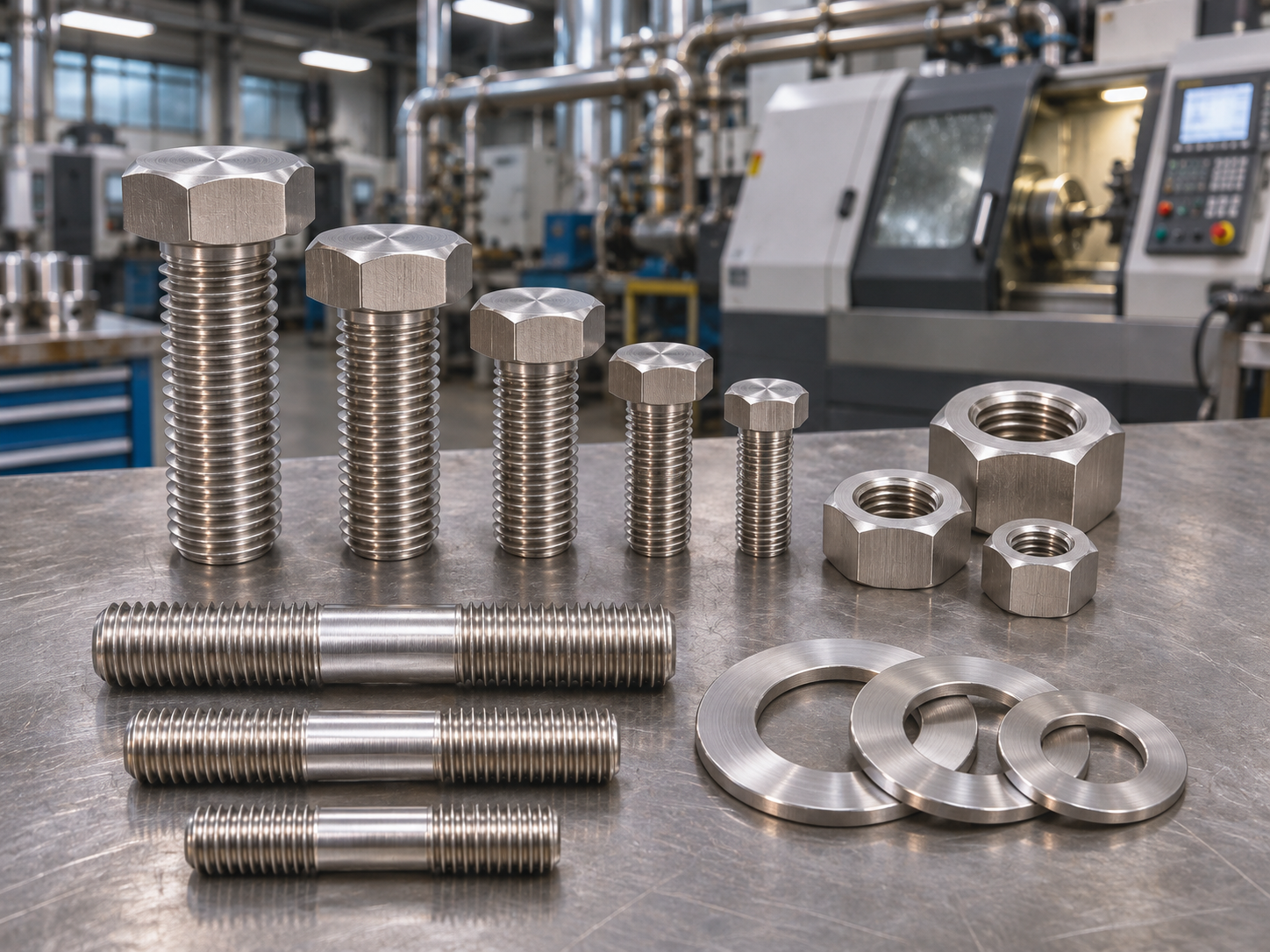
The RAYCHIN Monel range covers hex cap screws, heavy hex bolts, socket head cap screws, machine and set screws, standard and heavy hex nuts, nylon-insert and all-metal prevailing-torque lock nuts, Keps and clinch nuts, plain and spring washers, continuous-thread and double-end studs, threaded rod, U-bolts and J-bolts, and custom CNC parts. Sizes extend from M3 to M100 and #4 to 4″, in imperial and metric thread series, with small-batch and large-batch capability.
Fasteners are manufactured to ASTM B164, ASTM B865, ASTM F468, ASTM F467, NACE MR0175, NAS, MS, AN, ASME B18.2.1, ISO 4017 / DIN 933 and related standards. RAYCHIN controls condition explicitly — annealed, half-hard, or age-hardened for K-500 — and presents mechanical properties in both MPa and ksi with full material traceability. Certification is supplied to EN 10204 3.1 as standard, with 3.2 third-party witness and NACE compliance documentation available. For subsea CP-exposed K-500 joints, RAYCHIN’s engineering team can discuss QQ-N-286 testing and the joint-level hydrogen-embrittlement considerations rather than supplying a bolt certificate in isolation.
8. Frequently Asked Questions
What is the difference between Monel 400 and Monel K-500 fasteners?
Monel 400 (UNS N04400) is a solid-solution nickel-copper alloy with moderate strength and excellent corrosion resistance in seawater, hydrofluoric acid and reducing media. Monel K-500 (UNS N05500) adds aluminium and titanium so it can be age-hardened to roughly three times the yield strength of 400 while retaining similar corrosion resistance. K-500 is chosen when the joint must carry high preload without yielding, but it introduces a hydrogen-embrittlement risk under cathodic protection that does not apply to 400.
Is Monel 400 immune to crevice corrosion in seawater?
No. Monel 400 has an excellent general corrosion rate in flowing seawater, typically on the order of 0.02–0.03 mm/year, and resists chloride stress-corrosion cracking. However, independent seawater exposure reviews and deep-ocean tests have documented crevice attack on Monel 400, ranging from negligible to severe depending on geometry and oxygen availability. Threaded fasteners are inherently crevice-forming geometries, so joint design, sealing and periodic inspection remain necessary.
Why did Monel K-500 fasteners fail on North Sea platforms?
Subsea clamp bolts made from correctly aged Monel K-500, comfortably below the NACE 35 HRC hardness ceiling, fractured at the thread root in a brittle intergranular mode after about a year in service. The cause was hydrogen embrittlement induced by cathodic protection, not a material defect. This is a documented failure mode for K-500 under CP, and it means that a hardness certificate alone is not sufficient evidence of fitness for a cathodically protected subsea joint.
What standards govern Monel fasteners?
Raw material is governed by ASTM B164 for Monel 400 and R-405, and ASTM B865 for Monel K-500. Finished bolts, hex cap screws and studs are made to ASTM F468, and nuts to ASTM F467. K-500 fasteners for aerospace may be ordered to AMS 4676. Sour service requires NACE MR0175 / ISO 15156, commonly at a 35 HRC maximum for K-500. The marine subsea grade QQ-N-286 adds a slow-strain-rate test.
Can RAYCHIN supply Monel 400 and K-500 fasteners?
Yes. RAYCHIN LIMITED manufactures Monel 400 and Monel K-500 bolts, hex cap screws, nuts, lock nuts, studs, washers and threaded rod to ASTM B164, ASTM B865, ASTM F468, ASTM F467 and NACE MR0175. The company is ISO 9001:2015 certified, controls condition (annealed, half-hard or age-hardened for K-500) with full material traceability, and supplies EN 10204 3.1 certification with optional 3.2 third-party witness.
Specify Monel Correctly — Grade, Condition and Joint Context
Send your service environment, load and preload requirements, cathodic-protection status and certification needs to RAYCHIN LIMITED. Our engineering team will confirm whether Monel 400 or K-500 is the correct grade, define the condition and hardness requirements, and build a certification package that proves what you received.