
MP35N Fasteners in Deepwater Oil & Gas and Offshore Engineering
In subsea production hardware, a fastener is often the smallest component with the least maintenance access and the most consequential failure mode. MP35N — a cobalt–nickel–chromium–molybdenum alloy — is specified where bolts, nuts, screws, studs and washers must combine ultra-high preload capacity with resistance to seawater, chloride brines, sour gas and hydrogen charging. This guide examines the specific offshore applications, the governing NACE conditions, and the engineering constraints that separate a reliable subsea joint from a qualification problem.
1. Why MP35N Is Specified in Subsea and Offshore Bolting
Subsea oil and gas equipment operates under a combination of constraints that eliminates most conventional high-strength fastener alloys. A Christmas tree flange bolt, a wellhead connector stud or a riser tensioner fastener must carry very high preload in a compact envelope, resist continuous seawater immersion on the exterior and produced fluids on the interior, tolerate chloride pitting and crevice attack in stagnant areas, and remain immune to sulfide stress cracking where H₂S is present. Maintenance intervention is measured in months or years, and the cost of a failed joint is not simply replacement — it is deferred production and, in some cases, a well-control event.
MP35N occupies a unique position in this space. It is the highest-strength alloy approved in NACE MR0175 for use in unrestricted sour service, with yield strengths exceeding 200 ksi (≈1380 MPa) while retaining excellent corrosion resistance in seawater, chloride brines, sweet gas and sour gas. In seawater, MP35N is described as virtually immune to crevice corrosion, stress corrosion cracking and pitting even at the highest strength levels. For a subsea bolting engineer, this means a fastener that can be preloaded to a level that keeps the joint tight under cyclic and thermal loading, without the corrosion penalty that forces a compromise with lower-strength alloys.
2. NACE MR0175 Compliance: The Condition Defines the Fastener
For subsea and sour-service fasteners, the material specification is inseparable from the condition specification. MP35N can be supplied in several cold-worked and aged conditions, and the selected condition determines whether the fastener is compliant, and at what strength.
2.1 Hardness limits and approved aging schedules
NACE MR0175 / ISO 15156-3 permits MP35N up to 51 HRC maximum in the solution-treated, cold-worked and aged condition, provided one of the listed aging schedules is used. If the material is not aged to one of those approved schedules, the hardness limit drops to 35 HRC. A specific allowance permits up to 55 HRC for cold-worked-and-aged MP35N used as springs.
Carpenter Technology’s published NACE MR0175 minimum properties illustrate how aging temperature trades strength against the hardness ceiling for subsea bolting. The 1425 °F / 6 hr age is popular for subsea bolting, particularly for bar sizes 2 inches and below, delivering approximately 180 ksi yield and 190 ksi UTS at ≤2.00 in diameter, within the 51 HRC maximum. Lower aging temperatures raise strength: 1350 °F / 4 hr gives roughly 200 ksi yield and 210 ksi UTS; 1300 °F / 4 hr reaches about 210 ksi yield and 220 ksi UTS for sizes ≤1.50 in.
The 1300 °F / 4 hr condition for sizes 2.00–3.25 in gives approximately 175 ksi yield and 185 ksi UTS at the same 51 HRC maximum. Always confirm the approved schedule against the current NACE MR0175 / ISO 15156-3 edition and the project-specific material specification.
2.2 Why this matters to the fastener manufacturer
A subsea MP35N fastener is therefore not ordered as “MP35N, 260 ksi.” It is ordered as MP35N to a specific NACE condition, at a specific hardness ceiling, with a specific aging schedule, and with mechanical test evidence that confirms the delivered lot meets both the strength and the environmental-cracking requirements. RAYCHIN controls the cold-working and aging route to these condition-specific requirements rather than supplying a generic high-strength temper and leaving compliance to the buyer.
3. Application Zones: Where MP35N Fasteners Are Used Offshore
MP35N’s offshore application profile is concentrated in joints where preload integrity, corrosion resistance and restricted intervention justify the alloy’s cost. The following sections map the principal equipment zones to the fastener forms most commonly used.
3.1 Subsea Christmas trees, wellheads and connector bolting Tree / Wellhead
Subsea Christmas tree and wellhead connector bolting is a defining MP35N application. These joints clamp the tree to the wellhead or connect flow-control modules under high preload, and they are exposed externally to seawater and internally to produced fluids that may contain chlorides, CO₂ and H₂S. RAYCHIN’s MP35N product literature specifically identifies Christmas tree components, wellhead equipment and riser connectors as oil and gas application zones for the alloy. The fastener forms are typically heavy hex bolts and nuts, double-ended studs and 12-point flange bolts for compact, high-torque connections.
The specification logic is straightforward: the joint needs the highest practical preload to maintain sealing and structural integrity, and the material must remain immune to sulfide stress cracking and chloride crevice attack at that strength level. MP35N’s combination of NACE-approved strength and seawater crevice-corrosion resistance is the reason it appears in these bolted connections rather than a lower-strength stainless or a high-strength nickel alloy that lacks the sour-service approval at the required strength.
3.2 Riser connectors and subsea pipeline flanges Riser / Pipeline
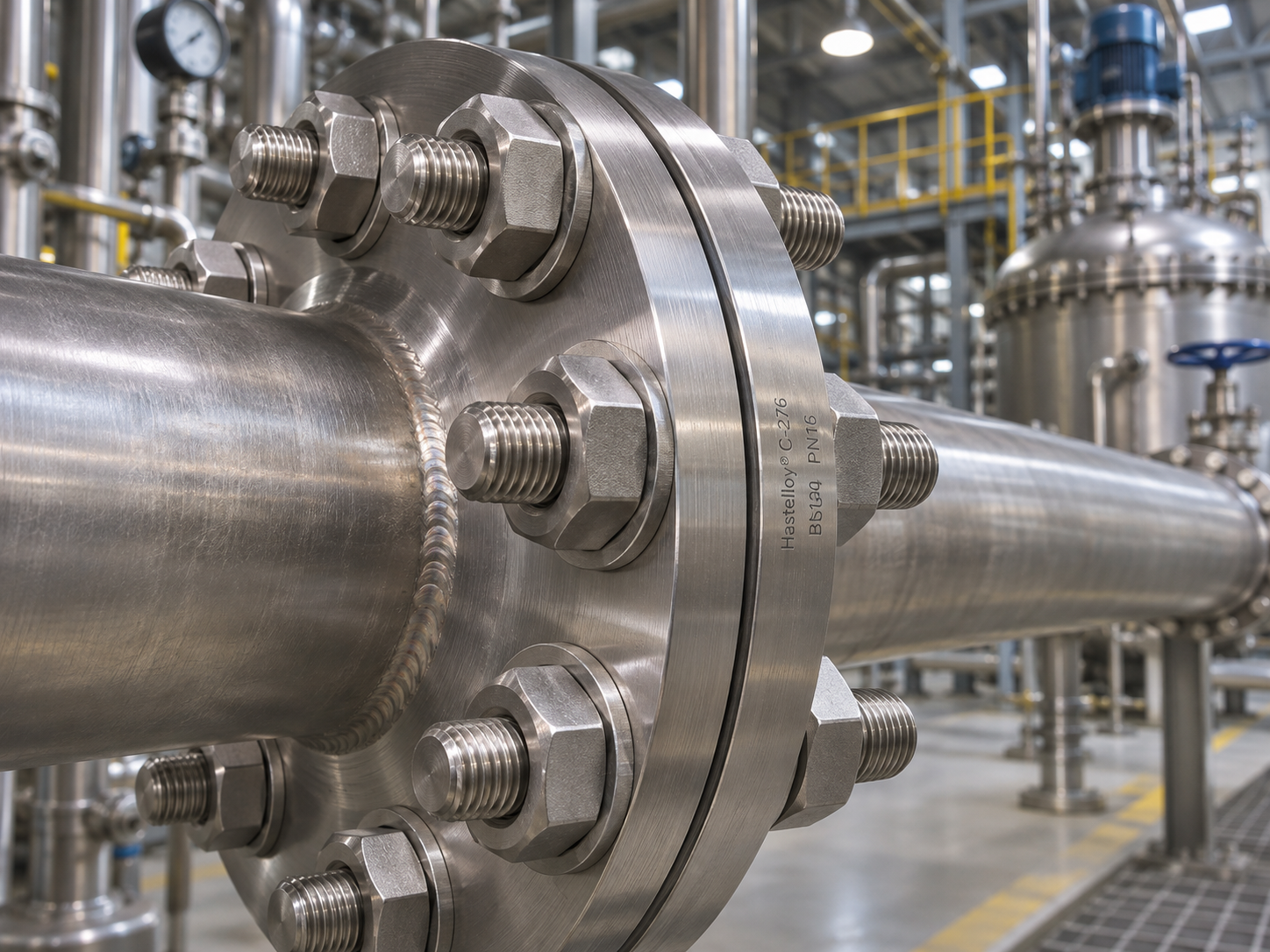
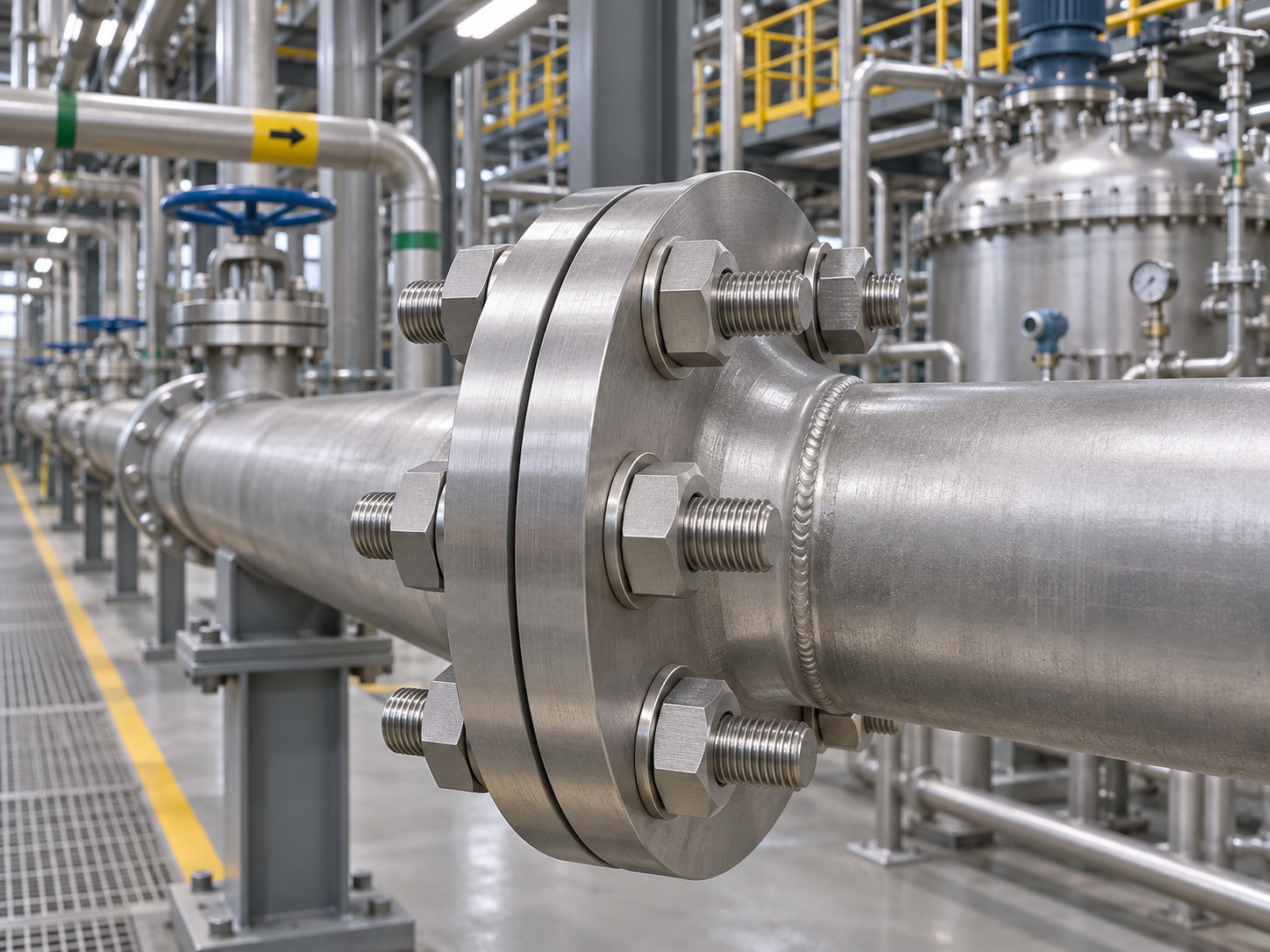
Riser connector hardware and subsea pipeline flange bolting operate in a fatigue-dominated and corrosion-exposed regime. The fasteners are cyclically loaded by vessel motion and current, continuously wetted, and in many cases connected to structures under cathodic protection. MP35N heavy hex bolts are used in flanged connections for subsea pipelines, and the alloy’s high fatigue strength and resistance to hydrogen embrittlement are directly relevant where CP-generated hydrogen is present.
Studs and threaded rods in MP35N are also used where a continuous threaded member runs through a flange pair or a connector body. The RAYCHIN range includes continuous-thread studs to ASME B18.31.2 / DIN 976, double-end studs to ASME B16.5, and 12-point flange bolts for high-pressure compact connections.
3.3 Subsea control modules and pressure housings SCM / 1-atm enclosures
Subsea control modules (SCM) and pressure housings protect electronic and hydraulic components in 1-atmosphere enclosures. The fasteners securing these enclosures are not carrying the highest structural loads in the system, but they are exposed to continuous seawater and must not corrode to the point of breaching the seal. RAYCHIN’s subsea application notes identify SCM and pressure housings as a specific MP35N use case, where corrosion resistance must be absolute to protect sensitive equipment, and report field replacement of failed fasteners with RAYCHIN-manufactured MP35N bolts.
For these enclosures, the fastener forms are often socket head cap screws, hex head screws and washers in smaller thread sizes. MP35N’s non-magnetic character is also relevant where magnetic interference with sensors or instrumentation must be avoided.
3.4 Downhole tools, subsurface safety valves and high-pressure valves Downhole / Valve
Downhole tools and equipment, subsurface safety valves and high-pressure valve assemblies are exposed to the most aggressive produced-fluid chemistry in the system, often at elevated temperature and pressure. MP35N fasteners are used in these assemblies because the alloy resists sulfide stress cracking in sour wells and chloride pitting/crevice attack in brine, while maintaining the high strength needed for tool connections and valve bodies. Fastener forms include socket head cap screws, hex bolts, nuts and studs, often in custom geometries per tool drawings.
3.5 BOP, subsea actuators and ROV system fasteners BOP / Actuation / ROV
Blowout preventer (BOP) assemblies, subsea actuators and ROV system fasteners operate in a seawater-exposed, high-load and intervention-limited environment. MP35N hex bolts qualified per NACE MR0175 are used in subsea actuators and BOP assemblies, and MP35N hex bolts in seawater pump couplings, subsea connector assemblies, ROV systems and offshore platform components resist pitting and crevice corrosion in saltwater. The bolts are often supplied with 12-point or hex heads for high-torque wrenching in confined subsea spaces.
3.6 Offshore platform seawater systems and marine propulsion Topside / Marine
On offshore platforms and marine vessels, MP35N fasteners appear in seawater handling systems, marine propulsion equipment and offshore platform components where conventional stainless steels suffer crevice attack in stagnant seawater or under deposits. The fastener forms in these applications are typically hex bolts, socket screws and washers, often in pumps, couplings and structural brackets. While the structural loads may be lower than subsea tree bolting, the corrosion environment is continuously aggressive, and maintenance access is still restricted compared with onshore plant.
4. Engineering Constraints Offshore Designers Must Manage
MP35N is not a universal drop-in replacement. Its very nobility, which gives it exceptional corrosion resistance, creates a galvanic responsibility toward less noble materials. Its high strength, which enables preload, makes hydrogen embrittlement a joint-level consideration rather than only a material property.
4.1 Galvanic compatibility: titanium and HY-130 are favourable; aluminum and 316 are not
MP35N is galvanically compatible with titanium alloys such as Ti-6Al-4V and with HY-130 steel. In seawater exposure tests, MP35N and titanium bolts were the only fasteners that remained unaffected across fiberglass, aluminum, HY-130 steel, titanium, 17-4PH and mixed-material panels — no corrosive attack was observed on either material in any of the tested structures.
The situation reverses with less noble materials. MP35N has poor galvanic compatibility with Alloy K-500, 316 stainless steel, carbon steel, 7075-T6 aluminum and 5456 aluminum. When MP35N is coupled to these materials in seawater, the less noble member becomes the anode and can suffer accelerated attack. In aluminum structures, MP35N fasteners can cause localized galvanic attack of the aluminum unless the joint is protected by coating, sealant, sleeving or an appropriate active coating on the fastener. Offshore designers should treat the MP35N fastener as a cathodic member and design the isolation accordingly, particularly where the anode-to-cathode area ratio is unfavourable.
4.2 Hydrogen embrittlement and cathodic protection
Subsea structures are commonly protected by cathodic protection (CP), which generates hydrogen on the surface of the protected component. For a high-strength, highly preloaded fastener, this creates a hydrogen-charging condition that must be assessed. MP35N is highly resistant to hydrogen embrittlement, and in severe galvanically induced hydrogen charging tests no bolt failures occurred after 1000 hours of exposure[reference:18]. This resistance is a principal reason MP35N is selected over higher-strength alloys that are more susceptible.
Resistance is not the same as immunity at every condition. The interaction of strength level, hardness condition, preload, coating and CP current density means that hydrogen embrittlement should be assessed for the specific joint. NACE MR0175’s hardness control is itself a hydrogen-cracking-management measure, and the selected aging condition should reflect both the strength requirement and the environmental-cracking margin. Where CP overprotection or intermittent hydrogen charging is possible, the lower-hardness NACE conditions may offer additional margin.
4.3 Temperature and the boundary with nickel superalloys
MP35N maintains useful properties from cryogenic temperatures up to approximately 800 °F (427 °C), with some data extending the upper useful range to about 850 °F depending on condition and exposure. It is not intended to replace Inconel 718 or other nickel superalloys in high-temperature, creep-dominated service. In subsea production, wellstream temperatures are usually within MP35N’s comfortable range, but high-temperature/high-pressure (HPHT) wells and certain topside equipment may reach conditions where a nickel superalloy is the better elevated-temperature choice. The offshore decision is therefore application-specific: MP35N for strength-plus-corrosion-plus-sour-service dominated joints; a nickel superalloy where creep and sustained elevated temperature dominate.
4.4 Non-magnetic behaviour as an additional selection driver
MP35N is non-magnetic. In subsea instrumentation, sensor-adjacent hardware, ROV tooling and certain downhole measurement equipment, a non-magnetic high-strength fastener can eliminate a source of magnetic interference while still providing the required preload and corrosion resistance. This is an additional differentiator against ferromagnetic high-strength steels and some nickel alloys.
Where MP35N is the offshore default
- Sour service with H₂S and chlorides
- Seawater-immersed, high-preload bolting
- Christmas tree / wellhead / riser connections
- Joints under cathodic protection where hydrogen is generated
- Non-magnetic fastener requirements
- Intervention-limited equipment where failure is unacceptable
Where another alloy or a protected design may be preferred
- Aluminum structures without an isolation strategy
- Coupling to 316 stainless, carbon steel or K-500 without protection
- Creep-dominated HPHT service above MP35N’s useful range
- Cost-driven, low-criticality joints with adequate corrosion allowance
5. RAYCHIN LIMITED: MP35N Fasteners for Subsea and Offshore Projects
RAYCHIN LIMITED manufactures MP35N fasteners as a direct factory source, with in-house control over cold drawing, heat treatment, thread rolling, testing and certification. For offshore projects, this vertical control matters because the NACE condition is not a material label — it is a process outcome that must be verified on the finished fastener.
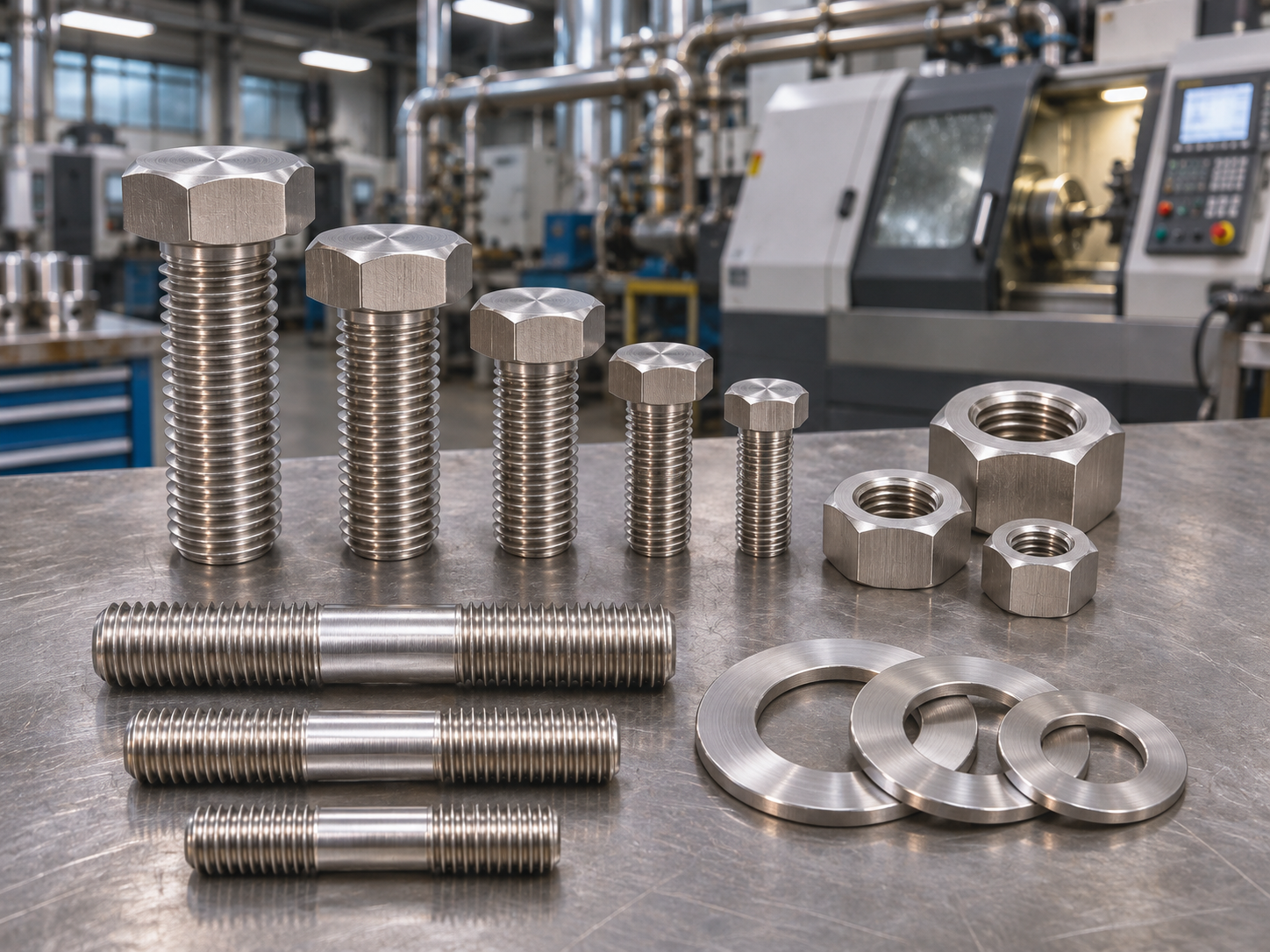
The RAYCHIN MP35N range covers bolts, studs, nuts, screws and washers in metric and imperial sizes, including heavy hex bolts and nuts, double-end studs, continuous-thread studs, 12-point flange bolts, socket head cap screws, and custom geometries per engineering drawing. Diameter coverage extends from M5 to M64 and 1/4″ to 2-1/2″, with larger sizes and non-standard lengths available on request.
Fasteners are manufactured to NACE MR0175 / ISO 15156-3, ASTM F562, AMS 5844, AMS 5845 and related oil and gas specifications, with hardness and mechanical properties verified against the specified condition. Full material traceability from certified mill ingot to finished fastener is maintained, and certification packages can be tailored to subsea project quality requirements. RAYCHIN’s MP35N fasteners are used in deepwater completions, Christmas tree and wellhead connector bolting, subsea control module pressure housings, downhole tools and marine equipment exposed to chlorides and sour service.
6. Frequently Asked Questions
Why is MP35N used for subsea fasteners instead of Inconel 718 or duplex stainless steel?
MP35N is the highest-strength alloy approved in NACE MR0175 for unrestricted sour service, reaching yield strengths above 200 ksi while resisting sulfide stress cracking, chloride pitting and crevice corrosion in seawater. Inconel 718 offers higher elevated-temperature creep strength but is not approved at the same strength level for sour service, and duplex stainless steels cannot approach MP35N’s strength. MP35N also resists hydrogen embrittlement at high strength, which matters where cathodic protection is present.
What is the NACE MR0175 hardness limit for MP35N fasteners?
NACE MR0175 / ISO 15156-3 permits MP35N up to 51 HRC maximum in the solution-treated, cold-worked and aged condition, provided one of the listed aging schedules is used. If the material is not aged to one of those approved schedules, the limit is 35 HRC. A specific exception allows up to 55 HRC for cold-worked-and-aged MP35N springs.
Is MP35N compatible with cathodic protection in subsea bolting?
MP35N is highly resistant to hydrogen embrittlement and has shown no bolt failures in severe galvanically induced hydrogen charging tests. However, cathodic protection generates hydrogen on the fastener surface, and the combination of very high strength, high preload and sustained hydrogen exposure still requires engineering assessment for each joint. MP35N is generally regarded as one of the most tolerant high-strength fastener alloys under CP, but hardness condition, coating and joint design must be specified correctly.
Where are MP35N fasteners used in subsea production equipment?
MP35N fasteners are used in subsea Christmas tree and wellhead connector bolting, riser connector hardware, subsea control module pressure housings, downhole tool connections, high-pressure valve assemblies, BOP-related equipment, seawater pump couplings and ROV system fasteners. The alloy is selected where high preload, chloride/sour service exposure and limited maintenance access make fastener failure unacceptable.
Can RAYCHIN supply NACE MR0175-compliant MP35N fasteners for subsea projects?
Yes. RAYCHIN LIMITED manufactures MP35N bolts, nuts, screws, studs and washers to NACE MR0175 / ISO 15156-3, ASTM F562, AMS 5844/5845 and related oil and gas specifications. The company controls cold working and aging schedules to meet the specified hardness and mechanical property limits, and supplies full material traceability and certification packages for subsea and offshore projects.
Specify MP35N for Your Subsea or Offshore Fastener Package
Send your material specification (NACE MR0175 condition, ASTM F562, AMS 5844/5845), drawing, quantity and project documentation requirements to RAYCHIN LIMITED. Our engineering team will confirm condition selection, hardness compliance, dimensional standard, test certification and lead time.