
MP35N Fasteners in Medical Devices: Bone Screws, Spinal Fixation, Dental and Surgical Instrument Applications
In medical devices, a fastener is often the component that determines whether an implant remains stable for a decade or an instrument survives hundreds of sterilization cycles. MP35N — a non-magnetic cobalt–nickel–chromium–molybdenum alloy — is specified where a small cross-section must carry high load, resist bodily fluids and fatigue, and remain compatible with magnetic resonance imaging. This guide examines the specific medical applications, the governing standards, and the engineering trade-offs that define MP35N’s role in orthopedic, spinal, dental and surgical fastening.
1. Why Medical Devices Specify MP35N Fasteners
Medical fastening occupies a different constraint space from aerospace or oil and gas. A bone screw must fit within a pedicle or a dental alveolus, carry physiological cyclic loads for millions of cycles, resist chloride-rich body fluid without releasing ions, remain stable through sterilization, and — increasingly — allow the patient to undergo MRI without unacceptable image degradation or risk of implant movement. A surgical instrument fastener must survive repeated autoclave cycles and maintain mechanism precision after hundreds of uses.
MP35N meets this combination through a property set that is difficult to replicate in a single material. It is compliant with ASTM F562, the standard specification for wrought 35Co-35Ni-20Cr-10Mo alloy for surgical implant applications, and with ISO 5832-6, the corresponding international implant standard. It is non-magnetic, with permeability below 1.005 even after extensive cold working, and it can reach ultimate tensile strengths of approximately 260–300 ksi (1790–2070 MPa) through cold working plus aging. For a medical device engineer, that translates into a fastener that can be smaller, survive higher cyclic stress, and remain imageable.
2. Biocompatibility and Standards: What “Medical-Grade MP35N” Actually Means
For a medical fastener, “MP35N” is not a sufficient specification. The material must be produced and verified to an implant standard, with biological response evidence appropriate to the application and with a surface condition that minimizes ion release and tissue irritation.
2.1 ASTM F562 and ISO 5832-6
ASTM F562 covers wrought 35Co-35Ni-20Cr-10Mo alloy in bar and wire form for surgical implant manufacture, and the material attains its properties through combinations of work strengthening and work strengthening plus aging. ISO 5832-6 is the international counterpart. A fastener intended for permanent implantation should be ordered to one of these standards, with the condition (cold-worked, or cold-worked and aged) and the mechanical property requirements specified explicitly.
2.2 Biological response evidence
MP35N’s biocompatibility is supported by both animal and clinical evidence. A study of local and systemic host response in two mammal species, with implantation times from one to twelve months, concluded that MP35N produces a degree of local tissue response comparable to that of 316L stainless steel, with no systemic side effects observed during the implantation periods studied. Long-term clinical experience has also shown an acceptable biological response for MP35N in implant applications. For a device engineer, this places MP35N in the same general biocompatibility conversation as the established surgical stainless steels, while offering substantially higher strength.
2.3 Surface condition matters as much as alloy chemistry
A biocompatible alloy can still produce an unacceptable device if the surface is left with machining marks, embedded contaminants or an incompletely formed passive film. Medical MP35N components typically require a controlled surface finishing sequence: grinding and polishing to remove machining artifacts, optional electropolishing to smooth microscopic peaks and valleys, thorough cleaning, and passivation in nitric acid to enhance the protective chromium oxide layer. Surface roughness targets depend on the application — vascular implants have been finished to Ra below 0.107 μm — and the finishing route should be specified on the drawing rather than left to shop-floor discretion.
3. Mechanical Property Ranges for Medical MP35N Fasteners
Medical device designers need the property range, not a single headline number, because the condition determines what the fastener can do. The following table summarizes typical mechanical properties of MP35N in the three conditions relevant to medical fasteners.
Medical implant specifications typically require a balance of strength and ductility, not simply maximum hardness. A 51–60 HRC condition may be appropriate for a bone screw shank, but the same condition in a thin, notched geometry requires careful fatigue and fracture-toughness assessment.
RAYCHIN’s high-strength MP35N fastener line is engineered to a minimum ultimate tensile strength of 1,793 MPa (260 ksi), a 0.2% offset yield of at least 1,586 MPa (230 ksi), 8% minimum elongation in 4D, and 44 HRC minimum hardness — a specification tier that exceeds some general MP35N bar conditions while preserving measurable ductility. For medical components, the condition is selected against the device’s fatigue and biocompatibility requirements, not against the highest achievable hardness.
4. Medical Application Zones
MP35N fasteners and small threaded components are used across several medical device categories. The following sections map the principal applications to the fastener forms and design logic most commonly encountered.
4.1 Orthopedic bone screws, plates and pins Orthopedic
Bone screws are the most direct medical fastener application for MP35N. The alloy is used in bone screws, bone plates and pins where a high-strength, corrosion-resistant, biocompatible material is required in a small cross-section. In cannulated screw systems, MP35N and L605 cobalt–chromium guide wires are described as mechanically superior to conventional 316L stainless steel guide wires, reducing the occurrence of mechanical failures when used with cannulated screws. The AOF Foundation has noted that a 1.25 mm guide wire for 3.5/4.0 mm cannulated screws is available in MP35N as a stiffer, higher-yield-strength alternative to 316L that is less likely to fail clinically.
For the fastener itself, MP35N bone screws benefit from the combination of high fatigue strength and resistance to bodily fluids. The alloy’s ability to be cold-formed and then aged means the thread roots and shank can be produced with favorable residual stress and surface condition, rather than being fully machined from a harder temper.
4.2 Spinal fixation and pedicle screw systems Spinal
Spinal fixation is a major MP35N application area. The alloy is used in spinal fusion rod–screw systems, pedicle screw assemblies and auxiliary wiring, where high strength and compatibility with titanium are both required. In one spinal device disclosure, auxiliary wiring is formed from MP35N specifically because it exhibits a high degree of strength and flexibility and is compatible with titanium and titanium-compatible materials. Other spinal implant descriptions list MP35N alongside titanium alloy 6-4 as a material option for fastener and bushing components.
The design logic in spinal constructs is often hybrid: titanium for the primary rods and screws where modulus match and imaging are priorities, and MP35N for high-stress auxiliary components, cables or fasteners where titanium’s fatigue strength is marginal. MP35N’s fatigue strength is approximately 50% higher than Titanium Grade 5, which makes it attractive for dynamically loaded spinal and orthopedic fasteners.
4.3 Dental implants and abutment screws Dental
Dental implant systems use small-diameter abutment screws and prosthetic retaining screws that must maintain preload under cyclic occlusal loading while resisting chloride-rich saliva and cleaning chemistry. MP35N is identified as suitable for medical implants and orthodontic/prosthetic devices, and is listed among the materials used in dental applications. The alloy’s high strength allows a smaller screw to achieve the required clamping force in the limited space of an implant connection, and its corrosion resistance supports long-term retention in the oral environment.
4.4 Surgical instruments and robotic mechanisms Instruments
Surgical instrument fasteners face a different duty cycle: repeated assembly and disassembly, autoclave sterilization, and — in robotic and minimally invasive instruments — high-cycle flexural loading in small-diameter shafts. MP35N instrument components have demonstrated survival of 250 sterilization cycles with no signs of pitting or corrosion, compared with 316L instruments that required replacement after approximately 80 cycles. MP35N is also formed into thin-wall hypotubes that act as both a torque-transmitting spine and a flexible guide in robotic instruments, a use that draws on the alloy’s combination of strength and flexibility.
For instrument fasteners — set screws, pivot pins, threaded collars and small socket screws — MP35N’s work-strengthened condition offers an excellent balance: high strength for mechanism integrity, enough ductility for staking or swaging, and corrosion resistance that survives repeated sterilization. RAYCHIN supplies MP35N set screws, socket head cap screws and custom threaded components for medical instrument assemblies.
4.5 Cardiovascular and implantable device components Cardiovascular
MP35N is used in cardiovascular devices and implantable springs, including occluder components, stent-adjacent hardware and implantable lead conductors. Five cardiac occluder implants made of MP35N were confirmed non-ferromagnetic in a 1.5 T MR evaluation, and MP35N has been used in vascular prosthesis anchoring systems where a resilient, compressible anchor is required for percutaneous delivery. While these are not always “fasteners” in the traditional sense, the same alloy properties — high fatigue strength, corrosion resistance, biocompatibility and non-magnetic behaviour — drive the selection, and the fastener manufacturing discipline (cold working, aging, surface finishing) applies directly.
5. MRI Compatibility and the Artifact Trade-Off
For implanted medical devices, magnetic resonance imaging compatibility is now a design requirement rather than an afterthought. MP35N’s behaviour in the MRI environment is well characterized, but it is not identical to titanium, and the difference matters for device selection.
5.1 Non-ferromagnetic and MR-safe
MP35N is non-ferromagnetic. Clinical implant guidance classifies MP35N as MR-safe at 1.5 T and 3 T, and aneurysm clips made from MP35N have been described as not deflecting or deflecting only weakly in the magnetic field, so they would not be expected to dislodge during MR. This is the primary safety consideration: the implant will not experience a displacing force in the scanner.
5.2 Artifact size: smaller than stainless steel, larger than titanium
The more nuanced consideration is image artifact. Comparative studies of pedicle screws in porcine spines found the artifact size in the order SUS316 stainless steel > MP35N cobalt alloy > Ti-6Al-4V titanium alloy. A separate comparison of aneurysm clips found titanium clip artifacts 2.5 to 5 times smaller than those around MP35N, Elgiloy and similar cobalt-based clips. In practical terms, an MP35N fastener near a region of diagnostic interest will create a larger signal void than a titanium fastener of the same geometry.
5.3 Non-magnetic behaviour in instruments and sensors
Beyond MRI safety, MP35N’s non-magnetic character is useful in surgical navigation, robotic instruments and sensor-adjacent assemblies where magnetic interference could degrade positioning accuracy or measurement. The alloy remains essentially non-magnetic (permeability <1.005 μ) even after extensive cold working, a property that persists in the finished fastener.
6. Engineering Trade-Offs: MP35N Versus Titanium and Other Medical Alloys
Material selection in medical devices is rarely a single-property decision. MP35N’s advantages come with countervailing considerations, and the correct choice depends on which constraint dominates the device.
Where MP35N is the stronger choice
- Small cross-section requiring very high tensile or fatigue strength
- Dynamically loaded orthopedic or spinal fasteners
- Repeated sterilization with corrosion resistance beyond 316L
- Non-magnetic instrument or implant components
- Dental abutment screws in limited connection space
- Implantable cables, springs and auxiliary wiring
Where titanium or another alloy may be preferred
- Weight-sensitive large implants (titanium is substantially lighter)
- MRI artifact must be minimized near the diagnostic target
- Modulus match with bone is the dominant design driver
- Cost-sensitive high-volume disposable instruments
- Weldability with titanium mating components is required
The density difference is significant: a cubic centimeter of Ti-15Mo weighs 4.95 grams versus 8.43 grams for the same volume of MP35N. MP35N is also not weld-compatible with titanium in the same way that titanium alloys are with each other, which matters in assemblies that rely on welding rather than mechanical fastening. On the other hand, MP35N offers roughly double the tensile strength of titanium and a fatigue strength approximately 50% higher than Titanium Grade 5, which is the reason it remains the material of choice when the fastener is the strength-critical element.
6.1 Galvanic considerations in mixed-material implants
Many modern implant systems are hybrid, combining MP35N fasteners or cables with titanium structural components. MP35N is noted as compatible with titanium and titanium-compatible materials, which is why it appears in spinal auxiliary wiring and hybrid constructs. Where MP35N is coupled to a less noble alloy — 316L stainless steel, for example — galvanic corrosion of the less noble member is possible, and the same joint-design discipline used in other industries applies to the medical device. The fastener should not be treated as an isolated component; the galvanic couple to the mating implant or instrument body is part of the design.
7. Manufacturing Medical MP35N Fasteners: What Separates a Device-Grade Part
MP35N is difficult to machine in its high-strength condition, and medical fasteners often combine small diameters, fine threads, fillets and internal drives that leave little room for process error. The manufacturing route therefore becomes part of the device specification.
7.1 Condition route: machine-then-age versus machine-aged stock
The conventional medical route is to machine the fastener in a softer condition and then age to final strength, which minimizes machining difficulty and allows the thread form to be produced before the material reaches its hardest state. Where the geometry permits, cold forming or thread rolling before aging can produce favorable residual stress and grain flow in the thread roots. RAYCHIN controls cold reduction ratios and aging parameters to meet the specified strength and hardness while preserving the ductility minimums required for a medical component.
7.2 Precision machining and thread quality
Medical fastener threads are frequently fine-pitch and shallow, and the surface finish at the thread root influences fatigue performance. MP35N is machined with carbide tooling, continuous coolant flow and sharp tools to avoid work hardening and dwelling, and small complex parts are often produced on Swiss-type lathes. RAYCHIN’s production line includes high-precision CNC thread rolling for work-hardened, mirror-smooth threads after aging, which is relevant to fatigue life and galling resistance in instrument and implant mechanisms.
7.3 Surface finishing, passivation and cleanliness
A medical MP35N fastener is not finished when the dimensions are correct. The surface must be free of machining residue and embedded foreign material, the passive chromium oxide layer must be fully formed, and the part must be cleaned to a level appropriate for the device’s contact category. RAYCHIN offers specialized surface treatment options, and the process sequence — grinding, polishing, optional electropolishing, cleaning and nitric acid passivation — should be specified and verified rather than assumed.
7.4 Traceability and certification
Medical device quality systems require traceability from the mill heat to the finished fastener, with mechanical test reports, material certifications and process records that support the device history file. RAYCHIN maintains full material traceability from certified mill ingot to finished product and provides comprehensive documentation and certification packages. For medical programs, the certification package should explicitly address the ASTM F562 or ISO 5832-6 condition, the hardness and tensile results, and the surface finishing and passivation records.
8. RAYCHIN LIMITED: MP35N Medical Fastener Capability
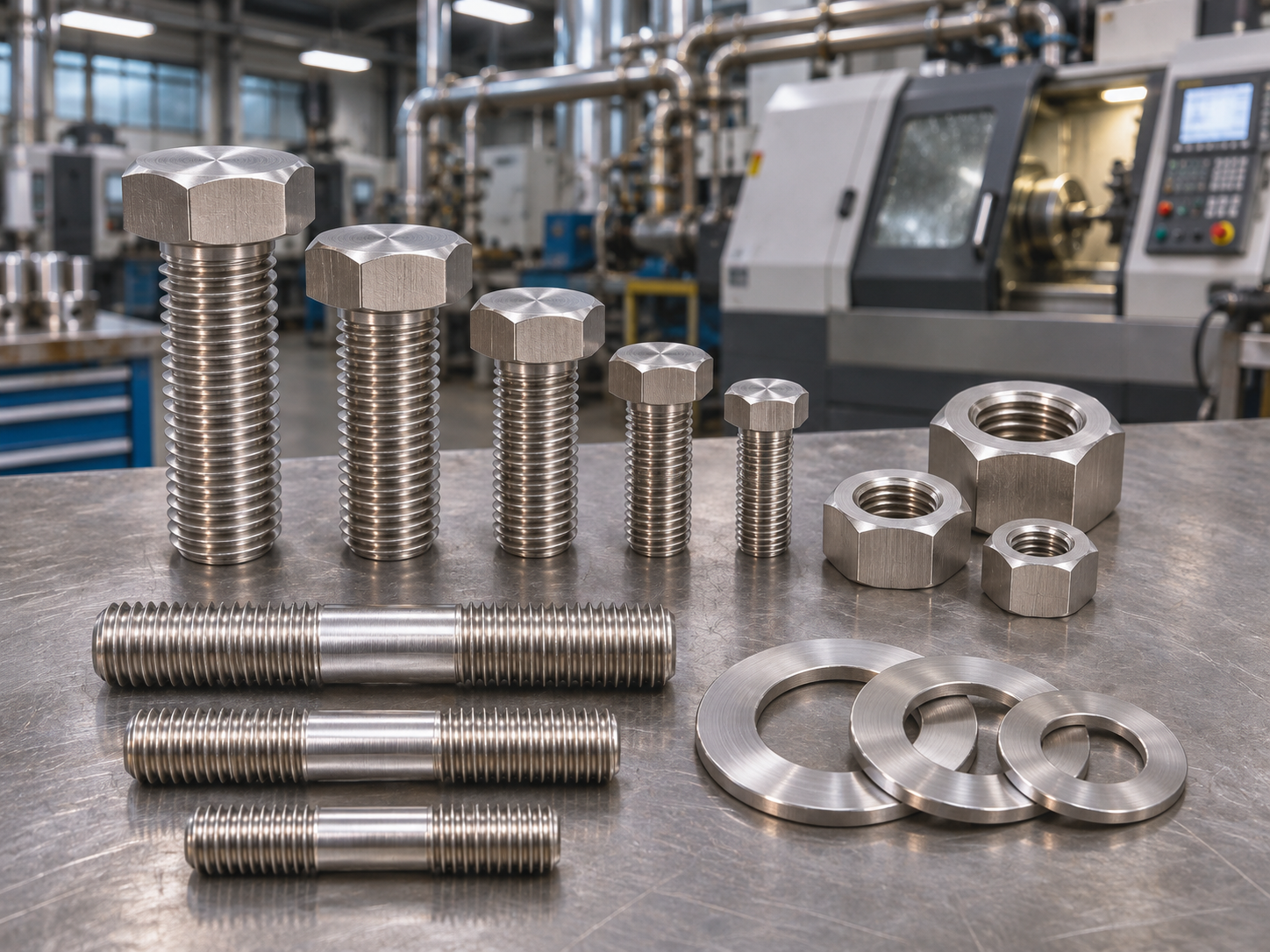
RAYCHIN LIMITED is a manufacturer and global supplier of special alloy fasteners, with MP35N as a core alloy across medical, aerospace, oil and gas and marine applications. The company manufactures MP35N screws, bolts, nuts, studs and washers in standard and custom configurations, in metric and imperial sizes, and in prototype and production quantities.
For medical customers, the relevant capability is the ability to hold the condition and surface specification, not merely to machine the alloy. RAYCHIN manufactures to ASTM F562, ISO 5832-6, AMS 5844, AMS 5845 and related specifications, with precision cold working, controlled aging, CNC machining, thread rolling, passivation and electropolishing options. The company’s MP35N product literature identifies medical devices, surgical instruments, implantable devices, MRI-compatible equipment assemblies, and dental and orthopedic applications as core application areas.
RAYCHIN’s quality system is ISO 9001:2015 certified, with in-house manufacturing from raw material to final packaging, full material traceability, and documentation packages that can be aligned to medical device supplier requirements. For device engineers, this means a fastener supplier that can engage at the material-condition and surface-finish level, rather than only at the catalog-part level.
9. Frequently Asked Questions
Is MP35N biocompatible for permanent surgical implants?
Yes. MP35N is compliant with ASTM F562 and ISO 5832-6, the standards for wrought cobalt-nickel-chromium-molybdenum alloy for surgical implants. Animal studies have shown that MP35N produces a degree of local tissue response comparable to that of 316L stainless steel, with no systemic side effects observed over implantation periods of one to twelve months. Long-term clinical experience has also shown an acceptable biological response.
Why choose MP35N over titanium for a medical fastener?
MP35N offers roughly double the tensile strength of titanium and approximately 50% higher fatigue strength than Titanium Grade 5, which allows smaller fasteners or higher preload in space-constrained implants and dynamically loaded instrument mechanisms. Titanium is lighter and produces smaller MRI artifacts, so the choice depends on whether strength and fatigue or weight and imaging are the dominant constraints. Many implant systems combine both materials, using MP35N for high-stress screws or cables and titanium for the primary structural components.
Is MP35N MRI-safe?
MP35N is non-ferromagnetic and has been classified as MR-safe at 1.5 T and 3 T in clinical implant guidance. Its MRI artifact is smaller than that of 316 stainless steel but larger than that of Ti-6Al-4V titanium alloy. It does not deflect or dislodge in the magnetic field, but the artifact size should be considered when the implant is near the region of diagnostic interest.
Where are MP35N fasteners used in orthopedic and spinal devices?
MP35N fasteners and small components are used in bone screws, bone plates, pins, intramedullary nails, spinal fixation systems, pedicle screw assemblies, and orthopedic cables. MP35N is also used as auxiliary wiring in spinal constructs because it is compatible with titanium and titanium-compatible materials. The alloy is selected where high strength, fatigue resistance and resistance to bodily fluids are required in a small cross-section.
Can RAYCHIN supply MP35N medical fasteners to ASTM F562 and ISO 5832-6?
Yes. RAYCHIN LIMITED manufactures MP35N bolts, screws, nuts, studs and washers to ASTM F562, ISO 5832-6, AMS 5844/5845 and related specifications. The company controls cold working and aging to achieve the required strength and hardness while preserving ductility, and offers precision machining, thread rolling, passivation and electropolishing options suitable for medical component requirements.
Discuss Your Medical MP35N Fastener Requirements
Send your drawing, material specification (ASTM F562 condition, ISO 5832-6, AMS 5844/5845), surface finish requirement and quantity to RAYCHIN LIMITED. Our engineering team will confirm condition selection, machining and finishing route, certification package and lead time.