
Hastelloy Fasteners: Bolts, Nuts, Screws, Studs and Washers — Grade Selection and Application Guide
“Hastelloy” is not one alloy. It is a family of nickel-based corrosion-resistant alloys, and the grade you specify determines whether a bolted joint survives a decade in a chemical reactor, a sour-gas wellhead or a flue-gas scrubber — or fails within months. This guide gives engineers and procurement teams the selection logic across C276, C22, B2/B3, G30 and X, the standards that govern them, and the application map for chemical processing, oil and gas, pollution control, aerospace, pharmaceutical and marine service.
1. The Fastener Problem Hastelloy Solves
A bolted joint is an engineered crevice. The thread root, the under-head contact, the nut-to-washer interface and the bolt-to-flange gap are all tight geometries where chlorides concentrate, oxygen becomes scarce, and the local chemistry departs from the bulk process stream. Stainless steels — even super-duplex and 6Mo grades — rely on a passive chromium oxide film that breaks down precisely in those locations, leading to crevice corrosion that begins out of sight and progresses until the joint leaks or the fastener loses section. This is why Hastelloy fasteners appear where stainless steels fail, and why the selection of the specific Hastelloy grade is a corrosion-mechanism decision rather than a brand-name decision.
The Hastelloy family addresses this problem through high nickel content combined with molybdenum, chromium and, in some grades, tungsten. C276, the most widely specified fastener grade, has a pitting resistance equivalent number (PREN) of approximately 69 — nearly triple that of 316L — and is effectively immune to chloride stress-corrosion cracking in the solution-annealed condition. The B-series alloys push molybdenum even higher for pure reducing-acid service, while C22 shifts the balance toward chromium for oxidizing media, and G30 targets phosphoric acid and mixed-acid environments.
2. Grade Selection Matrix: Which Hastelloy for Which Joint
The C-family and B-family grades are not interchangeable. Each is optimised for a different corrosion mechanism, and specifying the wrong one wastes the alloy's advantage or introduces a failure mode that a different grade would have avoided. The matrix below summarises the selection logic.
Chemistry values are nominal for orientation. Procurement should always be against the governing ASTM or application specification and lot certification, not the nominal composition alone.
3. Chemical Processing and Petrochemical
Chemical processing is the largest Hastelloy fastener market, and the application logic is equipment-specific. Reactor flanges, heat-exchanger covers, column internals and piping connections handling sulphuric, hydrochloric, phosphoric and mixed acids are the core C276 application. C22 is preferred where nitric acid or strongly oxidizing streams are present, while B2 and B3 are specified for pure HCl service.
3.1 Reactors, heat exchangers and columns Chemical / Petrochemical
In reactors, heat exchangers and columns, the fastener is exposed to process chemistry on the wetted side and to the external environment on the other, and the joint must remain leak-tight across thermal cycles. C276 fasteners are used in reactor flanges, heat-exchanger covers and column internals in sulphuric, hydrochloric and mixed-acid service. In phosphoric acid plants, G30 fasteners are used on evaporator bolting, agitator shafts and pump connections, where commercial wet-process phosphoric acid — containing fluorosilicic acid and other aggressive species — attacks conventional alloys.
For pure reducing-acid service, B2 and B3 fasteners are used on HCl synthesis reactor closure bolts, MDI/TDI polyurethane reactor flanges, and pure reducing-acid reaction vessels. B3's 28–33% molybdenum content delivers near-zero corrosion rates in boiling concentrated HCl — a condition where 316L would fail within hours.
3.2 Piping flanges, valves and pumps
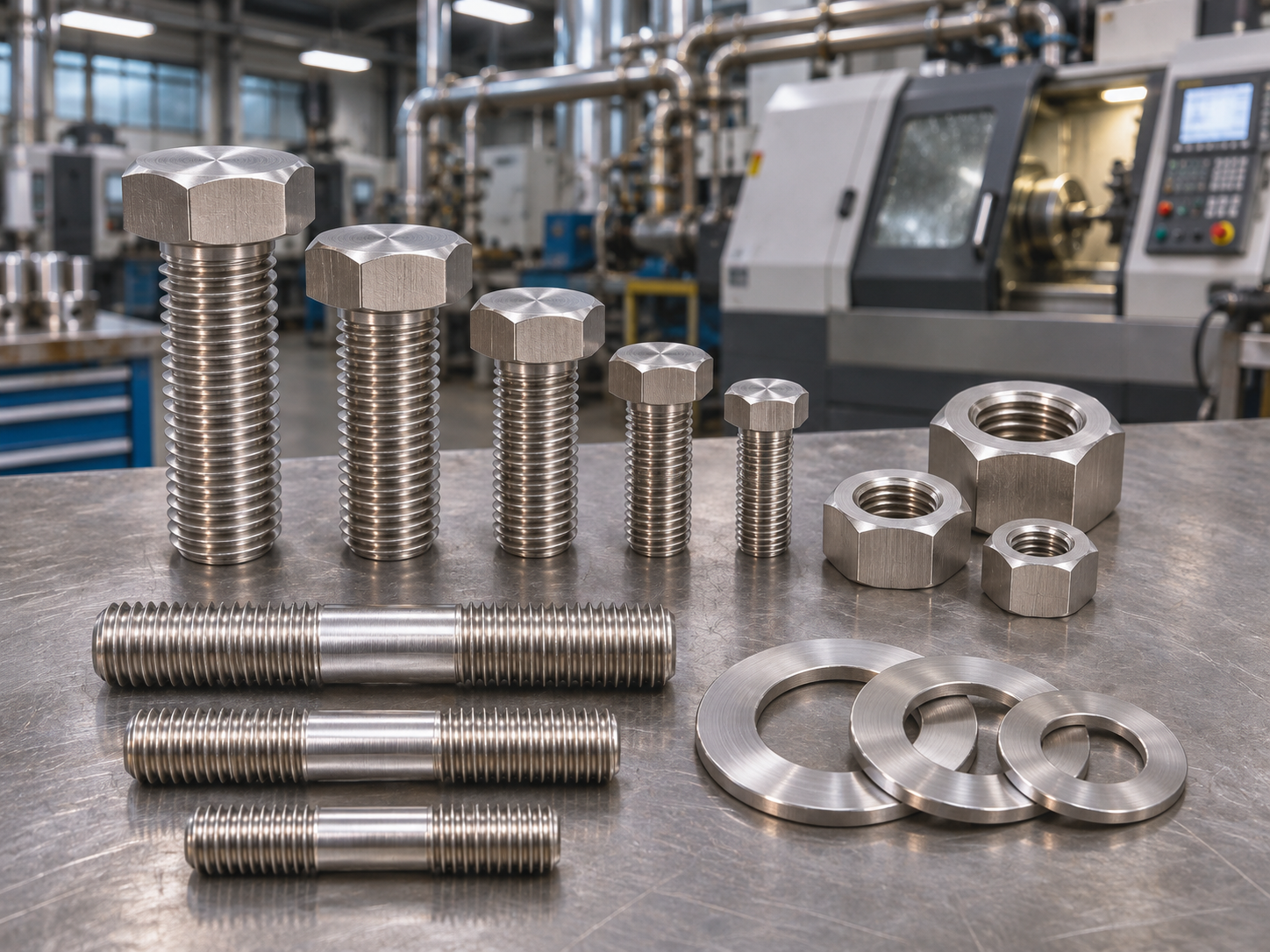
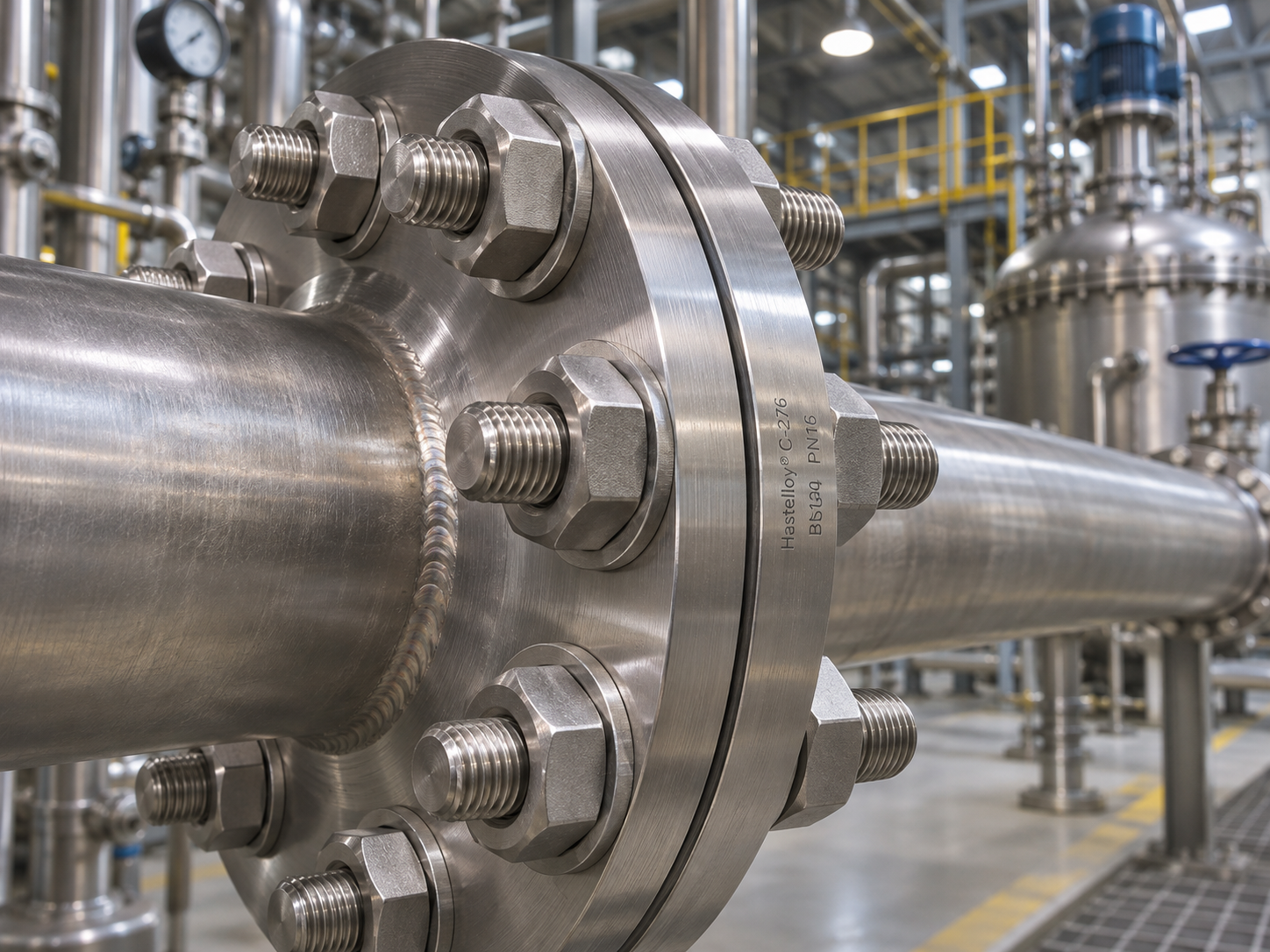
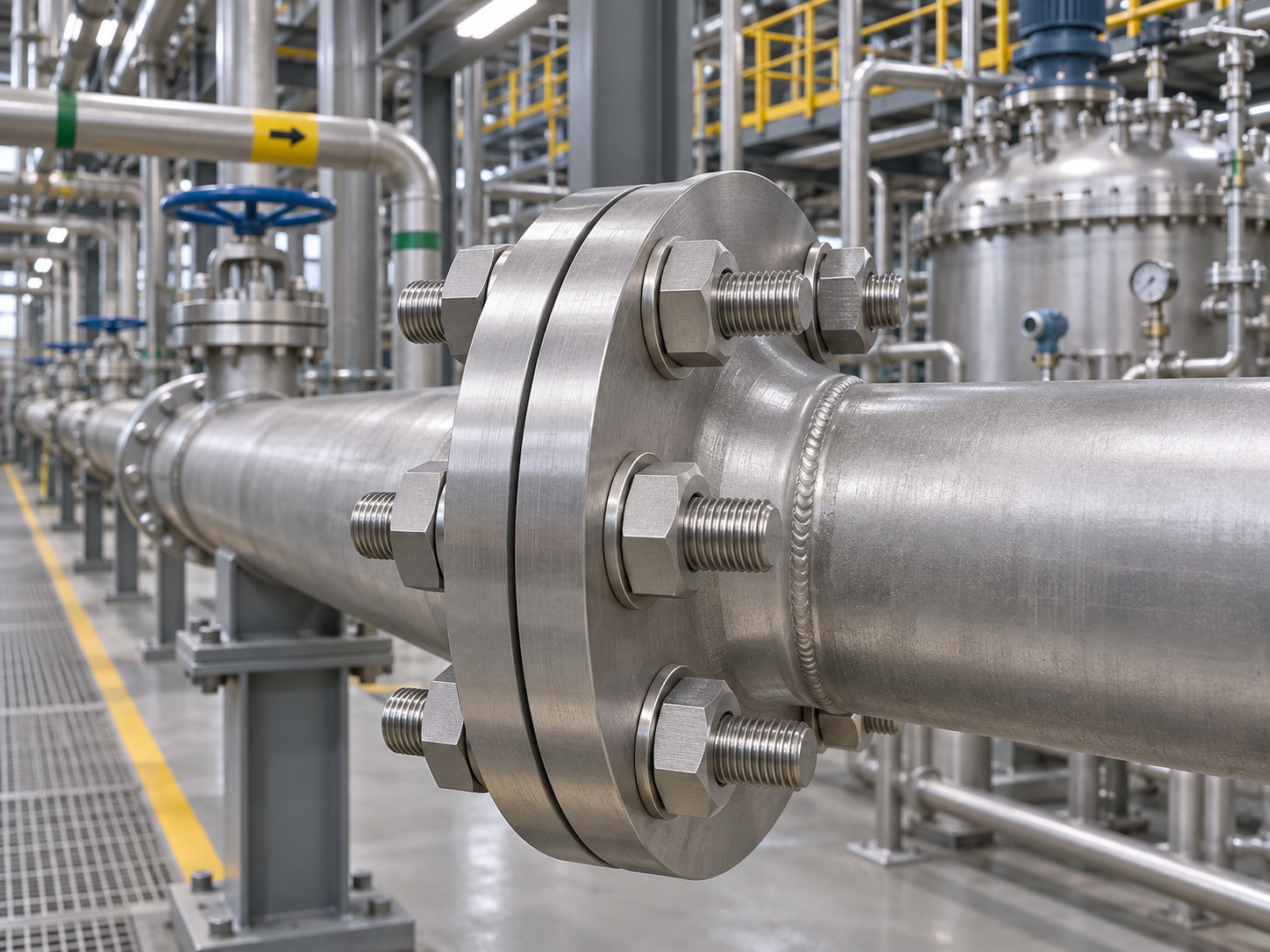
Piping flanges, valve bodies and pump casings in acid service rely on Hastelloy fasteners to maintain gasket compression while resisting crevice attack at the flange-to-gasket interface and under the washer face. C276 is the default for mixed-acid and chloride-bearing streams; C22 for oxidizing streams; B2/B3 for pure HCl. The fastener forms are typically heavy hex bolts and nuts, studs, and washers sized to distribute preload without over-stressing the flange face.
4. Oil and Gas: Sour Service and Refining
In oil and gas, Hastelloy fasteners are concentrated in wet sour gas service with chlorides, in refinery overhead systems, and in wellhead and manifold connections where a corrosion-related leak is unacceptable. C276 is the benchmark for sour service in the solution-annealed condition, compliant with NACE MR0175 / ISO 15156 at the applicable hardness limits.
4.1 Wellheads, X-mas trees and manifolds Oil & Gas
Wellhead flanges, Christmas tree connections and manifold bolting are high-consequence joints: they carry pressure and thermal cycling, and they are exposed to produced fluids on the bore side and to the marine or arid external environment. C276 fasteners are used in these locations where the fluid composition includes H₂S and chlorides. A gas processing facility handling highly corrosive wet H₂S and CO₂ required C276 fasteners for critical valve and piping connections with full NACE MR0175 compliance and documented zero corrosion-related failures.
4.2 Refinery overhead and petrochemical units
Refinery overhead systems and petrochemical units exposed to H₂S, chlorides and organic acids use C276 fasteners where the combination of reducing and oxidizing species exceeds the capability of stainless steels or lower-alloy nickel grades. The fastener is often a stud bolt or heavy hex bolt in a flange connection, and the selection is driven by the worst-case chemistry rather than the average. For strongly oxidizing refinery streams, C22 may be preferred.
5. Flue-Gas Desulfurization and Pollution Control
Flue-gas desulfurization (FGD) scrubbers are a defining Hastelloy application. Absorber internals, spray headers, mist eliminators, damper linkages and stack liners are exposed to acidic chloride slurries, wet chlorine and low-pH scrubber liquor — a combination that destroys stainless steels and demands a corrosion-first alloy. C276 is a benchmark for these locations because of its resistance to crevice corrosion under deposits and in threaded assemblies.
G30 is specifically used in FGD absorber towers, reheaters, dampers and stack liners where the scrubber liquor is low-pH and high-chloride. Experimental data show G30 corrosion rates below 0.02 mm/year in simulated flue gas containing 0.5% SO₂, 5% O₂ and saturated humidity. Fasteners in these systems are typically hex bolts, nuts and washers in C276 or G30 depending on the specific chloride and acid balance.
6. Aerospace, Gas Turbine and High-Temperature Service
Hastelloy X is the high-temperature member of the family, and its fastener applications are driven by oxidation resistance and strength at temperature rather than by chloride corrosion resistance. X fasteners are used in gas turbine combustion sections, transition ducts, combustor cans, flame holders, afterburner assemblies and industrial furnace fixtures. The alloy resists oxidation up to approximately 1200 °C in non-load-bearing service and maintains useful strength at 815 °C and above.
The boundary with C276 is important. C276 is limited to approximately 600 °C for continuous service under load; above that, creep and microstructural instability become limiting. For joints that require both high temperature and high strength above roughly 650 °C under load, a precipitation-hardened nickel alloy such as Inconel 718 is the appropriate step-up, or Hastelloy X where oxidation resistance is the dominant requirement and the load is moderate.
7. Pharmaceutical, Food Processing and Semiconductor
Pharmaceutical and food processing applications require fasteners that resist corrosion and do not contaminate the process stream. Hastelloy fasteners are used in high-purity reactors, piping systems and sterile equipment, with electropolished surfaces where hygiene standards demand it. C22 is often preferred in pharmaceutical reactors where oxidizing acids and solvent mixtures dominate.
In semiconductor and electronics manufacturing, Hastelloy fasteners appear in high-purity chemical delivery systems, etching equipment and CVD reaction chambers, where resistance to strong acids and ultra-pure media prevents metallic ion contamination of the process. The fastener’s contribution is not structural — it is contamination control.
8. Marine and Offshore Engineering
In marine and offshore environments, Hastelloy fasteners are used in seawater desalination plants, ship power systems and offshore platform equipment where resistance to seawater and chloride ion corrosion prevents stress-corrosion cracking. C276 offers excellent resistance to seawater pitting and crevice corrosion with a PREN of approximately 69, but for continuous seawater immersion, super-duplex stainless steels or AL6XN may offer a more cost-effective balance of performance and price. C276 is typically specified for seawater applications where chlorides are combined with elevated temperature or other aggressive species — for example, marine exhaust-scrubber wash-water systems where wet chlorine and hypochlorite may be present.
9. Engineering Constraints: Galling, Torque and Standards
Hastelloy fasteners have practical assembly characteristics that differ from carbon steel and stainless steel. These constraints must be engineered around, not discovered during commissioning.
9.1 Thread galling and seizure
Hastelloy threads gall more readily than carbon steel or standard 300-series stainless steel because the nickel-rich, solid-solution matrix can cold-weld under the pressure and friction of assembly. Anti-seize lubrication is mandatory for Hastelloy-to-Hastelloy assemblies. Molybdenum-disulfide (MoS₂) or PTFE-based compounds formulated for nickel alloys give the most consistent results. Rolled threads are preferred over cut threads for fatigue life and surface integrity, and controlled thread finish and assembly speed reduce the risk of cold welding. RAYCHIN can supply fasteners with pre-applied anti-seize coatings and provide torque recommendations based on the specified coating, thread condition and target preload.
9.2 Torque and preload
C276's moderate yield strength (283 MPa minimum per ASTM B574) limits the achievable preload compared with higher-strength nickel alloys. A lubricated M20 C276 bolt is typically tightened to approximately 170 Nm, and the nut factor K for well-lubricated Hastelloy threads with anti-seize falls in the range of 0.12–0.16, compared with 0.20–0.30 for dry or lightly oiled threads. Joint design must be checked against the proof load of the fastener, not simply the bolt's ultimate tensile strength.
9.3 Standards and specifications
Hastelloy fasteners are procured against a layered set of specifications: the raw-material standard, the finished-fastener standard, and application-specific compliance requirements. ASTM B574 controls the chemistry and properties of the bar from which fasteners are machined. ASTM F468 sets the mechanical property requirements for finished nonferrous bolts, hex cap screws and studs. A compliant purchase order typically references both: B574 for the input material and F468 for the finished fastener. For sour service, NACE MR0175 / ISO 15156 adds hardness and environmental limits. For North Sea projects, NORSOK M-650 qualification may be required.
10. RAYCHIN LIMITED: Full-Range Hastelloy Fastener Manufacturing
RAYCHIN LIMITED manufactures the complete Hastelloy fastener range — C276, C22, B2, B3, G30 and X — as a true manufacturer with CNC machining, solution annealing, thread rolling and final inspection controlled under one roof. The product portfolio covers hex bolts, heavy hex bolts, socket head cap screws, set screws, fully threaded and double-end studs, heavy hex nuts, lock nuts, flat and spring washers, threaded rod and custom CNC parts in metric and imperial sizes from M3 to M100 and 1/8″ to 4″.
Quality assurance is built around the traceability challenge that high-value nickel-alloy fasteners present. Every shipment includes EN 10204 Type 3.1 material certification as standard, with Type 3.2 available with third-party witness. Positive Material Identification (PMI) by optical emission spectrometry is performed on finished fasteners — not just the raw bar — closing the gap between mill heat chemistry and delivered part chemistry. Full mechanical test data covers tensile, yield, elongation and hardness. NACE MR0175 / ISO 15156 compliance documentation is supplied for sour service, and NORSOK M-650 qualification is available for North Sea projects.
RAYCHIN's metallurgists routinely assist clients in grade selection based on the full chemical profile, including trace oxidizing species that could accelerate corrosion in B-series alloys. The company serves customers on six continents with expedited delivery for project-based orders and ongoing MRO demand, and maintains strategic stocking of Hastelloy bar to respond to urgent outages.
11. Frequently Asked Questions
What is the difference between Hastelloy C276 and C22 fasteners?
C276 has higher molybdenum (15–17%) and tungsten (3–4.5%), giving it superior performance in reducing acids such as hydrochloric acid and contaminated sulphuric acid. C22 has higher chromium (20–22.5%), giving it better resistance in strongly oxidizing media such as nitric acid and ferric chloride. C276 is the default choice for mixed or variable chemistry; C22 is preferred where oxidizing conditions dominate, such as fertilizer production or pharmaceutical reactors with oxidizing acids.
When should Hastelloy B2 or B3 be used instead of C276?
B2 and B3 are nickel-molybdenum alloys optimised for pure reducing acids — hydrochloric, hydrobromic and sulphuric acid — at all concentrations and temperatures up to boiling. They outperform C276 in hot concentrated HCl without oxidizing contaminants. However, they are not suitable where even trace oxidizing species such as ferric or cupric ions are present, because those species accelerate corrosion. B3 is the third-generation Ni-Mo alloy with improved thermal stability and fabricability compared with B2.
What is Hastelloy G-30 used for in fasteners?
Hastelloy G-30 (UNS N06030) is a high-chromium nickel-iron-chromium-molybdenum-copper alloy designed for wet-process phosphoric acid and mixed oxidizing-reducing acid service. Fasteners are used in phosphoric acid plants, fertilizer production, flue-gas desulfurization scrubbers, pickling lines and nuclear fuel reprocessing. G-30 offers outstanding resistance to commercial wet-process phosphoric acid, which is one of the most complex and corrosive industrial chemicals.
Why is Hastelloy X used for aerospace fasteners?
Hastelloy X is a nickel-chromium-iron-molybdenum alloy designed for high-temperature oxidation resistance and strength. Fasteners are used in gas turbine combustion sections, transition ducts, combustor cans, flame holders, afterburner assemblies and industrial furnace fixtures. It resists oxidation up to approximately 1200 °C in non-load-bearing service and maintains useful strength at 815 °C and above, making it suitable where C276's 600 °C load-bearing ceiling is insufficient.
Are Hastelloy fasteners NACE MR0175 compliant for sour oil and gas service?
Hastelloy C276 and C22 are suitable for NACE MR0175 / ISO 15156 sour service in the solution-annealed condition. C276 is typically supplied at ≤100 HRB (well below the 35 HRC limit). RAYCHIN supplies NACE compliance documentation including hardness verification and EN 10204 3.1 material certification. Fasteners for sour service should always be ordered with the NACE condition explicitly stated on the purchase order.
Can RAYCHIN supply the full Hastelloy fastener range?
Yes. RAYCHIN LIMITED manufactures Hastelloy C276, C22, B2, B3, G30 and X bolts, nuts, screws, studs and washers in metric and imperial sizes. Products include hex bolts, heavy hex bolts, socket head cap screws, set screws, fully threaded and double-end studs, heavy hex nuts, lock nuts, flat and spring washers, threaded rod and custom CNC parts. Certification includes EN 10204 3.1 as standard, 3.2 with third-party witness, finished-part PMI by OES, and NACE MR0175 documentation.
Select the Right Hastelloy Grade for Your Bolted Joint
Send your process chemistry, temperature, pressure, load and certification requirements to RAYCHIN LIMITED. Our metallurgists will confirm the grade selection, condition, galling-control measures, torque guidance and documentation package for your specific application.