
MP35N Fasteners in Aerospace: Bolts, Nuts, Screws, Studs and Washers
MP35N is the alloy aerospace engineers specify when a bolted joint must survive the combination of ultra-high strength, aggressive corrosion and fatigue loading that conventional high-strength fasteners cannot tolerate. This guide examines the metallurgical logic behind MP35N fasteners, the specifications that govern them, and the specific aerospace applications — from landing gear and turbine engines to launch-vehicle hardware — where they are used.
1. Why MP35N Exists in the Aerospace Fastener Landscape
Aerospace bolted joints are rarely limited by a single property. A landing-gear fastener must carry very high shear and tensile loads, resist seawater and de-icing chemistry, tolerate repeated load cycles without fatigue cracking, and remain non-magnetic for certain instrument and sensor-adjacent locations. A turbine-engine fastener adds elevated-temperature exposure and vibration. A spacecraft fastener adds vacuum, cryogenic cycling and hydrogen-rich propulsion environments.
MP35N was developed specifically for this multi-constraint space. It is a cobalt–nickel–chromium–molybdenum multiphase alloy — nominally 33–37% Ni, balance Co, 19–21% Cr and 9–10.5% Mo — that achieves its strength not primarily through conventional precipitation hardening, but through a combination of cold work and aging. The face-centred-cubic Co–Ni matrix, with Cr and Mo in solution, persists to room temperature and below; controlled cold reduction followed by aging at roughly 538–649 °C activates the strengthening response while preserving ductility and toughness[reference:0].
The practical consequence for fastener design is a strength–ductility–corrosion combination that is difficult to match. MP35N fasteners routinely reach 260–300 ksi ultimate tensile strength (approximately 1790–2070 MPa), remain ductile enough for thread rolling and installation, and resist stress-corrosion cracking and hydrogen embrittlement at those strength levels. For aerospace engineers, that means smaller fastener envelopes, higher preload capability and greater environmental margin in the same joint.
2. Metallurgy and Strengthening: What the Fastener Manufacturer Controls
Understanding how MP35N is strengthened explains why fastener processing route and condition selection matter as much as the raw material certificate. The alloy is typically vacuum induction melted followed by vacuum arc remelting (VIM-VAR), giving tight chemistry and ingot soundness control. The subsequent thermomechanical path determines the final fastener properties.
2.1 Cold work plus aging — not a conventional precipitation reaction
MP35N derives its ultra-high strength from the interaction of cold deformation and a low-temperature aging treatment. The cold work creates a high density of crystallographic defects and conditions the microstructure; aging then promotes the fine-scale multiphase reaction responsible for strengthening. The amount of cold reduction and the aging temperature are the two primary levers. For AMS 5844/5845 full-strength material, a typical aging treatment is approximately 566 °C for 4 hours. Over-aging or exposure above the recommended aging range can revert the cold-worked structure and cause a significant, non-reversible loss of strength — a critical consideration for fastener manufacturers who must control heat-treat furnaces and machining sequences precisely.
2.2 Property ranges relevant to fastener design
Values are typical for bar and are shown for engineering orientation. Fastener procurement must be based on the governing AMS, AS, ASTM or customer specification and the applicable lot-certified mechanical test reports.
The AMS 5844 route is often preferred when the final aging treatment would make the material too difficult to machine economically. The fastener is machined in the cold-worked condition and then aged to final strength. AMS 5845 material arrives already aged, simplifying the fastener manufacturer’s process flow but requiring tighter control of machining parameters on harder stock. Both routes are standard in the RAYCHIN MP35N fastener portfolio, alongside AMS 5758 and ASTM F562.
3. Governing Specifications for MP35N Aerospace Fasteners
Aerospace procurement is specification-driven. For MP35N fasteners, the relevant documents fall into material specifications, fastener procurement specifications and application-specific standards.
3.1 Material and procurement specifications
- AMS 5844 — solution heat treated and cold-worked bar, intended for parts that will be aged after machining. Provides the condition-and-capability route for complex fastener geometries.
- AMS 5845 — solution heat treated, cold drawn and aged bar. Fully aged input stock for fastener machining without a subsequent aging operation.
- AMS 5758 — another MP35N material specification referenced in fastener and wire product forms.
- SAE AS7468 — the aerospace procurement specification for MP35N bolts at a 260 ksi tensile strength level: “Bolts, Cobalt-Chromium-Nickel Alloy, UNS R30035, Tensile Strength 260 ksi”. This is the key document linking material capability to a finished bolt procurement requirement.
- ASTM F562 — the standard specification covering MP35N/UNS R30035 wrought forms, widely referenced across aerospace and medical fastener supply chains.
- NACE MR0175 / ISO 15156 — relevant where aerospace-adjacent or dual-use fasteners encounter sour service or chloride environments; defines the reduced-strength, hardness-controlled condition for maximum sulfide stress-cracking resistance.
3.2 Fastener standards and configurations
MP35N fasteners are manufactured to the same dimensional and thread standards as other aerospace fasteners, with the alloy specified separately. RAYCHIN manufactures MP35N screws to NAS, AN, MS, ANSI, ASTM, ASME, SAE, API, ISO and DIN standards, including ISO 4762 / ASME B18.3 socket head cap screws, ISO 4014 / DIN 933 hex head screws and a range of pan, flat, button-head and set configurations. For aerospace joints, the relevant head-style and thread decisions usually follow the airframe or engine OEM’s fastener standard, while the MP35N material callout is attached via the procurement specification.
4. Aerospace Applications by Fastener Type and Airframe Zone
MP35N’s application profile in aerospace is not uniform across the airframe. It concentrates where the joint is simultaneously strength-critical, corrosion-exposed and fatigue-loaded. The following sections map the principal applications to the fastener forms most commonly used.
4.1 Landing gear and actuation: bolts, nuts and studs
Aircraft landing gear is a canonical MP35N application. The joint must carry high static and dynamic loads, survive repeated seawater and runway de-icing chemical exposure, and resist stress-corrosion cracking in a high-strength condition. MP35N bolts and nuts are used in landing-gear structural joints, actuation attachments and related high-load fittings. The alloy’s combination of 260+ ksi strength and excellent stress-corrosion resistance allows a smaller fastener or a higher preload margin compared with lower-strength corrosion-resistant alloys. Studs and threaded rod in MP35N are used where a continuous threaded member is required through a landing-gear fitting or actuator clevis.
4.2 Gas turbine engines: bolts, screws and washers
In turbine engines, MP35N fasteners appear in compressor and engine-structure joints and in other locations where moderate elevated temperature combines with vibration and corrosive media. MP35N was developed with a 750 °F (≈400 °C) capability, and it retains useful strength and oxidation/sulfidation resistance in that range. Engine fasteners often use MP35N socket-head or hex-head screws and bolts in smaller thread sizes, with washers selected to manage bearing stress and galvanic separation. The alloy’s non-magnetic nature is also relevant for engine and accessory locations where magnetic interference must be avoided.
4.3 Spacecraft, launch vehicles and propulsion: the Space Shuttle precedent
The largest single application of MP35N fasteners has been in the Space Shuttle, where MP35N and Inconel 718 fasteners were used together across the vehicle. MP35N fasteners have also been used in launch-vehicle and propulsion-system hardware, including joints exposed to cryogenic propellants and hydrogen-bearing environments. MP35N can be used at cryogenic temperatures without embrittlement, and its resistance to hydrogen embrittlement at high strength levels is a specific advantage in propulsion and pressurant-system joints. Screws and bolts in MP35N are also used in satellite and instrument structures where non-magnetic behaviour and vacuum compatibility are required.
4.4 Airframe structural joints: bolts, nuts and washers
MP35N high-strength fasteners are used in airframe components and structural joints where corrosion-resistant steel or titanium fasteners would be marginal on strength or fatigue. The fastener is typically a tension bolt or shear bolt with a matching nut and washer. In airframe joints, the washer material and coating must be selected with the same galvanic care as the bolt itself, particularly where the mating structure is aluminum.
4.5 Missile and defense hardware
MP35N has been selected for missile canister and launcher hardware following comparative corrosion and stress-corrosion-cracking testing against PH13-8Mo, and appears in defense and space-exploration supply chains alongside aerospace applications. Fasteners in these applications benefit from the alloy’s seawater resistance, non-magnetic behaviour and high strength-to-section ratio.
5. Engineering Constraints Aerospace Designers Must Manage
No fastener alloy is unconditionally superior. MP35N’s advantages come with specific engineering constraints that should be designed around, not discovered during qualification.
5.1 Galvanic compatibility: titanium is favourable, aluminum requires protection
MP35N is a very noble alloy, similar in electrochemical character to titanium. This is advantageous when MP35N fasteners are used in titanium structures or with HY-130 steel: MP35N is considered galvanically compatible with Ti-6Al-4V and HY-130. In exposure testing, MP35N and titanium bolts were the only fasteners that remained unaffected in certain marine-atmosphere panel tests.
The situation changes with aluminum. MP35N coupled to aluminum alloys such as 7075-T6 can promote galvanic corrosion of the aluminum because MP35N is strongly cathodic to it. Aerospace practice therefore commonly specifies cadmium plating or an equivalent active coating on MP35N fasteners where they contact aluminum structure, together with sealants and joint-design measures to exclude electrolyte. Designers should also note that MP35N has poor galvanic compatibility with alloy K-500, 316 stainless steel and carbon steel in some environments, and should not be coupled to these materials without protection or separation.
5.2 Fatigue and stress-corrosion cracking
MP35N is noted for high fatigue strength among corrosion-resistant fastener alloys, and its stress-corrosion-cracking resistance in chloride environments is a principal reason for its selection in landing gear and marine-exposed airframe joints. In comparative SCC rankings for aerospace bolting materials in acidified NaCl, MP35N performs strongly; no SCC was observed under freely corroding conditions in the referenced test series. However, fatigue and SCC performance are joint-specific: surface condition, thread root geometry, coating, preload and the compliance of the mating structure all influence the outcome. Fastener procurement should therefore specify the required fatigue and SCC test evidence for the application, not rely solely on handbook values.
5.3 Temperature capability and its boundary
MP35N maintains useful properties up to approximately 600–800 °F depending on condition and exposure duration, with a commonly quoted service ceiling in the 750 °F class for fastener applications. It is not a substitute for nickel-based superalloys such as Inconel 718 at higher temperatures: Inconel 718 was developed for applications up to 1200 °F, and its creep-rupture capability is superior at elevated temperature. The trade-off is that MP35N offers higher room-temperature strength and superior corrosion resistance in many chloride and seawater environments, at significantly higher cost due to its cobalt content. The correct aerospace decision is therefore application-specific: MP35N for strength-plus-corrosion-dominated joints; Inconel 718 for elevated-temperature-dominated joints.
Where MP35N is the stronger choice
- Seawater or chloride exposure with high static strength
- Landing gear and actuation joints
- Hydrogen-bearing propulsion environments
- Non-magnetic fastener requirements
- Cryogenic-to-moderate-temperature cycling
Where Inconel 718 or another alloy is indicated
- Sustained service above roughly 1200 °F
- Creep-rupture-dominated engine hot-section joints
- Cost-sensitive joints not requiring MP35N’s corrosion margin
- Joints where MP35N’s galvanic couple to the structure is unfavourable
6. RAYCHIN LIMITED: MP35N Fastener Manufacturing and Supply
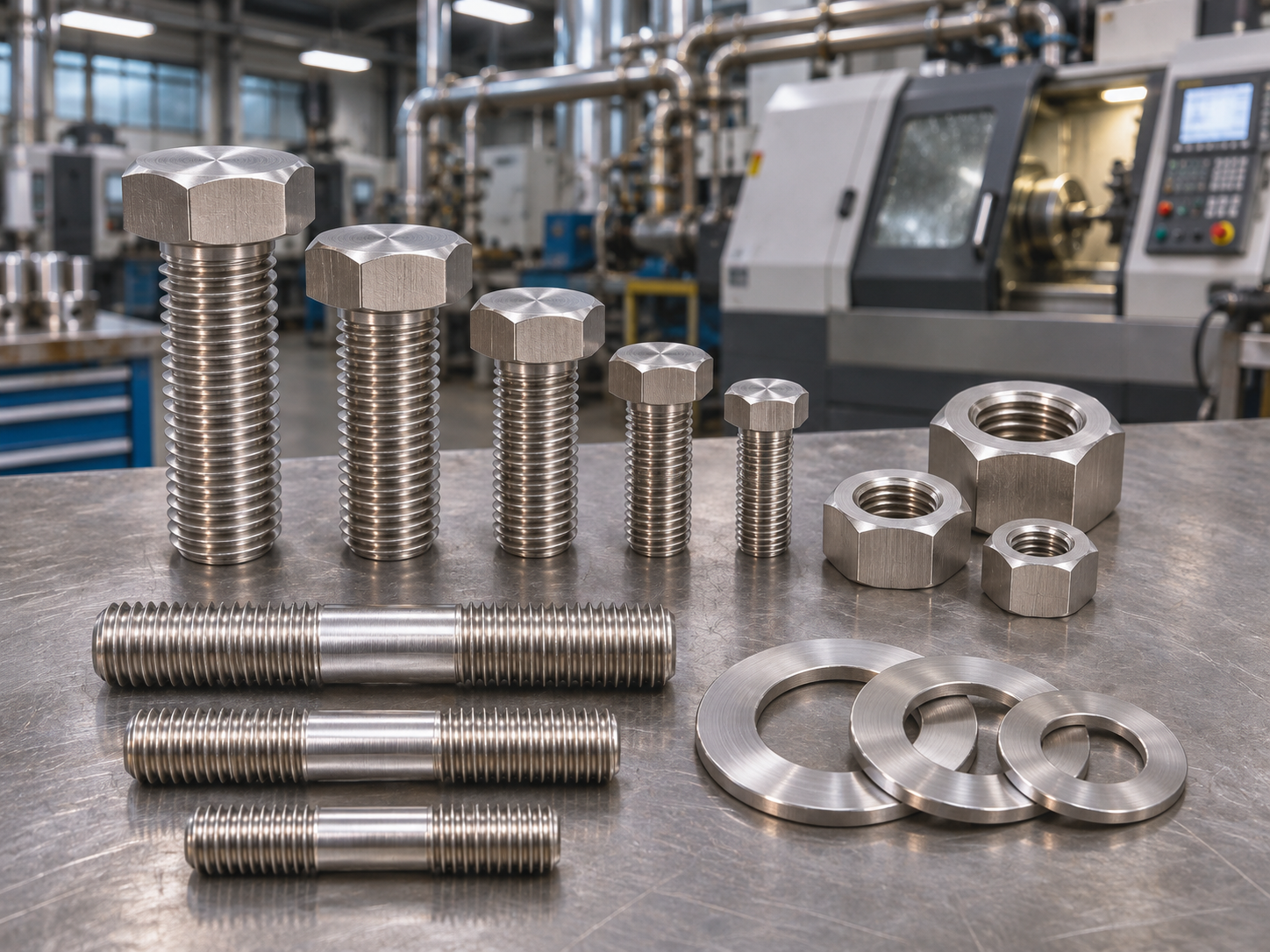
RAYCHIN LIMITED is a manufacturer and global supplier of special alloy fasteners, with MP35N as a core aerospace alloy in its product portfolio. The company manufactures MP35N bolts, nuts, screws, studs and washers in standard and custom configurations, in inch and metric threads, and in small-batch and large-batch quantities.
For aerospace customers, the relevant capability is not simply machining MP35N, but controlling the condition-specific process route. RAYCHIN supplies MP35N fasteners to AMS 5844, AMS 5845, AMS 5758, ASTM F562 and NACE MR0175 requirements, and manufactures to NAS, AN, MS, ASME, SAE, ISO and DIN dimensional standards. Through precise cold working and age hardening, MP35N fasteners achieve ultimate tensile strength up to 300 ksi (≈2070 MPa) while maintaining ductility and toughness. Material certification, mechanical test reports and full traceability are available with each lot.
The RAYCHIN MP35N fastener range includes socket head cap screws, hex head screws, pan head, flat head and button head screws, set screws and machine screws, as well as matching nuts, studs and washers. For aerospace programs requiring AS7468 bolts at the 260 ksi level, RAYCHIN can align manufacturing and testing to the governing procurement specification rather than supplying only to a generic material callout.
7. Frequently Asked Questions
What is the difference between AMS 5844 and AMS 5845 for MP35N fasteners?
AMS 5844 supplies MP35N in the solution-treated and cold-worked condition. The fastener is machined in this condition and then aged after machining to reach final strength. AMS 5845 is supplied already aged, so the fastener manufacturer does not need to perform a separate aging operation. AMS 5844 is often chosen when the final aging treatment would make the material too difficult to machine economically, while AMS 5845 simplifies process flow but requires tighter machining control on harder stock.
What tensile strength can MP35N aerospace fasteners achieve?
Through cold working plus aging, MP35N fasteners can reach ultimate tensile strengths of approximately 260–300 ksi (1790–2070 MPa). AMS 5845 sets a minimum UTS of 260 ksi and minimum 0.2% yield strength of 230 ksi. AMS 5844 sets a minimum UTS of 255 ksi and minimum yield of 225 ksi. SAE AS7468 is the procurement specification for MP35N bolts at the 260 ksi tensile level.
Where are MP35N fasteners used on aircraft and spacecraft?
MP35N fasteners are used in gas turbine engines, airframe structural joints, aircraft landing gear and actuation, spacecraft and launch-vehicle hardware, and other high-stress joints exposed to seawater, chloride or hydrogen-bearing environments. The alloy was used extensively on the Space Shuttle, including in combination with Inconel 718 fasteners, and in propulsion-system and cryogenic hardware.
Is MP35N galvanically compatible with titanium and aluminum in aerospace joints?
MP35N is galvanically compatible with titanium alloys such as Ti-6Al-4V and with HY-130 steel. When MP35N fasteners are used against aluminum structures, galvanic corrosion of the aluminum is a risk because MP35N is a very noble alloy. Cadmium plating or an equivalent active coating, together with sealants and proper joint design, is commonly specified to protect aluminum where MP35N fasteners are used.
Can RAYCHIN supply MP35N bolts, nuts, screws, studs and washers to aerospace specifications?
Yes. RAYCHIN LIMITED manufactures MP35N fasteners to AMS 5844, AMS 5845, AMS 5758, ASTM F562, NACE MR0175 and related aerospace procurement specifications. The product range includes bolts, nuts, screws, studs and washers, in standard and custom configurations, in inch and metric threads, with full material traceability and certification packages available on request.
Request an MP35N Aerospace Fastener Quote
Send your drawing, material specification (AMS 5844 / AMS 5845 / AS7468 / ASTM F562) and quantity requirements to RAYCHIN LIMITED. Our engineering and production team will confirm condition route, dimensional standard, test certification and lead time.