
Categories List
Recent Posts
 A286 Fasteners in Oil & Gas and Offshore Engineering: The Economic Sweet Spot Between Stainless Steel and Nickel-Base Superalloys
 A286 Fasteners in Aviation MRO and NAS/MS Standard Parts: The Alloy Behind the Dash Number
 A286 Fasteners in Automotive Exhaust and Turbocharger Systems: Why the Alloy Choice Beats the Grade Upgrade
A286 Fasteners in Automotive Exhaust and Turbocharger Systems: Why the Alloy Choice Beats the Grade Upgrade
Bolts · Studs · Screws · Nuts · Washers · V-band T-bolts | Exhaust Manifolds · Turbocharger Mounting · EGR · Catalytic Converter Connections | AMS 5731 / 5732 / 5737 · SAE AS4108 | Manufactured by RAYCHIN LIMITED
The most common response to a broken exhaust manifold stud is to specify a higher-grade fastener. Grade 8.8 to 10.9, or 10.9 to 12.9. The logic seems sound: a stronger bolt should last longer. But in an exhaust system, the failure is rarely a strength problem in the conventional sense — it is a **thermal ceiling problem**. A Grade 10.9 carbon alloy bolt at 600°C retains roughly **24% of its room-temperature yield strength**, because its tempering temperature (370–425°C) has been exceeded and the microstructure has softened. Upgrading within the same alloy family does not raise that ceiling. A286 (UNS S66286 / ASTM A453 Grade 660) is the iron–nickel–chromium precipitation-hardening superalloy that raises the ceiling to approximately 650°C fastener metal temperature, with good oxidation resistance to 816°C and useful strength retention through the exhaust manifold and EGR range. This article examines, location by location, where A286 fasteners are specified in automotive exhaust and turbocharger systems, what each joint demands, where A286 stops being sufficient, and how RAYCHIN LIMITED manufactures and certifies these fasteners for automotive and industrial exhaust customers.
1. The Three Mechanisms That Break Exhaust Fasteners — and Why A286 Addresses Them
Exhaust fastener failures are usually attributed to “vibration,” but the evidence points elsewhere. Three mechanisms dominate, and they interact.
Thermal softening of carbon alloy fasteners
Grade 8.8 and 10.9 fasteners derive their strength from quench-and-temper heat treatment. Once the fastener metal temperature approaches or exceeds the tempering temperature, the microstructure softens and yield strength drops. The data is stark: Grade 10.9 retains about 56% of room-temperature yield at 500°C and roughly 24% at 600°C. In turbocharged exhaust manifolds, 500–600°C at the fastener is normal operating territory, not an edge case.
Stress relaxation and clamp-load loss
Even below the thermal ceiling, a fastener under sustained load at temperature creeps — it slowly and permanently elongates, bleeding off clamp load without any nut rotation. The joint comes loose without visible evidence. This is the mechanism most commonly misattributed to vibration. A locking feature cannot fix it; only a material with better creep and relaxation resistance can.
Galling at the thread interface
At elevated temperature, lubrication burns off and oxidation changes surface characteristics with every thermal cycle. Thread surfaces cold-weld and tear during disassembly, producing seized or snapped fasteners. A286’s austenitic matrix is less prone to galling than many high-strength steels, and anti-seize coatings (MoS₂, silver) are commonly specified to further reduce risk.
A286 addresses all three because its strengthening mechanism is precipitation hardening via gamma-prime (Ni₃(Al,Ti)) in an austenitic iron–nickel–chromium matrix — not quench-and-temper. The γ′ precipitate remains effective through the exhaust temperature band, and the austenitic matrix provides the corrosion resistance and galling behavior that carbon alloy and martensitic stainless fasteners lack. The typical aged mechanical properties are UTS ≥ 895 MPa, yield ≥ 585 MPa, hardness 24–37 HRC, with service capability to approximately 650°C and oxidation resistance to 816°C.
2. Where A286 Fasteners Are Specified in Exhaust and Turbo Systems — A Location-by-Location Breakdown
A286 is not the right answer for every joint in the exhaust system. The selection depends on confirmed fastener metal temperature — measured or modeled at the shank, not inferred from exhaust gas or surface temperature — and on whether the joint must resist vibration-driven loosening in addition to heat. The applications below cover the principal automotive and industrial exhaust uses.
450–600°C Exhaust Manifold Studs and Bolts
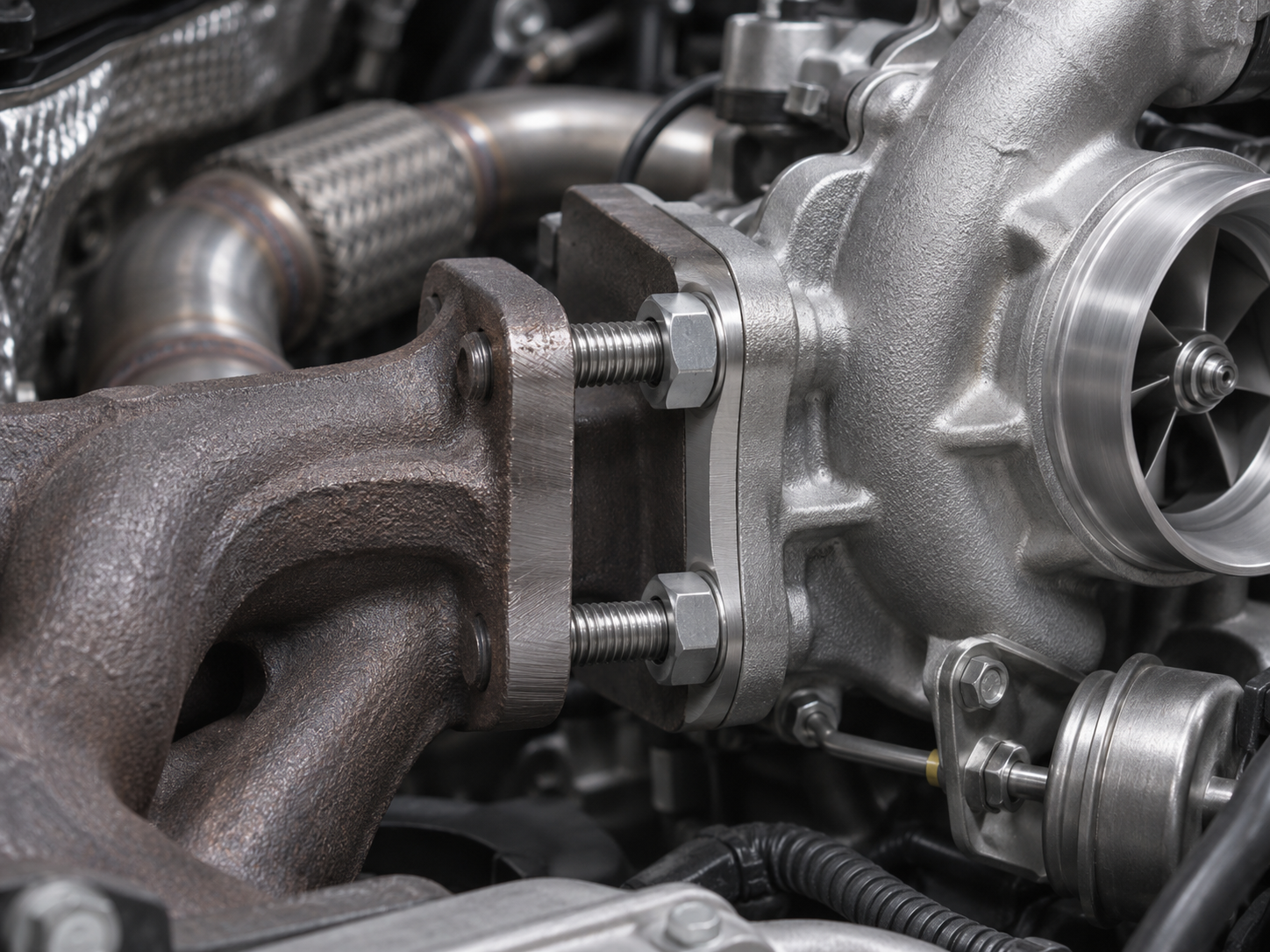
The exhaust manifold is the defining A286 application. On a naturally aspirated engine, fastener metal temperatures may sit up to roughly 500°C; on a turbocharged engine, they commonly run 450–600°C[reference:8]. This is precisely the band where carbon alloy fasteners have already lost most of their room-temperature strength and where A286 retains meaningful clamp load. A286 studs and bolts are the standard choice for exhaust manifold and EGR service up to approximately 650°C fastener metal temperature.
The joint is also cyclic: the manifold expands against the cylinder head on every heat-up and contracts on cool-down. If preload is lost, the gasket unseats and exhaust gas escapes — producing the cold-start “tick” that disappears as the system warms, or carbon tracking at the manifold face. A286’s creep and relaxation resistance keeps the joint tight through these cycles, and its corrosion resistance supports harsh under-hood environments where road salt and moisture are present. RAYCHIN manufactures A286 double-end studs, hex bolts and matched nuts for manifold applications in metric and inch sizes, with anti-seize coatings available for galling control.
500–700°C Turbocharger Mounting Hardware and Housing Fasteners
Turbocharger mounting hardware sits at the upper boundary of the A286 range and sometimes beyond it. The fastener metal temperature depends on the mounting location and the thermal path from the turbine housing: 500–700°C is the relevant band, and the joint combines high temperature with high-cycle vibration and elevated load requirements. A286 is used for turbocharger-adjacent joints, compressor and turbine housing bolting, and actuator mounts where the temperature stays within its ceiling. Socket-head cap screws are common in space-constrained locations such as turbocharger actuator mounts and EGR valve attachments.
Where the confirmed temperature approaches or exceeds 650°C, or where the combination of temperature and high-cycle fatigue exceeds A286’s capability, Inconel 718 is the appropriate upgrade — it retains useful strength to approximately 700–980°C depending on the property in question, and offers higher fatigue resistance in the overlapping temperature range. This is the correct direction for a material upgrade: change the alloy family, not the grade within the same family. RAYCHIN manufactures both A286 and Inconel 718 fasteners in-house, and can support the selection decision with application-specific data rather than a generic datasheet comparison.
V-band & clamps V-Band Couplings and T-Bolt Clamps
V-band clamps and T-bolt couplings are used to join exhaust system sections, turbocharger downpipes and aftertreatment components. The fastener form here is not a conventional bolt or stud but a T-bolt or eye bolt that tensions the clamp band. This is a distinct A286 application with its own aerospace-derived standard: SAE AS4108 defines the requirements for A286 CRES T-bolts and eye bolts, with room-temperature tensile strength of at least 160,000 psi, for use with clamps and V-band couplings at 1000°F (538°C) maximum ambient temperature.
The AS4108 scope is a useful reality check: V-band hardware is fatigue-rated and temperature-qualified as a system, and the A286 T-bolt is the standard hardware that meets that qualification. For automotive exhaust and turbo downpipe joints, this translates into a fastener that resists vibration-driven loosening and maintains clamp load through thermal cycling at the clamp band. RAYCHIN manufactures A286 T-bolts and eye bolts to AS4108, as well as custom V-band fastener configurations to customer drawings.
400–600°C EGR Systems and Catalytic Converter Connections
Exhaust gas recirculation (EGR) system fasteners see a wide thermal cycling range — 400–600°C — and must be validated for stress relaxation under the actual duty cycle[reference:18]. A286 is the standard choice for EGR valve attachments, EGR cooler connections and associated flanged joints, where carbon alloy fasteners soften and standard stainless fasteners lack the creep resistance. The manifold-to-catalytic-converter connection typically runs 400–550°C and is often a dissimilar-metal joint; the coefficient-of-thermal-expansion mismatch between the fastener and the adjacent casting or stainless component can affect clamp-load retention, so the joint should be reviewed as a system rather than as an isolated bolt.
3. A286 Versus the Alternatives: Grade 10.9, Inconel 718 and Nimonic 80A
A286 is best understood not as “the best high-temperature fastener” but as the cost-effective engineering default for the 650°C band. Above that band, different alloys take over.
4. What Automotive-Grade A286 Fasteners Require — and How RAYCHIN Delivers
A286 is more forgiving to forge and machine than nickel-base superalloys, but it is not a commodity stainless. The alloy is solution-treated and precipitation-hardened, and the aging response and thread-rolling sequence affect the final property balance. A fastener that meets chemistry but is improperly aged may not achieve the required elevated-temperature strength or relaxation resistance.
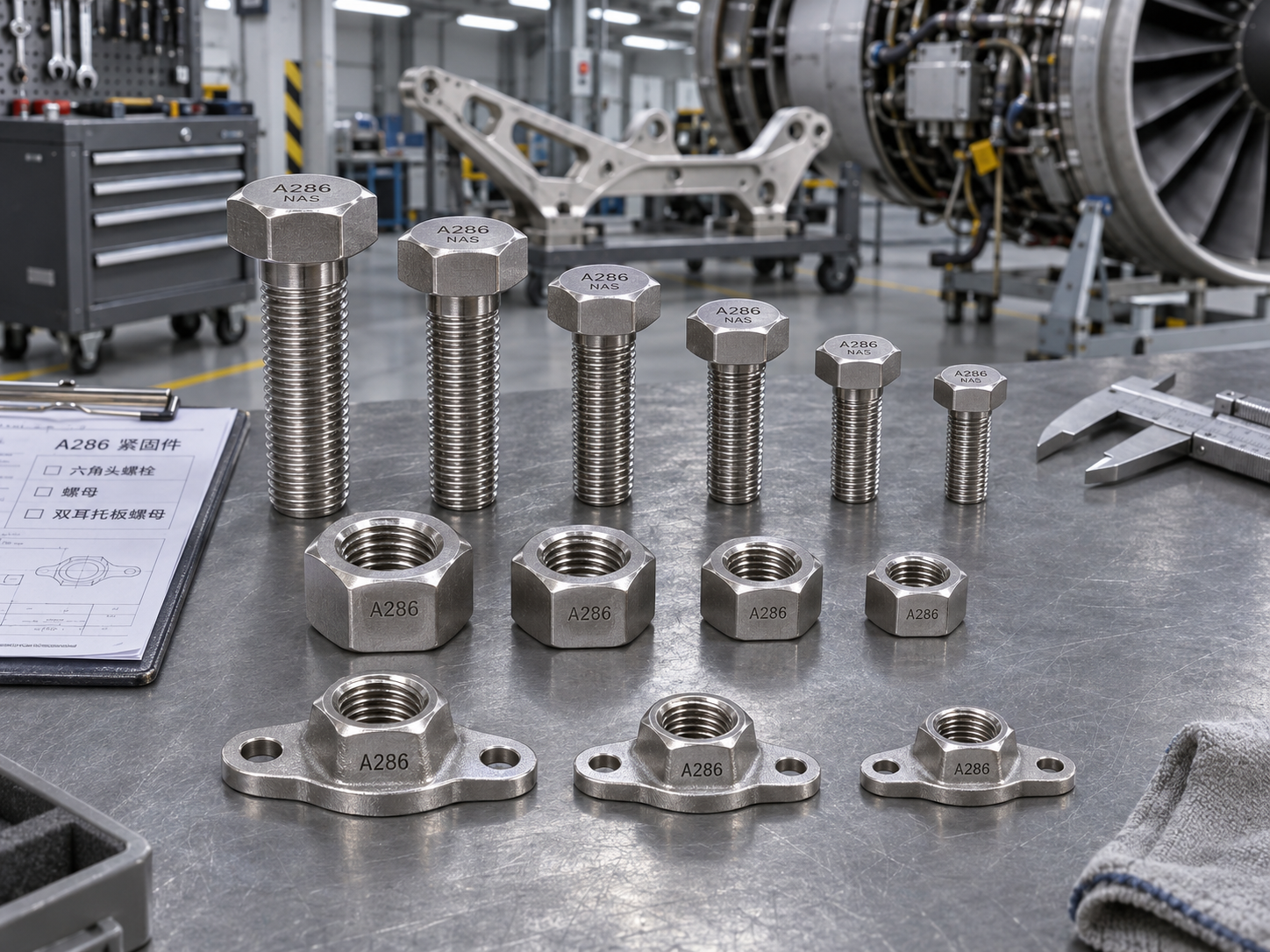
RAYCHIN LIMITED manufactures A286 fasteners with controlled solution treatment, vacuum aging and rolled threads in-house. The product scope covers the forms that exhaust and turbocharger joints actually use:
- Studs: double-end and fully threaded studs, 1/4″–2-1/2″ / M6–M64, to ASME B16.5, DIN 976 or customer drawings.
- Bolts: hex head to ASME B18.2.1 / DIN 931/933 / ISO 4014, 1/4″–2″ / M6–M48, including partial and full thread.
- Socket-head cap screws: ASME B18.3, #4–1″ / M3–M24, for turbocharger actuator mounts and confined hot-zone attachments.
- Nuts and washers: matched-grade heavy hex and standard nuts; flat washers for load distribution.
- T-bolts and eye bolts: A286 CRES to SAE AS4108 for V-band clamps and couplings at up to 1000°F ambient.
Material is certified to AMS 5731 / 5732 / 5737, ASTM A453 Grade 660 and UNS S66286, with EN 10204 3.1 / 3.2 certification, lot mechanical data and full heat traceability. Anti-seize coatings (MoS₂ or silver) are available pre-applied for galling-free assembly and disassembly. For automotive and industrial exhaust programs, RAYCHIN supports both standard catalog configurations and custom geometries to OEM drawings.
Frequently Asked Questions
Why do exhaust manifold bolts break, and how does A286 fix it?
Most exhaust manifold bolt failures are not vibration failures in the conventional sense. Grade 8.8/10.9 carbon alloy fasteners lose strength when their tempering temperature (370–425°C) is exceeded; at 600°C a Grade 10.9 bolt retains roughly 24% of its room-temperature yield strength, and the joint loses clamp load through thermal softening and stress relaxation. A286 retains useful strength and creep resistance to approximately 650°C, so it maintains clamp load in the exhaust manifold temperature band where carbon alloy fasteners have already failed.
Does upgrading from Grade 10.9 to 12.9 solve the problem?
No. Grade 10.9 and 12.9 share the same quench-and-temper strengthening mechanism and the same approximate thermal ceiling. A higher-strength carbon alloy bolt at 600°C still loses more than 75% of its yield strength. If the failure is thermal in origin, the fix is to change the alloy family — to A286 or a nickel-base alloy — not the grade within the carbon alloy family.
What is the maximum temperature for A286 exhaust fasteners?
A286 fasteners are typically rated for service to approximately 650°C fastener metal temperature, with oxidation resistance to about 816°C. The practical ceiling depends on load, environment and duty cycle. For joints approaching or exceeding 650°C, Inconel 718 (to ~700–980°C depending on property) or Nimonic 80A (to ~815°C) may be required.
Which standards cover A286 automotive and exhaust fasteners?
Material specifications include AMS 5731, AMS 5732 and AMS 5737, plus ASTM A453 Grade 660 and UNS S66286; the European equivalent is DIN EN 10269 1.4980, and the Japanese designation is SUH660. V-band T-bolts and eye bolts are covered by SAE AS4108 for service at up to 1000°F ambient.
Source A286 Exhaust and Turbocharger Fasteners from a Manufacturer, Not a Distributor
RAYCHIN LIMITED manufactures A286 studs, bolts, socket-head cap screws, nuts, washers and V-band T-bolts to AMS 5731/5732/5737, ASTM A453 Grade 660 and SAE AS4108 — with in-house solution treatment, vacuum aging, rolled threads and full EN 10204 3.1 / 3.2 certification. Factory-direct pricing for automotive and industrial exhaust programs.
Send your exhaust joint specification, operating temperature or drawing for a material review and quotation within 24 hours.
Request A Quote! We'll respond as soon as possible(within 12 hours)
Get a Quote