
Categories List
Recent Posts
 A286 Fasteners in Oil & Gas and Offshore Engineering: The Economic Sweet Spot Between Stainless Steel and Nickel-Base Superalloys
 A286 Fasteners in Aviation MRO and NAS/MS Standard Parts: The Alloy Behind the Dash Number
 A286 Fasteners in Automotive Exhaust and Turbocharger Systems: Why the Alloy Choice Beats the Grade Upgrade
A286 Fasteners in Oil & Gas and Offshore Engineering: The Economic Sweet Spot Between Stainless Steel and Nickel-Base Superalloys
Bolts · Studs · Screws · Nuts · Washers | Wellhead Equipment · Christmas Trees · Subsea Bolting · Offshore Platform Hardware · Cryogenic / Non-Magnetic Tools | Manufactured by RAYCHIN LIMITED
Offshore fastener selection is rarely a single-property decision. A wellhead flange stud must simultaneously resist seawater external exposure, produced-fluid internal chemistry, elevated temperature from the reservoir, and the sustained preload that keeps the seal energized — all while the procurement team is comparing a 316 stainless bolt, a 17-4PH bolt, an A286 bolt and an Inconel 718 bolt against a budget. The engineering reality is that no single alloy wins on every axis, and the correct choice depends on which axes actually bind in the specific joint. A286 (UNS S66286 / ASTM A453 Grade 660) occupies a well-defined position in this trade space: it delivers yield strength in the 85–95 ksi class, a thermal expansion coefficient matched to austenitic stainless flanges, NACE MR0175 sour-service capability in qualified heat-treat conditions, and ductile non-magnetic behavior down to −196°C — at a material cost that is a fraction of Inconel 718’s. This article examines, location by location, where A286 fasteners are specified in oil and gas and offshore engineering, what each application demands, where A286 should not be used, and how RAYCHIN LIMITED manufactures and certifies these fasteners for the standards that govern offshore procurement.
1. Where A286 Sits: The “Moderate Corrosion + Heat/Load” Quadrant
A286 is an austenitic iron–nickel–chromium superalloy strengthened by gamma-prime (Ni₃(Ti,Al)) precipitation. It is not a nickel-base superalloy in the Inconel 718 sense — its nickel content is roughly 25%, compared with 718’s ~50–55% — and it is not a conventional stainless steel either. That intermediate chemistry is the source of both its advantages and its limits.
The thermal expansion match is a particularly underappreciated offshore advantage. A193 B7 alloy steel bolts expand at roughly 12 × 10⁻⁶/°C, while austenitic stainless flanges (304, 316, 321) expand at roughly 17 × 10⁻⁶/°C. At elevated temperature, the flange grows faster than the bolt, gasket stress drops, and the joint leaks. A286 at ~16 × 10⁻⁶/°C closes that gap, maintaining bolt load and gasket stress as temperature rises. This is why ASTM A453 Grade 660 exists as a bolting specification in the first place: it was written for high-temperature bolting into austenitic stainless flanges, and that is exactly the configuration found on many wellhead, manifold and process-piping connections.
2. A286 Fastener Applications in Oil & Gas and Offshore — A Location-by-Location Breakdown
The applications below reflect the documented service descriptions attached to A286 fastener specifications and the alloy’s qualified standards for offshore procurement.
Wellhead · X-tree Wellhead Equipment and Christmas Tree Flange Bolting
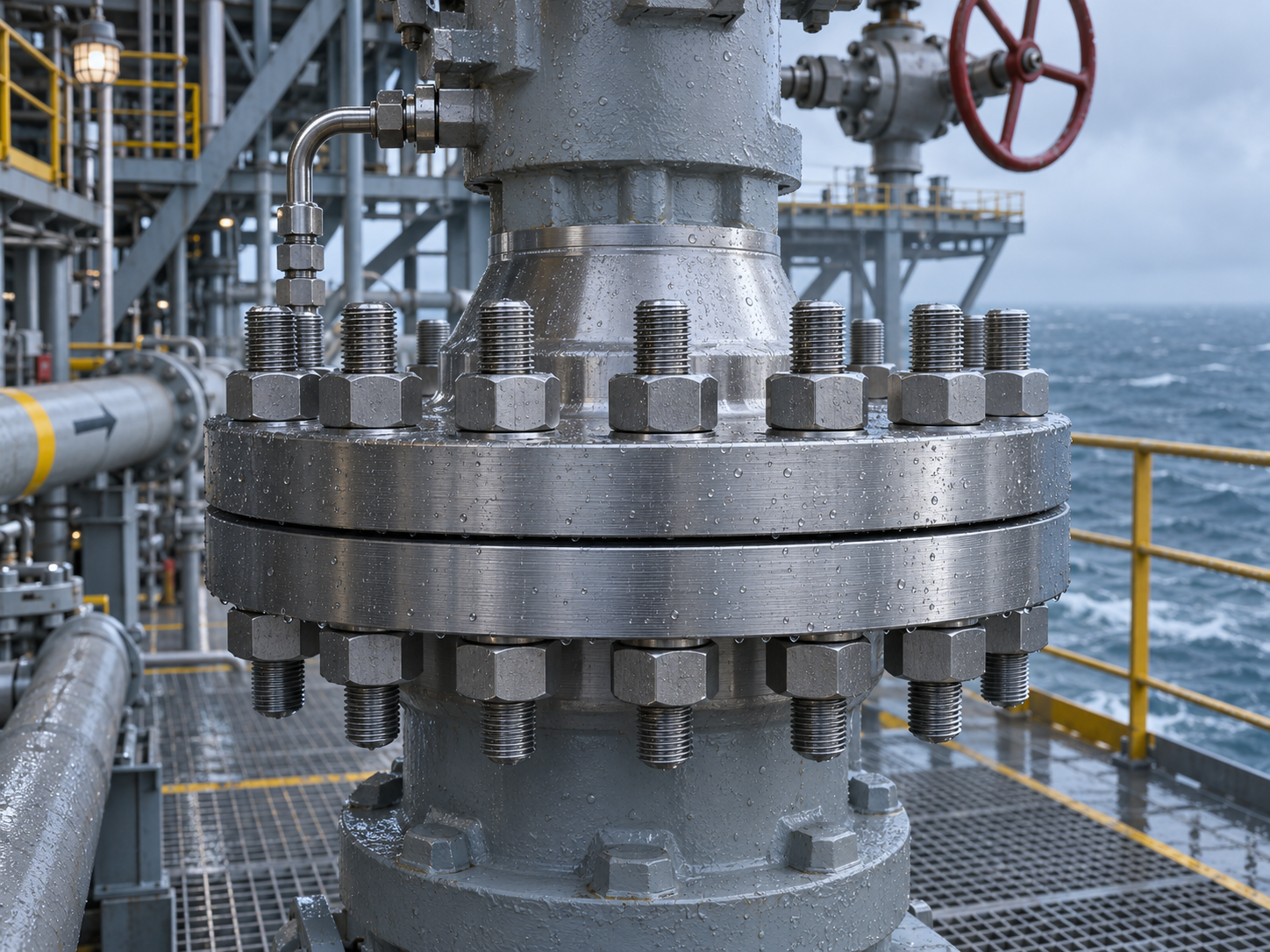
Wellhead and Christmas tree flange bolting is the defining A286 oilfield application. A286 stud bolts and nuts are specified in wellhead equipment, Christmas tree valves and manifold connections, where they must resist sour gas (H₂S), seawater and high-pressure environments while maintaining seal load under thermal expansion. The bolting standard that governs this application is API 6A for wellhead and tree equipment, with A286 fasteners supplied against ASTM A453 Grade 660 and, where sour service applies, NACE MR0175 / ISO 15156.
The engineering logic for A286 in this location is a three-way fit. First, NACE MR0175 compliance is achievable in qualified heat-treat conditions, with hardness controlled to the ≤ 35 HRC range (or ≤ 330 HB) that the standard requires for this alloy. Second, the thermal expansion match to austenitic stainless and duplex flange materials reduces differential stress at temperature. Third, the alloy’s cost position — roughly one-third to one-quarter of Inconel 718 for comparable 650°C bolting performance — makes it the economically rational choice where 718’s higher strength is not the binding requirement. RAYCHIN manufactures A286 stud bolts, hex bolts and matched nuts for wellhead and X-tree flange connections, with API 6A and NACE documentation available per order.
Subsea Subsea Bolting and Underwater Connector Hardware
Subsea bolting introduces a failure mode that topside design often underweights: cathodic protection (CP) generates hydrogen at the fastener surface, and a high-strength bolt under sustained preload in that environment is exposed to hydrogen embrittlement. A286 is not immune to this mechanism, but its austenitic matrix and its qualified heat-treat conditions make it a viable candidate for API 20E subsea bolting and NORSOK M-650 subsea/topside applications, where the specification framework explicitly addresses material qualification for the service.
The subsea application is also where the distinction between A286 and Inconel 718 becomes a genuine engineering trade-off rather than a cost preference. In high-pressure, high-temperature subsea wells with severe sour service and CP, 718’s higher strength and documented hydrogen-embrittlement resistance may be the safer choice. In moderate subsea service — manifolds, jumper connections, valve bodies — A286 provides adequate strength and corrosion resistance at a lower material and fabrication cost. The correct selection depends on the confirmed partial pressure of H₂S, the CP potential, the design temperature and the preload requirement, not on a generic “subsea = 718” rule. RAYCHIN supplies A286 subsea bolting with EN 10204 3.1 / 3.2 certification and can support NORSOK M-650 and API 20E documentation packages.
Topside · Structural Offshore Platform Hardware, Flare Systems and Structural Connections
Offshore platform fasteners face a combination of salt-laden marine atmosphere, cyclic loading from wave and wind action, and elevated temperature in process areas (flare systems, compressor and turbine enclosures, heat exchangers). A286 fasteners are specified in marine offshore platforms, refinery heat exchangers and flare systems, where standard stainless fasteners would lose strength at service temperature and where 718 would be over-specified. The alloy’s fatigue resistance under cyclic loading — a documented property of the austenitic γ′-strengthened structure — is relevant to structural connections that see dynamic service loads.
It is important to be precise about the corrosion environment here. A286’s aqueous corrosion resistance is broadly comparable to 316L austenitic stainless steel in many environments, and it performs well in seawater and salt-spray exposure for structural and flange hardware. But it is not a high-molybdenum nickel alloy, and it should not be used for sustained service in concentrated chloride environments or strong oxidising acids where 718 or a C-type Hastelloy would be required. The practical rule is: A286 for atmospheric marine exposure and moderate produced-water chemistry; a higher-molybdenum alloy for aggressive chloride or sour brines.
Cryogenic · Non-magnetic Downhole Tools, MWD/LWD and Cryogenic Equipment
Two niche but technically distinctive A286 applications deserve attention. First, A286 remains ductile and non-magnetic to −196°C, making it suitable for cryogenic equipment and for downhole tools where magnetic interference must be avoided. MWD/LWD tools and directional drilling equipment carry magnetometers that require non-magnetic housings and fasteners; A286 heavy hex nuts and bolts are used in non-magnetic well-logging tools and high-strength downhole fasteners for this reason.
Second, the combination of non-magnetic behavior and high strength has made A286 a candidate for non-magnetic cryogenic equipment and deep-well drilling tools in the offshore sector. The limitation to keep in view is that the non-magnetic property must be preserved through the full manufacturing route — cold work and aging can affect magnetic permeability if not controlled — and the fastener should be supplied with magnetic permeability verification where the tool’s measurement accuracy depends on it.
3. A286 Versus 316, 17-4PH and Inconel 718: An Offshore Selection Table
The offshore material decision is often framed as a binary between “stainless” and “Inconel.” A286 is the intermediate option that is frequently overlooked, and the table below makes the trade-offs explicit.
Yield and temperature data consolidated from RAYCHIN A286 vs 718 comparison, voestalpine Grade 660 data and TorqBolt A286 specification literature; cost ratios from ASTM A453 Gr 660 vs Inconel 718 forged-parts comparison (Grade 660 4–6× cheaper in part cost, 20–25% of 718 cost in oil-and-gas valve work) and RAYCHIN cost analysis (718 raw material 3–4× Grade 660).
The comparison makes A286’s niche visible: it offers twice the yield strength of 316, a 300°C higher service ceiling than 17-4PH, and roughly one-third the material cost of 718, while carrying NACE-qualified heat-treat conditions and a thermal expansion match that 718 does not provide to the same degree. Where the joint does not require 718’s absolute strength or its superior performance in severe sour/CP conditions, A286 is the engineering default rather than a compromise.
4. NACE MR0175 Compliance: What “Qualified Heat-Treat Condition” Actually Means
The phrase “NACE MR0175 compliant” appears on many A286 datasheets, but the qualifier matters. A286 is included in NACE MR0175 / ISO 15156, but its acceptability in sour service depends on hardness and heat-treat condition. The standard imposes a hardness limit — typically cited as ≤ 35 HRC or ≤ 330 HB for this alloy — and the fastener must be supplied in a condition that satisfies that limit while still meeting the drawing’s strength requirement.
This is not a trivial procurement detail. A286 is strengthened by aging, and the aging response determines both strength and hardness. An over-aged condition may be softer and more NACE-compliant but lower in strength; an under-aged condition may meet the tensile minimum but exceed the hardness limit. The correct approach is to specify the ASTM A453 Grade 660 class (Class A, B, C or D) and the NACE condition together, and to require the mill certificate to state both the heat-treat condition and the hardness result. RAYCHIN supplies A286 fasteners with NACE MR0175 / ISO 15156 documentation, lot hardness data and EN 10204 3.1 / 3.2 certification, so that the sour-service qualification is auditable rather than assumed.
5. What Offshore-Grade A286 Fasteners Require — and How RAYCHIN Delivers
Offshore procurement is documentation-intensive. A286 fasteners for wellhead, subsea and platform service are not bought on a chemistry certificate alone; the purchase requires a chain of standards conformance that the end user’s quality system can audit.
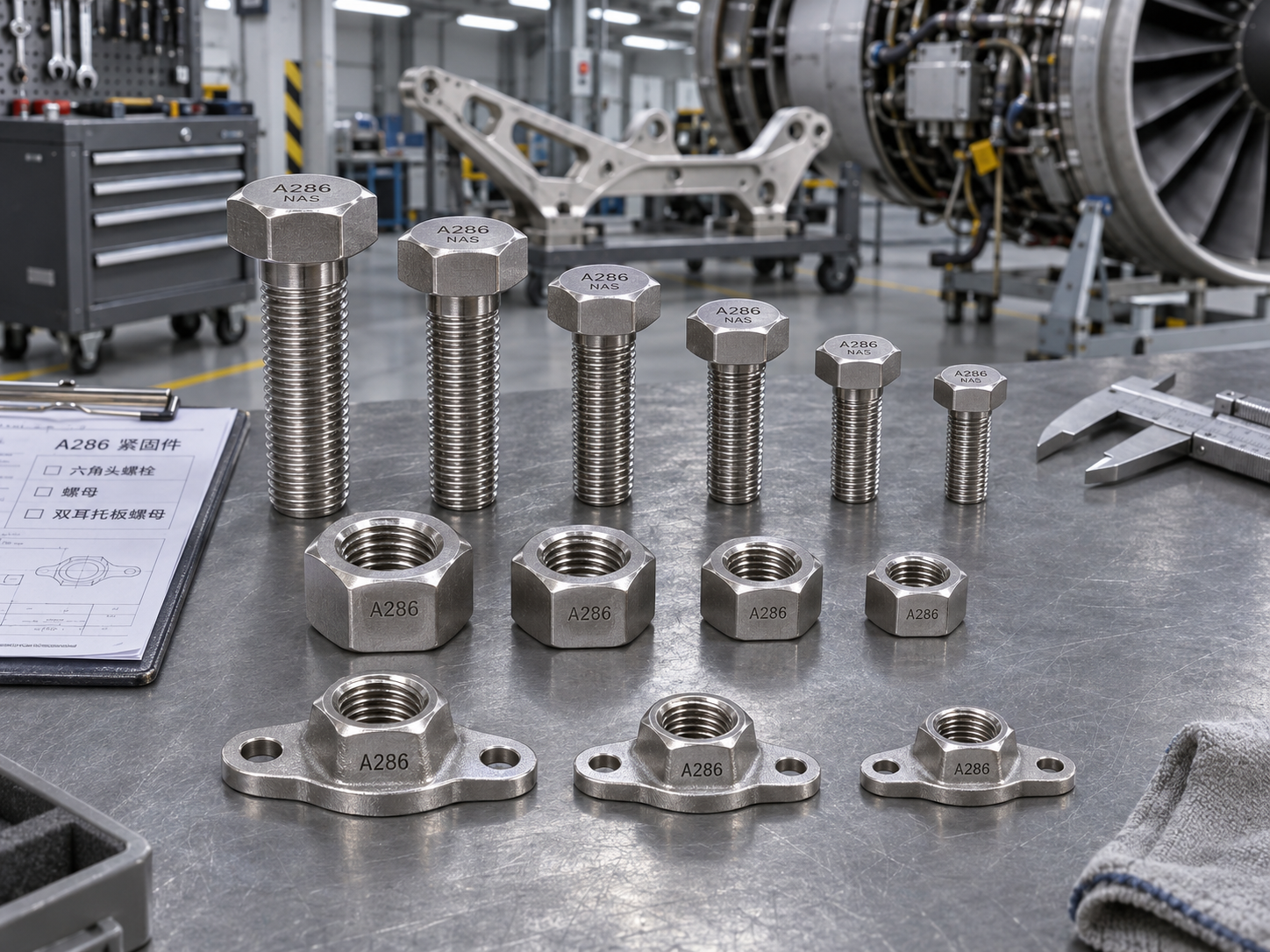
RAYCHIN LIMITED manufactures A286 fasteners in the forms that oil and gas and offshore joints use: stud bolts for wellhead and flange connections, hex bolts and heavy hex bolts for structural and manifold assemblies, socket-head cap screws for confined hardware, matched nuts and washers, and threaded rods for custom applications. The manufacturing route includes controlled solution treatment and aging, with lot hardness verification against the NACE limit and dimensional inspection to the applicable API, ASME or customer standard. Third-party inspection (TUV, Lloyd’s, BV, DNV, SGS) can be arranged on order, and PED 2014/68/EU qualification is available for pressure-equipment service.
Frequently Asked Questions
Is A286 suitable for sour service under NACE MR0175?
Yes, in qualified heat-treat conditions. A286 is included in NACE MR0175 / ISO 15156, subject to a hardness limit typically cited as ≤ 35 HRC or ≤ 330 HB. The fastener must be supplied in a condition that meets both the hardness limit and the drawing’s strength requirement, and the mill certificate should state the heat-treat condition and hardness result. A286 is not a universal sour-service material — the specific H₂S partial pressure, chloride concentration and temperature must be assessed against the qualified condition.
How does A286 compare with Inconel 718 for offshore wellhead bolting?
A286 delivers 85–95 ksi yield strength, a ~650°C service ceiling and NACE-qualified conditions at roughly one-third to one-quarter the material cost of Inconel 718. 718 offers higher strength, a higher temperature ceiling and greater margin in severe sour/CP service. For wellhead and manifold bolting where the joint does not require 718’s absolute capability, A286 is the economic and technically adequate choice; for HPHT or severely sour service, 718 may be the safer selection.
Why does thermal expansion matter for A286 wellhead flange bolting?
A286’s coefficient of thermal expansion (~16 × 10⁻⁶/°C) closely matches austenitic stainless flanges (~17 × 10⁻⁶/°C), whereas A193 B7 alloy steel bolts (~12 × 10⁻⁶/°C) expand more slowly than the flange. The mismatch in B7 joints reduces gasket stress at temperature and can cause leakage. A286 maintains bolt load and gasket stress as temperature rises, which is a primary reason ASTM A453 Grade 660 bolting exists as a specification.
Is A286 non-magnetic, and why does that matter in oil and gas?
Yes. A286 is non-magnetic, and remains ductile and non-magnetic to −196°C. This matters for MWD/LWD tools and directional drilling equipment, where ferromagnetic fasteners can distort magnetometer readings and compromise survey accuracy, and for cryogenic equipment where magnetic interference must be avoided.
Source Offshore-Grade A286 Fasteners with NACE and API Documentation
RAYCHIN LIMITED manufactures A286 stud bolts, hex bolts, socket-head cap screws, nuts and washers to ASTM A453 Grade 660, with NACE MR0175 / ISO 15156 hardness documentation, API 6A / API 20E / NORSOK M-650 support and EN 10204 3.1 / 3.2 certification. Factory-direct supply for wellhead OEMs, subsea contractors and offshore platform operators.
Send your wellhead or subsea fastener specification, API standard reference or drawing for a material compliance review and quotation within 24 hours.
Request A Quote! We'll respond as soon as possible(within 12 hours)
Get a Quote