
Categories List
Recent Posts
 A286 Fasteners in Oil & Gas and Offshore Engineering: The Economic Sweet Spot Between Stainless Steel and Nickel-Base Superalloys
 A286 Fasteners in Aviation MRO and NAS/MS Standard Parts: The Alloy Behind the Dash Number
 A286 Fasteners in Automotive Exhaust and Turbocharger Systems: Why the Alloy Choice Beats the Grade Upgrade
A286 Fasteners in Aviation MRO and NAS/MS Standard Parts: The Alloy Behind the Dash Number
Bolts · Studs · Screws · Nuts · Washers · Anchor Nuts · Self-Locking Nuts | Airframe · Powerplant · Accessory Brackets · Control Linkages | AMS 5731 / 5732 / 5737 · ASTM A453 Gr 660 | Manufactured by RAYCHIN LIMITED
In aviation MRO, the part number comes first. A maintenance planner does not search for “an A286 bolt” — they search for MS9491-27, NAS6303-17, NAS509-4C or NAS6703A3, and the alloy is an attribute inside that dash number. This is the defining feature of the A286 standard-parts ecosystem: the alloy is not specified in isolation; it is embedded in an NAS or MS part-number-level specification that governs dimensions, thread form, material condition, locking feature, finish and certification. Understanding A286 in aviation MRO therefore requires understanding both sides of that equation — what the alloy can do at temperature, and how it enters an aircraft through a controlled part number. This article examines the A286 standard-parts family, where those parts are used in airframe and powerplant applications, what MRO organizations actually need from a supplier, and how RAYCHIN LIMITED manufactures A286 NAS/MS standard parts with the documentation chain that aviation quality systems audit.
1. A286 in the Aviation Material Hierarchy: The 1300°F Iron-Base Workhorse
A286 is an austenitic iron–nickel–chromium superalloy strengthened by gamma-prime precipitation. In the aviation fastener hierarchy, it occupies the band between conventional corrosion-resistant steels — 300-series stainless, 17-4 PH, A286’s lower-strength cousins — and the nickel-base superalloys such as Inconel 718 and Waspaloy that take over at higher temperatures or higher strength requirements.
Three material specifications matter for MRO procurement, and the differences between them are not cosmetic. AMS 5731 covers solution-treated A286 (1800°F / 982°C, water or oil quench), the condition in which bar stock is often supplied before the fastener manufacturer completes aging. AMS 5732 covers solution-treated and aged material (1800°F solution plus 1300–1400°F / 704–760°C precipitation treatment for not less than 16 hours), producing the typical 130 ksi UTS / 85 ksi yield combination. AMS 5737 uses a lower 1650°F (899°C) solution temperature, which improves ductility and room-temperature strength at some cost in creep-rupture performance — a distinction that matters when a drawing calls out a specific AMS condition rather than “A286, aged.”
2. The NAS/MS A286 Standard-Parts Ecosystem: What the Dash Numbers Actually Cover
A286 appears across a wide cross-section of the NAS and MS fastener families. The examples below are drawn from active part-number listings and illustrate the range of configurations that MRO inventory must cover.
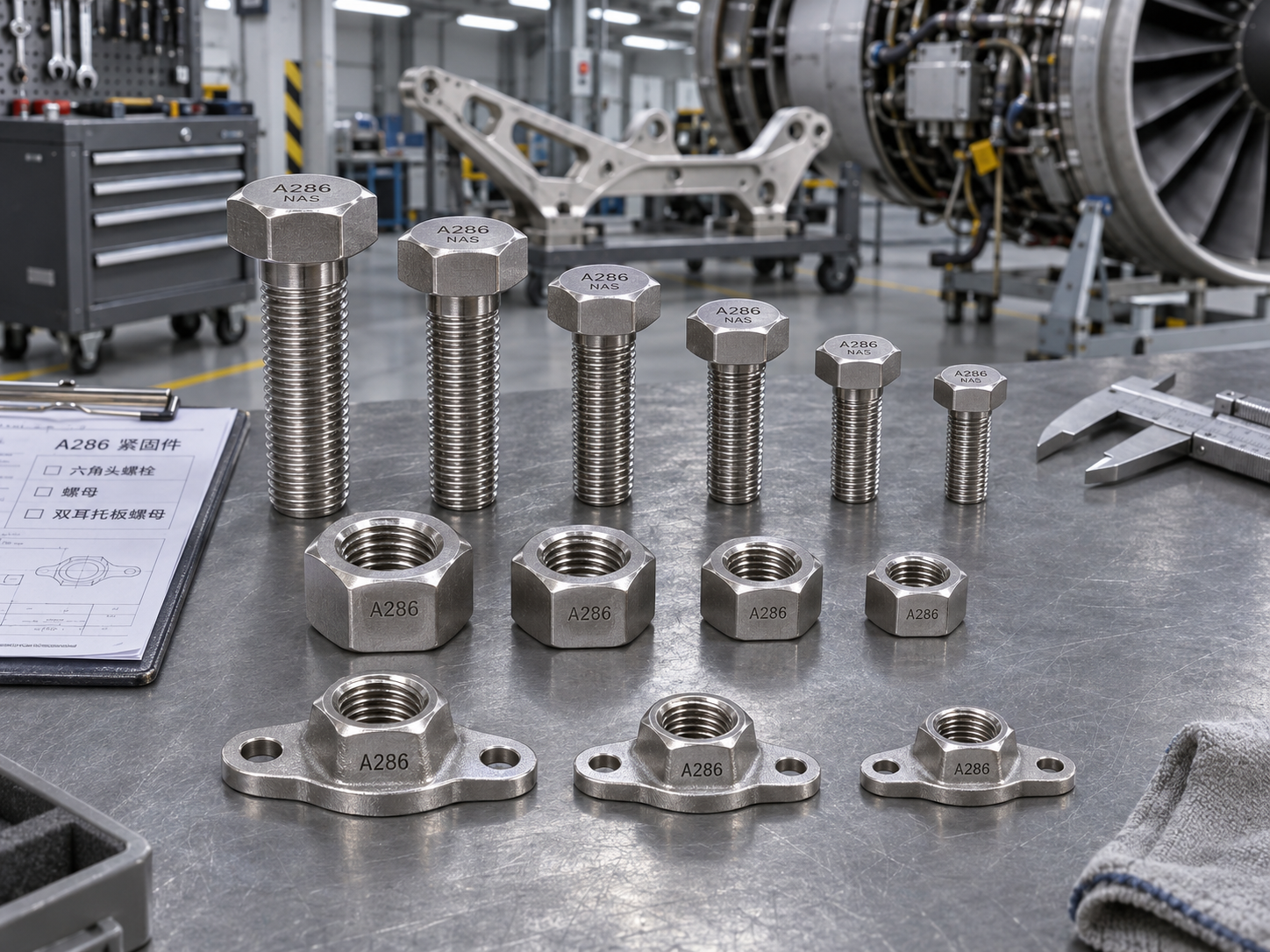
The range is instructive. A286 is used for threaded fasteners (bolts and screws), nuts (plain, drilled, self-locking, plate and anchor types), and in some specifications for studs and washers. The thread forms are dominated by UNJF — the controlled-root-radius aerospace thread that improves fatigue life relative to a standard UNF thread — and the part-number families include both safety-wired retention hardware (NAS509) and self-locking hardware (NAS679, NAS6703 self-locking variants). A286 also appears in anchor nut configurations (MS21060L06 / NAS686C06M) for captive nut installations in airframe structure.
For MRO planning, this ecosystem means that “A286 standard parts” is not a single product line. It is a set of part families with different dimensional standards, locking features and inspection requirements. A supplier that can manufacture across the family — rather than only stocking one or two configurations — reduces the number of purchase orders and certification trails an MRO organization has to manage.
3. Where A286 NAS/MS Parts Are Used in Airframe and Powerplant MRO
A286 standard parts appear across the airframe and powerplant at joints where conventional corrosion-resistant steel lacks elevated-temperature capability and where a nickel-base alloy is not required. The application categories below reflect the actual service descriptions attached to active A286 part numbers and the alloy’s documented aerospace usage.
4. The MRO Realities: Stress Relaxation, Source Approval and the Documentation Chain
A286 standard parts are not exempt from the physics of high-temperature bolting. Two technical and regulatory realities govern MRO sourcing decisions.
4.1 Stress Relaxation at the Service Temperature
At elevated temperature, a tightened A286 bolt creeps and loses clamp load over time. This is the same mechanism that affects every high-temperature fastener, and it is why the MRO question is not only “does the replacement meet the drawing” but “will it retain preload for the next interval.” A286’s creep resistance to approximately 1300°F is what qualifies it for these joints in the first place, but the specific AMS condition — solution-treated and aged per 5732 versus 5737 — affects the strength and ductility balance and therefore the relaxation behavior. For MRO, a lot-level mechanical certificate that confirms the AMS condition is more useful than a generic chemistry certificate.
4.2 Part-Number-Level Source Approval
In aviation MRO, a fastener is interchangeable only within the approved source framework for that specific part number. A manufacturer that can produce an A286 bolt to NAS6703 dimensions is not automatically an approved source for NAS6703A3; the MRO organization or its OEM must establish the approval pathway. The FAA Parts Manufacturer Approval (PMA) route exists for aftermarket parts that meet the original design, and equivalent frameworks apply in other jurisdictions. MRO quality systems therefore require a supplier that can support the approval file with material certification to AMS 5731/5732/5737, dimensional inspection reports, mechanical test data and first-article inspection packages.
5. A286 Standard-Part Standards and Specifications at a Glance
Frequently Asked Questions
What is the difference between AMS 5731, 5732 and 5737 for A286 fasteners?
AMS 5731 covers solution-treated A286 (1800°F / 982°C, quench) — the condition in which bar stock is often supplied before fastener aging. AMS 5732 covers solution-treated and aged material (1800°F solution + 1300–1400°F age for ≥ 16 h), producing the typical 130 ksi UTS / 85 ksi yield combination. AMS 5737 uses a lower 1650°F (899°C) solution temperature for improved ductility and room-temperature strength. The drawing’s AMS callout determines which condition is acceptable.
Which NAS/MS part numbers are commonly made from A286?
A286 appears across a wide range of NAS/MS families, including MS9491 hex head machine bolts, NAS509 drilled jam nuts, NAS6303 close-tolerance tension bolts, NAS6703 dished hex close-tolerance bolts (160 ksi minimum tensile), NAS679 self-locking nuts, NAS1068 plate nuts and MS21060 / NAS686 anchor nuts. Thread forms are predominantly UNJF. The specific dash number controls dimensions, locking feature, finish and material condition.
Can RAYCHIN supply A286 fasteners to a specific NAS dash number?
Yes. RAYCHIN manufactures A286 fasteners to NAS, MS, AN and customer-drawing dimensional requirements, with material certified to AMS 5731 / 5732 / 5737 or ASTM A453 Grade 660. For MRO programs, RAYCHIN supplies EN 10204 3.1 / 3.2 certification, lot mechanical data, dimensional inspection reports and AS9102 first-article inspection packages where required. The company can also review the applicable part-number specification with the customer to confirm dimensional and material conformance before quotation.
How does A286 compare with Inconel 718 for aviation standard parts?
A286 is an iron-base alloy with useful strength and creep resistance to approximately 1300°F (704°C), at a lower material and fabrication cost than nickel-base superalloys. Inconel 718 offers higher strength and a higher temperature ceiling (approximately 700–980°C depending on the property) and is specified where A286’s capability is exceeded. For standard NAS/MS parts, the drawing or part-number specification determines the material; substitution between A286 and 718 requires engineering approval, not a procurement decision.
A286 NAS/MS Standard Parts with the Documentation MRO Quality Systems Audit
RAYCHIN LIMITED manufactures A286 bolts, studs, screws, nuts and washers to NAS, MS and customer-drawing dimensions — with material certified to AMS 5731 / 5732 / 5737 and ASTM A453 Grade 660, lot mechanicals, dimensional inspection and EN 10204 3.1 / 3.2 certification. Factory-direct supply for aviation MRO providers, parts distributors and OEMs.
Send your NAS/MS dash number, drawing or A286 specification for a conformance review and quotation within 24 hours.
Request A Quote! We'll respond as soon as possible(within 12 hours)
Get a Quote